Chapter 9
A Bowl of Yangchun Noodles
The third morning after the confrontation.
Dawn had not yet broken over South Alley. Only the nightsoil carrier passed through, early on his rounds. The crooked jujube tree cast its shadow at a slant across the door plank; its branches trembled faintly in the morning breeze. The noodle shop’s door panels were still half-worn, the lacquer peeling away to reveal the ash-gray wood beneath.
Six men stood in the kitchen for the length of a burning incense stick.
Around the eight-immortal table, seven benches. Six had their men, one sat empty. That empty bench stood precisely where Old Seventh’s place had been for ten years, as it was every night, when he set his coarse ceramic bowl upon it—a bowl crusted at the bottom with yesterday’s tea leaves. The tea leaves were Old Second’s share, divided as they always were. The tea had long gone cold. Day after day, the same.
Today the bench sat empty.
Acheng stood at the threshold, not yet inside.
His blue cloth robe had worn thinner in the past few days. No sword at his hip. But his stance still carried the marks of rigorous training. He waited—waited for the men inside to rise on their own.
The silence stretched. The air itself had turned to dust.
Old Second moved first.
He dragged a sack of flour from the corner of the kitchen, the motion identical to every morning of the past ten years—sharpen the knife first, then pour the flour, add water, knead. But his hands trembled. The diagonal scar across his palm caught the light of the stove fire, pale and gleaming, running from the base of his thumb to the wrist bone. An old wound that seemed to ache anew in this moment.
Old Second went to help chop the scallions.
The scallions had been soaked overnight by Old Fifth. Roots washed clean, the white stalks thick and tender. Old Second lifted the blade—his knife work still as clean as ever. One stroke and the scallion white split open, filling the air with its fragrance. But the cuts were finer than usual, chopped into tiny fragments of green and white scattered across the cutting board like pieces of broken jade strewn across stone.
Old Fourth fed the fire.
The firewood he had split himself, the finest locust wood from the south city meat market. It burned without smoke, releasing only a faint woody fragrance. He crouched before the stove, turning the embers with the poker, the flames burning high. Firelight flooded the entire kitchen, dancing up the stove ledge, licking the iron wok, illuminating Old Fourth’s rough, weathered face.
Old Fifth cut the meat.
The cleaver moved slowly in his hand. Not because the blade was dull—because his heart was slow. The meat had been ordered the night before, the best cut Third Brother had sent Old Seventh to procure at the market—fat and lean distributed evenly, each slice cut to identical thickness. Old Fifth set each slice aside on the cutting board before moving to the next. The soft thock, thock of blade against wood was the only steady rhythm in that entire morning.
Old Sixth wiped the bowls.
One by one, using the rough cloth from Old Seventh’s money shop. The bowls were coarse ceramic, their glazed bottoms webbed with hairline cracks. When he finished wiping each one, he set it on the stove ledge in a row, waiting for someone to carry them away.
Old Seventh worked the accounts.
Not silver—he was writing something. His abacus sat untouched beside him, not a single bead disturbed. He was drafting a new promissory note, his brush moving across xuan paper line after line:
Received: three hundred taels of silver, to be repaid to Acheng, nephew of Third Brother.
The calligraphy was even and formal, Guange script, an exact match to the hand that had written the original IOU ten years before. He set the note at the table’s edge to dry.
Six bowls of Spring Sunshine Noodles, carried to the table one after another.
The simplest of noodle bowls—clear broth, finely chopped scallions, a few Sichuan peppercorns floating on the surface. Not heavy on fragrance, but warm. Old Second carried the bowls, setting them around the table: Old First at the head, Old Second at his side, Old Fourth, Old Fifth, Old Sixth, Old Seventh each at their proper places. Six bowls in all, and one more.
That bowl he placed before the empty seat.
Acheng’s bowl.
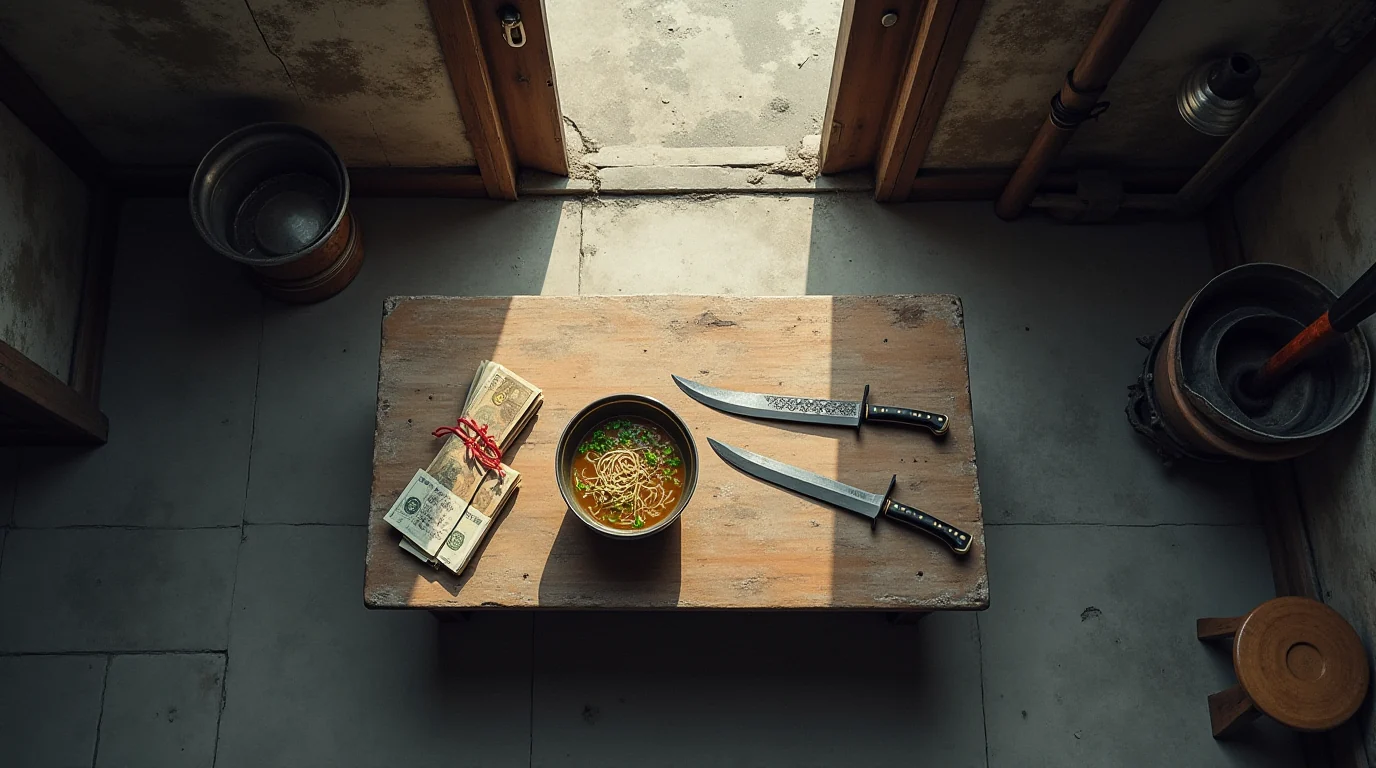
Old Seventh set the silver before Acheng. Three hundred taels in banknotes, folded and stacked, bound with red cord, neat and orderly.
“This is Third Brother’s debt.” Old Seventh’s voice came out rougher than usual. “Who he owed, I won’t say. Now it’s yours.”
Acheng stared at the bowl of noodles. He did not lift his chopsticks.
Old Fourth rose and crossed to where Acheng stood. He set half a blade on the table. The steel caught the firelight, cold and bright, the rust-scored edge of the break clearly visible.
“This is Third Brother’s blade.” Old Fourth’s voice cracked like gravel. “I took it from his hand before he fell. The other half is Sixth Brother’s.”
Old Sixth rose.
He crossed to the table and laid the other half beside it. The two halves lay side by side, broken ends meeting—the edges matched perfectly, the rust patterns aligning without a gap. But ten years of silence, ten years each clutching their half without asking the other a single question—this could not be made whole by physics alone.
“Tested it.” Old Sixth said, only these three words. “The break doesn’t match.”
Old First came out from behind the stove.
Flour still clung to his hands. The old scar across his palm caught the firelight, pale and gleaming. He stopped before Acheng, standing face to face with the young man.
“Third Brother is buried in the back alley of Coffin Street.” Old First’s voice was heavy. “We buried him there ourselves that night, the seven of us. For ten years I’ve walked past his grave every day and never once dared to stop.”
Acheng’s eyes reddened.
He did not speak. For ten years, he had received from Third Uncle only one vague letter. It mentioned the three hundred taels and asked whether the brothers were well that night. What it did not say was what had truly happened that night—and these past days, Acheng had drawn it out of them one sentence at a time.
Old First sat down across from him.
He lifted the bowl of noodles, picked up his chopsticks. The noodles slid down smooth. The broth was light. But there was too much salt—it tasted briny.
“Eat.” Old First said, his voice softer than usual. “When the noodles go cold, they’re no good.”
Acheng lifted his chopsticks.
He took one bite. The noodles were salty. Saltier than usual. Old Second always seasoned heavy—but today he had gone heavier than usual, so heavy he himself could not taste the difference.
The noodles slid in his mouth. They scalded going down his throat. What they tasted in his heart, only Acheng knew.
Acheng set down his bowl.
He looked at it for a moment. Only broth remained at the bottom; the scallion fragments floated green on the surface, the peppercorns had sunk to the base.
“Third Uncle said there’s a noodle shop in the south district of Yunze.” Acheng’s voice was steady. “He said the noodles were excellent. Said he’d take me sometime.”
No one answered.
The shop fell quiet for a moment. The stove fire still crackled, flames still danced, the jujube tree’s shadow still swayed across the door plank. The air was thick with the scent of locust wood, of scallions, of noodle broth—the fragrance of ten years.
Old Second spoke first: “Third Brother’s been gone ten years. Never ate this bowl.”
Old Seventh said: “He has now.”
Old Fourth said: “Finish up and go.”
Acheng rose.
He nodded to Old Seventh, then to Old First, then to each of the remaining four. He turned and walked toward the door. At the threshold he stopped, not looking back.
“Take me to Third Uncle.” Acheng said.
Old First rose and crossed to stand beside him.
“I’ll take you.” Old First said.
Acheng nodded.
The two men walked out of the noodle shop one after another, turning into South Alley, heading east toward Coffin Street. The jujube tree’s shadow fell across their backs, then left them, then fell again as they moved.
After Acheng left, the shop sat in silence for a long while.
Morning light slanted through the open door, falling on that empty seat. Falling on the empty bench, on the bowl of noodles no one had touched. The light crept slowly across the table, from rim to base, until the broth cooled, the scallions sank, the peppercorns bloated in the cold liquid.
Old Sixth spoke suddenly: “Third Brother’s half of the blade. I’ll keep it.”
Old Fourth glanced at him.
“Keep it.” Old Fourth said.
Old Fifth said: “The road money to take Third Brother home. I’ll pay.”
Old Seventh said: “I’ll pay. I have the means.”
Old Second said: “No arguing.” He rose, crossed to the stove, lifted the bowl of cold noodles, and poured it into the slop bucket. The bucket had been cleaned the night before; the fresh grain of the wood had not yet softened. The broth hit the surface, formed a single bubble, then sank.
“I’ll repay Third Brother’s debt.” Old Second said, his voice flat. “Acheng’s three hundred taels, I don’t acknowledge.”
Old First looked up.
“Acknowledge what?”
“That Third Brother owed anything.” Old Second said, his cleaver striking the cutting board once. “A loan is not a debt.”
Old Fourth laughed—a short, dry laugh, like wood splitting. But he laughed. Old Fifth laughed. Old Sixth laughed. Old Seventh laughed. Even Old First laughed. All six men, laughing.
The laughter echoed through the empty shop, bouncing off the walls, off the ceiling beams, off the empty seat, then scattering outward—filling the kitchen, filling the front room, filling all of South Alley.
The jujube tree’s shadow still swayed across the door plank. That crooked jujube tree, standing at the alley’s mouth ten years ago, would stand another ten.
The noodle shop’s door panels were half-worn, the lacquer peeling away. Above the lintel, the wooden plaque bearing the character Mian still hung.
When the sun rose tomorrow, the shop would open as always.
Six men, six blades, six bowls of Spring Sunshine Noodles.
And one empty bench.
And ten years of the code.
Not born on the same day, but may we die on the same. When trouble comes, the brothers carry it together.
Honor is cleared between us, but accounts must be settled.
But this bowl of noodles—this bowl delayed ten years—today finally made it to the table.
The noodles were salty.
But once eaten, everything would be fine.