Chapter 2
segmentation fault
Six forty-five p.m. Three sets of bowls and chopsticks on the dinner table.
Jingxi was carrying the last dish to the table when Yanqiu had already climbed onto his chair. Yanhe stood nearby, fingers pinching the tips of his chopsticks, eyes fixed on the front door.
“Dad’s not back yet.” Not a question.
“He’s on a business trip, sometimes it runs late.” She straightened the chopsticks and swatted Yanqiu’s hand away from the braised eggs. “Did you wash your hands?”
Yanqiu hopped off the chair and ran to wash his hands. Yanhe didn’t move. Still watching the door.
She picked up her phone. Three outgoing calls in the log, all unanswered. The last one, forty minutes ago, had gone straight to voicemail. She tried again. Ring — ring — ring — “The number you have dialed is currently unavailable — ”
She hung up.
Probably a dead battery. That man never had enough charging cables — one in the study, one in the living room, one in his backpack, all three in constant use, and he still managed to drain his phone to zero.
Seven-thirty. Eight. Nine-fifteen.
She finished the dishes, herded both boys to brush their teeth. Yanqiu flung water everywhere in the bathroom. Yanhe brushed quietly and climbed into bed on his own. She was toweling Yanqiu’s hair dry when her phone buzzed — her heart lurched.
It was her mother. Calling from Hualien.
“Everything’s fine, just checking in,” Jingxi said, her voice so steady it impressed even herself.
After she hung up, she sat on the couch with the phone on her knee. The screen dimmed and lit, dimmed and lit — she pressed it every few seconds, making sure she hadn’t missed a message.
The living room was very quiet. At this hour, there used to be the clatter of a keyboard from the study, like a crew of miniature woodpeckers on deadline.
Now there was nothing. Just the hum of the refrigerator.
“Cheng Anyuan, if you’re working overtime and forgot to charge your phone, I am cutting every single one of your charging cables.”
She said this to the empty room, then went quiet for three seconds. Then picked up her phone and made her eleventh call.
She stood up. Went to the bedroom for a jacket. Dug two small pairs of sandals out of the shoe cabinet.
The fluorescent lights in the police station were an indecent shade of white, washing her face to a greenish pallor.
It was past midnight. She couldn’t remember the exact time. She’d brought both boys in a taxi; Yanqiu had fallen asleep in the car, and she’d carried him inside. Her shoulder was starting to ache. Yanhe had walked on his own, one hand gripping the hem of her jacket.
The officer behind the counter looked to be in his early thirties. Expression: neither warm nor cold. He slid a form across to her.
“Name of the missing person?”
“Cheng Anyuan.”
“National ID number?”
“A-one-two…” She froze. What came after A? She could never remember. She’d written that string of numbers hundreds of times — for taxes, credit card applications, insurance — and right now her mind was completely blank.
She dug through her bag for thirty seconds and found a photocopy of his health insurance card. Her hands were shaking.
“Height?”
“One seventy-five.”
“Weight?”
“Sev — seventy-two. Last time he weighed himself. Might have changed.”
“What was he wearing when last seen?”
She went blank.
At five-thirty that morning, she’d been asleep when he left. She didn’t see what he’d been wearing. She didn’t know. She was asleep.
“I don’t know.”
The officer glanced at her and wrote something on the form. His ballpoint pen scratched across the paper, the wall clock ticked, the radio crackled once. The air smelled of disinfectant and cheap instant coffee.
She stared at the form. Name, sex, age, height, weight, last known location, clothing. Each field was a small box. Her husband had been stuffed into these boxes, dismantled, reduced to text and data. A man who snuck braised pork into her bowl. A man who stayed up past midnight writing code for her. A man who looked back at his home before walking out the door — on this form, he was none of those things. Just a set of fields pending inquiry.
“We’ll put out an alert,” the officer said. “We’ll contact you if anything comes up.”
Yanqiu was slumped over her shoulder, breathing evenly. Yanhe stood beside her, head tilted up at the missing persons posters on the wall. The faces on the posters didn’t look like his father, but the bold red characters spelling MISSING made him look away.
Outside the station, she stood at the end of the corridor, back against the wall. Her knees buckled for a moment. She lowered herself into a crouch, one arm holding Yanqiu, the other hand pressed flat against the floor.
Yanhe watched her. She looked up and forced a smile.
“Mommy’s legs are tired. Just resting for a second.”
He didn’t say anything. He placed his hand on the back of hers. A five-year-old’s hand. Small. Warm.
Waiting was a skill she had never once practiced.
Every time the intercom buzzed, her heart took a kick from the inside. A delivery. A neighbor. The gas company doing their rounds. Every time, it wasn’t him. Every phone call, it wasn’t either.
The day after she filed the report, she called his company. The HR person’s voice was polite, but Jingxi could hear her choosing her words. “Mr. Cheng was scheduled to visit the Taitung branch office… but Taitung reported he never arrived.” She hung up and immediately searched for hotels in Taitung city. Three. She called them one by one. No guest registered under that name. She called his direct supervisor. The supervisor said Anyuan had confirmed his route before departing. “He said he’d take the Suhua Improvement Highway to Provincial Highway 9. Faster that way.”
She put the phone down. Opened the computer, logged into Google Maps, and dragged the route from the Suhua Improvement Highway all the way to Taitung. The road on screen was so long her finger had to scroll the mouse again and again. She didn’t know what she was looking for. She traced the entire route a second time.
Through all of this, her hands were steady. Call after call, hotel after hotel, road segment after road segment — efficient, methodical, like she was at work. When she finished, she sat on the couch and touched her lip. Wet. She’d bitten through her lower lip. She didn’t know when.
She left the living room lights on all night. Because she thought — if he came back and opened the door to darkness, would he think she’d moved away?
At night she lay in bed. Not insomnia. She was too exhausted for insomnia. But the moment she closed her eyes, the images came.
A car skidding into a guardrail. The sound of metal twisting. The windshield shattering. His head —
Eyes open. Ceiling. Breathe. Close again.
A mountain-road curve, a gravel truck in the oncoming lane. Too close. Brakes not fast enough —
Eyes open again. Her heartbeat hammering in her ears.
Every image came with sound and color. The screech of brakes was gray; the crash of metal was white light; blood was dark red — her brain was running simulations of every possibility she refused to think about, and each one was rendered in exquisite, high-fidelity detail. Quality so good she wanted to file a complaint.
She got up for water. Stood in the kitchen. Three-thirty a.m. The tap water was cold. She set the glass on the counter, braced both hands against the edge, and stared down into the drain until the images slowly receded, like a tide pulling back.
On the third afternoon, the police station called.
“Mrs. Cheng, just updating you on our progress.” A different voice this time — older, measured, unhurried. “We tracked your husband’s vehicle through the ETC license plate recognition system — that’s the electronic toll collection on the highway, cameras at every gantry.”
“Mm.” She didn’t fully understand what a gantry was, but she was listening.
“Records show his vehicle entered National Highway 5, passed through the Xueshan Tunnel, and exited at Su’ao.” A pause. “From there he turned south onto Provincial Highway 9. Timestamp: seven twenty-three a.m. that day.”
Seven twenty-three a.m. She’d been putting socks on Yanqiu.
“Regarding his phone,” the officer continued, “the last time it connected to a cell tower was near the Taitung coastal highway, around the 123-kilometer mark on Provincial Highway 11. After that, the signal went dead.”
She paused. “Provincial Highway 11? Wasn’t he on Highway 9?”
“Yes, we noticed that too.” The officer’s tone was even, as though stating a puzzle they hadn’t solved either. “He may have switched to the coastal route partway through. The specific reason is still unclear.”
“What do you mean, ‘went dead’?”
A beat of silence. “The phone may have run out of battery, or…”
He didn’t finish the sentence. She didn’t ask him to. She knew.
“There are fewer surveillance cameras on that stretch of Highway 11,” the officer added, as if explaining why they didn’t have more to offer. “We’ve already pulled footage from monitored intersections in the area and are cross-referencing.”
After she hung up, she sat at the dining table. Yanqiu was in the living room watching a kids’ show; someone on TV was singing a handwashing song. She stared at the place setting nobody had used — she still set three every day.
Day five. Late afternoon. The station called again. The tone was different this time.
“Mrs. Cheng, we found the car.”
Her heart stopped for one beat, then slammed back so hard her chest hurt.
“On the shoulder of Provincial Highway 11, near the 127-kilometer mark. The front edge of the hood shows impact damage, and there’s a crack on the right side of the windshield.”
She opened her mouth. Nothing came out.
“The doors were unlocked. On the driver’s seat…” The officer’s pace slowed, as though reading from his notes one word at a time. “There was a small amount of blood.”
Her nails dug into her palms. Deep. She didn’t notice until later — four red crescents pressed into the flesh.
“And him?”
“No one was in the vehicle.”
She looked up that stretch of road later on Google Maps. Mountain wall on the left. Ocean on the right. Beyond the shoulder, a guardrail. Below the guardrail, a slope of loose rock. Below the rocks, a reef shelf. Below the reef, the Pacific.
The officer kept talking. Forensics had arrived to collect evidence. The impact marks suggested a sideswipe against the roadside rock face — not at high speed. The amount of blood was small; preliminary assessment was that it wasn’t a fatal injury. But the person was not in the car. The vehicle was less than thirty meters from the coastline. They’d checked his bank accounts too — completely dormant. The last credit card transaction was at a CPC gas station at a highway rest stop on the day he left, 1,320 dollars. “If this were someone who left voluntarily, there would typically be financial activity.” The officer’s tone seemed meant as reassurance, but she couldn’t figure out which part was supposed to make her feel better — he didn’t leave voluntarily, so he was forced to disappear?
“We’ve notified the Taitung precinct to expand the search. The fire department’s rescue team will also be deployed. The Coast Guard will dispatch patrol boats to search the waters and shoreline.”
Coast Guard. Search the waters. She knew what that meant. They were looking for a body.
She said “okay.” Then hung up. Then sat for a long time.
She was going to the scene.
The police advised against it. Too far, bad road conditions, and the search-and-rescue team was still working.
“I’m going.”
She dropped both boys at their neighbor Mrs. Wang’s place. She told Mrs. Wang she “had to step out for something.” Mrs. Wang asked what. She said “work.” Mrs. Wang looked at her for a moment and didn’t ask again.
She took the train to Taitung, then a taxi to Highway 11. The taxi driver was a chatty old man who talked the entire way about which part of the east coast had the best views and where to find the best flying fish. She said exactly one thing the whole ride: “Kilometer 127.”
When she arrived, the car had already been towed. Traffic cones and police tape still marked the shoulder, the yellow tape flapping back and forth in the wind. A few rescue workers in orange vests were moving across the reef below, looking very small from up here, like ants.
She stood by the guardrail. The wind was strong. March on the east coast — wind straight off the Pacific, carrying salt and sea mist. Her hair kept whipping into her face. She didn’t bother pushing it back.
The ocean below was deep blue, waves smashing against the rocks and bursting into white foam. Beautiful. She would have thought it was beautiful before.
She stood there a long time. Her phone vibrated once. She looked down — spam email.
“Your vehicle maintenance reminder: Your car has exceeded its scheduled service mileage…”
She stared at the line for five seconds, then put the phone back in her pocket.
A rescue worker climbed up the slope and said something to the officer nearby. She couldn’t hear what, but she saw him shake his head.
The intensive search lasted five days. The Taitung precinct deployed over twenty officers. The fire department’s rescue team hiked the coastline daily. Coast Guard patrol boats swept the near shore back and forth. She knew all this because the officer assigned to the case called her every evening with the day’s progress.
“Today’s search area was expanded to the 120 to 135-kilometer stretch.”
“No discoveries at this time.”
“Tomorrow we’ll add dive teams to search the nearshore reef zone.”
“No discoveries at this time.”
Every call had the same structure: what they’d done, what they hadn’t found. What they’d done, what they hadn’t found. She started to feel the calls themselves were a kind of torture — not bad news, but not good news either. A daily delivery of nothing.
After she came back from Taitung, she sat alone at the computer past midnight and opened Google Maps. She switched to Street View and started at the 120-kilometer mark of Highway 11, segment by segment. Road, cliff face, guardrail, ocean. Road, cliff face, guardrail, ocean. Every stretch looked the same. She didn’t know what she was looking for — a figure standing on the roadside? A silhouette caught by the camera car? She knew the Street View photos weren’t live; they could be a year old, two years old. She knew this was completely pointless. She went through every segment anyway.
By the second week, the officer’s calls went from daily to every other day.
The language was shifting too. The first five days it had been “we are actively searching.” Now it was “we are continuing to monitor the situation.” She heard the difference. She called the Taitung station and asked the assigned officer if there were any new developments. “The search is still ongoing; we will notify you immediately if anything comes up.” She called again two days later. Same answer, word for word. The third time she called, the person on the other end paused for one second before speaking. In that one second, she understood everything.
Her sleep was broken. Not insomnia — she was so exhausted she dropped the moment her head hit the pillow. But she woke at exactly three a.m. every night, as if something had poked her. And then she couldn’t fall back asleep.
She started losing track of whether she’d eaten. The fridge went from full to empty and back to haphazardly stuffed, no one checking expiration dates. She still signed Yanhe and Yanqiu’s school contact books every day. The handwriting grew more illegible each time.
One day in the third week, Yanqiu knocked over his milk.
It wasn’t a big deal. The whole glass slid off the edge of the table and exploded on the floor, white spray hitting her pants and the chair legs. Yanqiu’s eyes went round; he hadn’t even had time to react.
She screamed at him.
Not scolded. Screamed. The sound ripped out from somewhere deep in her gut — sharp, hard, so sudden it startled even her. Yanqiu’s lip trembled for one second, then he burst into tears. Yanhe’s chopsticks hung frozen in midair, eyes on her.
The moment she saw Yanhe’s eyes, it was like a bucket of ice water over her head.
She crouched down and scooped Yanqiu up, saying “I’m sorry, I’m sorry, Mommy didn’t mean it” over and over. Her voice was shaking. Yanqiu was still crying but had downgraded from wailing to hiccups. She carried him into the bathroom, shut the door, crouched beside the toilet, one arm around Yanqiu, one hand clamped over her own mouth.
She didn’t know if she was crying or hyperventilating. The two felt very similar.
Outside the door, it was quiet. Yanhe didn’t come knock.
A few minutes later — maybe longer, she couldn’t tell — she wiped her face and came out. Yanqiu’s eyes were still red, but the tears had stopped. He reached out and patted her shoulder.
“Mommy, don’t cry.”
A five-year-old imitating the way adults comfort people. Clumsy movements, completely wrong amount of force, like patting a basketball. But very earnest.
She nearly broke down again. She bit her lip — same spot, and it started bleeding again.
A few more days passed. At dinner, Yanqiu tilted his head toward the chair where Dad usually sat.
“Where did Daddy go?”
Jingxi’s hand paused for a moment.
“Daddy’s on a business trip. Somewhere far away.”
“When’s he coming back?”
“Soon.”
“When he comes back, tell him to bring McDonald’s.”
She let out a laugh. It came out squeezed and slightly crooked. “Okay.”
Yanhe didn’t look up once through the entire meal. He ferried rice into his mouth in small, precise bites, chopstick-load by chopstick-load, like executing a subroutine. When he finished, he carried his bowl to the sink himself.
“What a good big brother,” she said.
He didn’t turn around. “Mm.”
That night, after both boys were asleep, she buried her face in the sofa cushion. She couldn’t make a sound. The door to the next room wasn’t fully closed — Yanhe’s bed was against the shared wall, and sometimes he woke up.
She didn’t make a sound. A damp patch spread across the cushion.
One month.
The police had officially shifted to “routine monitoring” mode. The calls went from once a week to “we’ll be in touch if anything comes up.” She could feel the temperature in those words dropping by the day.
Her mother called from Hualien. “Your father and I talked it over. I’m coming up this week to help with the boys.”
“You don’t need to, Mom. I’ve got this.”
“Jingxi — ”
“Really, Mom, I’ve got everything sorted out here. You and Dad stay in Hualien and take care of yourselves. Don’t go running around on my account.”
Her tone was warm, steady, airtight. Her mother couldn’t argue past it, and hung up with a final “Don’t try to carry everything yourself.”
Their neighbor Mrs. Wang brought over a pot of chicken soup. “I made too much — help me finish it.” Jingxi smiled, thanked her, and took the pot inside. Three days later, she poured the untouched soup down the drain, washed the pot, and returned it.
One of Anyuan’s college friends called to ask if she needed anything. She said, “Thanks, we’re managing.” HR from his company asked if she wanted them to arrange counseling. She said, “Not right now, but thank you for asking.”
Her mouth kept saying “I’ve got this.” Every single time — sincere, grateful, considerate. Don’t make anyone worry. Don’t be a burden. Don’t let anyone think she was falling apart.
Yanhe stopped asking where Dad was. He started pouring his own water. Packing his own bag. Lining up his own shoes. Turning off his own light before bed without being reminded. A five-and-a-half-year-old boy running like a small, autonomous machine — precise, quiet, error-free.
When she said “What a good big brother,” she didn’t know those words were crushing him.
She had mostly stopped crying. Not because the wound had healed, but because the nerve endings had been severed. Her body kept running — cooking, laundry, dropping off and picking up the kids — like a machine programmed to its routines, movements precise, face blank.
One night she stood on the balcony, looking at the windows across the way, lit up one square at a time. Every square had someone inside. She wanted to ask a question but didn’t know who to ask. Asking her mother would be cruel. Asking the police would be absurd. Asking herself would only yield useless answers. The question sat lodged in her throat like something she could neither swallow nor spit out.
Late at night. Both boys asleep.
She stood in the doorway of the study. She hadn’t opened this door in a month. A thin layer of dust coated the handle.
She pushed the door open.
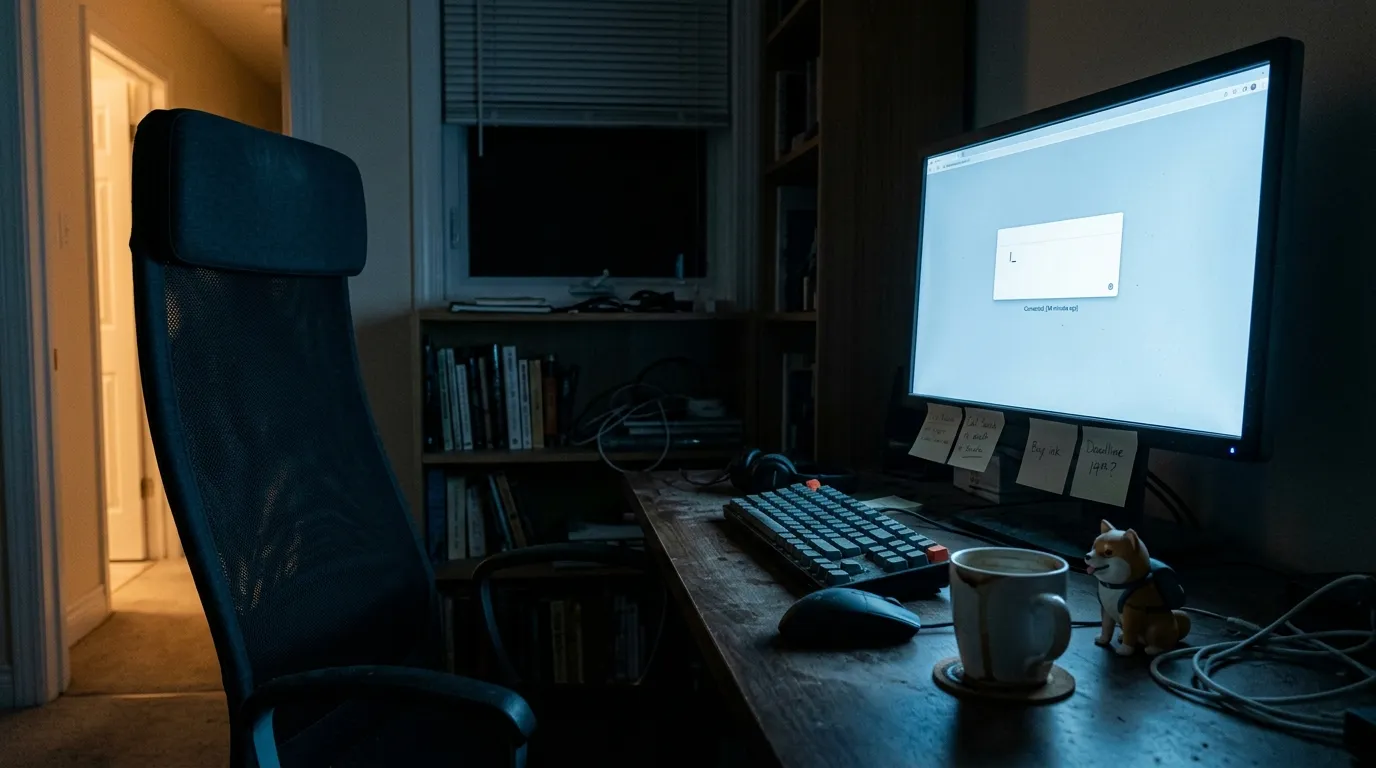
The air in the study was stale. Both monitors were dark, dust had settled on the mechanical keyboard, and the coffee cup was still in its place — the brown residue dried into a ring like a tree’s growth lines. The lopsided Shiba Inu capsule figurine sat quietly beside the keyboard, its plastic eyes catching the hallway light as the door swung open.
The sticky notes were still clinging to the monitor bezel. She couldn’t read the arrows and boxes.
She sat down in the ergonomic chair. It was too big for her; her feet dangled a few centimeters off the ground. The backrest still held the shape of him — the shoulder area worn a shade lighter.
She pressed the power button. The fan spun up, like something exhaling a long breath.
The screen came to life. A few folders scattered across the desktop, a terminal shortcut, and an icon she recognized — a simple, unadorned chat window.
She remembered this. He’d said it was just like texting on LINE.
She clicked it open.
The chat window appeared in the center of the screen. White background, cursor blinking in the input field. Nothing else. Just an empty box.
She placed her hands on the keyboard. The mechanical switches felt much stiffer than the phone screen she was used to. She typed two words.
“Hello”
Stared at it for three seconds. Deleted.
Typed a name.
“Cheng Anyuan”
Stared for five seconds. Deleted.
The cursor kept blinking.
Her fingers hovered above the keyboard. The study was quiet, only the fan spinning. The lopsided Shiba Inu tilted its head at her. The sticky notes were still illegible. The chair was too big, her feet couldn’t reach the floor.
She typed three words:
“Are you there?”
And pressed Enter.