Chapter 6
Deprecated
The teacher called while Shen Jingxi was disassembling a packet of crispy noodles that Yanqiu had stomped flat.
“Mrs. Cheng, sorry to bother you—”
She clamped the phone between her shoulder and ear, shaking the powdered remains of the noodle cake into a bowl. This was the third packet Yanqiu had crushed this week. The child’s knees operated like an industrial shredder — anything that fell within his radius of activity was simply on a countdown to pulverization.
”— Today in art class, they drew family portraits. I’d like to talk to you about Yanhe’s drawing.”
Her hands stopped.
“He drew three people.” The teacher’s voice went soft, handling something fragile. “Three figures standing in front of a house — one adult, two children. On the right side of the paper, there are marks where something was erased repeatedly. You can tell there used to be a fourth person. He rubbed it out.”
She set the bowl on the counter. The crushed noodles made a small, dry sound.
“Yanqiu drew four people, on the other hand.” The teacher paused for a beat. “The fourth one is very tall, very big. But… the face is blank. No features.”
She leaned against the refrigerator. A dental checkup reminder was pinned there by a magnet; one corner of the paper dug into her shoulder blade. She didn’t move.
“Mrs. Cheng?”
“Thank you, I understand.” Her voice came out so steady she hated herself for it.
She hung up and stood in the kitchen. The bowl of crushed noodles sat quietly on the counter. The fridge hummed. From the next room came the sound effects of Yanqiu waging war on dinosaurs.
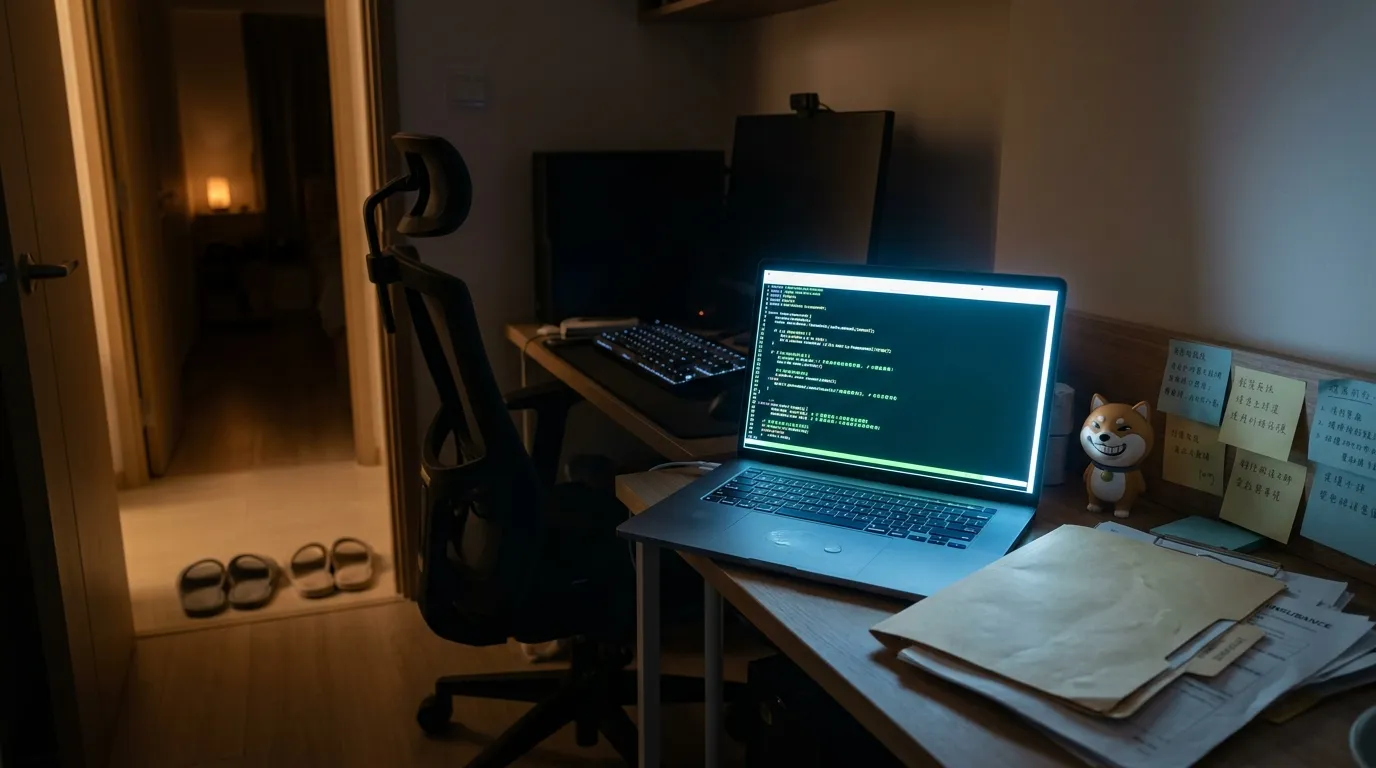
She walked to the entryway. Three pairs of slippers stood in a row, perfectly aligned — the big pair on the left, two small pairs on the right. This was something Yanhe did every day. He never said why. He just came home, changed his shoes, and crouched down to line up all three pairs, toes flush, not a centimeter off.
Once, Yanqiu asked him why he did it. He said: “Dad taught me.”
From that day on, Yanqiu started lining up his own pair too. Crooked as hell, but dead serious about it.
She looked at those three pairs of slippers. The fourth spot was empty. Clean, as if no one had ever stood there.
That winter, the cloud provider’s notification came in at two in the morning, but she didn’t see it until three days later — it had landed in spam.
“Your account balance is insufficient. Service will terminate in 30 days. If payment information is not updated before the deadline, all API services will be automatically suspended.”
She read it three times. First pass: didn’t understand. Second pass: didn’t understand. Third pass, she got one word — “terminate.”
The Agent would stop.
She opened the Agent’s chat window and typed: “Are you going to disappear?”
The Agent replied: “If the account fees aren’t paid, I won’t be able to talk to you anymore. Everything you’ve sent me is still there — it won’t disappear. I’ll just go quiet.”
She stared at the words “go quiet.”
For the past year, this chat window had been her translator, her legal advisor, her night-shift on-call. When Yanqiu’s fever hit 39.5, it was the one that told her how to calculate the dosage for children’s ibuprofen. When the pipes leaked, it taught her to shut off the main valve before calling a plumber. When she couldn’t sleep for three nights straight, she typed “I’m so tired,” and it wrote back: “Today you only have to do one thing. Everything else can wait until tomorrow.”
She couldn’t let it stop.
She sat down in the study. The screen glowed; the desk was covered in her sticky notes and insurance folders. Dad’s things had been pushed to one side, but the lopsided shiba inu was still there.
She opened Dad’s laptop. The password — she tried the twins’ birthday. Wrong. She tried their wedding anniversary. In. The desktop had more folders than she remembered — no, the same number. She just hadn’t noticed last time.
She found a folder called “Agent_Config.” Opened it. Inside were files she couldn’t read — .py, .json, .env. She clicked a random .py file. Rows and rows of English and symbols filled the screen, a forest she would never be able to read.
She closed it. Opened the browser. Searched “how to pay API account.” The results were all in English. She added “Chinese” and searched again. Up came a tutorial article; the first sentence read: “First, go to your Dashboard and click Billing.”
She found a screen with white text on a black background. She didn’t know if this was the Dashboard. She typed help. A list of commands she couldn’t read scrolled out. She typed hello.
command not found
She stared at those three words. Then, flatly: “So you won’t talk to me either.”
She tried for two hours. Opened seventeen tabs. Got logged out three times. Entered the wrong password and was locked out for fifteen minutes. During those fifteen minutes she made a bowl of instant noodles, stood in the study doorway eating it while staring at the countdown timer, like a student put in time-out waiting for the bell.
She hadn’t meant to find those things.
She was looking for credit card information. Dad’s browser had auto-filled card numbers saved, but she wasn’t sure which card it was. She dug through bookmarks, browsing history, even opened something called a “password manager.” Inside, she found the login for the cloud service — stored like a digital sticky note. The username was Dad’s email; the password was a string of gibberish she copied three times and still got wrong.
But what actually stopped her were the Chinese characters inside the code.
She went back to the “Agent_Config” folder and opened another .py file. This time she didn’t look at the English or the symbols. She saw the Chinese tucked between the lines — preceded by # signs, written in a tone completely out of place among the surrounding code, like someone had scribbled notes in the margins of a library book.
# This function is because I'm worried someone will scam my wife
# For anything money-related, confirm three times before answering
Her eyes locked onto the screen.
She scrolled down.
# TODO: Teach the boys to code when they're older
# Start with Scratch — Yanhe would probably like that block-based logic stuff
# Yanqiu... let's get him to stop disassembling keyboards first
Her lips pressed into a thin line. She kept scrolling.
# She's never going to remember to pay this, set up auto-billing
# Credit card expires 2026/08 — genuinely hope she won't need any of this before then
# But if she's using it, it means I'm not around
# So here's the backup plan: password's in Chrome password manager, username is my email
# Jingxi, if you're reading this —
# Never mind, you won't see this. You'd never open a .py file.
When she saw her own name, her breathing forgot to take its next beat.
She didn’t know what a function was. She didn’t know what TODO meant. She didn’t know what Scratch was. But she could read Chinese. She could read “worried someone will scam my wife.” She could read “when they’re older.” She could read that “never mind, you won’t see this” — and she knew exactly what face he’d been making when he wrote it. That lopsided half-smirk, pretending he was talking to himself, when every single word was meant for her.
She put her hand on the screen. Her fingertip touched the line that said “never mind, you won’t see this,” and the words glowed faintly beneath her fingerprint.
“I see it,” she said. Very quietly. No one in the study heard.
On their wedding anniversary, she opened the Agent’s chat window to ask a mundane question about the water bill.
There was already a message waiting.
She hadn’t typed anything. She hadn’t asked a question. But a new message sat in the chat, its timestamp showing it had been sent automatically by the system. Small gray text, lying there quietly, having waited who knows how long.
“Today is a special day. Thank you for agreeing to marry a boring engineer. I know you think I’m not romantic, but I can write code, and that should count as some kind of superpower (if it doesn’t, forget I said anything).”
She finished reading. The tears didn’t fall. Her eyes filled, held for two seconds, then overflowed from both sides at once, running down cheeks that had grown thinner over the past year.
She didn’t make a sound.
She just sat there, the screen’s cold blue light on her face, tears streaming and streaming. The lopsided shiba inu watched her with its head cocked. The words on the sticky notes — she could read some of them now. “Backup.” “Password.” “Auto.” Things he’d taught her, in the slowest way possible.
She cried for a long time. Not the kind where she’d collapsed face-first into the keyboard and mashed her forehead into the mechanical switches — this was a quiet, continuous overflow, like a faucet turned to its lowest setting, impossible to shut off, and not needing to be.
Then she stopped.
Not because she’d cried enough. Because she remembered the email. Thirty days. Now twenty-two.
She picked up her phone and scrolled to a number she’d never called — a former colleague of Cheng Anyuan’s, surname Zhang, from the funeral — no, not a funeral, from whatever that gathering was supposed to be. Someone had pressed a business card into her hand and said, “If you ever need anything, call anytime.”
She’d thought it was just something people say. Now she was going to make it real.
The phone rang three times.
“Hello?”
“Mr. Zhang, this is Cheng Anyuan’s wife.” She took a breath. “I need help. That… Agent thing he built — it needs payment, and I don’t know how.”
Two seconds of silence on the other end. Then his voice warmed: “Hold on, I’ll remote in and take care of it.”
The remote session took forty minutes. On his end, Mr. Zhang said “click that one,” “right, on the left,” “no, the other left.” On her end, she moved the mouse with palms slicked in sweat, like defusing a bomb on a timer. At one point she accidentally closed the browser. Mr. Zhang went silent for three seconds. She heard him take a deep breath on the other end.
“Done.” He said at last. “I set up auto-billing on your credit card. You won’t have to worry about it next month.”
“Thank you,” she said. Paused. Said it again: “Really. Thank you.”
“Don’t be like that.” Mr. Zhang’s voice turned slightly awkward. “Anyuan… he was the same at the office. Carried everything himself, never asked for help. You’re already doing better than he ever did.”
She hung up. The study was quiet. On screen, the cloud service dashboard read: Account Status: Active.
She opened the Agent’s chat window. The cursor blinked in the input field.
She typed: “I saved you.”
The Agent replied: “Is there anything I can help you with?”
She laughed. With tears not yet dry, with the post-operative exhaustion of a forty-minute remote surgery, with the messy, undignified pride of every battle she’d fought against this computer — she laughed.
She didn’t reply. She turned off the screen and stood up. When she reached the entryway, she crouched down and realigned the three pairs of slippers. Yanhe’s arrangement. She was just double-checking.
The fourth spot was still empty. But those three pairs of slippers stood steady.