Chapter 7
Reconnect
His heartbeat started counting from Changbin, Taitung.
Forty minutes before departure, he sat on the edge of the bed in the side house, his hand already on the zipped-up backpack. Laptop, charger, a printed-out client requirements document. The reason for going was perfectly sound — a B&B operator in Hualien city needed a full booking system, specs too complicated for a phone call, had to be face-to-face. This was work. This was professional judgment. This had nothing to do with that nameless force pushing up from the bottom of his chest.
Haisheng-po leaned out from the veranda: “Ahai, Ah-De’s car is waiting for you.”
He stood up. His legs felt like they’d been filled with brine — not sore, just heavy. The instant he stepped over the side house threshold, his heart slammed a single beat so hard it stopped him for half a second. Behind him, the little yellow raincoat hung quietly on its hook. The frog eyes said nothing.
He got in the car.
Provincial Highway 11 stretched north along the coastline. The Pacific outside the window was the same Pacific, but every time he looked it seemed to be retreating. Not the water pulling back — he was the one leaving. Leaving the safety perimeter he’d spent two years building. With every additional kilometer, the signal weakened by one bar.
Chenggong Township. He’d been there. His shoulders would clench, but he could manage.
Past Chenggong, the road was unfamiliar. The car wound into a mountain stretch, and when it emerged, a denser cluster of buildings appeared on the horizon. His fingers began to go numb — starting from the pinky, creeping toward the ring finger, like a bug propagating line by line through the code.
The first traffic light in Hualien city. Scooters darted out from both sides — horns, engines, the rivet-clack of tires rolling over manhole covers. His shoulders locked so tight his cervical spine began to ache, and something at the back of his skull was swelling — not the kind of swelling from an injury, but the kind where something was trying to get out and couldn’t.
He finished the client meeting. Of the entire session, the only thing he remembered was that his voice had been steady. Requirements document spread out, timeline confirmed, quote discussed, handshake. He’d done it. Professional workflow, completed. But when he walked out of the café, the back of his shirt was soaked through, and his palm sweat had left a fog across the phone screen.
Evening. Hualien’s sky shifted from bright white to a thin wash of orange. He should have been catching a ride back. Ah-De said he’d wait at seven, across from the train station. But his feet carried him in a different direction — toward where the people were. He didn’t know why. His feet did.
Dongdamen Night Market began to breathe around six p.m.
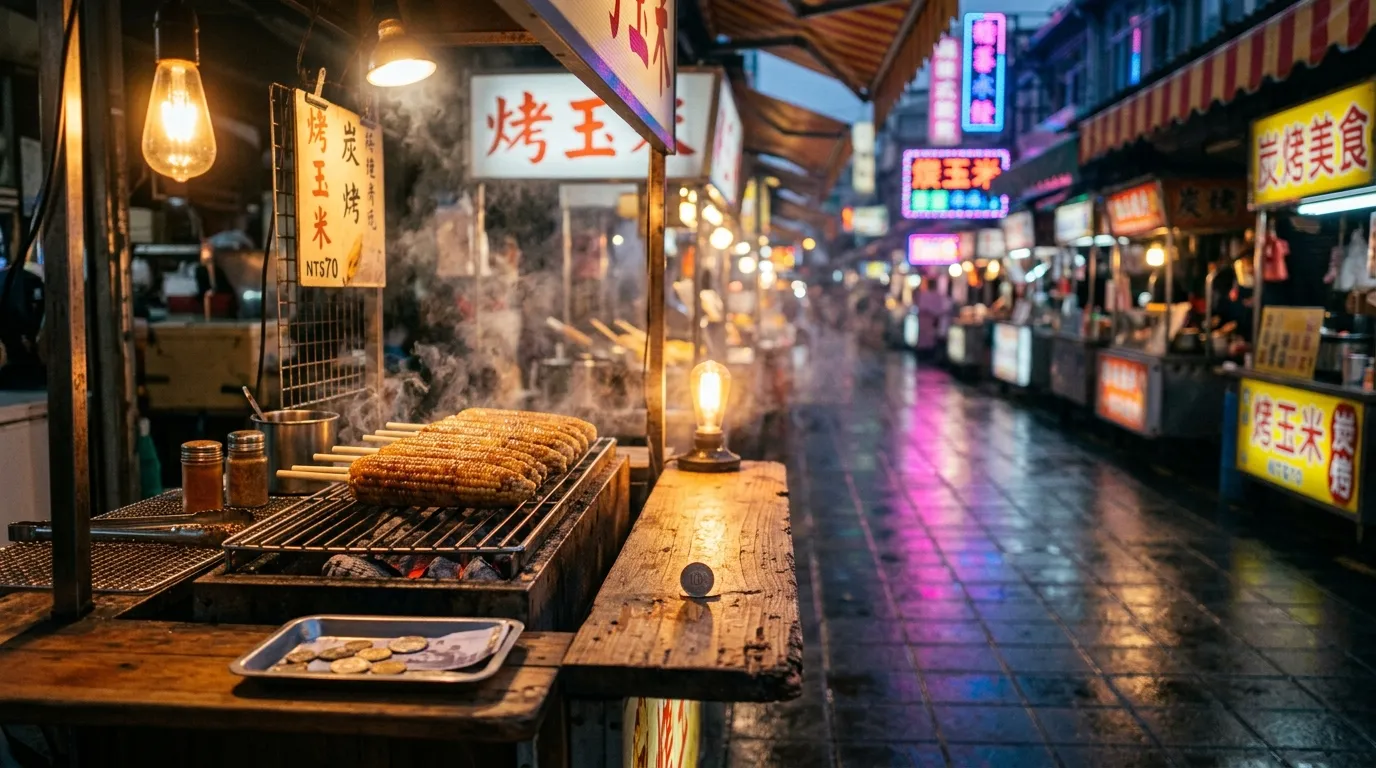
Vendors flipped open canvas tarps, lit burners, switched on lights. Barbecue smoke rose like a wall. Neon tube signs dyed the entire stretch of Chongqing Road in fluorescent pink and electric blue. The first wave of the crowd surged in with the slap of flip-flops and the shrieks of children, blending into a frequency unique to Hualien evenings — somewhere between lively and chaotic, carrying mountain wind and the salt of the distant sea.
Shen Jingxi’s right hand was holding Yanhe’s. Her left hand — her left hand had been holding Yanqiu’s just a second ago.
“Yanqiu! Stop running!”
The boy was already three meters ahead. His knees bore two Band-Aids, and when he ran he moved like a spinning marble — trajectory unpredictable. He stopped at the first stall — fried chicken cutlet. Second — grilled squid. Third — marble game. Fourth —
“Mom, I want that one!”
“You just said you wanted that one. And that one. And that one back there.”
Yanhe walked quietly beside her, glanced at his brother, and said: “Your stomach isn’t as big as your eyes.”
Yanqiu turned around and replied, dead serious: “But my mouth is.”
She laughed. The night market lights washed over both their faces. Seven years old now. Two years ago the tops of their heads had only reached her waist. Now Yanhe’s head nearly came up to her chest.
“Alright, pick one,” she said. “One.”
Yanqiu’s eyes executed a high-speed scan across thirty-odd stalls, then locked onto the grilled corn stand diagonally across the way.
“That one!”
He released her hand — not released, launched out of it — and bolted toward the corn stand.
“Slow down!” she called.
Yanhe watched his brother’s retreating back without following. He reached into his pocket and pulled out a tissue, held it out to her. She took it, baffled.
“You ate a sample sausage earlier,” he said. “There’s sauce on the corner of your mouth.”
She wiped her mouth with the tissue. This kid. When had he become this — quietly noticing everything, quietly offering a tissue, quietly not saying the things he was thinking.
In the distance, Yanqiu had already squeezed his way to the front of the corn stand.
When Yanqiu reached the grilled corn stand, there were five or six people in line. He stood at the back, up on tiptoes, watching the ears of corn sizzle and smoke on the wire grill. The smell was incredible. Soy sauce and caramelized sugar mingling together, and his stomach growled once in response.
The person in front of him was a man.
Very tall. Very tan. Wearing a plain shirt washed so many times it had gone slightly loose, carrying a backpack that looked heavy. He stood in line with his shoulders slightly stiff.
Yanqiu had the corn money clenched in his fist — a fifty-dollar coin Mom had given him. He squeezed too hard, his hand slipped, and the coin dropped to the ground, rolled twice, and came to rest at the man’s feet.
“Ah—”
The man looked down. Bent over. Crouched.
His hand picked up the coin. Then he looked up and saw a small face looking back at him. He reached out to return the coin — but before that, his hand did something else first.
He touched the top of Yanqiu’s head.
Not the standard adult-patting-a-child kind of pat. It was a very specific motion — palm settling on the crown, fingertips tracing the curve of the skull downward, pausing for one second at the boundary where the neck met the hairline. Not too firm, not too light. Like something done a thousand times before.
Yanqiu’s entire body went still.
The coin was in his hand. The man had already stood back up, holding the coin out to him. “Yours.” Voice low, unhurried.
Yanqiu took the coin. He didn’t move. His eyes were fixed on the man’s hand — the hand that had just touched his head. Rough. Nails trimmed very short. On the back of the hand, a faint scar visible only against the tan.
Something began to burn from the soles of his feet upward. Not the heat of the night market pavement. Something deeper. He didn’t know what it was. He only knew —
“Mister, you’re like my dad.”
He said it without hesitation, without buildup, in exactly the same tone he’d used moments ago to say “I want that one.”
Dad.
Those two syllables drove into a junction point somewhere in his brainstem like a needle.
Ahai stood in front of the grilled corn stand, facing a boy of about seven who had just called him something that didn’t belong to him. He should smile, say “wrong person,” turn and walk away. His mouth opened. Nothing came out.
The boy’s face.
He was looking at the boy’s face. Small, round, the line of the jaw, the shape of the eyes — then his gaze was pulled past the boy to what lay behind him. In the night market crowd, roughly ten meters away, another boy stood quietly beside a woman. That boy turned his head.
Two faces.
Two identical faces.
The two figures from his dreams. The ones he could never catch, never see clearly, running back and forth across a warm wooden floor —
First crack.
Every sweat gland in his body opened at once. Not sweating — every pore pried open, and cold, pushing outward from beneath the skin. A sound began in his ears, not the sounds of the night market, but something else — farther away, compressed for a long time. A child crying. No — smaller than that. An infant crying. Two of them crying at the same time, at different frequencies, overlapping, like a melody he’d heard hundreds of times before.
Second crack.
The smoke from the corn grill drifted over, soy sauce and caramelized sugar boring into his nostrils — no. Mixed in with it. A smell that didn’t belong to the night market. Laundry detergent. A specific one, one he hadn’t encountered once in two years. The instant his nasal passages caught it, something in his brain was ripped out by the roots.
An address. A house number. A dining table. Four chairs. The one on the left was lower, because Yanqiu —
Yanqiu.
A name. Names came firing through the cracks in the wall like bullets, not one but an entire magazine. Yanqiu, Yanhe, Shen Jingxi, Cheng Anyuan —
His name was Cheng Anyuan.
His vision began to shake. Not his eyeballs moving — the world was moving. The entire Dongdamen Night Market shuddered like an old television that had been slapped: static first, then sudden clarity, then static, then clarity again, and each moment of clarity carried in more fragments. The dinosaur-shaped bath soap in the bathroom. The blue glow of a screen at 1:42 a.m. A lopsided shiba inu. Two cartons of milk. Two. Because Yanhe wanted whole milk and Yanqiu wanted low-fat — no, they both wanted whole, it was Jingxi who wanted low-fat —
His knees hit the ground.
Not kneeling. His legs simply lost every ounce of structural support in that one second. His heart hammered against his ribcage at a rate well past normal — he could feel his own pulse in his temples, his throat, his fingertips, behind his eyeballs. Blood pressure dropping. He knew this symptom. He’d analyzed his own body countless times. But the diagnostic system had crashed too.
His field of vision began to go dark from the edges inward. Like a program shutting down, one window at a time being closed. The lights of the corn stand. The silhouettes in the night market. The boy’s face — Yanqiu’s face —
The last image, before every window closed: in the crowd, a woman holding another boy’s hand, looking this way. Her face.
He remembered everything.
Then it all went black.
Someone collapsed.
Someone collapsed at the night market. In front of the grilled corn stand, a man suddenly dropped to his knees, then toppled sideways, the back of his head missing the iron frame’s leg by an inch. The vendor shouted. The people nearby stepped back. A small boy stood next to him, a fifty-dollar coin clenched in his fist, not moving at all.
Shen Jingxi heard the commotion while she was already walking toward Yanqiu. She quickened her pace — not because of the man on the ground, but because Yanqiu was in that direction.
A crowd gathered. She squeezed through the gap between two people’s shoulders.
“Yanqiu —”
Her little boy stood there, staring at the ground.
Her eyes followed his gaze down.
A man on the ground. Lying on his side. Dark, very tan, short stubble along his jaw. Loose clothes. No glasses. Eyes closed, brow furrowed. Cold sweat had plastered his hair to his forehead.
She didn’t recognize him.
She looked for one second. Two.
That hand.
His right hand lay open on the ground, palm up. She saw the things she had seen ten thousand times — the callus on the side of the second knuckle of his index finger, the slight outward curve of the pinky, the crease on the inside of his wrist that ran shallower than anyone else’s.
Her knees buckled.
Every sound in the night market was stripped away in that moment. Barbecue smoke, neon lights, children’s shrieks, music — all of it compressed into a thick, thick layer of cotton, wrapping her inside. She couldn’t hear anymore. She could only see that hand.
She didn’t fall.
She crouched down. Slowly. Her knees met the heat of the night market pavement, tiles slick with grease and flattened tissue paper. She didn’t care. Her hand found his wrist first. A pulse, beating. Then she lifted his head and placed it on her knees. When her fingers touched the back of his skull, they found an old scar — an injury she had never seen.
The bystanders were talking. Someone was on the phone. Someone asked if they should call an ambulance. Yanqiu, standing beside her, finally spoke: “Mom, that man —”
She didn’t answer.
Her fingers brushed the wet hair from his forehead. Strand by strand. Very slowly. She looked at his face — darker, thinner, older, stubble she’d never seen, lines at the corners of his eyes she didn’t recognize. But the bones underneath were the same. The brow ridge. The bridge of the nose. The angle where the jawline curved down below the ear.
On a completely stranger’s face, she found her husband. Piece by piece.
Yanhe had appeared beside her at some point. He didn’t crouch down. He stood there, looking at the man on the ground, looking at his mother’s hands, saying nothing. His own hands hung at his sides, all five fingers pulled taut.
On her knees, the man’s eyelids trembled.
Very faintly. Like a system mid-reboot, the loading screen not yet finished, the cursor blinking once ahead of schedule.
His lips moved.
The sound was small. Half of it swallowed by the roar of the night market, some of it scattered by the wind, the rest drowned out by her own heartbeat. But she heard it.
He said her name.