Chapter 1
The Prognosis
Luo Tianxu thought the air conditioning in this consultation room was turned up too high.
He sat with his hands folded in his lap, watching the man in the white coat stare at the computer screen. Fu Jingming — that was what the nameplate said — clicked the mouse a few times, and a black-and-white image jumped onto the screen. Luo Tianxu couldn’t make it out very well, but he knew it was a picture of the inside of his own body.
He didn’t like waiting.
His daughter sat beside him, spine straighter than his. Luo Wanqi always sat like she was in a meeting, even on a plastic hospital chair. She held her phone face-down in her lap, her nails cut very short.
Fu Jingming turned the screen toward them slightly and pointed to a brighter region in the image.
“Mr. Luo, this is the CT scan we did last week.” His voice was level, like a man reading a weather forecast. “We found a tumor in the body of the pancreas — approximately 4.2 centimeters.”
He paused, and moved his finger to another part of the image.
“Here, in the liver, there are also several smaller lesions. This indicates the tumor has already undergone distant metastasis. Taking both the imaging and the previous biopsy results together, the diagnosis is pancreatic adenocarcinoma, stage IV.”
When Luo Tianxu heard the words stage IV, his mind went blank for a moment. Like a television signal cutting out — screen black, not even static.
Then he heard his daughter draw a sharp breath. Very short, like something had caught in her throat.
Dr. Fu kept talking. He mentioned “treatment plans,” “chemotherapy,” “response rates,” and some numbers Luo Tianxu couldn’t hold onto. Something about thirty-something percent, something about medians. The words were like a pile of components dumped on a table — he knew what shape they were supposed to make, but his hands wouldn’t cooperate.
”…At this stage, we would recommend beginning with systemic chemotherapy as the primary course of treatment. Based on the data in the literature —”
“Speak plainly.”
Dr. Fu stopped.
Luo Tianxu looked at him. The air vent was directly overhead, blowing cold air on the back of his neck, but he didn’t move.
“How long do I have?”
The room was quiet for a moment. Beside him, his daughter’s grip on her phone tightened until her knuckles went white.
Dr. Fu eased back in his chair and lifted his hands from the keyboard. He held Luo Tianxu’s gaze, as if taking a measurement. Then he said:
“Every patient is different. Some people respond very well to chemotherapy and can maintain quality of life for a considerably longer period. But given the current stage and the extent of metastasis —” he paused again, as if choosing his words. “Median survival time is approximately three to twelve months.”
Luo Tianxu gave a small nod.
Three to twelve months. A minimum of one season, a maximum of one year. He converted the number into units he could work with. One season — he could see the summer end. One year — he could have one more Lunar New Year.
From beside him came a sound he couldn’t quite hold in check — a stifled sob.
Luo Wanqi’s eyes had gone red, but she didn’t cry out loud. She bit down hard on her lower lip and reached across to the tissue box on the desk, pulling one out and then another. Her other hand settled on her father’s arm.
“Dad —”
“Alright, alright.” Luo Tianxu didn’t look at her. He kept his eyes on Fu Jingming. “So three to twelve, take the midpoint — roughly six months?”
Dr. Fu’s expression didn’t change, but his lips moved slightly. After nearly thirty years in this room, he had seen every kind of reaction. People who wept. People who raged. People who went blank. People who dropped to their knees and begged him to find a way. But someone doing the arithmetic on their own median survival time — that was less common.
“Statistics are one point of reference,” Dr. Fu said, his voice steady at the same frequency as before. “Individual variation between patients is quite large. Some people —”
“I know, that’s what you all say.” Luo Tianxu made a small dismissive gesture. “Statistics are statistics, people are people. But I’m an engineer — give me a number and I can make a plan.”
He said make a plan in the tone of a man mentioning he needed to replace a downspout before the rainy season.
His daughter’s hand tightened on his arm.
Dr. Fu glanced at the daughter, then back to the father. “Mr. Luo, I understand you want a specific timeframe. But at this stage, we would recommend focusing on the treatment plan. The purpose of chemotherapy —”
“If it’s six months,” Luo Tianxu interrupted, “what happens if I don’t do chemo?”
“Dad.” Luo Wanqi’s voice jumped up, not quite a shout but sharper than anything she’d said so far. “Let the doctor finish.”
Luo Tianxu glanced at her. Her eyes were red and bright, the tissue crumpled in her fist. He recognized that look — Wanqi got angry when she was scared, had been that way since she was little. When she was five and a thunderstorm rolled in, she didn’t hide under the covers. She stood at the window and yelled at the sky.
He turned back to Dr. Fu.
“Without treatment,” Dr. Fu said, his tone unchanged by the interruption, “the progression tends to be faster. But I wouldn’t recommend making that decision right now.”
“I’m not saying I won’t treat it.” Luo Tianxu said. “I’m just asking. Engineers evaluate every option.”
He suddenly felt how absurd that metaphor was in this context. Engineers evaluate every option. He was talking with a doctor about when he was going to die.
But he found he didn’t want to take it back.
Dr. Fu held his gaze and gave a small nod. “All right. I’ll schedule you to come back next week to discuss the details of the chemotherapy plan — you’re welcome to bring family. In the meantime, if you have any questions, you can call the nursing station at the clinic.”
“Fine.”
“Ms. Luo,” Dr. Fu said, looking toward the daughter, “the follow-up testing schedule — the nurse at the front desk will walk you through everything on your way out.”
Luo Wanqi nodded, the motion too fast, like she’d nodded several times at once. When she stood, her chair scraped backward across the floor — a sharp sound in the quiet room.
“Sorry.” She pushed the chair back into place, her voice already normalized, or at least sounding normalized. The quality-control manager’s switch. She could flip it fast.
Luo Tianxu stood. His back still ached — it had been aching, in fact, for three months. He’d assumed it was from sitting too long, from getting older, from needing a better chair.
So that was what it was.
He walked to the door and gripped the handle. Cold metal. He turned back.
“Dr. Fu.”
“Yes?”
“A man my age,” Luo Tianxu said, “doesn’t usually have much on the calendar. Now you tell me I have six months, and suddenly I have to start making appointments.” He tilted his head. “You could call that a bright side.”
Dr. Fu blinked.
Luo Wanqi stood behind her father, that crumpled tissue still in her hand, her whole face the expression of someone trying very hard not to cry.
Fu Jingming had spent thirty years learning not to let patients’ emotions sweep him off course. But he would admit, privately, that this one caught him. The corner of his mouth moved — not quite against his will, but close.
“Mr. Luo,” he said, “I’ll be putting that in the chart. Under mental status assessment. Positive.”
Luo Tianxu gave a short “Mm,” pulled open the door, and walked into the corridor.
The corridor was brighter than the consultation room, and louder. A nurse pushed a cart past, its wheels rolling across the terrazzo floor. Someone in the waiting area was coughing. A child was fussing. The call bell chimed twice, then stopped.
He walked about ten paces and stopped near a row of plastic chairs along the wall.
His daughter came out after him, almost at a jog. She opened her mouth but said nothing.
Luo Tianxu stood in the middle of the corridor, and the foot traffic of the hospital flowed around him on both sides. He felt, suddenly, like a stone placed in the middle of a river — the water moves around it, but the stone doesn’t move.
“Go get that schedule,” he said.
“I’ll be right back. Wait here.”
“I’m not going anywhere.”
Luo Wanqi looked at him — that look of a quality inspector confirming a defect, precise and quick, anticipating the answer — and turned toward the nursing station.
Luo Tianxu sat down in one of the plastic chairs. The seat had been worn slightly lopsided. He put his hands in his jacket pockets and felt a half-used packet of tissues and a receipt.
Three to twelve months.
He closed his eyes. The sounds of the corridor were still there, but farther away.
Sixty-eight years. He had lived sixty-eight years. Thirty-five of them at the Water Resources Agency, and the irrigation channels he’d overseen end to end could run from Taichung all the way to Pingtung. His wife had been gone for twelve years. His son was up in Taipei and didn’t come back much. His daughter was nearby, but she was busy.
He opened his eyes. At the far end of the corridor there was a window, and the late-afternoon sun cut through it, dividing the floor into one half bright and one half dark.
All right. At least now he knew.
He thought: not knowing is harder than knowing. Can’t get anything done when you don’t know.
The car turned onto Wuquan Road. The light ahead went red.
Luo Wanqi pressed the brake and the car nosed forward slightly. Her right hand rested on the steering wheel at ten o’clock, her fingernails pressed into the leather cover.
In the passenger seat, her father’s face was turned toward the window. He hadn’t spoken since he got in.
The radio was playing a song she didn’t recognize. Someone singing about waiting for someone to come back. She felt as though the universe was making a joke at her expense.
She thought about turning it off, then decided if she turned it off the car would get too quiet — quiet enough that she wouldn’t know what to do with herself. So she let the song keep playing.
Sixty seconds for the red light. She glanced at the dashboard clock. Four forty-seven in the afternoon. Forty-seven minutes ago she’d been sitting in that consultation room, listening to Dr. Fu read out numbers in that voice of his, the one with no affect in it.
Three to twelve months.
Her mind started doing arithmetic. This was how she handled everything. Worst case, three months — ninety days, two thousand one hundred and sixty hours. Best case, a year — though “best” felt like the wrong word here. Take the midpoint at six months — she caught herself using the same calculation as her father, and felt her stomach turn.
She breathed in slowly. In the passenger seat her father still hadn’t moved. His profile in the evening light looked ten years older than it had that morning. No — she was only just noticing now when he had become so old. The skin at his temple was thin enough to see the veins beneath, and his hair was —
Green light.
The car behind her honked. She moved her foot from the brake to the accelerator, smoothly, almost without a jolt. Muscle memory. Her body was driving. Her mind was somewhere else.
She turned onto Minquan Road. Another red light. She picked up her phone.
“I’m calling Wanyang,” she said.
No response from the passenger seat.
She pressed her brother’s number. It rang four times before he picked up.
“Hello? Sis?” Noise in the background — it sounded like he was in a room full of people.
“Dad’s results are in. You should —”
“Hold on, I’m in a meeting.” Her brother’s voice dropped, carrying the particular irritation of someone taking a personal call in front of colleagues. “Give me a second. Actually — just let me call you back.”
Then he hung up.
Luo Wanqi set the phone face-down in the cupholder. She knew her brother wouldn’t call back. That hold on from Wanyang always meant I’ll get to this when I think of it, and he was always busy, and he never thought of it.
She wasn’t angry. She had gotten past being angry at her brother.
The passenger seat shifted. Her father rolled the car window down a crack. The evening air came in, carrying the smell of Taichung at dusk — motorcycle exhaust, the oil-smoke from a roadside stall, and from somewhere far off the faint scent of golden trumpet trees in bloom.
“Close the window. The air —”
“I’m hot.”
Two words.
Luo Wanqi turned the AC up one degree and said nothing more.
They drove past a PX Mart. She found herself thinking that the milk in the refrigerator was about to expire. Then she thought about the word expire, and then about the numbers from the consultation room, and her stomach clenched again.
She fixed her gaze on the road ahead. Taillights, traffic signals, crosswalks, turn indicators. One thing at a time, don’t try to take in everything at once. This was something she’d learned in quality control — no matter how high the defect rate, you pull them out one by one.
But she knew you couldn’t sort this out one piece at a time.
Past the art museum now. Almost home. The corner shop at the mouth of the alley was still open, the owner’s wife sitting out front folding cardboard boxes. Her father glanced that way for a moment, then looked back.
“Go slow through the alley,” he said.
That was the third thing he’d said since getting in the car. The first had been “Mm,” when he got in. The second had been “I’m hot.”
Luo Wanqi slowed to twenty and turned into the alley. The iron gate of the townhouse was ahead. She pressed the remote and the gate rolled upward, making the sound she had heard for thirty-eight years.
Her father unclipped his seatbelt, opened the door, got out. His movements were slower than usual — or maybe it only seemed that way because she was watching everything more slowly now.
“What do you want to eat?” she asked.
“Not hungry.”
“You didn’t eat at noon.”
“I said I’m not hungry.”
He went inside. She listened to his slippers go pad pad pad across the floor, from the living room to the foot of the stairs, and then up.
She sat in the car, hands still on the wheel. The gate motor was still running, the iron rolling door descending slowly.
She picked up her phone and looked at it. Wanyang hadn’t called back.
She put the phone down and pressed her forehead against the steering wheel. The smell of leather, leather and sweat. She stayed there for a long time — or maybe only thirty seconds. Time had broken today, stopping and starting.
Finally she lifted her head, turned off the engine, and got out.
She was going to cook dinner. He would be hungry.
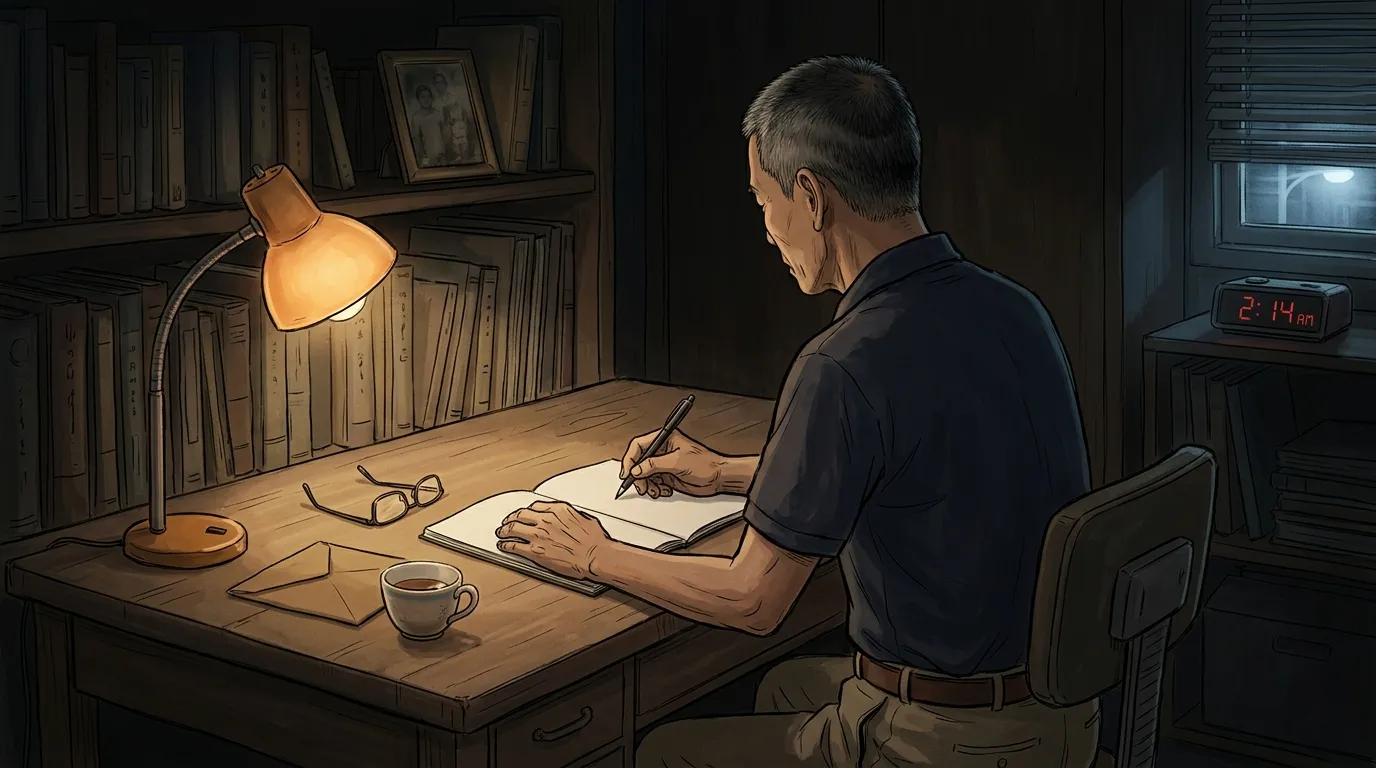
2:14 a.m.
Luo Tianxu knew the time because the digital clock in the corner of his desk had been at the edge of his vision the whole time. Red numbers glowing in the dark room, like an eye that wouldn’t shut.
He had been sitting at his desk — he didn’t know how long. He’d lain down for a while, tossed and turned until the blankets were bunched up in a pile, and eventually given up and gotten out of bed.
The desk lamp in the study was on — a sixty-watt incandescent, its warm yellow light falling only in a circle on the desk’s surface. Everything else was dark. The bookshelves were a black wall, with only the gold lettering on a few spines catching a little light at the edge of the lamp’s reach.
Spread across the desk were the materials he’d brought back from the hospital today — yesterday, now. A manila envelope containing a disc with the CT images, Dr. Fu’s consultation notes, and the appointment card for the next visit.
He picked up the disc and looked at it. A thin sliver of plastic, holding the secrets inside his own body. His pancreas. His liver. Organs he had spent sixty-eight years not thinking about, which had now become the most important things in the world.
He put the disc back down.
The study had a layered smell — the dry, faintly sweet smell of decades’ worth of books and paper, mixed with the faint burning smell of the lamp’s bulb warming up. This room was his. It had been his even when his wife was alive; even more so after she was gone.
His gaze moved across the desk. His reading glasses sat folded next to the pen holder, and there was still half a cup of cold tea in the mug. The pen holder held a few ballpoint pens and a red-and-blue pencil — the kind he’d used for engineering drawings.
Second drawer on the right side of the desk.
He pulled the drawer open. Inside were a few old notebooks, a calculator, a stack of receipts held together with a rubber band. At the bottom was a notebook that had never been used — B5 size, black hardcover, a birthday present from Wanqi, years ago. He’d always thought keeping a diary was too much fuss, and it had sat in the drawer collecting dust.
He took the notebook out.
There was a thin layer of dust on the cover. He rubbed it off with the back of his hand. He opened it — the pages were completely blank, the edges faintly yellowed. He set the notebook on the desk, flattened it out, and picked up a ballpoint pen.
Then he didn’t write anything.
He stared at the blank page.
Three to twelve months. Dr. Fu’s voice ran through his head again. Three to twelve months, median survival time. The median meant half of patients died sooner and half survived longer. He was a man who worked with data, and he knew he wouldn’t necessarily land in the middle.
He could be gone in three months.
His hand gripped the pen, and the tip of his finger trembled slightly. Not very noticeably — if someone had been there watching, they probably wouldn’t have caught it. But he knew. His hands had never trembled in thirty-five years of engineering work — not when drawing, not when signing documents, not when holding incense at his wife’s coffin.
But now they did.
He set the pen down and laid his hand open on the surface of the desk, waiting for the trembling to stop.
The desk lamp hummed. Somewhere far off a dog was barking, the kind of far away that put several alleys between it and you. The window was open a crack, and the night air drifted in from time to time, carrying the cool of the back lane.
He looked at his open palm. The knuckles had thickened. The skin had loosened. There were age spots on the back of his hand. This hand had supervised dams, repaired irrigation ditches, held his newborn daughter, held his newborn son, and pulled white hairs from his wife’s back one by one.
Now this hand had one last thing left to do.
He picked up the pen again.
At the top of the first page of the notebook, he wrote a title. The characters were not large, but they were steady. An engineer’s handwriting — horizontal lines even, vertical lines straight, like filling out a form.
Below the title, he wrote 1. Then he paused, thought for a moment, and wrote a line.
He looked at what he’d written.
The strange thing was, once it was on paper, the trembling stopped.
Not because he was no longer afraid. Because there was something to do.
Before he retired, Luo Tianxu had managed any number of engineering projects. Every one began the same way: define the problem, break it into steps, then do it one step at a time. Whether you were building an irrigation channel or a flood barrier, the first step was always the same — write it down.
Below 1., he wrote 2.
Then 3.
He wrote slowly, thinking for a long time over each entry. Some he wrote and then crossed out; some he crossed out and then wrote back in. The ballpoint pen made a quiet scratching sound against the paper.
This was not a will. A will was a legal document with a format, requiring a notary. This was something else. This was a list — things to finish before he went.
He didn’t know how long he wrote. When he finally looked up, the red digits on the clock had ticked to 3:41.
He looked back down at the notebook. He had written more than he’d expected. Some entries were just a few words; others ran longer. The handwriting was steady from start to finish.
The corner of his mouth moved. Not quite a smile, but not bitterness either.
Bē bái.
He closed the notebook and put it back in the drawer, then turned the lock. The key went into the bottom of the pen holder, buried under a few pens.
He switched off the desk lamp. The study went dark, leaving only the clock’s red glow and a little streetlight coming through the window. He sat in the dark for a while longer.
Then he stood, and the chair scraped a brief note against the wooden floor.
The corridor outside was unlit. He pushed open the study door and walked out.
He didn’t see the person standing at the top of the stairs in the dark.
Luo Wanqi pressed herself against the wall, breathing as shallowly as she could manage.
She had heard sounds from the study for nearly two hours. She’d woken up around midnight — she hadn’t really slept, just lain there with her eyes closed, listening to her own heartbeat and counting her breaths. Then she heard footsteps in the corridor, and then the sound of the study door, and then the click of the desk lamp switch.
She got up.
She hadn’t turned on the light. She felt her way along the wall to the end of the corridor and stood just outside the study door. It was closed, and a strip of warm yellow light leaked from under it.
She stood there and listened.
She didn’t hear much. Occasionally the rustle of paper. Occasionally the scratch of pen against page. No crying. No sighing. Nothing — just someone quietly doing something.
She thought about knocking.
Her hand came up in front of the door and held there for a few seconds. Her knuckles were perhaps three centimeters from the wood.
She didn’t knock.
She didn’t know why. Maybe because she didn’t know what she would say if she knocked. Dad, are you okay? — pointless. Dad, do you need anything? — he wouldn’t say. Dad, I’m here — she wasn’t sure he wanted to know.
Maybe it was because the silence behind that door didn’t sound like grief. It sounded like something else — something she shouldn’t interrupt.
Her hand dropped.
Later, the light in the study went out. The sound of a door handle turning. She retreated to the dark space by the top of the stairs, her back against the wall.
Her father came out of the study and walked toward the bedroom. He passed within less than two meters of where she stood, but the corridor was dark and he didn’t look over.
She watched his silhouette. No hunching of the shoulders. Steady steps.
The bedroom door closed.
Luo Wanqi stood in the dark corridor for a long time. Her hand was still in the position it had fallen to, hanging at her side, loosely curled.
She was thinking about the scratching sound. Paper and pen. What had he been writing?
She didn’t know.
She walked back to her room, lay down, and pulled the blanket up to her chin. There was a line of light across the ceiling — streetlight coming through the slats of the blinds. She stared at that line.
Her phone was on the pillow beside her. She looked at it.
Wanyang still hadn’t called back.
She turned the phone face-down and closed her eyes.
There would be a lot to deal with tomorrow. Schedule the next appointment, look into chemo, check the insurance, arrange time off work. She started making a list in her mind, sorting it item by item.
What she didn’t know was that in the room next door, the person she was thinking about had just been doing the same thing.
Only the two lists were nothing alike.