Chapter 2
The Weight of Care
Luo Wanqi’s alarm was set for five o’clock. She was awake by four forty-three.
Sleep had nothing to do with it. Something inside her was more punctual than any alarm — it hauled her up out of shallow sleep before the sky had even decided to lighten. She lay in bed, staring at the stripe of streetlight across the ceiling. Same position it had been for the past two weeks, same angle. Two weeks, and she still hadn’t managed more than four hours of sleep under that stripe.
She picked up her phone. She turned the screen brightness all the way down until it lit only her face.
She opened an app called CareNote. The home screen was a column of numbers arranged like a quality-control report. Temperature, blood pressure, weight, pain score, food intake, bowel movements. Each had a line graph she could pull out to show the seven-day trend. She’d downloaded it two weeks ago, because the notebook she’d been using was too slow — writing couldn’t keep up with the pace of her mind sorting through its lists.
She scrolled to yesterday’s records. Temperature 36.7. Blood pressure 128/82 — elevated, but the doctor had said this was normal under stress. Weight 62.1 kilograms, down 0.8 from before the diagnosis — she wasn’t sure whether this was ordinary fluctuation or whether it had already begun. Pain score 4, back, sustained. For food intake she used three categories: Normal, Barely, Almost nothing. Yesterday had been Barely.
She set the phone down, swung her feet to the floor. The slippers were cool against her soles.
Five o’clock. She went downstairs.
The kitchen light wasn’t on, but she knew where everything was by touch. Rice cooker, measuring cup, storage containers. She took the pumpkin soup she’d made the night before out of the fridge and poured it into a pot to heat. Fu Jingming had said it at last week’s appointment: two days before chemotherapy, switch to liquids — reduce the burden on the digestive system. Today was his first chemo. She had started preparing three days ago.
She stirred the pumpkin soup with one hand and scrolled her phone with the other. Long-term care subsidy forms, which she’d been reading until one in the morning last night. Households employing a foreign domestic caregiver may not simultaneously use in-home care services — she’d read that line three times. It meant that as long as Thuy Hang was here, she couldn’t apply for the government home care worker on top of that. A monthly caregiver cost north of thirty thousand, plus nutritional supplements, tube-feeding supplies, out-of-pocket medications, gas back and forth to the hospital. She had a spreadsheet in Excel with every line item entered, and when she’d arrived at the final number she’d closed the laptop.
Six o’clock. Upstairs, blood pressure.
Her father was already awake. He sat on the edge of the bed in his old grey sweatpants and a white undershirt, feet flat on the floor, as though waiting for someone to come and tell him what today required of him.
“Blood pressure.” She already had the cuff out.
“Just woke up. Reading won’t be accurate.”
“You’re only ‘just woken up’ if it’s been less than ten minutes. How long have you been up?”
He looked at her. “How did you know I was awake?”
“Your room light was off before six.”
His mouth moved, as if he was going to say something. In the end he just held out his arm. She wrapped the cuff around it; the machine beeped twice and the numbers came up. She entered them into her phone.
“Medication.” She opened the pill organizer. Three types in today’s compartment — one white, one yellow, one capsule. She poured a cup of warm water and held it out.
He dropped all three pills into his mouth at once, swallowed with a single sip of water. Fast, like a man meeting a quota.
“Pumpkin soup is downstairs.”
“Pumpkin again.”
“The nutritionist said so.”
“The nutritionist doesn’t have pancreatic cancer.”
She didn’t respond to that. She had learned not to. If she responded, she lost. She’d be pulled into the long conversation she didn’t want to have, the loop about you don’t have to work so hard and I can manage myself.
Seven o’clock. Medication organized, departure items prepared.
She spread a clear zip-lock bag on the coffee table in the living room: health insurance card, photocopy of his ID, clinic records, last week’s blood-test report, a small blanket (the chemotherapy ward ran the air conditioning cold), a thermos, two packs of crackers, a vomit bag.
Thuy Hang came out of the kitchen carrying the pumpkin soup on a tray, already ladled into a bowl, a spoon set beside it, and placed it on the dining table.
“I’ll take that.” Luo Wanqi took the tray from her hands.
Thuy Hang’s hands paused in midair for a moment, then drew back. Her expression didn’t change. She had been working in this house for nearly two years and knew when to yield and when not to. This was a yielding moment.
Luo Wanqi set the tray in front of her father. “Eat. We leave at eight.”
“Heard the briefing.”
She turned back to the zip-lock bag. With her back to the dining table she heard the sound of spoon against bowl. He was eating. Good.
Thuy Hang stood in the kitchen doorway, a dish cloth in her hands. She watched Luo Wanqi crouch at the coffee table and check through the bag item by item, swap the health insurance card and the ID photocopy, then swap them back.
Thuy Hang’s last employer had been an old woman who’d had a stroke, and the family’s daughter came once a month. In this house, the daughter lived here, and she wanted to do everything herself.
Without drawing attention to herself, Thuy Hang draped the cloth back over the counter, walked into the living room, and began folding the laundry she’d washed the night before.
The chemotherapy ward was on the third floor, a sign above the door reading OUTPATIENT CHEMOTHERAPY CENTER.
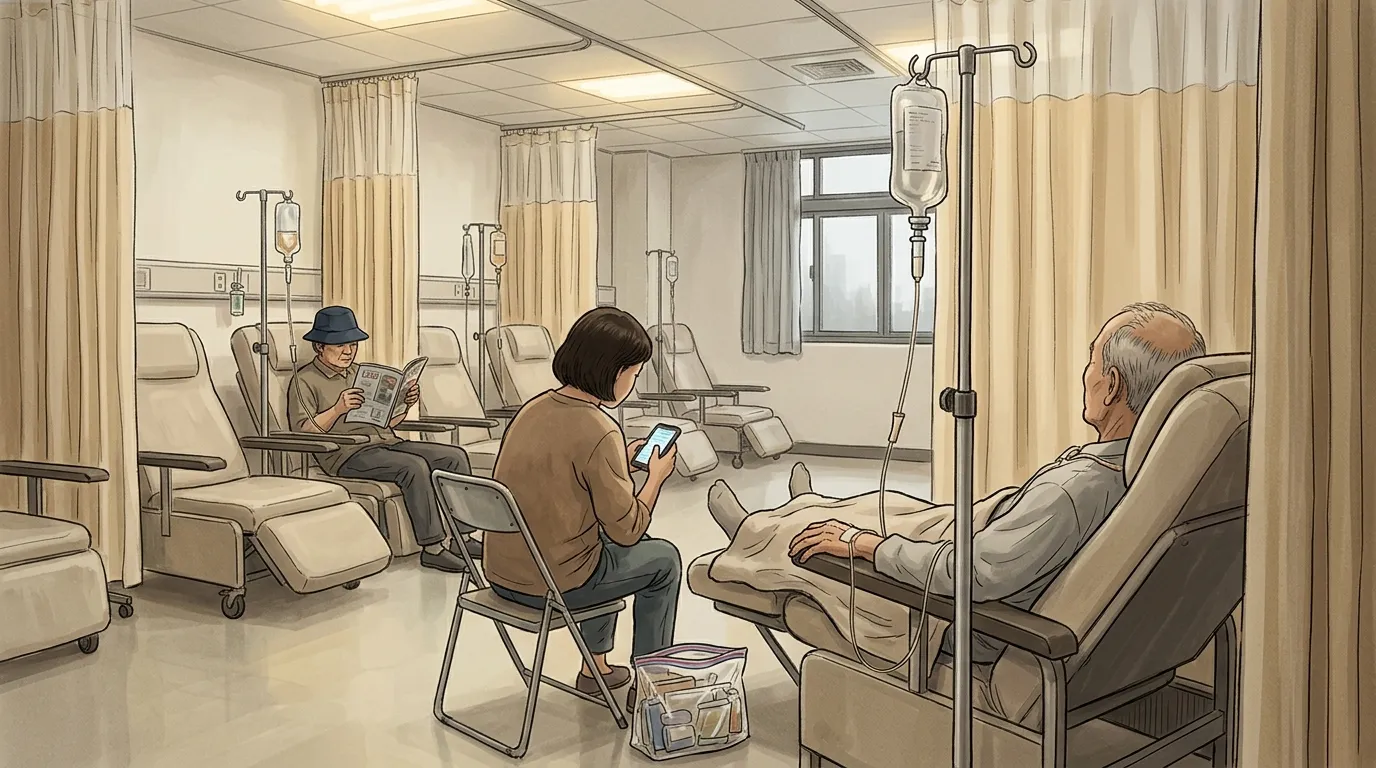
When Luo Tianxu went in, seven or eight people were already seated. An open space, maybe thirty-something square meters, chemotherapy chairs lined up in a row along two walls, each with a stainless-steel IV stand beside it. The chairs were divided by panels of off-white curtain, but most of the curtains were open — nobody actually wanted to close themselves in. The window seats were all taken.
A nurse led him to the third chair from the right. He sat. The upholstery was synthetic leather, cool. His daughter stood beside him and tucked the small blanket over his legs.
“Let me.”
“You don’t know how to put it on.” She folded the corners under the armrests, her movements as precise as someone packaging a sample unit for inspection.
The nurse began her preparations. She confirmed the implanted port under his collarbone — the Port-A, installed at his appointment two days ago, still covered with a transparent waterproof film. She disinfected, inserted the needle, secured it. Then she connected a small bag of anti-nausea medication and began pushing it through the line.
“This one will take about half an hour,” the nurse said. The badge on her chest read 何 — she looked to be in her early thirties, her movements economical and sure. “After that we’ll connect the chemotherapy drug, which takes longer — roughly three hours or so. During the infusion, if you feel any burning at the site, or any discomfort, press this button.”
She pointed to the call button on the armrest.
“Fine.” Luo Tianxu watched the IV bag, clear liquid dropping one drop at a time into the tube.
His daughter was already sitting on the folding chair beside him, phone open to the app. In the Today’s Log field she added a new entry: 10:02 — pre-chemo anti-emetic started. Her thumb paused on the screen, then added a note: Affect stable, no subjective complaints. She was recording his condition the way she would record quality parameters on a production line.
He glanced at her and said nothing.
Half an hour later, the nurse returned to change the bag. The new one was larger, the liquid inside slightly yellowish. The nurse adjusted the flow rate, confirmed the connection at the tube junction, and left.
The drug began moving into his body.
There was a faint swelling feeling beneath his collarbone — not pain, but an awareness that something was entering. He thought of a dam’s sluice gate — opened just a little, letting the water through slowly, controlling the flow. Except now he wasn’t the one controlling. He was the channel.
In the chair beside him sat a man who looked a few years older, wearing a dark-blue bucket hat pulled down low, though the brim couldn’t hide the bare scalp beneath. His IV was halfway finished. He was reading some sort of tabloid magazine.
“First time?” the bucket hat asked.
Luo Tianxu looked at him. “That obvious?”
“Brought a blanket.” The man gestured at his legs. “First-timers always bring a blanket. By your third or fourth round you’ll figure it out — bring a pillow. Holding your neck up for four hours hurts worse than the chemo.”
Luo Tianxu couldn’t keep his mouth from pulling into a slight curve. “Noted.”
“What’s yours?”
“Pancreas.”
The bucket hat let his mouth fall in a slow, judging arc, like a man assessing a wine. “Tough one. Mine’s lung. Stage three — this is my fourth round.” He turned a page of the magazine. “Four rounds in, I’ll give you one tip: find someone to talk to while they’re running the IV. Don’t watch the needle, and don’t close your eyes and think.”
“So you’re talking to me.”
“Look at that — you’ve already got it.”
Luo Tianxu laughed — not because anything was funny, but because this man reminded him of veteran workers on a construction site: men who’d been doing it for decades and turned every risk into a joke, because taking it seriously was too heavy a load to carry.
“Your wife?” The bucket hat tilted his chin toward the folding chair.
“Daughter.”
“Ah, daughters are good. Daughters pay attention. My wife drove me to my first round and came home more exhausted than me. I told her: forget it, I’ll take the bus myself from now on.”
Luo Tianxu glanced over at Wanqi. She was looking something up on her phone, brow faintly creased, thumb scrolling fast. Probably researching the side effects of the chemotherapy drugs. Or the side effects of the side effects. Or how to manage the side effects of the side effects.
“Is your daughter in medicine?” the bucket hat asked.
“Quality control.”
“That explains it.”
Luo Tianxu didn’t know what it explained exactly, but he understood.
About an hour later, Wanqi stood.
“I’m going to get coffee. What do you want?”
“Tea.”
“You can’t have tea — the caffeine —”
“Then why are you asking?”
She pressed her lips together. “I’ll get you warm water.”
“I won’t drink it.”
“I’ll get it anyway.”
She left.
Luo Tianxu waited until her back disappeared through the ward door, then counted to ten to be sure she wasn’t coming back. Then he reached into his jacket pocket and took out his phone.
He didn’t use his phone much. His contacts list wasn’t long — mostly names with numbers he’d stored but hadn’t called in a year or more. He scrolled through it, found the name he was looking for, and pressed call.
Three rings. Someone picked up.
“Hello.” A voice on the other end.
“It’s me. Tianxu.” He kept his voice low. Wanqi was gone, so there was no one he needed to hide from, but it was rude to speak loudly in a room where everyone had a line running into their arm.
The call lasted less than two minutes. Short sentences, with several pauses. At the end he said: “I’ll come by. Yeah. All right.”
He hung up.
He put the phone back in his pocket and leaned against the headrest. The pale yellow liquid in the IV tube was still falling, drop by drop.
The bucket hat lifted his head, looked at him for a moment, and went back to the magazine.
Five minutes later, Wanqi came back, a convenience store coffee in one hand and a bottle of mineral water in the other. She twisted the cap loose before handing the water over.
“What did you do?” she asked.
“What?”
“While I was gone.”
“Sat here.” He took the water and drank a sip. “What else was I going to do — go jogging with an IV in?”
She looked at him and didn’t press further.
They got home just after three in the afternoon. He went upstairs for a nap.
Luo Wanqi stood in the kitchen, rinsed out the thermos, and left it upside down on the drying rack. She put everything from the bag back in its place. The vomit bag hadn’t been needed — First time is usually fine, the side effects start kicking in after a couple of days, Nurse 何 had said. She had entered that sentence into the app as well.
Thuy Hang was mopping the living room floor.
“Thuy Hang.” Wanqi came out of the kitchen. “Dad just finished his first round. There are a few things to watch for over the next few days.”
Thuy Hang set the mop against the wall and stood straight, looking at her.
“First: keep meals liquid, you can slowly add soft foods starting tomorrow. Second: if he vomits, write down the time and how many times and call me. Third: if his temperature goes above thirty-eight degrees, take him straight to the emergency room.”
Thuy Hang nodded. “Okay. Food — I make congee?”
“I’ll prepare the food. You’re responsible for his lunch on the days I’m not here.”
“Okay.” Thuy Hang turned to pick up the mop.
“Thuy Hang.”
Thuy Hang stopped again.
“The congee should use a bone broth base, and go easy on the salt. The one you made last time —” she paused, choosing her words. “The flavor might need adjusting.”
What Thuy Hang had cooked last week had galangal and lemongrass in it — the taste she’d grown up with. Her father had taken one spoonful, then held his spoon suspended over the bowl, his face compressing in a way Wanqi couldn’t quite decode as disgust or confusion. He put the spoon down, said what is this taste, and then in silence ate the whole bowl.
“Okay. Bone. Less salt.” Thuy Hang’s voice carried no variation in tone. She picked up the mop and kept going.
Luo Wanqi stood where she was for two more seconds. Thuy Hang mopped in circular arcs, not straight lines the way Wanqi did it. She wanted very much to say straight lines are more efficient. She bit down on it.
She turned and went to her father’s bedroom door. It was closed. She pressed her ear to it — steady breathing, even. He was asleep.
She went back to her own room.
Four thirty in the afternoon. Her “free time.”
She sat at the desk and opened her laptop. Three tabs still open on the screen: long-term care subsidy application guidelines, a guide to managing chemotherapy side effects, an Excel spreadsheet — household monthly expenses. She closed the first tab, because she’d already read it. She clicked the second open, then closed it, because she’d already screenshotted everything on her phone. She stared at the Excel sheet for thirty seconds, the cursor hovering over the column labeled Projected Monthly Expenses. The number was 58,400.
She closed the laptop.
Free time. She didn’t know what to do with it. When she’d been at the company, her calendar was blocked out every half hour. Now her calendar was appointments, chemo, medication pickup. The gaps in between she couldn’t bring herself to label rest — because the moment she stopped, her mind would start turning, turning toward all the numbers she’d been holding down during the day.
She picked up her phone. Her former colleague Meiqi had sent a message that morning: Are you okay? Let me know if you need anything.
She typed Thank you, stared at it for five seconds, and deleted it. She typed I’m fine, and deleted that too. She put the phone down without replying to anything.
Seven in the evening. She assisted her father with his bath — not by bathing him, but by waiting outside the bathroom door. He insisted on doing it himself. She heard the water running, the occasional cough, one dull thud (he’d stepped on the threshold; he still hadn’t gotten used to the stainless-steel grab bar she’d installed last week).
Eight o’clock. She organized tomorrow’s medications. Filled every compartment in the weekly pill organizer, cross-referenced against the prescription, confirmed the count was right. She took a photo for the record.
Eight thirty. He was watching television in his room. She brought a cup of warm water and set it on the nightstand. He was watching the news and didn’t say thank you, but he reached over and took a sip. She translated that gesture as: received.
Nine o’clock. He went to bed.
Nine thirty. She got tomorrow’s things ready. Two more days’ worth of pumpkin soup in the freezer. She’d asked Thuy Hang to make the bone broth that afternoon. She opened the fridge to check. Thuy Hang’s broth was darker than Wanqi would have made it — she thought it over, decided she’d re-season it herself in the morning.
She knew what she was doing. She knew this was called micromanagement. Back at the company her colleagues had said it behind her back. But her team had the lowest defect rate in the department.
She closed the refrigerator.
Eleven o’clock. She lay down in bed. Eyes shut. Her body was exhausted; her mind refused to stop. She started running through tomorrow: up at five, blood pressure, breakfast, ten o’clock take Dad to the follow-up appointment to check blood-test results — no wait, the follow-up was the day after tomorrow. Tomorrow there was no hospital. What was tomorrow then? She thought about it. Days without a schedule were actually harder. At least when they were running to the hospital, every minute had a task.
One in the morning. She woke, walked to her father’s door, pressed her ear to the wood. Breathing. Asleep. Good. She went back to lie down.
Three twenty in the morning. Awake again. She walked back to listen. Asleep. Good.
She went to the bathroom.
She closed the door and turned the tap all the way open. Water hammered the tiles, white noise. She sat on the lid of the toilet, elbows on her knees, face buried in her palms.
She didn’t cry for long. Maybe thirty seconds — she kept track, the way you time something on a factory floor. When the thirty seconds were up she stopped. She wiped the corner of her eye with the back of her hand, breathed in twice, deep to the bottom of her lungs, let it out slowly.
She turned off the tap. Opened the door.
There was a shape in the dark hallway. She startled.
Thuy Hang was standing in the corridor, holding a cup of water. She’d probably been on her way to the kitchen.
The two of them looked at each other for a moment.
Thuy Hang held the cup out. “Water. Drink.”
Luo Wanqi took the cup and drank. It was warm. Thuy Hang’s water was always warm — neither hot nor cold, the same way she was: calibrated to exactly the right measure for whatever was needed.
“Thank you.”
Thuy Hang nodded, turned, and went back to her corner of the living room — the spot she’d chosen herself, saying she could hear any sounds from Uncle’s room in the night from there. She didn’t ask anything further.
Luo Wanqi stood in the bathroom doorway, cradling the warm cup, watching Thuy Hang’s small figure disappear into the dark of the living room.
It occurred to her that she didn’t know what time Thuy Hang went to sleep each night. She didn’t know what Thuy Hang thought about when she was in this house. All she knew was that Thuy Hang put too many spices in the congee and didn’t mop in straight lines.
She finished the water, set the cup on the sink, and went to bed.
The following evening. The day had passed in medication, temperature readings, soup reheating, and wiping down the table — almost identical to the day before.
Thuy Hang had made congee.
Bone broth base, less salt, no galangal, no lemongrass. She had stood at the counter stirring for the better part of an hour until the texture matched what she’d learned this family wanted. Then she ladled it into a bowl and carried it to the table.
Her father sat at the head of the table — always, even when there was only one person eating. Wanqi sat to his right. Thuy Hang’s bowl was at the seat closest to the kitchen.
“Thuy Hang,” he said, after two spoonfuls, his expression considerably improved from last time. “You’re getting better.”
Thuy Hang kept her head down. The corner of her mouth moved slightly. “Thank you, Uncle.”
“But it’s still missing something.”
Thuy Hang looked up at him.
“Taiwanese congee,” he said, setting his spoon down with great seriousness, as if explaining an engineering problem, “the most important thing is that the rice has to bloom. If it doesn’t bloom, it’s just watery rice, not congee. Yours —” he took another spoonful. “Half bloomed. Passing grade.”
“Bloom?” Thuy Hang’s expression was genuinely puzzled.
“The rice grains cook until they break apart and open. That’s what blooming means.”
Thuy Hang frowned slightly, as though translating the phrase in her head. Rice. Bloom. She moved her mouth — that particular expression she made when Mandarin struck her as strange.
“Uncle,” she said. “Rice is rice. Flower is flower. Together how?”
“Hm, that’s — you know, you’ve got a point there.” He looked thrown for a moment.
Wanqi kept her head down and ate her congee, staying out of it.
“Okay, tell you what —” He suddenly brightened. “I’ll teach you a phrase in Taiwanese. One you use at mealtimes.”
Thuy Hang sat up a little straighter.
“Jia̍h-pá bē.” He said it slowly.
Thuy Hang blinked. “Ja… pa… may?”
“Jia̍h-pá bē.” He said it again, slowing down each syllable.
“Ja — pa — may?”
“Bē, not may. It’s bē.”
Thuy Hang scrunched her whole face with great concentration, lips pouting as if she had a large hard candy in her mouth that wouldn’t quite dissolve.
“Ja — pa — … ueh?”
He stared at her for two seconds. Then he laughed.
Not a polite laugh. The kind that came up from his chest — uncontainable, breathed through, his shoulders shaking.
Thuy Hang startled first, then laughed too. She wasn’t entirely sure what she’d gotten wrong, but Uncle was laughing, and Uncle hadn’t laughed much lately, so she laughed with him.
Luo Wanqi looked up at them. The way her father was laughing made something surface from a very long time ago — when she was a child, when her mother had made some dish too salty, and her father had taken one bite with his face compressing in on itself, and then her mother had laughed, and then she and her brother had laughed. All four of them at the dining table, going to pieces over a dish that was too salty.
The corner of her mouth moved.
“Jia̍h-pá bē,” he said again, still laughing, gesturing with his hand. “It means: have you eaten your fill? Taiwanese people say it as a greeting.”
“Jia̍h-pá bē!” Thuy Hang called it out at full volume, every tone wrong, sounding like someone calling a dog’s name.
He laughed again. This time Wanqi didn’t manage to hold it — the corner of her mouth went up.
Then he coughed.
One short cough, and then a second, a third. They came one after another, like an engine trying to start and failing and trying again. His body bent forward, one hand gripping the edge of the table, the other over his mouth.
The laughter stopped. The table went suddenly quiet — only the faint last ring of chopsticks touching a bowl’s edge.
Thuy Hang’s chopsticks stopped in midair.
Luo Wanqi’s chair scraped back; she was on her feet before she’d consciously made the decision. She went around to her father’s back and put her palm between his shoulder blades — not hard, not soft, the patting technique she’d looked up online.
“Don’t —” he forced out between coughs.
She didn’t stop.
“I said don’t.” He pulled in a long breath and the coughing gradually eased. “I’m not coughing to death.”
No one moved.
Thuy Hang looked down.
Luo Wanqi’s hand rested on his back. She could feel his spine through the cotton of his pajamas — the vertebrae, one by one, more prominent than she remembered.
She pulled her hand back.
“I’ll get water.” She went into the kitchen.
She filled a cup at the tap. She stood at the counter, back to the table. The cup was full, but she didn’t turn around. She watched the water surface go from trembling to still.
After a few seconds she carried the cup out. Her face had nothing on it.
He wasn’t coughing anymore. He’d picked up his spoon and was eating his congee again, as if nothing had happened. Thuy Hang was eating too. The table returned to its ordinary sounds — chewing, spoon against bowl, the occasional swallow.
“Full.” He pushed his bowl forward and stood.
He went to the living room and turned on the television. The news was doing tomorrow’s weather.
Deep night.
Luo Wanqi had gone to bed at eleven thirty and drifted off sometime after one.
In the corner of the downstairs living room, Thuy Hang lay on her fold-out mattress under a thin blanket, eyes closed but not yet all the way asleep.
She heard the staircase.
Very light footsteps. Someone coming down.
She opened her eyes a crack. No lights on in the living room, but the streetlight outside came through the mesh curtain and broke the floor into pale orange squares.
A shadow appeared at the foot of the stairs.
Luo Tianxu. He had on a thin dark jacket, and on his feet were the shoes he wore outdoors — not his slippers. His movements were very deliberate, as if he were managing the sound of every step.
When he passed through the living room he saw Thuy Hang’s fold-out mattress.
He stopped.
Thuy Hang didn’t move. She kept her breathing at the pace of sleep — slow, deep, even.
But her eyes were half open.
He noticed. He saw the faint reflected light in her eyes in the darkness.
The two of them faced each other across the living room, in silence, in the middle of the night.
Luo Tianxu raised one finger to his lips.
Thuy Hang gave the faintest nod. Almost imperceptible.
He turned toward the entryway. The front door opened and closed, very softly.
Thuy Hang lay on the fold-out mattress looking at the ceiling. From somewhere outside she could just make out the sound of footsteps receding.
She didn’t know where Uncle was going. Past one in the morning, a man who had just finished his first round of chemotherapy, jacket on, outdoor shoes, walking out alone.
She thought about whether to call for Miss Luo.
She didn’t call.
Uncle had made the shh sign.
She pulled the blanket a little higher and closed her eyes.