Chapter 3
The List
He could drive this road from Changhua city to Huatan with his eyes closed.
Luo Tianxu pulled the car over at the mouth of the alley, killed the engine, and glanced at the dashboard clock. Ten forty-two. He was eight minutes earlier than he’d calculated — Changhua’s roads had no traffic to speak of, nothing like Taichung’s constant snarls. He stayed in the driver’s seat and didn’t get out right away. He leaned his back against the seat, but the position pressed the Port-A line into something, and he shifted until he found an angle that didn’t sting.
He looked down at his feet.
Dress shoes. Black, slightly pointed at the toe, a stitched seam along the side. He hadn’t worn them in at least five years — after he retired there was no occasion for dress shoes, and they’d sat in the top shelf of the shoe cabinet in their box, collecting dust. This morning he’d been up before five, and while the sky was still making up its mind about whether to lighten, he’d taken them down, dampened a cloth, and wiped them clean.
The leather had fine cracks now. But it would hold.
He opened the car door. December in Changhua was as cold as Taichung, but the wind was different — flat plains, no shelter, the air funneling straight under his collar. There was a smell, somewhere between paddy fields and drainage ditches. Both sides of the alley were three-story townhouses, the walls mottled, bedsheets and quilts hung out to air through the iron-grated windows. He walked about forty meters down the alley and stopped in front of a house with a blue iron gate.
The gate was half open. A sweet olive tree stood in the yard.
He stood outside the gate and studied the tree for a few seconds. It was shorter than he remembered — no, that wasn’t right, it had grown; the trunk was taller, just the branches and leaves were less full than before. There was a groove worn into the main trunk where a rope had dug in — someone had lashed a support brace during typhoon season. The olives weren’t blooming; wrong time of year. But there was a faint sweetness in the air, either drifting over from somewhere else or something he was making up.
He breathed in.
Then he pushed open the gate and walked through. His dress shoes made a clean, crisp sound against the concrete — that particular sound of leather on hard ground, completely unlike slippers, completely unlike sneakers.
“Anyone home.” He called it out as a statement.
From inside came the scrape of a chair, then the slap-slap of sandals approaching. The screen door swung open, and a bald old man stood in the doorway.
Hong Miantong had lost weight. The last time they’d met — more than twenty years ago — his face had been round; now it had gone long, the flesh on both sides of his jaw deflated, like a balloon going slack. But his eyes hadn’t changed. That pair of eyes still held their permanent air of I’ve got you figured out.
The two of them sized each other up across three meters.
“You’ve gone bald,” Luo Tianxu said.
Hong Miantong blinked. “You’ve gotten old.”
“Likewise.”
A few more seconds of silence. Hong Miantong’s gaze traveled from his face to his shoes and back up. “You came to my house in dress shoes. Somewhere you’re heading to afterward?”
“That’s right. Passing through.”
“What’s there to pass through in Huatan.”
“Came to see if that sweet olive tree of yours had died.”
The corner of Hong Miantong’s mouth twitched. That twitch Luo Tianxu knew too well — from thirty-odd years ago, when they’d been running construction sites together at the Water Resources Agency, every time he said something that landed, Miantong’s mouth would do exactly that, like a small electric jolt.
“The tree is fine, thank you.” Hong Miantong stepped back and pulled the screen door open. “Do you want to come in.”
He said it the way he used to run site meetings — flat, declarative, already expecting the answer.
Luo Tianxu slipped off his dress shoes and left them at the door, taking the blue-and-white flip-flops Hong Miantong handed over. The sandals were too large; his feet slid around inside.
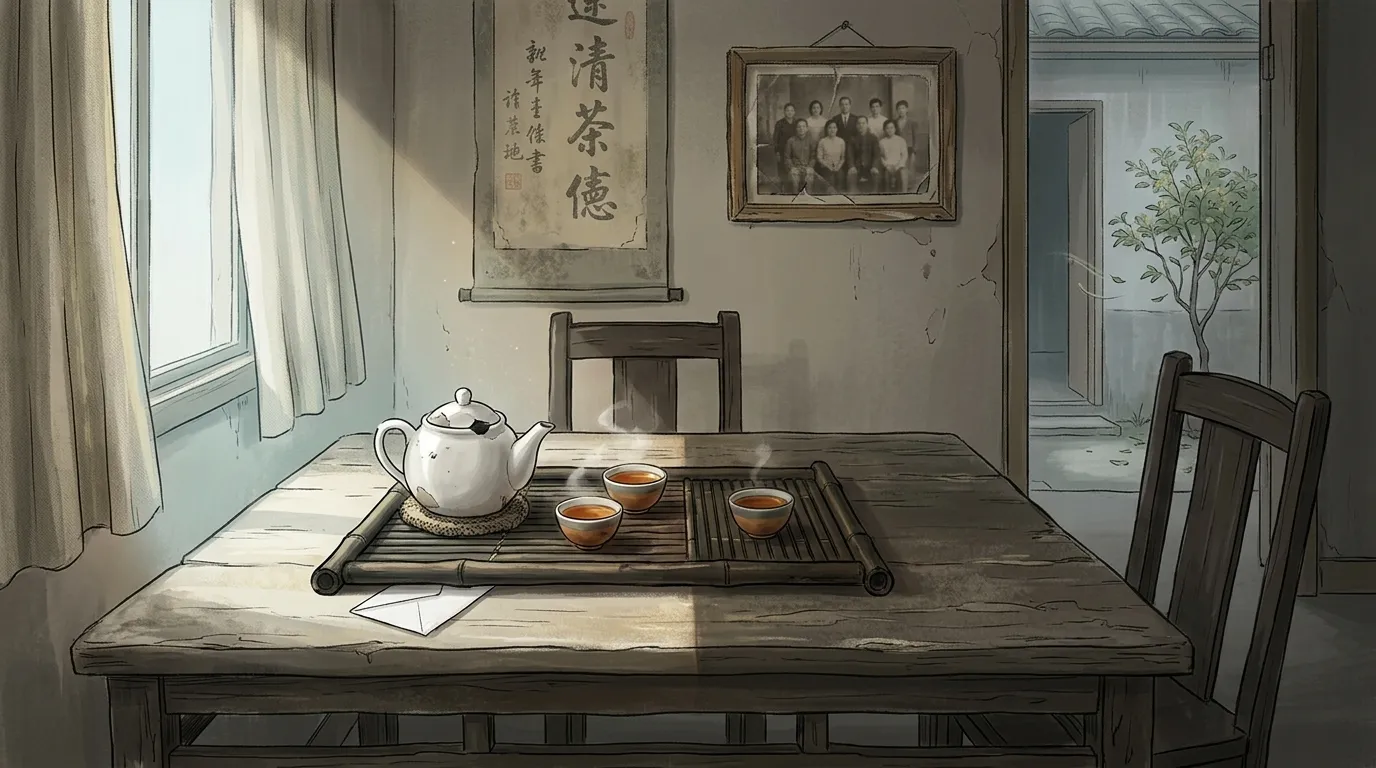
The sitting room was dim. The curtains had been pulled only halfway, and light coming in from the right divided the old square dining table into one half bright and one half dark. On the table sat a set of tea things — a white porcelain pot, several cups, a bamboo tea tray. The pot was cool to the touch; not freshly brewed.
“Sit.” Hong Miantong indicated a wooden chair beside the table.
“Your tea set looks the same as it did thirty years ago.”
“If it’s not broken, why replace it.”
“The lid has a chip.”
“That’s from when you knocked it.”
Luo Tianxu didn’t deny it. He did remember — one of the times they’d been drinking tea at Miantong’s place and gotten into an argument, he’d set the lid down hard and the rim had cracked off. What they’d argued about he couldn’t recall exactly, probably something to do with an engineering project. They’d both still been at the Agency then — he in design, Miantong in construction. Their projects crossed constantly, crossing meant arguing, and after arguing they’d go out together for a lamb hot pot.
Hong Miantong began to brew tea. Slowly, each step unhurried. Boiling the water, warming the pot, measuring the leaves. His hands had aged too — knuckles swollen, the skin spotted with sun damage. But his pour was steady, the stream of water unbroken.
“When did you retire?” Hong Miantong asked.
“Eight years ago.”
“And what do you do with yourself?”
“Nothing much.”
“You? Nothing?”
“Watch television. Water my plants. Go fishing now and then.”
Hong Miantong discarded the first steep and started the second. “Sounds like you’re spending your old age properly.”
“What else is retirement for.”
“I grow guava.” Hong Miantong said this in the tone of a man reporting a military citation. “Pearl guava, two harvests a year. At the farmers’ association competition last time, I placed third.”
“Third.” Luo Tianxu repeated this in the voice of an engineer evaluating data.
“Last year I was fifth. This year I moved up.”
“They have competitions for guava.”
“They have competitions for everything.” Hong Miantong pushed a teacup across to him.
Luo Tianxu picked up the cup and drank. Oriental Beauty. The liquor was deep-colored, a honey fragrance. He set the cup down.
Silence.
Two men in their late sixties sitting on either side of an old dining table, drinking tea. In the sitting room nothing moved except the occasional wisp of steam from the pot. On the wall hung a faded piece of calligraphy: Step back and the sky and sea open wide. Beside it was an old photograph — a group of people standing in front of a dam for a group portrait, hard hats worn crookedly or not at all, one person with a cigarette dangling from his lip.
“That photograph.” Luo Tianxu tilted his chin in its direction.
Hong Miantong followed his gaze. “Spillway repairs at Shimen Reservoir. 1989.”
“I’m in it.”
“You’re in the back. The short one.”
“I’m not short. You’re just tall.”
Hong Miantong drank again. When he set the cup down, his fingertip rested on the rim for a moment.
“You really just passing through?”
Luo Tianxu didn’t answer at once. He watched the last mouthful of tea in his cup, the leaves turning a slow circle at the bottom, settling.
“I had a follow-up appointment at Taichung Veterans General. Came around this way on the way.”
Hong Miantong looked at him. Those sharp eyes had gone a little quieter. “Follow-up for what?”
“Routine checkup.”
Miantong didn’t push. He poured the third steep, still slowly, as if stalling.
“You’ve lost weight,” he said.
“I was always thin.”
“Thinner than that.”
Luo Tianxu raised his cup. As he brought it to his lips he caught the scent of sweet olive — drifting in from the yard on a shift in the wind. He drank, set the cup down.
“Miantong.”
“Mm.”
“1992.”
Hong Miantong’s hand went still. He had been reaching for the pot to pour, and the chipped corner of the lid was pointing directly at Luo Tianxu.
“That money,” Luo Tianxu said.
The air seemed to thin. The sitting room went so quiet he could hear the leaves of the sweet olive tree in the yard susurrating under the wind.
Hong Miantong set the pot back on the tray. His lips pressed together.
- The year his son was born, when his wife had spent two months in the hospital — the insurance wasn’t enough, the household couldn’t manage. Luo Tianxu had lent him money with no promissory note, saying pay me back when you’re on your feet. What happened after was complicated — an irrigation channel project they’d collaborated on ran into trouble, a dispute arose over the supervision report, and the question of who bore responsibility dragged on for half a year. By the time it was over, both of them felt certain the other was at fault, and neither had said another word to the other since.
The money had never been mentioned. It hadn’t been forgotten — it simply couldn’t be raised. Raising it meant admitting you owed the other man something, and at that point both of them were convinced the other one owed them more.
“That money doesn’t need to be paid back.” Luo Tianxu’s voice was as level as if he were reading out an engineering figure. “It never did. I came here today to say so. So you don’t have to carry it to your grave.”
Hong Miantong stared at him for a long time.
“I wasn’t going to carry it to my grave.” His voice was a little rough.
“Good.”
Silence again. This silence was different from before — the earlier one had been the measured space between two old men testing each other; this was what remained when something had finally come loose.
“I brewed too much tea. You’ll never finish it, and it’ll go to waste.” Hong Miantong stood and headed toward the kitchen.
“Where are you going.”
“To get biscuits. You’re too thin. Eat something.”
Luo Tianxu watched his back disappear through the kitchen doorway. He reached into his inner jacket pocket and took out an envelope — white, unsealed, no name on it. He placed the envelope on the table and pressed it under the bottom of the teapot.
He stood, and put his dress shoes back on. Faster than when he’d come in.
Hong Miantong came out carrying a plate of pineapple cakes and found him already standing in the doorway.
“Leaving already?”
“Yes. I have things to do in Taichung.”
Hong Miantong looked at the table. The corner of the envelope was visible beneath the teapot.
“What did you leave?”
“Nothing much. You’ll see.”
“Tianxu.” Hong Miantong said his given name, and the word suddenly had weight.
Luo Tianxu turned. The two of them stood at the threshold, in the line where the inside light met the outside — one on the inside, one already out.
“Won’t you stay a little longer?”
“No.”
He walked out through the iron gate. Dress shoes on concrete: tap, tap, tap.
From behind him came the sound of the iron gate swinging open. Hong Miantong came out after him, holding a red plastic bag, stuffed full.
“Guava. First harvest of the year.” He pressed the bag into Luo Tianxu’s hands.
Luo Tianxu took it and hefted it. Heavy.
“Third-place guava,” he said.
“You eat one and tell me if it’s good.”
“Fine.”
He carried the bag of guava to the mouth of the alley. He didn’t look back. But he walked slower than he had coming in, as if the dress shoes had somehow gotten heavier underfoot.
He got in the car and put the guava on the passenger seat. Before he started the engine he sat behind the wheel for a moment.
He remembered what was in the envelope — some banknotes, and a slip of paper. On the slip he had written one line: Loaned in 1992. Late returning it. Interest waived.
Miantong would find it. Once he found it, that was enough.
He started the engine and drove out of the alley. In the rearview mirror, the house with the blue iron gate shrank to a small square and then was gone.
When Luo Wanqi woke at eight o’clock that morning, she knew something was off.
No alarm had gone off, no phone rang, nothing had fallen, no one had called her name. Just a quiet wrongness. She lay in bed staring at the ceiling, at the streetlight stain she couldn’t see in daylight but knew was there, and felt something gnawing in her mind — like a sensor on a production line, the reading still within range but the waveform slightly wrong.
She picked up her phone. Seven fifty-four.
She sat up. This was the first time in more than two weeks she’d slept more than six hours. It had nothing to do with feeling better — yesterday had simply exhausted her all the way through: she’d organized his medications until ten the previous night, cross-checked the post-chemo diet table again, and didn’t actually lie down until one in the morning.
She went downstairs.
The kitchen was empty. Thuy Hang wasn’t there. Her fold-out mattress had already been rolled and put away, the bedding folded neatly against the wall. On the kitchen counter was a glass of water, and beside it her father’s morning pill organizer — today’s compartment was already open.
She looked at the organizer. All three pills were gone. Taken.
She went to her father’s bedroom door. Open, the bed made but unoccupied. The bathroom, too.
“Dad?” She walked to the study doorway. “Dad?”
No answer.
Her phone went off — a reminder she’d set herself. 09:00 blood pressure. She swiped it away.
She opened the CareNote app. Today’s entry column was blank. Under the medication row she hesitated, then typed: Taken (self-administered).
“Thuy Hang.” She went to the sitting room. Thuy Hang came in from the small balcony off the kitchen, a drying pole in her hands.
“Where’s Uncle?”
Thuy Hang leaned the drying pole against the wall. “Uncle went out.”
“Out? Where?”
“Don’t know.” Her tone was even. “Morning. Very early.”
“How early?”
“When it got light.”
Wanqi’s brow tightened. She picked up her phone and called her father’s number. Six rings. No answer. She hung up and called again. Voicemail.
She stood in the middle of the sitting room, phone pressed to her ear, listening to the automated message. Her mind was moving fast — Day ten post-chemo. Low point of the white blood cell count. Dr. Fu had said it clearly: during peak immunosuppression, avoid crowded places. Her father had gone out alone. Where? And why without telling anyone?
She thought about calling Dr. Fu’s nursing station — but what would she say? My dad went out? He hadn’t gone missing. She thought about driving out to look for him — but in which direction? She didn’t know where he’d gone.
She put the phone down and walked to the entryway.
The shoe cabinet.
She crouched and looked at the top shelf. The box that usually sat there was still in place — but the lid was askew. She opened it. Empty.
She knew those shoes. Black dress shoes, slightly pointed at the toe. He hadn’t worn them since he retired.
She replaced the box lid and stood.
Dress shoes. This wasn’t a just going for a walk kind of outfit. She didn’t know where her father had gone, but she knew this was not a casual errand.
She called once more. Voicemail.
She went back to the sitting room and sat down. From the kitchen came the sound of Thuy Hang chopping something, the knife against the board steady and rhythmic.
Waiting. There was nothing else to do.
She picked up her phone, scrolled twice, put it down. Picked it up again, checked the time. Eight twenty-three.
She started calculating — he’d left at first light, so around six. That was nearly two and a half hours ago. Two and a half hours by car: Nantou, Changhua, Miaoli. Or maybe he hadn’t taken the car at all, maybe he’d walked somewhere nearby. But you didn’t walk somewhere in dress shoes.
Her foot tapped against the floor without her noticing.
Eleven forty-six.
The key turned in the lock. The front door opened.
Luo Tianxu came in. There was a thin sheen of sweat on his face, his hair slightly disheveled. In his right hand he held a red plastic bag; his left hand was working at the buttons of his coat.
“Where have you been?”
Her voice came out louder than she’d intended. She was on her feet faster than she’d intended.
Her father put the plastic bag on the shoe cabinet and bent to take off his dress shoes. Slowly, as if deliberately stretching the time before he had to answer.
“Out to see to something.”
“See to what?”
“Something that’s none of your business.” He fit the shoes back in their box without straightening them.
“Dad, it’s day ten post-chemo —”
“I know what day it is.”
“Your immune system is at its lowest. You can’t just go running off. Dr. Fu said —”
“I know what Dr. Fu said.” He moved past her toward the kitchen. “Thuy Hang, is there rice?”
Thuy Hang’s voice came from the kitchen: “Yes. Soup and congee.”
“Congee is fine.”
Luo Wanqi stood where she was. Her hand gripped the phone, the knuckles going white. She was holding back. Her way of holding back was to close her mouth for three seconds, run what she was going to say through her mind, and cut out anything that came from emotion rather than fact.
“You weren’t picking up your phone.”
Her father had already reached the kitchen doorway. He stopped, but didn’t turn. “Didn’t hear it.”
“All three calls?”
“The car was too noisy.”
The car. So he’d driven somewhere. She filed that away.
“You were wearing dress shoes,” she said.
That sentence made her father’s back stiffen — very briefly, barely a second, and then he kept walking into the kitchen.
“My feet hurt. The sneakers were rubbing.”
The excuse was transparently hollow; she knew it immediately. Sneakers were rubbing so he put on dress shoes he hadn’t worn in five years? She wanted to push back, but by then her father had already sat down at the kitchen table and Thuy Hang was ladling the congee.
She didn’t press. She had no illusions that pressing would get her anywhere. Once her father decided not to say something, no force in the world would pull it out of him.
She remembered everything instead. Dress shoes. The car. Three unanswered calls. An errand he’d left before dawn to see to. And that red plastic bag — she hadn’t asked what was in it yet, because larger questions had crowded to the front, but she’d noticed it.
The fragments didn’t yet form a picture, but they had been filed away into a folder somewhere in her mind. She would come back to them.
Her brother arrived at three in the afternoon.
When the doorbell rang, Luo Wanqi was in her father’s room organizing his medications — the follow-up appointment was in two days, and she was going through the prescription to confirm how much of each remained. The bell sounded twice. Before the third ring finished, she heard Thuy Hang go to open the door.
Then a voice she knew very well: “Thuy Hang — wow, look at you, have you lost weight?”
She set the pill organizer down.
By the time she came to the sitting room, Luo Wanyang was already taking off his shoes. He had on a navy polo shirt, khakis, white casual shoes. He looked as if he’d stepped directly off a weekend brunch and onto the high-speed rail south. He was carrying two paper bags — the larger one printed with the logo of an organic food store, the smaller one indeterminate.
“Sis.” He looked up and saw her, and smiled. She knew that smile — his standard sales smile, the corners of his mouth lifted exactly the right amount, eyes slightly narrowed, projecting warmth without intimacy.
“You came back.”
“Of course. To see Dad.” He set the bags on the floor. “I told you a few days ago, don’t you remember?”
She hadn’t forgotten. Last week he’d sent a message: Coming back this weekend to see Dad. She’d replied Okay. She’d assumed he would cancel.
“Dad’s in his room,” she said.
“Right, I’ll just —” He glanced at both bags, bent down and opened the larger one. “I brought some things. This is fucoidan, imported from Japan, excellent reviews online. This is curcumin, organic. And then this —” He produced a stack of A4 pages from the smaller bag, held together with a binder clip. “I printed some information — the latest results from an immunotherapy clinical trial, and a targeted drug from the US side, just cleared phase three.”
He held the stack of papers out toward her, the way you’d present a product briefing.
Luo Wanqi looked at the papers.
Then she looked at her brother.
Then she said: “Kitchen.”
The tone was wrong. Luo Wanyang caught it. He gathered the papers and followed her in.
She didn’t close the kitchen door — closing it would alert their father. But she kept her voice very low.
“Fucoidan.” She took the bottle from him and turned it over to read the ingredients label. “Do you know what this costs?”
“Around two thousand.”
“Two thousand eight hundred. One bottle lasts twenty days. That’s over four thousand a month. Do you know what we’re spending per month right now?”
“I know, I’ve been wiring —”
“You wire twenty thousand. Chemo, the caregiver, nutritional supplements, out-of-pocket medications, transportation, utilities. Fifty-eight thousand. Your twenty thousand doesn’t cover a third of it.”
Her voice was held in check. Barely — her throat was tight, and every word had been turned over in her mouth before she released it.
“And then you come back with fucoidan and curcumin.” She set the bottle on the counter. Her voice didn’t rise, but it sharpened by one register. “And a stack of printed pages. Immunotherapy. Phase-three clinical trials. You looked these up on the high-speed rail, didn’t you.”
Luo Wanyang said nothing. He was still holding the papers, and the metal binder clip turned between his fingers.
“Dad’s attending physician is Fu Jingming. Hepato-gastroenterology at Taichung Veterans General. Have you ever called him? Have you ever gone to ask which drug options have already been evaluated? Do you know what Dad’s genetic test results showed, or whether targeted therapy is even applicable?”
Her questions came rapid-fire, like a quality audit — every question had a correct answer, and she knew her brother couldn’t answer any of them.
“Sis —”
“You brought things back.” Her voice suddenly went quieter, and that quietness was more dangerous than sharpness. “You brought back a two-thousand-eight-hundred bottle of fucoidan. And now you feel like you’ve done something.”
“I didn’t —”
“You did. You always do this. Bring things back, stay two hours, take the high-speed rail home. The massage seat pad, the organic grain powder — every single one of them was something you ordered off your phone on the train. You don’t even know how many pills Dad takes every day.”
“Seven.” Luo Wanyang said.
“What?”
“Seven. Three in the morning, two at noon, two before bed.”
His voice was very quiet. He was keeping himself in check too.
Luo Wanqi paused. She hadn’t expected him to answer.
“You asked Thuy Hang?”
“I asked you. You texted me last week.”
A brief silence. The kitchen tap was dripping — irregular, uneven.
“What does knowing the number do.” Her voice dropped further. The low was exhaustion pressed thin. “Have you seen his face when he swallows those seven pills? Have you seen what he looks like after chemo, when there’s nothing left to bring up but stomach acid? Have you —”
She stopped. Because she heard her own voice beginning to shake.
She breathed in hard, pressed it back down.
“You wire twenty thousand a month.” She said it flat. Her throat tightened; the pitch came back under control. “When did you last come home?”
Luo Wanyang said nothing.
He looked down at the papers. The binder clip had been turned crooked.
“You don’t have to answer.” She said. “Three weeks. Once since the diagnosis, three hours. Today is the second time.”
“Sis, my work —”
“I have work too.”
The sentence landed, and Luo Wanyang’s mouth closed.
She looked at his face. Mouth shut, jaw tight, eyes sliding sideways — she knew that expression. As a child, when their mother scolded him to silence, he’d looked exactly this way. She had quit her job — nine years as quality-control manager — and quit without hesitating. He had not quit. Forty-five minutes on the high-speed rail from Taipei to Taichung, and every time he made it sound like crossing the Pacific.
His mouth opened, then closed. She waited two seconds. Nothing came out. The man who could talk a client into a signed contract was standing in this kitchen without a single usable word.
“What’s all this.”
The voice came from the kitchen doorway.
Luo Tianxu was standing there, one hand on the doorframe. He had on his house clothes, his feet in slippers, his hair slightly flattened on one side — he’d probably been lying down.
Both of them turned at once.
“Nothing.” Wanqi spoke first.
“Dad.” Luo Wanyang’s voice shifted immediately — from the blocked, heavy silence of a moment ago to a manufactured lightness. “I’m back. I brought —”
“I heard.” Their father walked into the kitchen, moving around both of them, opened the refrigerator and took out a bottle of water. “Fucoidan something-or-other. And curcumin.”
He shut the refrigerator and leaned against the counter, twisted the cap off and drank.
“Those things you brought,” he said, looking at his younger son, “are they going to do more good than the chemo?”
”…Those are supplementary —”
“Supplementary.” Their father repeated the word as if reading from an engineering report that didn’t meet spec. “Your company uses that word too when you’re selling equipment, I imagine. When the main product isn’t up to it, you add in a supplementary solution.”
Luo Wanyang’s mouth opened. No sound came out.
“You came back, that’s what matters.” Their father set the water bottle on the counter. “Don’t argue in the kitchen. I’m not dead yet. My ears still work fine.”
He walked out.
The siblings stood where they were. Luo Wanyang’s eyes had reddened, but he was holding it in. He turned his face toward the window, jaw clenched, lips pressed tight. His fingers were picking at a piece of hardened skin at the edge of his right thumb — a callus beside the nail, a habit he’d had since primary school, something he did under pressure until it bled.
Luo Wanqi looked at the side of his face.
She wanted to say something. Maybe you don’t need to bring all these things, maybe come back earlier next time, maybe something softer, something more like a sister than a quality-control manager.
She didn’t.
She picked up the fucoidan bottle from the counter, opened the cupboard, and placed it on the top shelf — alongside the organic grain powder, the vitamin D3, the fish oil from the visits before. A whole row of them, every package unopened.
She closed the cupboard.
Deep in the night, past midnight on the sitting room clock.
Luo Tianxu waited until the footsteps upstairs had gone completely quiet before he got up. He’d listened for twenty minutes — his daughter’s bedroom door had closed, the sound of the shower had stopped, and finally there was silence. His son had left that afternoon after a little over two hours, something about a client to deal with tomorrow. His daughter hadn’t tried to keep him.
He turned on the study lamp.
He opened the desk drawer; the key was under the pen holder. He had to feel around for a few seconds before he found it — the pen caps were much the same shape as the key, and his fingertips needed a moment to tell them apart.
He opened the notebook.
He turned to the first entry. Looked at it. Then he reached into his pocket, took out a ballpoint pen, and drew a line beside that row of text.
Not a checkmark. A horizontal line, left to right, drawn steadily across it.
First item. Done.
His mouth didn’t move. No expression that said relieved. He simply looked at the line for two seconds, then turned the page.
Second item. He studied it for a moment, then began writing notes beside it. The characters were small — timing, approach, details of the kind. He wrote slowly; the pen tip stopped now and then, pausing to calculate. He had done forty years of engineering. Every step was thought through before you moved.
He wrote for perhaps ten minutes. Then he put the pen down.
He turned the pages toward the back, past the third and fourth entries — both still with blank margins — until he reached the last page.
The last item.
A strip of tape had been fixed over that line of text. Semi-transparent, as if placed there on purpose to obscure it. His fingers paused when he began to peel it back, and then he pressed it flat again.
He looked at the blurred text beneath the tape. His expression was difficult to read — grief would be the wrong word, fear the wrong word. It was something with weight, like hefting a very heavy stone to look at the mud beneath, and then putting it back.
His eyes narrowed slightly. His lips pressed together, very slightly.
Then he closed the notebook, replaced it in the drawer, and locked it.
He sat at the desk for a while. The desk lamp lit his hands — the veins on the backs of his hands stood out more prominently than three weeks ago, the blue beneath the skin like tributaries of a river.
A soft sound at the doorway.
He looked up.
Thuy Hang stood in the study doorway, holding a cup of water. She had on her pajamas, her hair down, looking younger than she did in the daytime. Her footsteps had been very light — she was always the quietest person moving through this house.
The two of them looked at each other for a moment.
Thuy Hang walked in and set the cup on the desk. The water was warm. She stepped back, standing one arm’s length from the desk.
She didn’t ask what he was doing there. She didn’t ask why he hadn’t gone to sleep. She only set the water down.
Luo Tianxu looked at the cup. On the outside of the glass, a very thin mist had condensed.
“Thuy Hang.”
“Mm.”
He hesitated. Hesitating was not an expression he was accustomed to — most things in his life had not required hesitation; he judged, then acted. But now his mouth opened and closed, the way you do when you’re calibrating a word you’re not sure you’re pronouncing correctly.
“Terima kasih.”
He said it slowly. Each syllable held in the mouth for a beat before he released it. The tones were off, but every syllable was there.
Thuy Hang froze.
She had been in this household for nearly two years, and she had never once heard anyone here speak a word of her mother tongue. Mandarin, Taiwanese, the occasional English word — those were this house’s languages. Indonesian was hers alone: the songs she hummed over the dishes, the words she spoke into the phone when she called home, the fragments that surfaced in her mouth in the middle of the night when she was dreaming. Those sounds didn’t belong here.
But what Uncle had just said — Terima kasih — that was two words she said a hundred times a day. Thank you.
She blinked twice. Her lips parted, but no sound came.
Luo Tianxu picked up the warm water and drank a sip. He didn’t look at her. He moved his gaze to a point on the desk, as if the sentence had been said and required no reply.
Thuy Hang stood for a few seconds.
“Sama-sama,” she said. Softly. You’re welcome.
She turned and walked out of the study. Her footsteps were lighter going out than they’d been coming in, barely audible.
Luo Tianxu sat under the desk lamp. The study held only him now. The water in the cup sent up a thin thread of steam in the lamplight, a faint white line.
He finished the water. Then he turned off the lamp.
In the dark, the digital clock on the desk changed. One eighteen.
When he stood, his knee made a sound. He walked two steps toward the door, then stopped.
He looked back at the desk. The drawer was shut, locked. The notebook was inside. The list was inside. The words beneath the tape were inside.
He turned, and walked back to his bedroom. The corridor was dark, but he didn’t need to turn on the light. He had walked this corridor for forty years.