Chapter 4
The Fault Line
The hold music was a piano piece.
She listened to it for four minutes. She knew the exact duration because she’d been staring at the call timer in the top right corner of her phone screen.
“Long-Term Care Hotline 1966, hello, how can I assist you?”
“Hello. I’d like to apply for respite care services.”
“Of course. May I have the national ID number of the person being cared for?”
She read out her father’s ID number. The sound of a keyboard. She waited about ten seconds.
“Ma’am, our system shows that the care recipient is currently employing a foreign domestic caregiver. Is that correct?”
“Yes.”
“In that case — households employing a foreign domestic caregiver do have some limitations on respite care services. Under the Long-Term Care 2.0 regulations —”
“I’m aware there are limitations. I’ve read up on them. But the thirty-day window — when the caregiver is unable to provide services —”
“Right, right. That applies when the caregiver is returning home to their country, or is hospitalized, or is otherwise unable to work. Is your caregiver in one of those situations?”
“She isn’t. But I need respite care.”
“In that case —” The person on the line had a practiced, trained-sounding apology in their voice. “The current regulations work like this: while the caregiver is still providing services, respite care cannot be applied for. Unless the caregiver is unable to work due to —”
“What if it’s not respite care? In-home care workers?”
“In-home services have the same rule. Households employing a foreign domestic caregiver cannot simultaneously use in-home care services.”
Her fingers tapped the back of her phone twice without her noticing.
“So what can I apply for?”
“Um —” The person on the other end shuffled something — probably the service menu they kept on hand. “Assistive devices are available. Home environment modification too. For nutritional care or functional rehabilitation services — those would need an assessment from a care manager first.”
“How does the assessment work?”
“We’d send a care manager to your home. That takes about one to two weeks. After the assessment, the approved services and funding amounts are determined — another one to two weeks. Then matching with service providers —”
“One to two weeks plus one to two weeks. Two weeks minimum.”
“Um — yes, that’s how the process works.”
“What if I need it now?”
A brief pause on the other end. “Ma’am, I can register your case and have a care manager contact you as soon as possible —”
“Fine. Register it.”
She gave her address, contact number, her father’s age and medical condition. The person on the line said she’d also need to prepare documents — household registration, a physician’s diagnosis certificate, the Barthel Index evaluation. She added a line to her mental task list. Ended the call.
Total call time: eight minutes and twenty-three seconds.
That afternoon she went to the district office. She pulled a number, waited twenty minutes. She sat in a plastic chair in the waiting area, a transparent document folder on her knees — the documents she’d prepared that morning were inside.
The clerk at the counter produced three forms and laid them out on the small ledge one by one. “This one is the service application form. This is the basic case information form. And this is the family caregiver assessment form. Fill these out and return them together with your documents.”
She glanced down. The service application form: four pages. The basic case information form: six pages — medical history, surgical history, current medications, daily living function, communication ability, living environment. The family caregiver assessment form: three pages — how many hours per day did she provide care, did she have sleep disturbances, did she have emotional difficulties, had she ever thought about harming herself.
Thirteen pages.
Some fields called for generic drug names. The CareNote app on her phone only had the brand names. She’d need to look those up later. The clerk smiled — the standard window-counter smile.
She tucked the forms into her folder. The folder was twice as thick as before.
She walked out of the district office.
The sun outside the main entrance was fierce. Late March in Taichung, the sunlight hit the asphalt and steamed up a white haze. She stood beside the accessible ramp at the door, clutching that swollen folder, and suddenly felt her legs go soft.
The undramatic kind of soft. Something loosening from the lumbar spine up — as if a bolt holding her upright had turned half a revolution too far. Her knees bent forward slightly — her body wanted to crouch, but she didn’t let it. She hugged the folder a little tighter, using its weight as a kind of anchor. Soles pressed to the ground. Standing.
“Are you alright, miss?”
A middle-aged woman had stopped. She was carrying plastic bags from the market.
“Fine. Legs fell asleep from sitting.”
Her voice came out steady. Steadier than she’d expected. She gave a small smile. The woman nodded and moved on.
The thirteen pages of forms plus the documents she’d already had — she’d carried heavier. Last year, when she’d been running quality-control reviews, she’d wrangled sixty pages of supplier audit records in one hand while taking phone calls with the other, three hours straight.
The folder weighed almost nothing. Her legs were still going soft, and she would not let anyone see this.
He retched into the washbasin.
There was no heaving sound anymore — by the second round of chemo, he’d moved past that violent-churning stage. Now it was a dry, mechanical spasm, something pressing up from the bottom of his stomach, his body contracting by habit, squeezing out a little acid and the remnants of the rice congee from two days before.
Luo Wanqi stood at the bathroom doorway, a dry towel in one hand, a bottle of mouthwash in the other.
Her father gripped the rim of the basin, his shoulders rising faintly with each retch. She noticed his wrists had thinned — the watch strap had slipped down a notch.
He stopped. He leaned against the basin, catching his breath for a few seconds.
She went in and handed him the towel. He took it, wiped the corner of his mouth. She unscrewed the mouthwash cap and poured a cup.
“Don’t need it,” he said.
She set the cup beside the basin without taking it back.
He glanced at the mouthwash. Picked it up. Rinsed. Spat.
“Make noodles.”
She thought she’d misheard.
“What?”
“Make noodles. Whatever kind.” His voice was rough; every word had the ragged edge left behind by the retching. “Something real. I want actual food.”
She was about to say you just finished throwing up, but he hadn’t asked for anything to eat in three days. Three days. The last time was when he’d said everything tasted like rust and set down his spoon. Before that, she’d been timing every meal and prompting him to eat.
“Okay,” she said.
She went downstairs to make noodles. Thuy Hang was in the living room folding laundry; she looked up.
“Uncle?”
“He wants noodles.”
Thuy Hang’s eyebrows went up slightly. She stood up to head toward the kitchen.
“I’ll do it,” Luo Wanqi said.
Thuy Hang paused mid-step, looked at her face. The shadows under her eyes were past the stage of dark circles — they’d gone grey-purple, like old bruising, the kind that doesn’t wash off. Thuy Hang’s mouth moved slightly.
“I’ll wash up.” Thuy Hang said.
Luo Wanqi didn’t answer. Thuy Hang didn’t wait for one. She turned and sat back down to finish folding.
Luo Wanqi opened the refrigerator. In the freezer was a bag of plain white noodles she’d stocked last week — just in case. She put water on to boil, and when it came to a rolling boil she added a small piece of ginger and two dried shiitake mushrooms. No meat. He’d said whatever kind — she decided not to fuss with seasoning. Clear broth. Noodles on the softer side.
When she brought the bowl upstairs, her father was already sitting on the edge of the bed. His dark grey jacket was zipped to his chest — he felt cold all the time now.
She set the bowl on the bedside table.
He picked up the chopsticks and lifted a bite. Chewed three times, swallowed.
She watched his throat move. She held her breath.
Second bite. Third bite.
The third didn’t go down. His brow creased; the muscles along his jaw clenched — he held it for two seconds, then turned his head aside and spat into the plastic bag she’d prepared.
He pulled out a tissue and wiped his mouth himself. Lifted another bite. Fourth. Fifth.
Those two stayed down.
“Doesn’t taste good,” he said.
She didn’t know what to say. The noodles had bloated in the bowl, the broth half-cooled. He set down his chopsticks and looked at what was left.
“But they’re noodles.”
His tone was that of a man confirming a fact. He said it flat. The shape of the sentence still held that dry humor of his — like a match struck against the side of a damp matchbox: a scrape without a flame.
Luo Wanqi bent to pick up the bowl. Her gaze rested for a moment on the bloated noodles in the broth.
“I’ll make them better next time,” she said.
Her father settled back against the pillow and zipped his jacket a little higher.
She carried the bowl out of the room. At the top of the stairs, her hand trembled slightly. The broth sloshed in a circle. She steadied the bowl with her other hand, stood still for a few seconds, and waited for her hand to stop.
Downstairs, Thuy Hang had finished the last of the laundry. She divided the folded clothes into three stacks — Uncle’s, Miss Luo’s, and her own. She picked up Uncle’s stack and headed toward the staircase, crossing paths with Luo Wanqi coming down with the bowl.
Thuy Hang’s eyes swept the bowl — noodles half-eaten, broth mostly left. Her expression didn’t change, but her gaze rested on the bowl for a beat, as if she were noting something down.
Luo Wanqi watched her profile. Thuy Hang had been in Taiwan four years, almost two of them with the Luo household. Her contract and visa were tied to her employer — Uncle’s health was her job security. Every cup of warm water she poured, every item of clothing she folded — how much of it was care, and how much was calculation?
The thought surfaced and then she was too tired to follow it.
Fu Jingming’s consultation room was on the fifth floor of the outpatient building, third door on the left.
The door was open. He sat behind the computer, his white coat buttoned only at the top two buttons. He was turning a pen in his fingers — between index and middle finger, the barrel rotating at a steady rhythm, like an unconscious metronome.
When Luo Tianxu walked in, Fu Jingming’s pen slowed for half a beat. Then kept turning.
“Mr. Luo. Please sit.”
Her father sat. Wanqi sat beside him, notebook in hand — last time she’d been too slow taking notes on her phone, so today she’d brought a notebook.
Fu Jingming pulled up the records on his computer. “Last week’s blood work is in. White blood cells are recovering reasonably well, but the liver enzyme numbers are elevated. The CA 19-9 hasn’t declined significantly.”
He leaned back in his chair. “So. The response to the second round of chemo — honestly, it’s in line with what we expected. The side effects have been difficult, but they’re within the typical range for this drug combination.”
The pen stopped.
“Mr. Luo, I’d like to talk with you — and with your family — about what we do from here.”
Talk. Going forward. Treatment direction. Clinical language, standard phrasing. But it landed in the consultation room wrong. Like a stone tossed into water that looked shallow, and the splash was larger than expected.
Luo Wanqi’s pen went still on her notebook.
“What do you mean?” she said.
Fu Jingming looked at her. His expression was the standard consultation-room expression — focused, patient, kept at a distance.
“I mean we need to assess together, given the current state of his health, how to adjust the treatment plan in a way that’s most beneficial to Mr. Luo.”
“Adjust.” She repeated the word. The pen tip pressed a dot of ink into the notebook.
“The purpose of chemotherapy is to control tumor progression —”
“I know what chemotherapy is for.”
Her voice changed. The volume didn’t — the texture did. Like a wire under tension, wound half a turn past where it should be.
“When you say ‘adjust the treatment direction’ — are you saying you want to stop treatment?”
“I didn’t use the word stop.” Fu Jingming slowed his speech. “I’m talking about a conversation. At this stage —”
“What stage? He’s only had two rounds. Two rounds and you want to have a conversation about direction?”
Her notebook snapped shut. She hadn’t noticed herself closing it.
“Ms. Luo —”
“CA 19-9 hasn’t declined significantly?” Her finger pointed at the screen. “What does significantly mean? What’s your threshold?”
Fu Jingming’s chin lifted slightly — barely visible, but she recognized the reflex. In quality-control audits, suppliers being challenged on their professional judgment did the same thing.
“CA 19-9 is one reference marker among several, not the only —”
“What about the others? Has imaging been done? Has tumor size been measured?”
“Imaging is scheduled for next week. But based on current —”
“Based on current numbers, you want to have a conversation about direction?”
Fu Jingming’s mouth closed for a second. He set the pen down on the desk. Very lightly. But the act of setting down the pen was itself a signal — he was no longer evaluating data. He was listening.
“Ms. Luo, I understand —”
“You don’t.”
Her voice stayed level. The texture wound tighter — a wire another half-turn past its limit.
“You sit here. You look at numbers. You look at markers. And then you tell us you want to talk about a direction. What direction? Is it stopping medication? Is it palliative care? Say it plainly.”
Fu Jingming was silent.
He’d been in oncology for nearly thirty years. He’d been shouted at, wept at, threatened with lawsuits — he’d seen it all. His first thought was: given the number of cases I’ve handled, who are you to challenge my judgment? That thought survived in his professional pride for about two seconds. Then he let it go, because every question she’d asked had landed on something real. She wasn’t working herself into an emotional state. She was chasing data. And he was, in fact, considering a transition to palliative care. She’d seen through him.
He looked over at Luo Tianxu, sitting beside her.
From the moment his daughter had started her attack until now, her father hadn’t said a single word. He sat with both hands on his thighs, body leaning back slightly against the chair — the deliberate withdrawal of a man choosing to make space. His expression was difficult to read. There was no anger in it, none of the hostility of a father thinking you’re hurting my daughter. It was the quiet of a man watching something happen, and choosing not to step in.
“Ms. Luo.” Fu Jingming’s voice dropped half a register. This time he said I instead of we. “I’m not suggesting giving up. Palliative care is not the same as giving up. What I’m doing is —”
“Then what are you doing?”
“I’m asking whether you’re ready.”
After that, nothing in the consultation room made a sound. Even the rattle of the nurses’ cart out in the corridor seemed to be on the other side of a wall.
Luo Wanqi stared at him. Her eyes had gone red, but they were dry. Weeping was a form of release, and her body was refusing all release just now.
Fu Jingming picked up his pen. The moment it returned to his hand, his shoulders settled slightly downward — as if the weight of the white coat had resettled on him.
“For today, I’ll write up the pre-treatment orders for the next round. Blood work and imaging. We’ll wait for the results and then —”
“Then talk.” Luo Wanqi finished the sentence for him.
The appointment was over. The nurse called the next number.
Luo Tianxu rose slowly from his chair. He walked to the doorway and stopped.
He turned and looked at Fu Jingming.
The look lasted under a second. There was nothing in it that could be translated into language — no thank you, no I’m sorry, no gratitude, no apology. It was the kind of understanding exchanged between two men who’d walked the same job site and didn’t need to speak to know the structure wasn’t going to hold much longer.
Fu Jingming watched their backs disappear from the consultation room. He sat in his chair and looked at the medical chart still open on the screen. The cursor rested on the field marked Treatment Plan.
After every appointment ended, he locked the consultation room door and stood at the threshold for half a second before moving on. He wasn’t entirely sure what he did with that half-second. Perhaps he was leaving what happened inside the room behind the door, so he wouldn’t carry it home.
Today that half-second would run longer.
Luo Wanqi couldn’t remember driving home.
She’d spent three minutes in the hospital parking lot looking for the car — normally she always remembered which section, which row, but today she stood by a pillar on level B2, mind completely blank. She pressed the remote twice and followed the sound.
Her father didn’t speak on the drive. She didn’t either. The only sound in the car was the hum of the air conditioning vents.
They arrived home and her father went upstairs. His door closed.
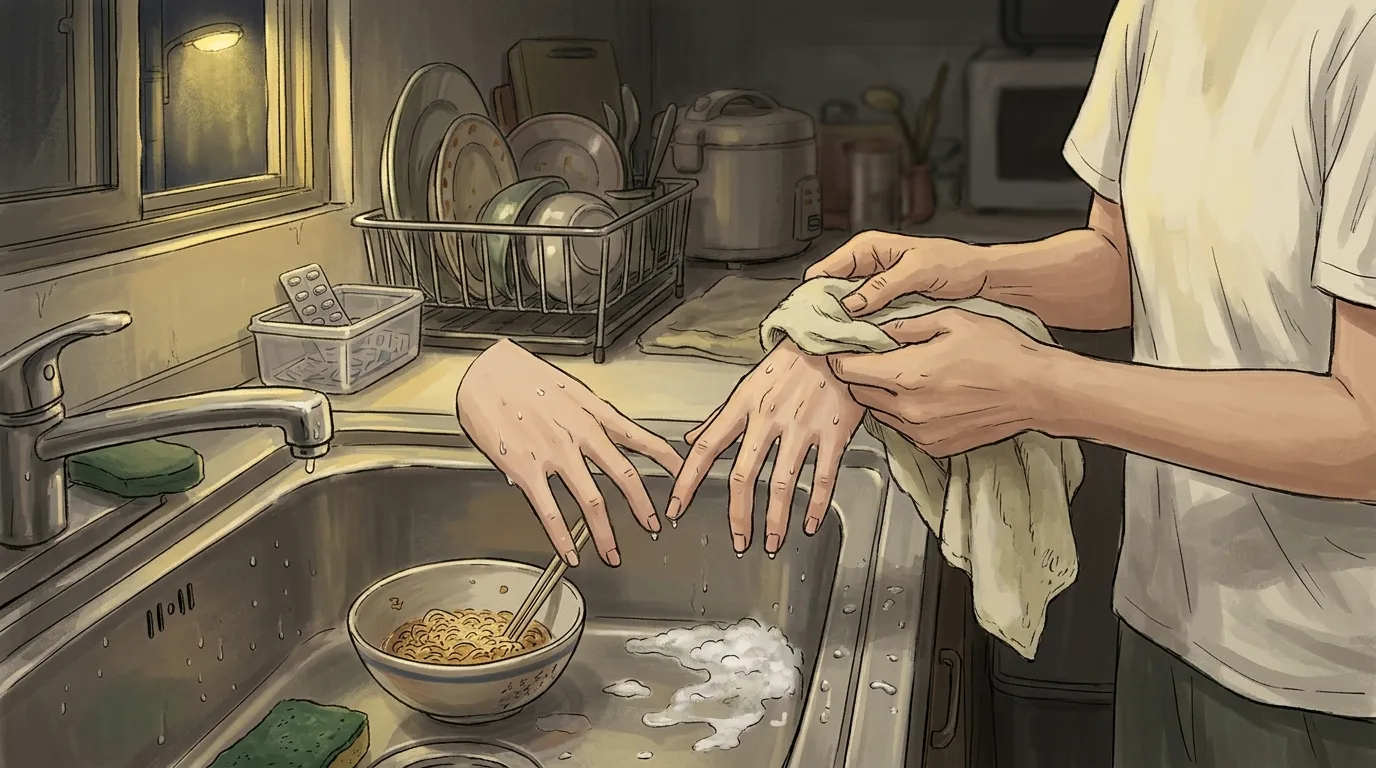
At nine-thirty that night, she stood at the kitchen sink washing dishes.
Three bowls, two pairs of chopsticks, a spoon, a pot. The sponge worked across the inside curve of a bowl; foam pushed out between her fingers. The tap was running, water on low.
First bowl. Rinsed. Placed on the drying rack.
Second bowl.
On the third bowl, her hand stopped.
The bowl wasn’t finished. It was still in her hand, sponge still pressed to the side. Her hand had simply stopped. The way a machine stops when a gear catches — the power still going, but the drive broken.
The tap kept running. Water fell against her wrist and ran down her forearm.
She thought about the forms. Thirteen pages. One to two weeks plus one to two weeks. She thought about the noodles her father had spat out. The moment Fu Jingming set down his pen. I’m asking whether you’re ready — a doctor’s warmth that shouldn’t have been there. Her father’s glance at Fu Jingming on the way out. She couldn’t read that glance.
She didn’t know how long she stood there. The water kept running. Her body held the posture of washing dishes, but she herself had gone somewhere else — somewhere with no sound of water, no forms, no numbers.
Footsteps.
Soft. She heard them but didn’t react.
Thuy Hang came into the kitchen to get the rice for tomorrow. She went to the other end of the counter and measured two cups, put them in the pot with water.
Then she saw.
The tap was running. Luo Wanqi stood at the sink, bowl and sponge in hand, but frozen in place. Shoulders curved slightly forward, the curve of her spine wrong — like a length of bamboo bent past its flex point, holding at the edge.
Thuy Hang walked over. She didn’t call out. She didn’t touch her shoulder. She stepped alongside her, reached over, and took the bowl from her hand, then the sponge. Her movements were unhurried, deliberate. Then she turned off the tap.
The water went quiet. The kitchen turned suddenly, wrongly still.
Thuy Hang picked up a towel and lifted Luo Wanqi’s hands from the sink. Her hands had gone cold — how long had they been under the water. Thuy Hang dried them with the towel, working from the back of the hand to the fingers, one by one.
Luo Wanqi’s eyes moved. She looked down at Thuy Hang’s hands drying her fingers. Thuy Hang’s hands were a size smaller than hers, the knuckles roughened — from washing dishes, mopping floors, wringing out wet towels.
Two women in the kitchen. Through the window, the security-alley streetlight sent a faint wash of light across the small stretch of tiles in front of the sink. The rest of the room was dark.
Thuy Hang put the towel back on the rack. Her gaze slid from Luo Wanqi’s face to the drying rack beside the sink, passing through the dishes to somewhere farther away. Then she blinked, came back. Took a step back.
“You need to rest too,” Thuy Hang said. In Mandarin. Her Mandarin wasn’t quite standard — the tone on too drifted up slightly, the tail of rest swallowed halfway. But every word arrived.
Luo Wanqi shook her head. A small movement.
Thuy Hang turned and took two steps toward the door. Then stopped.
“Uncle says the same thing.”
She said it without looking at Luo Wanqi. She was looking toward the kitchen doorway, as if speaking to the air. Her voice was light, with a slight hesitation — the hesitation of someone not sure they should have said it.
Luo Wanqi’s body shifted.
She turned, and looked at the side of Thuy Hang’s face.
“What did Dad say to you?”
Thuy Hang’s lips pressed together. She turned toward the kitchen doorway and walked out, her footsteps very quiet, almost soundless. The question was carried away with her back.
Luo Wanqi stood at the sink. The towel-dried fingers still held the faint texture of the cloth. The tap was off, but there was still pressure in the pipe; the last drop of water seeped from the joint at the faucet, slid along the curve of the stainless steel, and slowly ran down.
“What did Dad say to you?”
Her voice dropped into an empty kitchen. The security-alley streetlight flickered once, then steadied. In the bottom of the sink, the washing-up water that hadn’t drained yet held a few small clusters of bubbles — they were slowly dissolving.