Chapter 5
The Reckoning
Luo Wanqi found the key on the morning of the third day.
She hadn’t been looking for it. That was what she told herself. She was cleaning the study — Thuy Hang handled the ground floor, the second floor was her domain — and the vacuum’s noise was covering whatever was running through her head. She’d wiped down the desk, wiped the base of the lamp, and when she lifted the pen holder, something slid along the bottom.
A small brass key.
She knew what lock it fit. The second drawer on the right side of the desk had been locked since her middle-school years. Her father used to keep engineering drawings in there; after he retired she had no idea what it held. She hadn’t particularly wondered.
But these past three days had been different.
Thuy Hang’s remark — Uncle says the same thing — had been a seed. Planted in the kitchen on the fourth day, and growing every day since. She had begun paying attention in a new way: the foreground work continued, but a second process had come awake in the background and was quietly tagging every anomaly.
Her father had come downstairs at two in the morning on Tuesday. She’d heard it. The study door handle was turning — that old brass handle, the kind with a faint click when you turn it. She lay in bed and listened for twenty minutes, until the click came again.
Wednesday afternoon, during his nap, she heard Thuy Hang take a phone call. Thuy Hang said a few words in Indonesian, then switched to Mandarin: Uncle is sleeping… Okay, I’ll tell him. When she hung up and saw Wanqi standing in the hallway, her eyes darted — a flash, the startled kind of look from someone who had been caught in a specific position.
Thursday, she noticed a number with no saved name had appeared three times in her father’s recent call log. She didn’t dial it.
The pieces were accumulating. The dress shoes. The drive to Changhua. The unanswered calls. The late-night study sessions. Thuy Hang’s Uncle says the same thing. The unidentified calls. Each piece was a jigsaw fragment with blurred edges, but her mind was already arranging them into an outline. The shape of Dad doing something without telling me.
Now the key was in her hand.
Her father was downstairs taking his afternoon nap. Two-forty p.m. The fatigue from chemo had stretched his naps from an hour to well over two. Thuy Hang was in the kitchen prepping dinner. She could hear the chopping below, one stroke at a time, steady as a metronome.
She looked at the key. The brass had oxidized, coated with a layer of green-black.
Opening the drawer was a choice. Leaving it closed was also a choice. Both were irreversible — open it and she couldn’t pretend she hadn’t, leave it closed and she’d go on guessing in the dark.
She crouched and slid the key into the lock. Half a turn. At the moment the mechanism engaged, she heard a faint click — different from the door handle’s sound, smaller, crisper, like something sealed had been broken.
The drawer held only a few things. A bundle of envelopes held together with a rubber band. A bankbook. A notebook with a brown cover.
She picked up the notebook.
Nothing on the cover. An ordinary ruled notebook, roughly A5, the kind you could buy at any stationery shop for almost nothing. The corners were worn, creased from being opened and closed many times.
She turned to the first page.
Her father’s handwriting. She knew it too well — an engineer’s hand, every stroke as if measured with a ruler, square and small and even in pressure. But the writing on this page was smaller than usual, as if he were compressing something.
At the top of the page, with no title and no date:
1. Settle old debts.
A line beside it, drawn from left to right, steady all the way across. Done. Her eyes stayed on that line for two seconds. Settle old debts. The dress shoes. Changhua. The red plastic bag. The fragments snapped together in an instant — the way a string of seemingly unrelated anomalies in a quality-control report suddenly resolves when a trend line runs through them.
2. Wanqi’s fallback.
She saw her own name. Her heart skipped — a gap opened in the beat. Beside the heading her father had added notes in small writing: Labor insurance — confirm whether years of service can be carried over. Cathay policy — change beneficiary. Director Zhu — call, ask if quality-control dept has any openings.
Director Zhu. Her supervisor at her last company.
Her hands started shaking. A trembling from something surging outward through her fingers, her muscles holding it back.
3. ACP counseling.
After it, in parentheses: Advance care planning — prerequisite process. Window introduced by Fu Jingming. Second-degree relatives required to attend.
She wasn’t sure what ACP was. But advance care planning — those words she understood. Fu Jingming’s name she understood even more clearly.
4. Wanyang.
Below that, several lines of text, smaller than the first three entries, as if he were still weighing them. She could make out the words account, ancestral house, and one line whose characters she couldn’t quite read — the ink had spread a little.
She turned to the last page.
Item five.
A strip of semi-transparent tape was laid across the line. The tape’s edge had curled up slightly, as though it had been peeled back and then pressed down again. She wanted to pull it off. Her fingertip touched the edge of the tape — cool, with a faint trace of adhesive.
She left it.
She couldn’t say she didn’t want to look. The impact of the first four entries had already filled her chest to capacity. She needed to deal with these — no. She didn’t need to deal with anything. She needed an answer.
She closed the notebook. Held it in both hands.
The chopping sound downstairs had stopped.
She came down the stairs faster than usual. Her feet on the steps sounded wrong — none of her habitual, measured tread, just urgency, as if she were shouldering something out of her way.
The living room.
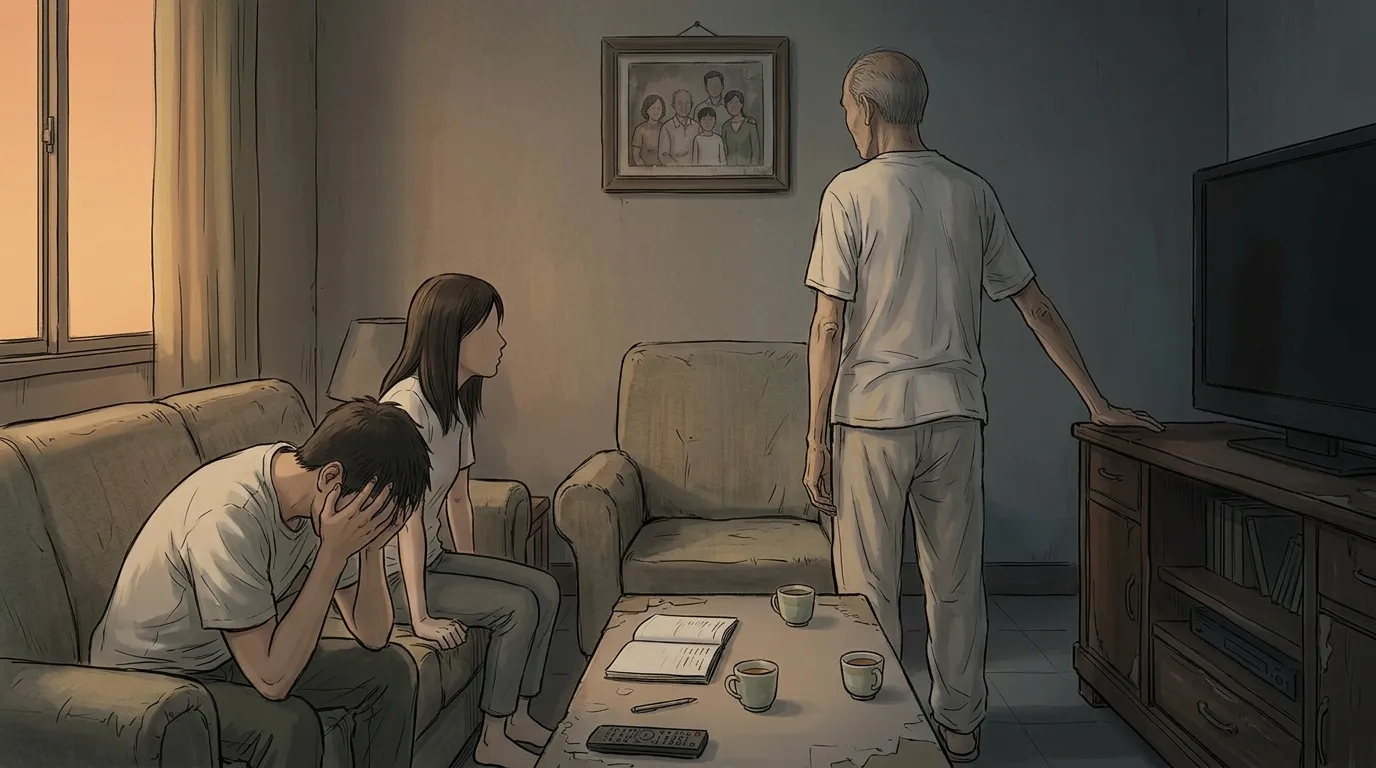
Her father wasn’t on the sofa. He’d woken from his nap, gotten up from the armchair in the corner, and was standing in front of the TV console, searching for something — the remote, probably. His movements were slow, back slightly stooped, the collar of his loungewear loose, the hollow below his collarbone deeper than last month.
“What are you doing?”
Her voice came out harder than she’d intended. She stood at the foot of the stairs, the notebook in her hand, fingers gripping the cover until her fingertips went white.
Her father turned.
His gaze dropped first to her face, then moved downward to what she was holding.
Three seconds. He said nothing. No movement in the muscles of his face — not calm, but frozen. Like concrete in the seconds after it’s poured: not yet set, but no longer flowing.
“You read all of it?”
His voice was level.
“You’re making arrangements for the end?”
“These aren’t end-of-life arrangements.”
“Advance care planning. ACP. That’s what you’re doing.” She raised the notebook slightly, like tendering evidence. “You’ve already been to see Dr. Fu, haven’t you? You talked. When did you start? How long have you been at this?”
“Sit down first.”
“I don’t want to sit down.” A crack ran through her voice. “Answer me. How long have you been making these arrangements? You — that day in Changhua — settling old debts — those dress shoes —” The fragments came out of her mouth in the wrong order, she had no time to sort them, they were coming on their own. “You’ve already been preparing. You’ve already given up.”
“I haven’t given up.”
“You’re signing a document that says you’re giving up treatment —”
“An advance directive is not giving up treatment.” His voice rose half a note. “It’s my choice about when —”
“When what? When to die?”
When those words left her mouth, the air in the living room felt like something had been taken out of it. Thuy Hang appeared in the kitchen doorway for a moment, then pulled back.
Her father’s jaw went rigid. She recognized the movement — he was about to push back.
“You think taking care of me is the same as not giving up?” His voice dropped, but each word landed with force. Taiwanese was starting to mix in, the way structural elements get shaken up from the foundations. “You quit your job, moved back, checking blood pressure every day, managing the medication schedule, tracking every bowel movement — do you think any of that makes me better?”
“I never said you’d get better —”
“That’s exactly what you think.” He looked at her steadily. Something was in his eyes she’d rarely seen — something with more gravity than anger, something heavier and slower. “You’ve put your life into this. Do you realize that? You’ve thrown your whole self in. You think I can’t see? How many kilograms have you lost? What color are the circles under your eyes? How long has it been since you’ve seen a friend?”
“This has nothing to do with me, we’re talking about you —”
“This is about you!” He slapped his hand on the TV console. The sound cracked through the living room and even the family photo on the wall shuddered slightly. From the kitchen came the sound of something being set down — the bright ring of metal against a ceramic bowl.
His chest heaved several times. He turned away and coughed. A real cough, nothing polite about it — something being pulled from deep inside him, dragging his abdomen with it. He covered his mouth with the back of his hand and coughed four or five times, each one yanking at his core, his body folding forward.
She reached toward him. Reflex.
“Don’t.” He pushed her hand away. His voice had gone rough, but the force in that don’t was as stiff as rebar.
He straightened up. A film of fine sweat on his forehead.
“Every item on that list,” his voice came back — hoarse but clear — “I worked through carefully. I’ve been working through it since the day Fu Jingming told me it was stage IV.”
“You worked through it, and then you decided alone.” Something shook in her voice too — the deep vibration of rebar inside a load-bearing wall, something structural rather than emotional. “You think I haven’t been doing enough to take care of you, so you decide to handle it yourself. You arranged everything behind my back —”
“I arranged everything so you wouldn’t have to!”
That sentence stopped her cold.
Her father looked at her. His lips were trembling slightly — a jaw held tight for too long, the muscles finally giving. His eyes had gone red at the rims. But no tears. This man would not let them fall.
“You’re like your mother.” He said it quietly — so quietly it sounded like he was talking to himself. “Always taking on everything. Always managing everyone. Until you collapse and you don’t even notice.”
Her mouth opened. No sound came out.
“When your mother was dying…” He stopped. Inside that pause was an entire road walked over twelve years, a road that reached a point where the ground had cracked open, and he was deciding whether to step across. He stepped. “In those last six months, you handled everything. You’d just started at the company. They’d just put you in charge of a quality-control line. You pushed through your leave and came back to take care of her. You think I didn’t know?”
Her fingers loosened. The notebook slid slightly; she caught it.
“Back then I was on-site every day —” His jaw closed around something, as if swallowing it back. He didn’t finish the sentence. He didn’t have to. What he couldn’t do in that time — twelve years, and he remembered every day of them. “This time, I’m not letting that happen again.” His voice dropped very low, as if coming up from underground. “I want to settle my own affairs. Without you.”
The only sound left in the living room was the hum of the air conditioner’s compressor.
She looked at her father. He was standing in front of the TV console, the family photo behind him. In the photo all four of them were smiling — her mother still there, her brother maybe ten, she herself fourteen. Her father in a white shirt, his hair black.
She looked down at the notebook in her hands.
“You didn’t even ask me.” Her voice fractured. The fracture of a material compressed past its limit, the first stress cracks appearing. “You arranged a fallback for me. You called my old supervisor. You decided what I’m doing with the rest of my life. You — how could you — do you know how I —”
She stopped. Because if she said what came next, she wouldn’t be talking about the notebook anymore.
She set the notebook on the coffee table. The motion had weight behind it, like putting down a slab of stone.
Then she took out her phone and dialed a number.
“Wanyang. Come home. Now.”
Her brother on the other end of the line must have heard something in her voice, because he asked only one question: “What happened?”
“Come home and you’ll find out.”
She ended the call.
Her father stood where he was, motionless. He was watching her hand — the one that had just put down the phone. It was still shaking.
The two of them faced each other across the coffee table, the notebook between them. The afternoon light had begun to angle, the sun’s reach pulling back from the window side, the shadow on the TV-console side lengthening.
Neither spoke. But neither left.
Luo Wanyang came through the door at five eighteen.
He didn’t look like he’d taken the high-speed rail — hair slightly disheveled, polo shirt wrinkled, as if he’d been at the office when the call came and grabbed his jacket and sprinted. His shoes were the brown Oxfords he wore to work, and the lace on the right was undone.
He felt it the moment he walked in.
The air pressure in the living room was off. His sister sat at one end of the sofa, their father in the armchair. A coffee table separated them, with a notebook sitting on top. Nobody was watching television. Nobody was drinking water. There was something in the air he recognized from childhood — the smell of the house before a fight. No. Heavier than a fight. Like the barometric drop before a typhoon.
“Sis?”
“Sit down.” Luo Wanqi said.
He sat. The other end of the sofa. The cushion had sagged and his body listed sideways.
“Dad is doing ACP.” Her voice came out like a knife cutting down — clean, fast, no room for reaction. “Advance care planning. He wants to sign a document specifying what conditions he doesn’t want resuscitation, doesn’t want intubation, doesn’t want life support. He’s already been talking to Dr. Fu.”
Luo Wanyang’s face didn’t react immediately. He’d heard her — she was certain he had — but the words looked like they hadn’t landed yet.
“What?”
“You didn’t follow?” Her voice sharpened. “Dad is making arrangements for his own death.”
“That’s not what it is —” their father started.
“Be quiet.” She turned to look at him. The three words left her mouth and she startled herself — she had never in her life told her father to be quiet. The air in the living room froze for an instant, then cracked.
She turned back to her brother.
“Did you know?”
“I… didn’t.”
“Of course you didn’t. You don’t know anything.” She stood up. Something inside her was an open valve, two months of pressure beginning to release. “Where were you when he was making these arrangements? Where were you when he drove to Changhua to settle old debts? Where were you when he was writing his list in the study in the middle of the night? In Taipei. You’re always in Taipei. You didn’t answer a call from the day he was diagnosed — the first one, you didn’t pick up the first one! I called three times before you called back!”
Her brother’s unanswered call. The fragment from the first chapter, surfacing.
Luo Wanyang’s lips moved, but nothing came out. His right hand rested on his thigh, his finger working at the edge of his thumb, picking at the callused skin. The hardened edge had already started to peel; he worked at it, and the side of his thumb went white.
“You wire two thousand a month. You bring fucoidan. You print out research. And then you feel like you’ve fulfilled some responsibility.” Her voice was climbing in even increments — the pressure cooker’s valve turning one click at a time toward the limit. “Do you know what Dad’s face looks like when he’s swallowing his pills? Do you know what he looks like after chemo, throwing up until there’s nothing left? Do you know who’s there when he wakes up coughing in the middle of the night?”
“Sis —”
“Me.” She pressed a finger to her own chest. “Every single time.”
Luo Wanyang lowered his head. His thumb had drawn blood — a thin red line along the edge, which he hadn’t noticed. His mouth opened and closed; his throat moved, as if swallowing something too large.
“I was the one who told him not to come back.”
Their father’s voice came from the direction of the armchair. Level. Like reciting a project specification.
Both of them turned.
“What?” Luo Wanqi said.
“Wanyang.” His father looked at his younger son. “The second week after the diagnosis, he called me. Said he wanted to take extended leave and come home. I told him not to.”
The living room went quiet. The quiet where sound has been taken out. The air conditioner’s hum was still there, a car passed outside, but those sounds were on the other side of a pane of glass.
“You told him not to come back.” Luo Wanqi repeated it.
“You alone was already enough. There was no reason for two lives to go in.”
“So you decided for him.” The anger had burned out of her voice — that position had been scorched through, leaving what was under it: something like exhaustion, something like a cold, clear seeing-through. “Just as you decided my fallback. Just as you decided everything for everyone. The way you’ve done your whole life.”
Her father didn’t deny it.
He got to his feet from the armchair. Slowly, both hands on the armrests, his knees cracking. When he was standing, he looked at his daughter, then at his son.
“Every item on the list,” he said, “I’ll go through once.”
“That’s not necessary —”
“Let me finish.”
A command. The same tone he had used on construction sites for forty years.
At that moment Thuy Hang appeared in the kitchen doorway. She was carrying a tray — on it, three cups of tea. She had probably heard every word, but her face showed nothing. She came into the living room, set the tray on the coffee table, beside the notebook.
All three of them watched her.
“No, thank you,” Luo Wanqi said.
“No need,” her father said.
“No, thank you very much,” Luo Wanyang said.
Thuy Hang’s hand paused at the edge of the tray. She looked at the three of them once, picked up the tray, turned and went back to the kitchen. Her footsteps disappeared behind the door.
Her father brought his attention back from the kitchen.
“Item one. Settle old debts.” His voice returned to his characteristic rhythm — short clauses, stripped of feeling, each word like driving a nail. “Hong Miantong. Something from 1992. I owed him an accounting. Went. Settled. Done.”
He glanced at his daughter. She said nothing.
“Item two. Your fallback.” He didn’t use Wanqi and didn’t use daughter. Just you. “You quit your job to take care of me. That was your choice. But after I’m gone, then what? You’re thirty-eight. Nine years in quality control. Stay away too long and you can’t go back. I called Zhu Qiwen, asked if the QC department had any openings. He said he’d hold a spot. Whether you take it is up to you. The spot is there.”
“The gap in your labor insurance.” He continued. “I checked with the labor bureau — you can bridge it through the national pension. I did the math on the difference and topped up your account. The insurance beneficiary I changed — you and Wanyang, half each.”
He paused. Took a breath. A plain mechanical intake for oxygen.
“Item three. ACP.” He said the three letters slowly. “Advance care planning. This is not giving up treatment. It’s my choice about when —” he traced a line in the air with his hand, as if drawing a boundary — “to stop fighting. No intubation. No defibrillation. No machines keeping me going.”
“How do you know when that point comes?” Luo Wanqi’s voice was low, but each word was holding its shape.
“That’s what the ACP process is for.” He said. “Counseling. A professional talks it through with me. With you. By law, second-degree relatives have to be present. You and Wanyang both.”
“You’ve already arranged it.”
“I made contact. Haven’t scheduled a time.” He looked at her directly. “This item was always going to need you to know.”
“And when exactly was always?”
He didn’t answer.
“Item four.” He turned toward his younger son. “Your situation — we’ll talk later.”
Luo Wanyang raised his eyes from the floor. A small dried fleck of blood was visible at the edge of his thumb, gone dark red. He gave a small nod.
Their father stood in the middle of the living room. He was narrower than three months ago — his clothes hanging off the shoulders, the belt pulled two notches tighter. But he was standing. His back straight.
“I don’t want you to remember a man lying in bed connected to tubes.” His voice was low, but it reached every corner of the living room. “I want you to remember a man who stood up and settled his affairs.”
No one answered.
Outside, a motorcycle went by, its engine sound coming from far away and going farther. The sun had dropped behind the rooftops of the building across the street, and the light in the living room shifted from orange to grey. The three untouched cups of tea on the coffee table had gone cool; a thin film of mist had settled on the surface.
Their father turned and walked toward the stairs. He’d taken three steps when he stopped and looked back.
“I’m still alive.” He looked at his daughter and son. “I still have the right to decide how I go.”
He went upstairs. The wooden stairs sounded under his weight, one step at a time, growing fainter.
Luo Wanqi sat on the sofa. Her hands were folded in her lap, all ten fingers interlaced, her knuckles gone white. The notebook was still on the coffee table, open to the page with the tape.
Luo Wanyang sat at the other end of the sofa. His body leaned forward, elbows on his thighs, his face buried in his hands. His shoulders weren’t shaking, but his breathing was wrong — too long on the inhale, too short on the exhale, like someone managing something on the verge of overflowing.
The two siblings sat on the same sofa. The distance of a cushion between them. Neither spoke.
Late at night.
Luo Wanqi sat in the plastic chair on the second-floor balcony. One chair leg was uneven; it tilted to the left. Her body tilted with it, and she didn’t adjust. The iron railing was damp with night dew, catching the light from the alley streetlamp. On the drying rack hung a few pieces of her father’s clothing — laundered and somehow thinner for it, shifting slightly in the night breeze, like shells with no one inside.
She wasn’t crying. Her eyes were burned dry. Whatever mechanism controlled crying had been scorched today, and now there was only a blackened clearing.
She looked out at the mouth of the alley. An April night, a coolness in the breeze without any chill, but her arms had gone to goosebumps. Somewhere down the street a person was walking a dog; she could hear footsteps and the dog’s panting bounce back from the alley walls.
She thought about what her father had said. Each sentence. You’ve put your life into this. You’re like your mother. I’m not letting that happen again. The words were like drill bits — going in, you don’t feel the pain; it’s afterward, now, after the drill has been pulled, the hole still there.
She didn’t know what to do with those words. Accept them? Push back? She wasn’t sure anymore which ground she was standing on. Two hours ago she’d been a caregiver — she’d known her task, her process, her standard. Now what was she? Someone whose fallback had already been arranged? Someone her father had seen through completely?
She pressed her face into her hands. She wasn’t crying. She only needed to close her eyes and keep the world at arm’s length a little longer.
Downstairs, the living room light was still on.
Her brother was probably still there. He hadn’t moved from the sofa after his sister went upstairs. When she’d left she’d glanced back at him — his eyes were fixed on the notebook on the coffee table, but his focus was somewhere behind it, further back, at something the notebook couldn’t reach.
Her father was in his room. Door closed.
Three of them, each in a separate corner. Like a house after an earthquake — every wall cracked, but the structure still standing, still holding. Still holding.
A faint sound came from the direction of the kitchen. The sound of a pot meeting the gas burner. Water being poured in. A click of ignition, then the steady low hum of a gas flame.
Thuy Hang.
Fifteen minutes passed, maybe less. Luo Wanqi wasn’t keeping track.
Light footsteps on the stairs. Thuy Hang’s — always the quietest walker in the house.
The balcony door was gently pushed open.
Thuy Hang came in holding a bowl. Congee. Plain white congee, nothing added, still steaming. She set it on the small stool at the railing — that stool normally held a flower pot, the plant long since dead, the empty pot still sitting there. She moved the pot to the side, set the bowl in its place.
She said nothing. Set it down and left.
Luo Wanqi looked at the bowl. The steam twisted in the night breeze for a moment and then dispersed. The bowl was one of those old blue-and-white ones, a small chip along the rim — as a child she had broken a corner off it. Her mother had said: a chipped bowl is a bowl that belongs to you.
She picked up the bowl. The congee was very hot. She blew on it, took a sip.
No particular taste. Just rice and water. But it was hot — from her throat all the way down to her stomach, heat all the way through.
She finished the bowl.
Downstairs, the living-room light went out. Then Wanyang’s footsteps on the stairs — much heavier than Thuy Hang’s, each step carrying a slight drag, as if his feet weren’t quite willing to lift off the ground. He stopped in the second-floor hallway.
She didn’t go to look. But she knew where he had stopped. Outside their father’s door.
Silence. Maybe ten seconds.
Then their father’s voice came through the door — muffled by the wood, but audible.
“Wanyang.”
Her brother’s footsteps stopped.
“There’s one thing on the list that’s yours.”
A few seconds of quiet. She heard her brother draw a breath — a long one, the kind that precedes a decision.
“What is it?” His voice was very low. A little roughness in it — he’d probably gone two hours without drinking anything either.
“Come in and sit down.”
The door opened. Then closed.
She was alone on the balcony. The empty bowl sat on the stool, a faint ring of congee left on the inside, tracing a white circle along the bottom.
She picked up the bowl and went back inside. As she passed her father’s door, her footsteps slowed for one beat. The door was shut. Voices from inside — the sound of talking, but too muffled to make out. Her father’s voice and her brother’s voice layered over each other, like two streams of different depths joining at the same point.
She walked on. Carried the bowl down to the kitchen.
In the kitchen, Thuy Hang was putting away the pots. On the counter sat another bowl — Wanyang’s, also empty. On the gas burner, the pot held a little congee still, barely warm.
Three bowls of congee. Three people. All finished.
Thuy Hang saw her come in and reached to take the bowl from her.
“I’ll wash it.” Luo Wanqi said.
She turned on the tap. Water ran over the inside of the bowl, washing away the remnants of rice. She went over it with a sponge twice, rinsed it clean, set it in the drying rack.
Thuy Hang stood beside her. Didn’t move.
The two women stood in the kitchen. Through the window, the light from the security alley was steady, without a flicker.
Luo Wanqi turned off the tap. Her hand stayed in the water for a moment — cool. Then she drew it out and dried it on the apron.
She didn’t say thank you. Thuy Hang hadn’t waited for it.
The night grew later. The lights in this house went out one by one. On the hallway floor, only the thin line of light under a door remained.
Then that line went dark too.