Chapter 6
Letting Go
The longan tree had listed.
Luo Wanyang stood in the courtyard of the ancestral house, looking at the tree that had been there for as long as he could remember. As a boy it had been upright — at least he remembered it that way. Now the main trunk had tilted west, maybe fifteen degrees, like a person who had decided mid-stride to change direction but whose feet hadn’t caught up yet. The roots had pushed up a concrete paving stone; black moss grew in the crack.
He had parked at the mouth of the alley. The alleys in Fengyuan were narrower than Taichung proper — two cars passing each other meant one of them pulling over. He’d left the rental Toyota in front of a low-rise house, and after he cut the engine the silence around him was wrong, too complete. This alley hadn’t been that quiet since he used to come here on summer breaks as a kid.
The ancestral house had started as a three-wing courtyard compound, then been rebuilt into a townhouse. Specifically: his grandfather, sometime in the 1970s, had kept the main hall of the three-wing compound and torn down the flanking wings to build a three-story structure in their place. So from the outside the house looked incongruous — red brick and exposed aggregate at the base, concrete and iron-grille windows above. His father was born here, grew up here, married here. Then moved to Taichung.
The lock on the iron gate had rusted. He turned it twice before it gave, and rust flecked onto his fingers — orange-red powder.
Inside. A few pairs of slippers piled in the entryway, plastic, their color gone. The floor tiles were the old patterned kind, each one different, the dust settled evenly into every groove. He changed into a pair of slippers — too small, his heels hung off the back.
The air held mold and old wood — dense, like walking into something solid, though not unpleasant in itself. He opened the living-room window; the aluminum track resisted, then gave, and cool air carried in the faint green smell of longan leaves.
April light came in at an angle through the window, drawing a rectangle of brightness on the terrazzo floor. Dust moved in the light. When he was small he liked watching it drift — he thought it was very tiny people flying.
The desk was upstairs. His father had been specific: Right side, first drawer, all the way at the bottom, a kraft paper envelope. The property deeds are inside, land and building both. Take them to the land registration office; they’ll give you the transfer forms. If you can’t figure out the forms, call me. And then, added on: Your mother’s memorial tablet is in the main hall. After I’m gone — first and fifteenth of every month. Look in on her.
He went upstairs first.
The wooden handrail felt like sandpaper — the wood had dried and split, the paint peeling away to bare grey-white wood underneath. The second floor was quieter than the first, curtains drawn, the light dim. He found the desk, pulled open the first drawer on the right. Not much inside — a few ballpoints, a calculator, a stack of envelopes. He found the kraft paper envelope at the bottom, drew it out, opened it to check. Property deeds. Two of them. Land and building. His father’s name, stamped.
He tucked the envelope into his backpack.
Downstairs.
The main hall was at the back of the ground floor, the surviving section of the original compound. The ceiling was higher than the other rooms, the beams original wood, smoke-darkened to deep brown by years of incense. In the center stood the altar table — memorial tablets for his grandfather and grandmother. To the left, slightly lower, another tablet.
He walked over.
His mother’s photograph stood beside the tablet in a small frame. She looked to be in her mid-forties in it, wearing a deep-red jacket, her hair permed and curled, smiling. The background was blurred, something like a park. He couldn’t remember who had taken this photo, or where.
In front of the tablet a lamp burned. Electronic, a small red bulb simulating the flicker of a flame. He didn’t know when the battery had last been changed, but it was still lit. In this house where dust had settled over everything, it was burning, steady.
He stood there.
When had he last come? Tomb Sweeping? Ten years ago? Maybe longer. His mother had died when he was twenty-two — just out of school, in Taipei. His sister had come back from Taichung; he’d come down from Taipei. After that he’d returned for Tomb Sweeping a few times, and then stopped. He hadn’t forgotten. Every time he thought about coming back, he’d think of the things he’d seen the last time — dust, air, his mother’s photograph — and whatever impulse had stirred would be pressed down by something else. He didn’t have a name for that something else.
He looked at his mother’s photograph. The lamplight laid a wash of orange-red across her face.
His father had left the ancestral house to him alone. His father had said only one sentence on the phone: Your sister has her own path. He hadn’t read anything further into it then. Now, standing in the main hall, he understood all at once — his father had seen something he hadn’t: that he, Wanyang, needed somewhere he could come back to.
He took out his phone, scrolled to his sister’s thread. Started typing, deleted it. Started again, deleted that too. He made the call instead.
Three rings.
“Yeah?” His sister’s voice had a quality he didn’t recognize — the usual quality-report precision was gone, replaced by something rough, like something had worn it down.
“Sis. Got the deeds. Heading to the registration office now.”
“Okay.”
He could have ended it there. Before, he would have. But he added: “Mom’s tablet is here. The lamp is still burning.”
Two seconds of quiet on the other end.
“How long has the battery been in?”
“No idea. But it’s still going.”
More quiet. He heard a rustling on her end — pages turning, or something sliding across a desk.
“Get the paperwork done and come back.” She said.
“Okay.”
He ended the call. Looked at the tablet once more. The red light moved across his mother’s photograph slowly, slowly, like a breath.
He turned and walked out of the main hall. At the courtyard he glanced back — through the main hall’s doorway, he could see only the single red lamp on the altar table.
The iron gate caught again when he pulled it shut. He turned it twice more before the bolt engaged. The rust powder came off on his pants, leaving an orange streak.
The following morning. The conference room was on the third floor of the hospital’s administrative wing. It was a meeting room rather than an exam room — no treatment table, no medicine cabinet, none of those chairs with the seat cushion that always felt too hard. Here there was a long table, six chairs, and a low cabinet along the window holding a fake green plant.
Luo Wanqi arrived at nine fifteen. Fu Jingming hadn’t come yet. Nurse He was already there, arranging documents on the table — one folder per seat, pale blue. Another woman Wanqi didn’t recognize sat at the near end of the long table: early forties, glasses, a notebook and pen in front of her. Her name tag read Chen Zhiruo — Social Worker.
“Good morning, Ms. Luo.” Nurse He looked up and gave a brief smile. Her smile was the same as the one in the chemotherapy ward — clean, without weight.
Her brother arrived at nine twenty. He was wearing a dark-grey sweater that looked like he’d worn it through yesterday and not changed. He paused in the doorway, scanned the room’s arrangement, then came in and sat beside her.
She noticed a ring of scabbing along the edge of his right thumb. Red-brown, picked over.
Nine twenty-five. Their father was wheeled in by Thuy Hang.
Her eyes stayed on the wheelchair for a moment. Her father never used a wheelchair. Last month at his checkup he had walked from the parking lot to the consultation room, stopping to rest twice — but he’d walked. Today he sat in the wheelchair, a thin blanket across his knees, his left hand resting on the armrest.
Thuy Hang brought the wheelchair to the head of the table — the short end of the rectangle, facing the two siblings. Then she stepped back to a chair at the door. Off the table. But in the room.
“The air conditioning is too strong,” her father said. His jacket zipper was pulled up to his throat.
Fu Jingming came in at nine twenty-eight. He wasn’t in his white coat today — suit jacket, dark navy tie, a folder and that pen he was always turning in one hand. He looked around the room, gave brief nods to the nurse and the social worker, then looked at her father.
“Mr. Luo.”
“Dr. Fu.”
The two men’s eyes met across the room. A confirmation, the way two engineers from different sites check each other’s progress when they finally meet in person: You’ve reached your point. I’ve reached mine.
She saw it. This time she understood it. The look she hadn’t been able to read in the consultation room that day — it opened its full meaning here. They had already talked it through, probably since the afternoon Fu Jingming had set his pen down in the consultation room. She had always assumed that conversation ended when the door closed. But for the two of them, that door had never closed.
Fu Jingming sat down. He did not turn the pen. He placed it on the table, parallel to the folder, nib pointing left.
“Today’s session is the legally required preliminary procedure for completing an advance directive.” His voice didn’t carry the precision-calibrated register of the consultation room — today there was something more, layered underneath, something she couldn’t name. Like padding placed beneath a hard object. “Present are the attending physician, a nurse, a social worker, and immediate family members. The procedure requires us to confirm each provision with Mr. Luo in turn, to ensure the decision is entirely his own.”
He glanced at her, then at her brother.
“At any point, we can pause.”
Her father’s hand came out from under the blanket and rested on the table. His nails were cut short; the veins on the back of his hand stood out more than they had last month, like stones that appear when a riverbed dries.
“Begin,” her father said.
Nurse He opened the first page of the folder.
“Part One, Basic Confirmation. Mr. Luo, do you understand your current diagnosis and prognosis?”
“Stage IV pancreatic cancer, liver metastasis. Prognosis three to twelve months; currently in month five.” His voice was the voice of a man reporting project status. No pause, no hesitation. The numbers came out the same way they had in the consultation room — dry.
“Do you understand the meaning and legal effect of completing an advance directive?”
“I do. I am choosing, under specific clinical conditions, to refuse or withdraw life-sustaining treatment.”
Nurse He checked the box on the form.
The social worker spoke: “Mr. Luo, I need to confirm — throughout the process of reaching this decision, were you under any external pressure or coercion?”
“No.”
“Have you had sufficient discussion of this decision with your family members?”
The corner of her father’s mouth moved. Very briefly. Like the afterimage of a smile passing through and gone.
“Sufficient,” he said. “Very sufficient.”
Her hands, under the table, twisted the hem of her sweater. Her fingernails scraped against the knit and pulled out a pill.
The session moved into the item-by-item confirmation. Nurse He read each provision; her father answered. Fu Jingming added clinical explanation when needed.
“Under terminal-stage conditions, do you consent to cardiopulmonary resuscitation?”
“No.”
“Do you consent to mechanical life-support systems, including ventilators, dialysis, and the like?”
“No.”
“Do you consent to tube feeding or other artificial nutrition?”
Her father paused for one second.
“No.”
That second. She heard what was inside it — an engineer’s final confirmation: her father’s mind running the calculation one more time before each no, verifying the answer had not changed. Then output.
“Do you consent to hospice and palliative care?”
“Yes.”
“Do you wish to designate a healthcare proxy?”
“Yes.”
“Name of proxy?”
“Luo Wanqi. Elder daughter.”
When her name was spoken aloud, something ran down her spine along its centerline — from the back of her neck to her lower back. The cold of the air conditioning had nothing to do with it. Something was being placed on her.
She said nothing.
Her brother glanced at her. She felt his eyes but didn’t return them.
Nurse He finished filling in the last line.
“Mr. Luo, those are all the provisions of the advance directive. If everything is correct, please sign here.”
She slid the document across to her father. A pen beside it.
Her father picked up the pen.
She watched his hand. That hand — decades of holding blueprints on construction sites, holding measuring tapes, holding pencils. The knuckles thick, the web between thumb and forefinger calloused. The hand was steady as if clamped to the table.
He signed. The strokes were square, the pressure even, every line as if measured with a ruler. Identical to the handwriting in the notebook.
He had not hesitated. Whatever hesitation he’d had was spent in the study. In those nights when he’d opened the notebook at two in the morning, in those pauses before the pen met paper. All of it spent. By the time he reached this table, there was only execution.
Fu Jingming took a seal from his pocket and pressed it onto the attending physician’s field. The motion was unhurried. When he finished he looked at her father — briefly, but not in the way a doctor looks at a patient.
Nurse He collected the documents. The social worker wrote the last few lines in her notebook and closed it.
“The consultation is complete. The documents will be uploaded to the National Health Insurance card within approximately five working days.” Nurse He’s voice kept its characteristic steadiness, but the way she closed the folder was lighter than when she had opened it.
People began to move. The social worker left first, exchanging a few quiet words with Nurse He at the door. Thuy Hang rose from her corner chair and moved to stand behind her father’s wheelchair.
Fu Jingming stood. He picked up his pen from the table with a deliberate grip, and walked to the door and stopped.
Half a second.
He had also paused at the doorway of the consultation room that day. That half-second had been a role switching — the gap where the physician stepped back into a person. This pause was different. There was no switching here. He had no longer needed to switch. In this conference room, from start to finish, he had not been only a doctor.
He turned and looked at her father.
“Mr. Luo.”
“Mm.”
Fu Jingming said nothing more. He gave a single nod, the angle a little larger than usual. Then he walked away.
The corridor.
She walked alongside her father’s wheelchair. Her brother was behind, sharing the pushing with Thuy Hang, one on each side. The corridor was long, the fluorescent lights making the floor shine, a nurse at the station on a phone call, her voice coming from far off.
Fu Jingming was several steps ahead. She quickened her pace.
“Dr. Fu.”
He stopped and turned.
“Is he clear?” Her voice was pushed low but every syllable was pressed hard. “Are you sure he’s clear?”
Fu Jingming looked at her. His glasses reflected the corridor’s fluorescent lights; she couldn’t make out his eyes clearly, but he held the look longer than she expected.
“Ms. Luo,” he said, his cadence dropping half a beat, “of all the patients I have seen, your father is the clearest.”
She didn’t reply.
Fu Jingming paused a moment longer. Then he took the pen from his suit pocket and clipped it into his breast pocket. Nib pointing up, settled into the fabric. Like putting something down.
He walked away.
She stood in the corridor and watched his back disappear around the corner. The fluorescent lights hummed in the empty hall. From behind came the creak of the wheelchair — Thuy Hang was pushing her father toward her.
She turned, fell back into step beside the wheelchair.
The document in the folder — one page. Checkmarks and a signature. One page deciding the direction of a life’s end. She thought of the stack of materials she’d hauled back from the district office: thirteen pages, three hundred grams, a thick sheaf crammed in a folder, two afternoons to fill out, and the long-term care system had left her wrung out and nothing solved. That one thin page — check, check, check, no, no, no — and it was done once signed.
She didn’t know which weighed more.
The hospice ward was on the twelfth floor of the inpatient building. When the elevator doors opened she smelled it first — something floral. Lavender? With a trace of citrus sweetness. The disinfectant was underneath still, she could tell it was there, but it had been pressed to second place, like something said that you know was spoken but can’t quite catch.
The nursing station stood in the middle of the corridor — an open long table rather than a glassed-in elevated counter, a few computers on it, a pot of real plants. The nurses wore pink uniforms.
“Mr. Luo, this way please.” A nurse led them left along the corridor. The name tag pinned to her pink uniform read Lin Xiaopan.
Room 1208. Door pushed open.
She stood in the doorway for three seconds.
This was not a hospital room. Or at least not one she recognized. The past four months she’d spent every chemotherapy admission in a general ward — fluorescent lights, white walls, the monitor above the bed beeping every few seconds, the plastic mattress sticky against skin, metal railings cold on the arm. Those were what her body had memorized: the feel of defective goods handled hundreds of times on a quality-control line.
Here the walls were sand-colored. The headboard was wood, pale oak grain. The window was large, east-facing, and the afternoon April light came through gaps in the curtain, drawing a few pale-gold lines on the floor. The bed was electric, adjustable, and the sheets were cotton — she touched one corner: soft texture, nothing like the smoothness of plastic sheeting.
In the corner stood a floor lamp, warm amber.
“Family members can bring personal belongings,” the nurse was saying. “Books, photographs, things he likes — all fine to put out. The sofa by the window unfolds at night. For family staying over.”
After her father was wheeled in he looked around slowly — ceiling, walls, window, then the small white essential-oil diffuser on the window sill, releasing a thin mist.
“Not bad,” he said. “Like a guesthouse.”
Behind him her brother exhaled — the sound of pressure finding a small release valve and leaking out.
Thuy Hang began to unpack. She took her father’s clothes out of the bag one piece at a time, folded them, placed them in the small cabinet beside the bed. Same as she did at home — underthings in the first compartment, outer clothes in the second, towels in the third. She didn’t ask. She knew the order.
Wanqi set out the things they’d brought from home on the window sill. Her father’s teapot — ceramic, lid chipped in one spot, in use for over two decades. A small painting, a landscape, wooden frame, that had originally hung in the study. She leaned the painting against the sill and adjusted the angle until it faced the bed.
Her father took in the arranged room. The teapot on the sill, the painting beside it, the clothes in the cabinet. His eyes traveled over these things one by one, like a site inspection.
“Missing a television,” he said. Then added: “But it’s fine. There wasn’t much worth watching anyway.”
Her brother actually laughed this time — one short sound, like a hiccup. Then he turned to look out the window.
She didn’t laugh. She heard the second sentence nested inside the first — worth watching wasn’t only about programs. But she didn’t say so.
The nurse continued her introduction: the PCA pain-control button was at the bedside, the call bell by the pillow, the bathroom had grab bars and an anti-slip mat. Her voice carried a trained warmth — not cold, but not personal either. A distance that put you at ease without letting you think she knew you well.
Her father pushed himself up from the wheelchair. Thuy Hang and her brother both reached out — he waved them off. He gripped the bed frame and lowered himself down slowly onto the mattress. The mattress sank a little; his body was too light for what it had been built to hold.
He leaned back against the raised headboard; the blanket on his knees slipped. Thuy Hang stepped forward and tucked it back, pressed the edge smooth. Natural as breathing — nearly two years in the Luo household, and these hands knew this body’s outline better than anyone.
She watched Thuy Hang’s hands.
Four months ago she would have stepped in to do it herself. She would have edged Thuy Hang aside, done it her way, at her pace, to her standard. Now she stood by the window and watched Thuy Hang do it. It wasn’t giving up. It was that her hands had stopped at some point she couldn’t locate — not stopped by anyone, just stopped on their own, the way a machine runs too long and a gear seizes and you find that the drive has broken without the power stopping.
The light outside was moving. The afternoon sun traveling west, the brightness retreating from the foot of the bed toward the window sill. Her father closed his eyes. He wasn’t asleep — his fingers moved lightly on the blanket, tracing the outline of something invisible.
Her brother stood at the door, hands in his pockets, not knowing whether to leave or stay.
“Go eat.” Her father said it with his eyes still closed. “Come back later.”
Her brother looked at his sister. She gave a small nod. He turned and left, his footsteps fading down the corridor.
Three people left in the room. Her father on the bed. Thuy Hang finishing the last few things. Her at the window.
The oil-diffuser mist drifted through the warm amber light, the slowest kind of cloud. Underneath it the disinfectant was still there — she knew it was. But the lavender was on top, holding steady, like one hand placed over another.
She looked at the sofa by the window. Fold-out. Opened, it would be a bed. She knew she would spend many nights on it. The fabric was dark grey, the armrests a little worn. She reached out and touched it — hard. Wouldn’t be comfortable. But she could sleep on it.
Thuy Hang finished and stood, looked at her. That look held a question that wasn’t spoken.
“You head back first,” she said.
Thuy Hang nodded. At the door she glanced back at the bed, then pulled the door shut behind her.
The door made barely any sound.
Late in the night.
A hospice ward’s nights were different from a general ward’s. No beeping monitors — there was no routine monitoring here. No fluorescent-light hum — the ceiling lights had gone out long ago; only the small bedside lamp remained, warm amber, enough to see each other’s outlines. In the corridor, the occasional nurse passing, footfalls very light, as if afraid of breaking something.
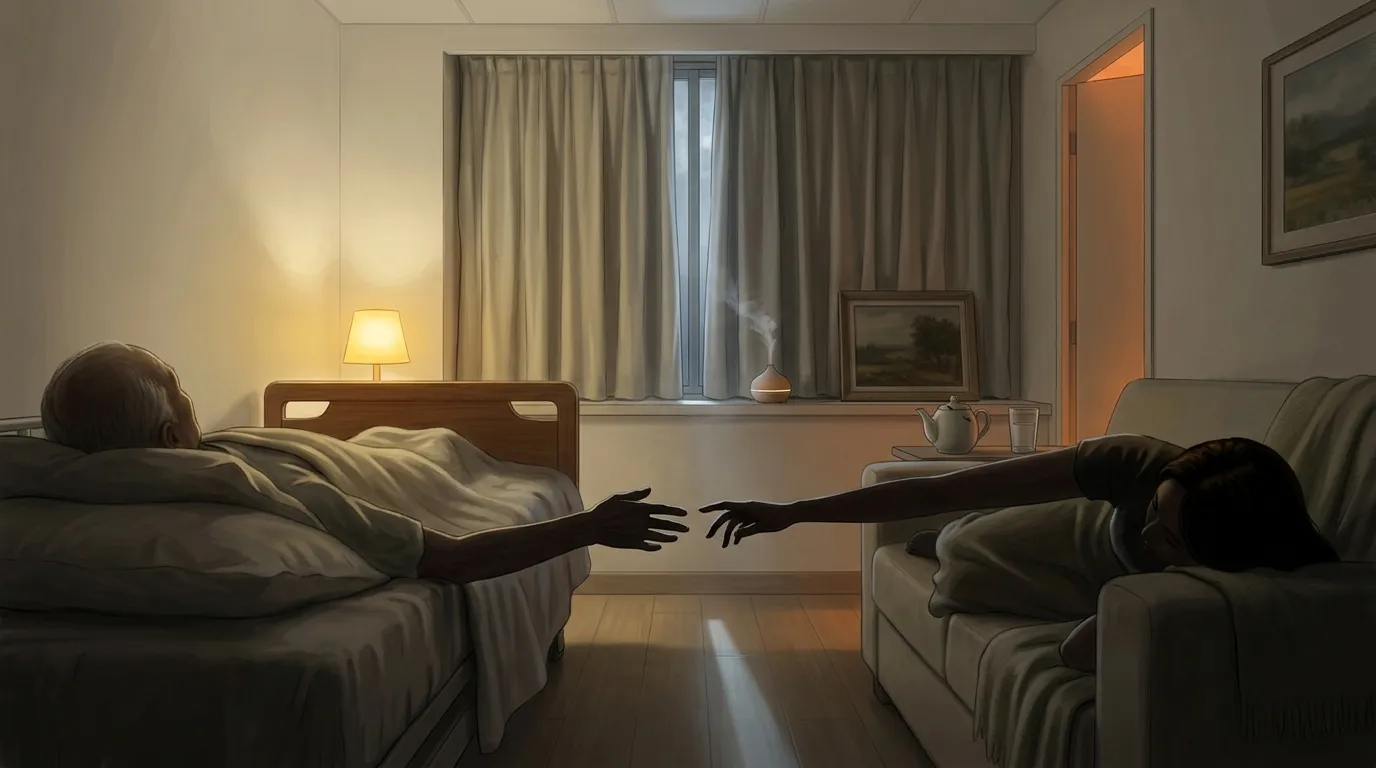
Outside there was moonlight. April moonlight, clear and thin, coming through the gap in the curtains, drawing a line of silver on the floor. Different from that line of light under the door of the old house on that other night — that one had been going dark, had been an ending. This one was bright, coming from outside, beyond the building’s control.
She lay on the sofa. After it unfolded it really was uncomfortable — a seam running down the middle, and it happened to line up exactly with her lower back. She turned over a few times. The blanket was one the nurse had given her, thin but warm enough.
She thought her father was asleep. His breathing over the past half hour had grown slower and slower, shallower and shallower, like a tide going out a very long way.
“You were afraid of the dark when you were small.”
His voice came from the bed — quiet, but in the stillness of this room every word came through clear, as if amplified.
She didn’t move.
“Every night you’d call for me to come and turn on your light.”
She turned onto her side, facing him. In the dark she could only make out his outline — the rise of the blanket, the shape of his head on the pillow. The bedside lamp’s light traced the faintest edge of his jaw.
“I don’t remember that,” she said.
“Of course you don’t.” He paused. “But every time I came to your room, I’d find you hadn’t closed your eyes at all. You just wanted to see me walk in.”
Something moved inside her chest. Something that had been sealed a long time — pressed down under the quality-control reports, pressed down under the caregiving schedules, pressed down under the medication lists and blood-pressure readings and temperature logs — that thing began pushing upward from below.
“You weren’t afraid of the dark.” His voice went softer. “You wanted to be sure I was there.”
Her sinuses ached. The ache spread from the bridge of her nose up to her eye sockets, to her temples, across her whole face. Her breathing went shallow — the space inside her chest was taken up by whatever was pushing up from below, leaving less room for air.
She was not that small girl afraid of the dark. She was thirty-eight. She had left her job. She got up at five o’clock every morning, checked the medication schedule, measured the blood pressure, recorded every bowel movement, argued with the insurance company, navigated the long-term care bureaucracy. She had put her whole life in. She had not been afraid of anything.
But he remembered.
He remembered her as the little girl who lay with her eyes open waiting for him to walk in.
Her eyes went wet. The bathroom, the three timed seconds, the pressure-cooker valve opening and closing — that was one kind of thing. The balcony, burned dry, nothing left to flow — another. What moved through her now had nothing in common with either.
When tears slid from the outer corners of her eyes she did not wipe them. No timing. No turning over to pretend she was adjusting position. The tears ran to the bridge of her nose, gathered at the wings, then slid down her cheeks and fell into the pillow. The pillow absorbed them, soundlessly.
She simply cried.
Something sealed had finally pushed open its lid, and found beneath the lid a deep well full of water — still, full to the brim, warm rather than violent. She didn’t know when all that water had been put there. Maybe the year her mother died. Maybe earlier. Maybe from the first night she stood outside her father’s study door, knuckles three centimeters from the wood.
She didn’t know how long she cried. She wasn’t keeping track. This was the first time in the past year she hadn’t kept track.
Her father didn’t speak. His body was caught in that bed — the electric one, adjustable, cotton sheets — and couldn’t get up and cross to her. Four months ago he might have been able to. Now the bed held him.
But he reached out his hand.
From beneath the blanket, his hand came past the edge of the mattress, extended toward her. Half a meter of air. His hand hung there in the space between them. As when he had walked into her room and turned on the light thirty years before — the gesture that needed no purpose beyond itself, the one that said: I am here.
She put her hand out. Touched his fingers. They were cool, the knuckles more prominent than she remembered. She didn’t grip tight. He didn’t either. The two hands rested against each other under the warm amber light of the hospice ward’s bedside lamp.
Time passed. Perhaps not much. The moonlight through the curtain shifted to another angle, and the silver line on the floor slanted.
She heard her father’s breathing grow slow and shallow again. He was almost asleep.
She drew her hand back. Turned onto her other side. Closed her eyes. The dried tears pulled the skin of her face taut.
She thought he had gone to sleep.
“Wanqi.”
His voice came as if from a great distance — the distance of consciousness going under, a sentence hauled back to the surface one last time before the descent.
“The last thing on the list…” His voice trailed. “It’s yours.”
She didn’t answer.
But she heard it.
The moonlight outside was still there. The warm amber of the bedside lamp and the cold white of the moonlight mingled on the ceiling, making an irregular shape of light. Under the hospice ward’s door came a thread of light from the corridor — warm, orange. The nursing station’s light, burning all night.
It would not go dark.