Chapter 7
An Accounting
The sofa seam pressed into her lower back. How many nights had it been — she had lost count.
Luo Wanqi lay on her side, facing the hospital bed. The nightlight’s warm yellow drew her father’s silhouette out of the dark — a mountain that kept narrowing. The shape beneath the blanket was lower than it had been a week ago.
“You awake?” Her father’s voice came from above the blanket. A statement — he’d heard her turn over.
“Mm.”
Silence. A nurse’s footsteps passed in the corridor, soft-soled shoes tapping the floor the way a finger taps a tabletop. On the windowsill the essential-oil diffuser breathed out white mist, lavender and citrus layered over the disinfectant — never quite masking it. The antiseptic smell underneath was like a stone on the riverbed. You knew it was there.
“Last item on the list.”
Her body tensed, just slightly. He had said the last item was hers. But what “hers” meant, she hadn’t asked and he hadn’t said. Those words had sat like a nail in the floor for the past several days — she’d been walking around it, leaving it alone, but each time she passed she knew it was there.
“There’s something I need you to promise me.”
She didn’t speak.
Her father raised the electric bed’s angle a little. The motor’s hum was faint — in the quiet of the ward it sounded like distant thunder. He sat up slightly; the blanket slipped from his chest to his abdomen. The nightlight lit his face with more detail now — his cheekbones sharper than a month ago, the flesh between them thinned away.
“Go find your job again.”
Her breath caught half a beat.
“Or find a new one. Go live your own life.”
“Dad —”
“Let me finish.”
His tone carried weight behind it — a door-opening kind of weight. When he used to say alright, alright, he was shutting a door. Now those words pulled one open.
“When you quit your job, I didn’t say anything. Because if I’d said something then, you wouldn’t have listened.” He paused. “You’re like your mother. Once you decide, you don’t turn back.”
She bit down on her lower lip.
“But you didn’t come here to take care of me.”
“I did —”
“You didn’t.” His voice hardened suddenly. Something in it like a nail driven into wood. “You think looking after me is your responsibility. Your responsibility is to live well.”
She sat up. The seam the sofa had pressed into her back was still there; her hand moved to it without thinking.
“I spent a whole life raising you.” He looked at the ceiling. “Not so you’d burn your own years down to keep me company through these last few months.”
She wanted to argue back. She had a hundred things she could say — you can’t decide that for me, here you go again, you always do this — but every one of them lodged in her throat. Because she heard it. This time the words were a plea.
“I’ve held onto Director Zhu’s number for you,” he said. “If you want to go back, go back. If not, find something else. But you are not allowed to —”
He coughed. Short. Dry. After it passed he drew a breath, and his rib cage pressed against the hospital gown.
“You are not allowed to turn yourself into an accounting.”
Her eyes went warm. She wasn’t crying. Something swelled behind her eyes and couldn’t find its way out.
She didn’t answer. She simply didn’t know what to do with those words. Turn yourself into an accounting. Four months of what she’d been doing had just been turned over by that sentence. She had thought she was taking care of him. He was saying she was making an accounting. An accounting of what?
“I’m not talking about this,” she said at last. Her voice was quiet, but each word came out bitten shut.
Her father didn’t press. He lowered the bed back to its original angle, pulled the blanket up to his chest. Every motion was slow, as if each joint needed to be separately persuaded.
“Think about it,” he said.
Then he closed his eyes.
She sat on the sofa looking at his profile. His breathing lengthened into the slow exhale of exhaustion.
She drew her feet up onto the sofa and wrapped her arms around her knees.
The next afternoon, her father’s energy was unnaturally good.
Thuy Hang noticed first. When she came to change the bedsheets, the father had already sat himself up — his own arms on the mattress edge, no help from the electric bed. Thuy Hang’s hands paused mid-motion.
“Make congee today,” he said. “Four bowls.”
Thuy Hang glanced at him. She had been with the Luo family for nearly two years, and she had seen every state this body passed through — from walking up and down stairs alone, to needing support, to refusing the wheelchair, to accepting the wheelchair. She knew what recovery looked like, and what this was. She said nothing. She only nodded: “All right. Four bowls.”
His daughter called his son. “Dad’s energy is very good today. Come.”
His son arrived at three in the afternoon. He brought a bag of tangerines — from which shop she couldn’t tell, the plastic bag printed with a fruit vendor’s name she didn’t recognize. He stood at the door for a moment, saw his father sitting up in bed, leaning against the raised headboard, eyes bright. Wanyang’s mouth moved slightly — but he didn’t say you look so much better today. He had learned.
Thuy Hang borrowed a folding table from the nursing station. Once the four bowls were on it there was almost no surface left. Plain congee, with a little pork floss and broken egg. The father’s bowl was a shade thicker, a few degrees cooler — Thuy Hang had adjusted it. Nobody had asked her to.
The four of them sat around the folding table. The floor lamp was on, its warm yellow casting everything in the tone of an old photograph.
The father picked up his spoon. His hand was steady today. He ate a spoonful. His expression didn’t change. A second spoonful.
“Not bad,” he said.
His son ate too. The tangerines sat on the windowsill, still in the bag. The edge of his thumb, where the skin had been raw, had gone pink again at the scab edge — he’d been picking at it without noticing while he sat, but less than last month.
“When I was young,” the father set down his spoon, “those years at the Water Resources Agency —”
His daughter’s chopsticks went still.
“There was one survey job on the Zhuoshui River. Measuring the riverbed. I took a new man with me — surname Chen, just out of military service.”
His father’s voice had a texture today she hadn’t heard in a long time. The thickness he used to have telling stories at the dinner table.
“This Chen, first day on the job, he planted the tripod legs of the survey instrument into the riverbed — mud, very soft — and then he stepped up onto the tripod to level it.”
His son looked up.
“I was watching from the side. I said don’t stand on it. He said how else am I supposed to level it. I said you’re standing on mud. He said he knew.”
The corner of the father’s mouth hooked.
“So he’s halfway through leveling, and the tripod starts sinking. One foot goes in. He can’t pull out his shoe. He reaches for the tripod — the tripod’s sinking too. Two things going down at once.”
“Then what?” his son asked.
“Then he made a decision — give up the shoe, save the instrument. He stood barefoot in the mud and carried the tripod out, mud up to his knees. The instrument was saved. The shoe was gone.”
The father paused. He looked at the congee in the bowl.
“He walked back to the car barefoot — a full kilometer. His feet cut up all over from the gravel. When he got to the car he said: Senior, the instrument is worth more than my feet.”
His son laughed. The kind that comes out through the nose.
“Then what?” his daughter asked. She heard it in the story — there was more than a story here. Still, she asked.
“Then I looked at the instrument,” her father said, “and found the lens covered in mud. He’d been carrying it face-down. The whole level had to be recalibrated from scratch.”
His son’s laugh got bigger.
“So his shoe was lost for nothing,” his daughter said.
Her father looked at her. Then he laughed. Genuine laughter — surprised out of him. Every wrinkle on his face crowded toward the center, the creases at his eyes lifted, his mouth came open, and the sound that came out was dry and soft, like sandpaper drawn slowly across wood.
Thuy Hang had been listening. Her Mandarin wasn’t quite fast enough — she’d been half a beat behind the joke. But she saw all three of them laughing, so she laughed too. Hers made no sound, only her eyes curved.
“Whatever happened to this Chen?” his son asked, his voice still carrying the last of the laugh.
“He made deputy chief engineer,” the father said. “Promoted before me.”
“Did they find the shoe?”
“They went back the next day. The mud was too deep.” He shook his head. “For thirty years afterward, whenever he told this story, he said I was the one who told him to stand on the tripod. I never once disputed it.”
His daughter’s smile was still there. She looked down at her bowl — the congee half-finished, the surface cooled over into a thin skin. She prodded it with her spoon.
“The way you let that debt with Uncle Hong drag on for thirty years before settling it was about the same, wasn’t it.”
The words came out of her without planning, and she was briefly startled by herself. The tone was flat — like stating a fact. But all three other people in the room looked at her.
His son reacted first, pulling one side of his mouth up. Her father looked at her, and for an instant something lit in his eyes — the particular brightness of you actually just said that.
“Thirty-two years,” her father said. “That’s not dragging. That’s waiting for the right moment.”
His son’s laugh broke loose properly this time. Thuy Hang watched them from the side, catching perhaps seven in ten, but she caught the rhythm — this was a normal moment, an ordinary moment, the kind of moment a family has over a meal.
Her father coughed. A tickle in the throat from too much laughing — the kind that didn’t alarm anyone. He covered his mouth with the back of his hand, coughed twice, stopped.
Nobody rushed forward. Nobody asked are you all right. His son retrieved the tangerines from the floor and put them back on the windowsill. Thuy Hang poured a cup of warm water and set it on the bedside table — at just the right distance so his arm could reach it without straining.
He picked up the cup and drank. Set it down.
“Thuy Hang.”
“Mm?”
He said it in that tilted-over pronunciation of his: “Terima kasih. Makanannya enak.”
Thuy Hang’s eyes went slightly wide — last time it had been two words, now it was a full sentence. Her lips moved, like she was translating in her head.
“Sama-sama, Pak,” she said. Then she added in Mandarin: “Your — Indonesian — has improved.”
His father’s eyebrow lifted. “I used a translation app.”
She laughed. This time there was sound — small and short, like a drop of water falling into a bowl.
The congee had gone cold. The tangerines sat in a row on the windowsill, still in the bag. The floor lamp’s warm yellow pressed the four of them into shadows on the cream-colored wall.
The father closed his eyes. The curve of a smile still on his mouth.
His son started clearing the bowls. Clumsy — the bowls stacked unevenly, a spoon knocked loose and rang against the tabletop. Thuy Hang helped him straighten it.
His daughter sat in her chair without moving. She watched her father. When he laughed just now, she’d caught sight of something very far away — the person inside a memory she carried but couldn’t usually reach. The engineer in his thirties who had cursed at new hires beside the Zhuoshui River. The man who put on dress shoes to go to Changhua. The man who wrote his list in the study at two in the morning. The same person. She couldn’t usually see it. Today she could.
She knew today would end.
Two in the morning.
Everyone had gone. His son left a little after seven, stood at the door longer than usual before leaving. Thuy Hang left at eight, tomorrow’s clothes folded in the second drawer, the medications sorted and left with the nursing station.
Before she left she stopped in the doorway.
“Wanqi jie.” Her voice was very quiet. “Tomorrow I — might come a little late. The agency — needs me to sign something.”
His daughter looked at her.
Thuy Hang didn’t explain further. But her eyes moved for just a moment. His daughter recognized that movement. She had seen it countless times on the production line — a supplier leaving a number in the report that was true, but only partly so.
The agency. Signing something. Her father still here, and Thuy Hang already arranging her next placement.
Was that wrong? Of course not. Thuy Hang had a contract, children, an agency fee, a next stop. She was here for reasons beyond love alone.
But that thought pressed against her chest for a moment. How many nights had Thuy Hang spent in this ward. Her hands knew which drawer held his medications, how thick to make the congee, how tightly to tuck the blanket. And she was also calculating. She had been calculating since the first day. Care and calculation had always been the same thing — the line had simply been lit up now.
“All right,” his daughter said.
Thuy Hang nodded. She turned and left.
After the door closed, only two people remained in the ward. Her father and her.
She lay down on the sofa. The seam pressed into her back. Her body had memorized the shape of this ridge by now.
Her father was sleeping. His breathing had changed from the day — shallower, with intervals inside it she had no name for. The nurse on the eleven o’clock round had said this is normal.
She closed her eyes.
She didn’t know how much time passed. She heard her father’s breathing shift — one long breath, one short, and between them a gap with no sound. Each gap stretched a little longer than the last.
She counted the gaps. One, two, three, four — then the breath came back. Again. One, two, three, four, five — it came back.
Her hands clenched under the blanket.
His breathing changed again. Every breath equally shallow now, like water sliding over a very flat stone — thin, barely there.
Her father’s last waking thought was not in darkness. He didn’t know when his eyes had opened — they hadn’t come fully open, too heavy for that, only a slit. Through that slit he could see the window. Nothing outside to see. The glass reflected the ward’s nightlight, painting a warm yellow circle on the black background.
The list. One — crossed off. Two — crossed off. Three — signed. Four — settled. Five —
He turned his head slightly. Very small a motion. The muscles in his neck were moving something heavier than they could bear.
The sofa. His daughter’s shape in the dark. She had pulled herself into a curl under the blanket, knees drawn up, hair spread across the pillow.
He looked.
He simply looked. With the last of the light left in that slit of eye.
His hand moved beneath the blanket. Very slight. As if reaching out — but it didn’t finish. His fingers found the blanket’s edge and stopped there.
His breathing changed. From shallow to almost nothing. The rise of his chest too small for the eye to follow.
He was not afraid. Every mark on that list had been made. Five of them. All of them.
His daughter’s shape on the sofa blurred in the dark. His sight was gathering inward. From the whole ward to one window, from one window to a warm yellow circle, from one circle to —
He closed his eyes.
The nurse’s hand was on her shoulder when she thought it was still the middle of the night.
But it was already light. Through the gap in the curtain came grey-white daylight, holding just a trace of warmth. April comes bright early.
“Ms. Luo.”
Lin Xiaopan’s voice was quiet. She wore a pink uniform; in this grey-white morning she looked like a flower someone had diluted. Her hand was still on her shoulder, not pulling back.
She knew.
She knew before the nurse spoke. The ward was too quiet. She had lain on this sofa for she didn’t know how many nights. Every night had sounds — breathing, turning over, the occasional press of the PCA button, the cart wheeling past in the corridor. Those sounds had built a background hum she’d grown so accustomed to she could no longer tell if it was quiet or noise.
Now something was missing from the background.
The breathing had stopped.
She sat up. The blanket slid from her knees.
Her father lay there. On his back, the blanket to his chest, left hand outside the covers, face turned slightly toward the window.
If not for the quiet, he looked like he was sleeping.
She stood. Barefoot. The floor was cooler than usual. Her slippers were under the sofa but she didn’t look for them.
She walked to the bed.
The nurse withdrew to the doorway. She heard the door drawn softly shut, the metal latch settling in the frame, very quiet.
She sat on the edge of the bed.
Her father’s hand. His left hand. Outside the covers. She touched it.
Still warm. Not the warmth of being alive — the warmth of having just left. The body’s heat not yet fully gone. Her fingertips touched the back of his hand, those raised veins, those ridges like a riverbed dried out and showing its stones.
She took his hand in hers.
He didn’t hold back.
Outside, the sky was brightening. The grey-white slowly took on color — a very faint orange seeping through the edge of the clouds. The day was coming.
She thought of being afraid of the dark as a child. Of calling for her father to come turn on the light every night. Of watching him walk in through the door — eyes open, watching him come.
The day had come now. Nobody needed to come turn on the light anymore.
She held his hand. She didn’t let go. The sky outside kept brightening. The ward’s nightlight was still on, but its glow had been pressed thin by the daylight.
She didn’t know how long she sat there.
His son arrived a little after nine. He stood at the door for a long time. She heard him breathing — inhaling long, exhaling short, the same as that night on the sofa. Then he came in and stood on the other side of the bed. The two of them looked at each other across their father’s body. His son’s eyes had gone red. He placed his hand on their father’s right hand.
Thuy Hang arrived at ten, today’s change of clothes in her hands. She looked once. She set the plastic bag on the chair by the door, came in, and pulled the father’s blanket up a little, tucking it at the edges. The way she did it every day.
She went to the window and turned off the essential-oil diffuser. Then she stood there, her back to them. Her fingers turned the hair tie on her wrist — the one she’d brought from home, thin, nearly stretched out.
Three weeks later.
The old house was quiet. Quieter than she ever remembered it.
Thuy Hang had left the week before. Contract ended. The agency had arranged another placement in Tainan. The day she left she’d cleaned the kitchen more thoroughly than any day she’d lived there — not a water stain on the countertop. Standing in the doorway, she said to his daughter: “Wanqi jie. Your father — good man.” Then she picked up her suitcase and left, the wheels trailing a long sound behind her down the alley.
She was alone in the upstairs study. The window was half open, and the late-April air came through, carrying a trace of dust.
Several cardboard boxes sat on the desk. His belongings. There wasn’t much. Clothes in one, books and blueprints in another. The photographs she hadn’t gone through yet — each one would take too long.
On her phone, the CareNote app notifications hadn’t been turned off. Every morning at six the reminder still chimed: Time to take blood pressure. She opened it. Four months of records. Blood pressure, temperature, medication times. Numbers sliding from November to March. A line that slowly descended.
She tapped the three dots in the upper right. Delete account. Confirmed.
The screen blinked. Four months of numbers disappeared.
The notebook.
It was at the bottom of one of the boxes. Brown cover, corners worn. She knew it too well. A5 size, the kind the stationery shop sold for twenty dollars.
She picked it up. Opened it.
First page. 1. Settle the old debt — a steady line drawn through it. Second page. 2. Wanqi’s fallback — crossed out too. Third page. 3. ACP counseling — crossed out. Fourth page. 4. Wanyang — crossed out.
She turned to the last page.
The tape was still there. Semi-transparent, its edge slightly curled. She hadn’t peeled it last time she’d touched it. She’d held back.
She pressed her fingernail under the edge. Cool. Less tacky than before — the tape had been aging, the way things do when left too long.
She pulled it off. The tape separated from the paper with a faint tearing sound — like the releasing of a seal.
Under the tape there was no list item.
No fifth entry. No entry at all.
A letter.
Her father’s handwriting. An engineer’s handwriting — square, small, the pressure even. Slightly looser than the list — the spacing between strokes wider, as if his hand moved slower than his mind.
The opening line.
Wanqi, you’ll see this page for sure.
Her eyes stopped there. Her hands didn’t shake. Something came into her chest — a deeper, slower sinking than anything before. Like stepping into warm deep water, the sand moving under her feet.
She kept reading.
The letter was short. One page. Small characters, the lines close together. She read it word by word.
The closing line.
Go. You don’t owe an accounting anymore.
She closed the notebook.
At the bottom of the box was a business card, folded many times. Zhu Qiwen. On the back, her father’s handwriting: Quality management department — ask her if she’d like to come back. She put the card in her pocket.
The notebook she put in her pocket too. Her pocket, on her body.
She stood up.
From the direction of the balcony came a sound — her brother. He’d come to help move things today. He was folding up the drying rack on the balcony, the one that had held her father’s last few shirts. The metal legs folded with a creak.
She walked out of the study. Downstairs.
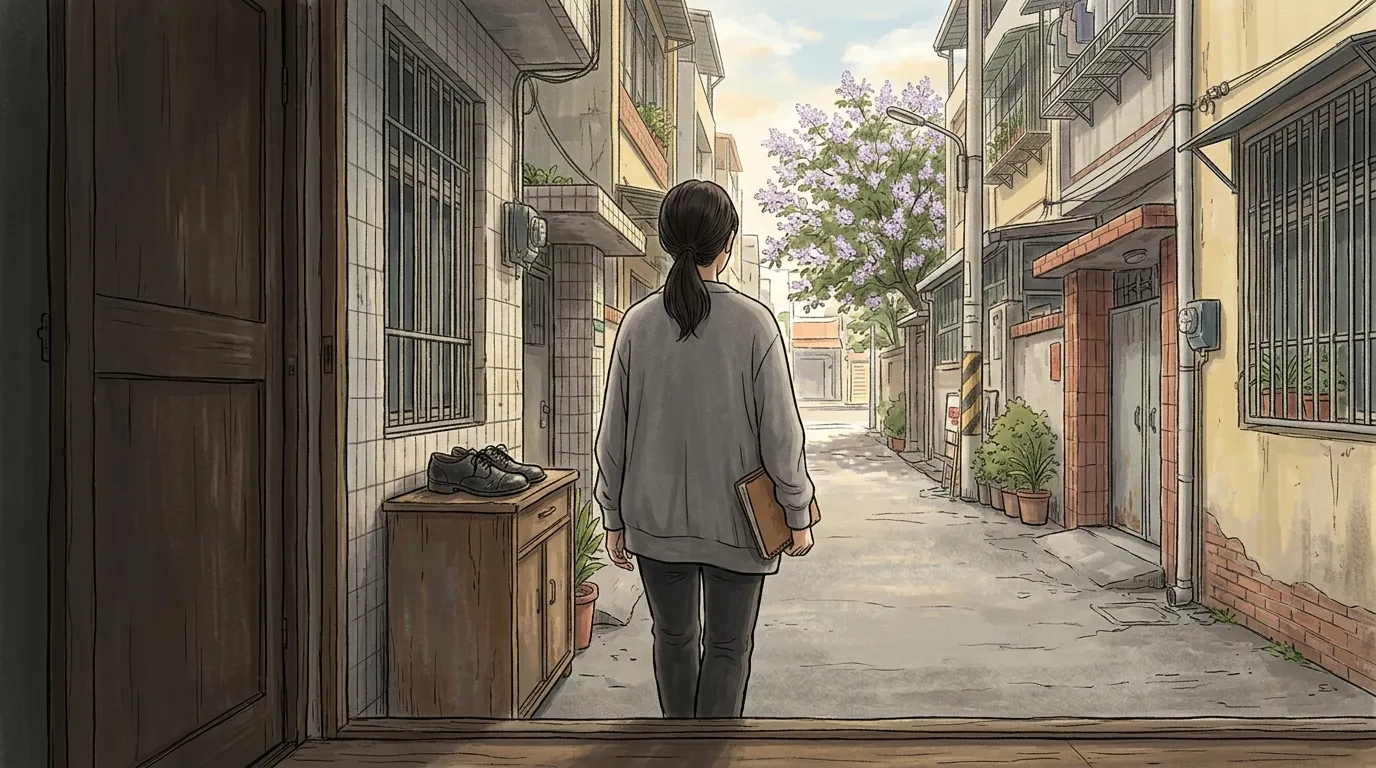
In the foyer, on the shoe rack, her father’s black leather shoes sat where they’d been left. Her brother had probably taken them out of a box. The leather was creased, the laces still tied. She looked at them for two seconds. She didn’t touch them.
The front door opened.
The air outside held the smell of trees — the Chinese bead tree at the mouth of the alley was in bloom, a faint bitter sweetness, mixed with the smell of asphalt warming in the sun. Late April in Taichung.
She stepped outside.
The corner of the notebook pressed hard through her pocket against her thigh. The business card sat in the other pocket. Her phone in the back pocket.
She stood in the alley. Ahead was the mouth of the alley. Beyond it was the road. On the road there were cars, people, sound.
She breathed in, deep. Her chest spread open for a moment. Then slowly let it go.
She walked forward.