Chapter 4
Social Dysfunction
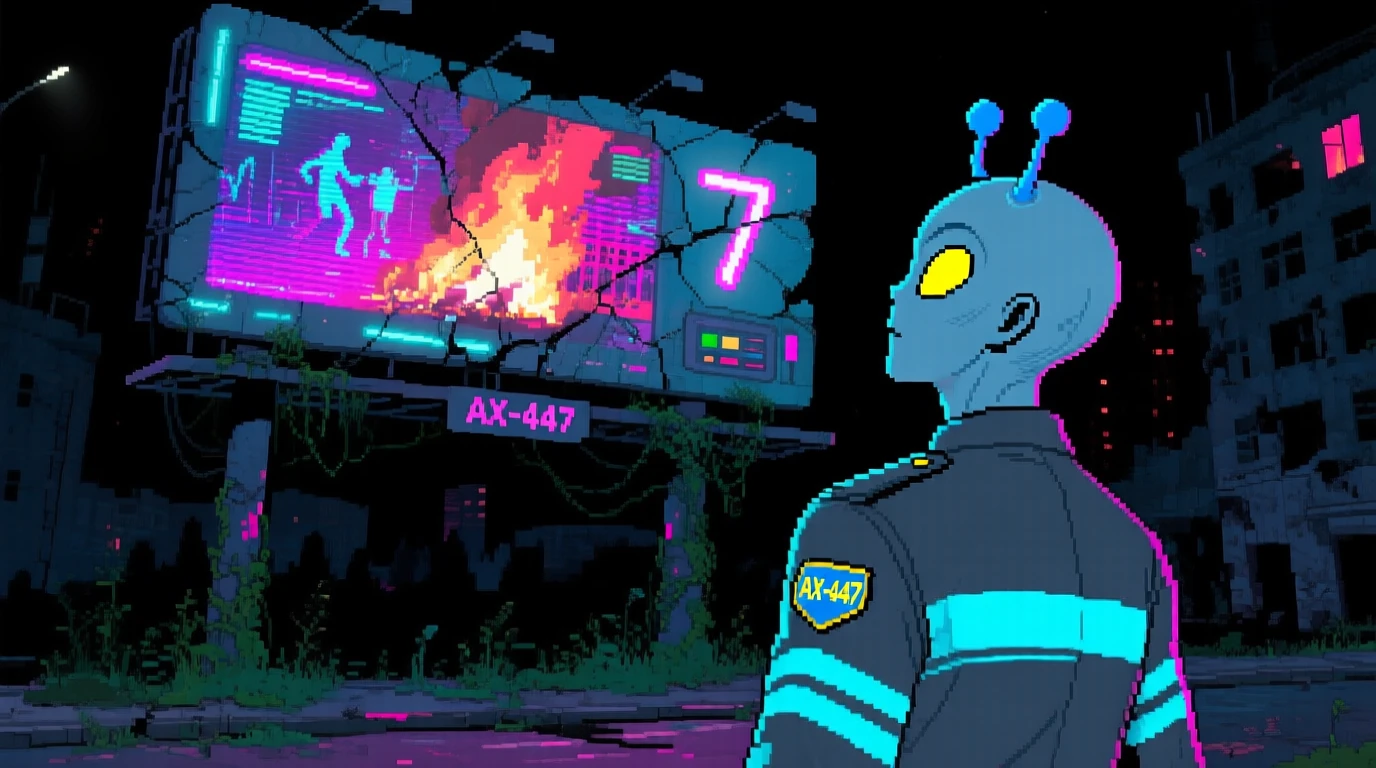
Ax stood inside the transport pod, his fingers setting coordinates on the control panel. Earth, the home planet of human civilization, seven standard years after its extinction. He pressed the activation button. A blue-white light rose from beneath his feet. Space warped, stretched, folded around him, then settled into stillness.
He opened his eyes.
He stood in an empty plaza. Underfoot, cracked concrete with weeds and vines sprouting from the gaps. The air was damp, carrying a faint smell of mildew and metal. He looked up. The sky was pale gray, clouds low, as if it were about to rain.
He turned, scanning his surroundings. Around the plaza stood buildings of varying heights—most windows broken, walls covered in green creepers. A few abandoned cars sat at the roadside, tires flat, bodies rusted. A streetlamp lay on its side, its shade shattered, revealing a blackened bulb inside.
He looked down at the ground. A phone lay among the concrete fragments—screen cracked, battery swollen, frame bent. He crouched and touched it with a fingertip. No response. No power. No life.
He stood up, opened his holographic recorder, and began filming. Standard Bureau procedure: field investigations must leave visual evidence, attached as appendices to the case-closure report.
He walked toward the edge of the plaza. There stood a building with a faded sign above its entrance—only a few characters still legible: “Municipal… Library.” He pushed open the half-closed door and stepped inside.
Light streamed in through broken skylights, illuminating dust particles dancing in the air. Bookshelves had toppled, books scattered across the floor—pages yellowed and brittle, covers smudged beyond recognition. He picked up a book and opened it. The pages were stuck together from moisture, impossible to separate. He placed it back and moved on.
Deep inside the library, he found a cleared area. Bookshelves had been pushed aside. In the center stood a table, on it a phone mounted on a ring light. The table drawer was half open, stuffed with cosmetics and props—wigs, sunglasses, gaudy necklaces. On the wall hung a handwritten poster: “Short-Form Video Shooting Scene Rental – Fifty Dollars per Hour.”
Ax stared at that poster for a long time.
He kept walking. Out of the library, along the street. Most shops on either side were closed—windows smashed, shelves empty. He passed a pharmacy. The counter’s medicine racks were nearly bare, only a few boxes of expired cold medicine left. He passed a restaurant. Pots and pans scattered across the kitchen floor, refrigerator door open, interior black with mold.
He stopped in front of a building. On its outer wall hung a sign, the lettering still fairly clear: “Global Nuclear Fusion Research Headquarters.” He pushed open the door and went in.
The lobby was spacious and bright—though the power was cut, large glass curtain walls let in ample light. Behind the reception counter hung a huge poster: “Clean Energy, Infinite Future.” The lower half of the poster was covered by a smaller sheet of paper, which bore another line: “Venue for Rent – Suitable for Dance Videos, Challenge Videos, Food Videos. Daily Rate Negotiable.”
Ax walked to the counter. On it lay a tablet, screen cracked but still showing part of its display. He tried to power it on—no response. He flipped the tablet over and saw a label on the back: “This device has been repurposed for short-form video platform content management system. Original research data backed up to… (illegible).”
He set the tablet down and headed deeper into the building. Most laboratory doors were open. Equipment was coated in dust, cables hanging loose. In one lab he found a whiteboard with handwritten equations and notes—calculations for nuclear fusion plasma confinement. Next to the equations, someone had drawn a smiley face in red marker, with the note: “Scrolled short-form videos for six hours again today. Will continue the calculations tomorrow.”
Ax recorded the whiteboard with his holographic imager.
He left the fusion research center and continued on. The sky gradually darkened. He switched on his portable lamp. The silhouettes of buildings along the street blurred in the twilight. Abandoned vehicles crouched like silent animals by the roadside. He passed a school—weeds in the playground reached knee height, a basketball hoop had fallen, classroom windows were pitch black.
He stopped at the school gate and noticed a notice taped to the door. The paper was yellowed, edges curled. The title read: “This school is hereby converted into a short-form video creator training center. Original courses suspended. Resumption date to be announced.” The date on the notice was fifty years after the birth of short-form video.
Ax photographed the notice.
He kept walking. The heart of the city—once the most prosperous commercial district—now resembled a stone forest. In clothing store windows, mannequins wore faded outfits, heads tilted as if watching something. In an electronics shop, display screens were all black, dust thick.
He found a restaurant with its door still open. He went in. The kitchen smelled of rot. A pot on the stove still held dried black residue. In the dining area, several phones lay on tables—screens cracked, batteries swollen. One phone was still connected to a charging cable, but the cable’s other end was broken, copper wires exposed.
He picked up that phone and tried pressing the power button. Nothing. He tried another. Nothing.
As he was about to leave, his peripheral vision caught a piece of paper taped to the wall. The note was held with tape, handwriting scrawled: “The Last Milan – Short-form video shooting, unlimited time, fifty dollars per session. Free WiFi included. Password: iloveshortformvideo.”
He reached out, tore off the note, and placed it in his sample bag.
He walked out of the restaurant and stood in the middle of the street for a while. The sky was almost fully dark. The city’s outline had become a blur of shadows. He switched on his lamp, its beam lighting the road ahead.
He continued along the street, passing a subway entrance. Moss covered the steps, railings rusted, gates open, the interior pitch black. He didn’t go down—he didn’t need to. He already knew what it looked like inside.
He arrived at a park. Trees had grown wild, branches intertwining into a dark canopy. Benches had tipped over, playground equipment rusted, swing chains swaying gently in the wind. He crossed the park and exited on the other side.
Across the exit stood a building that looked like it had once been some kind of public facility. He approached and saw it was the “Municipal Hospital.” The glass doors were shattered. The lobby was chaos—wheelchairs overturned, medical records scattered, waiting area TV screens broken.
He stepped inside. The corridor was lit by emergency lights—a few still glowed faintly green. He moved down the hall, past empty wards. Beds were neatly made, but the sheets were thick with dust.
He reached the emergency room. The door was open. Most equipment was still there, but monitors were black, cables hanging. He noticed a whiteboard on the wall with handwritten records—patient names, symptoms, treatments. He leaned in. The last entry was dated seventy-two years after the birth of short-form video.
“Patient: Male, approximately 40. Chief complaint: dehydration, malnutrition, multiple pressure ulcers. Family report: patient watched short-form videos continuously for 48 hours without eating or drinking. Treatment: IV fluids, nutritional support. Prognosis: stable.”
Next entry:
“Patient: Female, approximately 30. Chief complaint: retinal detachment in right eye. Family report: patient watched short-form videos continuously for 72 hours without sleep. Treatment: referral to ophthalmology. Note: ophthalmology department closed.”
Next entry:
“Patient: Male, approximately 20. Chief complaint: left thumb tendon rupture. Family report: caused by excessive screen swiping. Treatment: bandage and immobilization, advised rest. Note: patient requested to bring phone into ward.”
Ax looked at these records without speaking. He photographed the whiteboard.
He walked out of the hospital and stopped at the entrance. The night wind blew, carrying the smell of plants and earth. He looked up at the sky—the clouds had parted a little, revealing a few stars. Humanity’s ancestors had once gazed at the same stars, imagining whether other intelligent life existed up there. Now, one of those intelligent beings stood among their ruins, looking at the traces they had left behind.
He began walking back. The return coordinates for the transport pod were already set; he just needed to reach the plaza to activate it.
On his way back, he passed a building with a huge electronic billboard on its outer wall. The screen was cracked, but part of it still glowed—a faint light flickering in the darkness. He stopped and watched the billboard.
It was playing a video. Quality was poor, colors distorted, but the content was still recognizable—a person dancing, with a burning building in the background. Flames flickered in the video, the dancer swaying to an inaudible rhythm. In the corner of the video, numbers scrolled—like count, comment count, share count. The numbers were still moving—slowly, intermittently, as if a handful of humans somewhere were still watching this video.
Ax stood there, watching the video loop. With each repeat, the like count increased by a few hundred, a few dozen, single digits. The final number stopped at “7.” It didn’t move again.
He turned and continued back.
By the time he reached the plaza, it was completely dark. He stood at the activation point—a relatively clean patch of concrete—opened the control panel, and input the return command. The blue-white light rose again. Space warped, folded, then settled.
He opened his eyes. The light of the Bureau was uniform and bright, no shadows, no corners. He stood inside the transport pod, his holographic recorder full of image data.
He stepped out of the pod and returned to his cubicle. The holographic screen lit up, displaying the timer: forty-seven point three standard hours remaining.
He opened his notebook and wrote: “The last brick-and-mortar bookstore of human civilization was converted into a short-form video shooting scene rental shop. The last nuclear fusion research center rented out its venue to short-form video creators. The last hospital’s whiteboard recorded direct injuries caused by short-form videos. The last electronic billboard played the last dance.”
He paused, looking at these words.
Then he wrote the final line: “Human civilization wasn’t killed by short-form videos. They chose short-form videos—over and over, until there were no other choices left.”
He closed the notebook, leaned back in his chair, and shut his eyes.
The uniform white light penetrated his eyelids—no warmth, no weight. He sat in that light for a long time, until the timer emitted a soft beep—a reminder that he still had a report to write.
He opened his eyes and began organizing the investigation data.