Chapter 5
The Last Dance
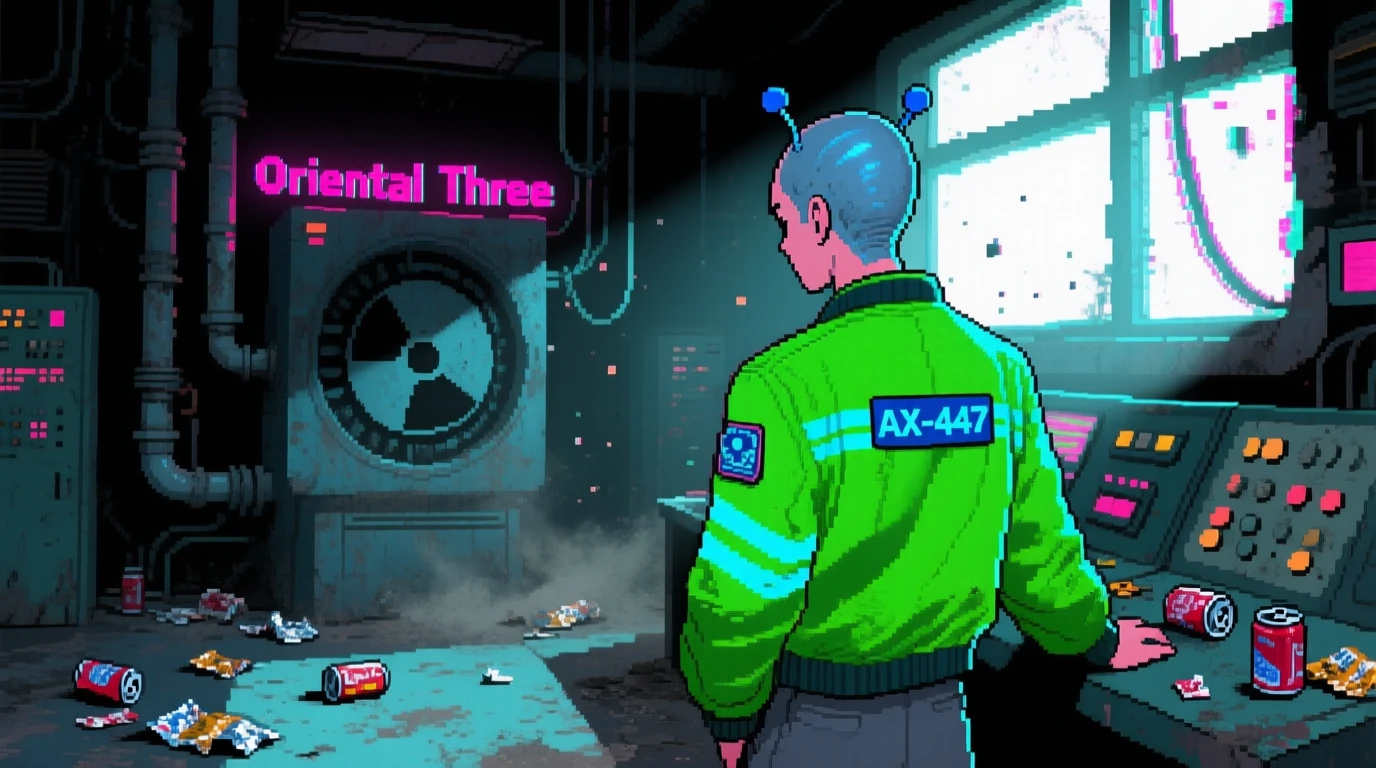
Ax sat in his cubicle, watching the timer flicker on the holographic screen.
Forty point six standard hours. It had been about seven hours since he returned to the Bureau from his field investigation—but he had barely moved. He’d been watching that video. The last dance playing on the electronic billboard from the holographic record he brought back from Earth. A person dancing in front of a burning building. Flames jumping, limbs swaying, the like count slowly pulsing in the dark, finally stopping at “7.”
He had replayed the video countless times—each time trying to find some meaning, some metaphor, some profound truth that could explain why a civilization would choose self-destruction. But the video was just a video. A person dancing. The background burning.
He shut down the holographic record and opened the database of human civilization archives. He typed in the keywords: “Last viral video.” When the search results appeared, he froze. It wasn’t one video. It was an entire folder—a complete backup of the final wave of mass uploads on the short-form video platform at the end of human civilization. The file dates spanned from November of the seventy-second year after short-form video’s birth to March of the seventy-third—about five months total. The data volume was staggering, but most views were concentrated on a handful of content.
He sorted by view count. The first video was titled: “The Last Dance of Humanity.”
He clicked it. The screen loaded. A young man stood in front of a massive machine—Ax recognized it as a plasma confinement device for a nuclear fusion reactor, probably the “Eastern Three” or “Sun God Seven” model; he’d seen similar equipment during his field investigation. The young man wore a fluorescent green top and sunglasses, flashing a bright smile at the camera.
Music started. A low bass beat, a simple repeating melody.
The young man began to dance. The moves were simple—swaying left and right, waving, spinning, occasionally throwing up a hand gesture. He wasn’t a great dancer, but he was full of confidence. Behind him, the nuclear fusion reactor emitted a blue-white glow, plasma burning steadily inside the magnetic confinement like a trapped star.
Ax looked at the data below the video.
Upload time: February 14, seventy-third year after short-form video’s birth.
Views: 4.7 billion.
Likes: 1.2 billion.
Comments: 300 million.
Shares: 800 million.
He opened the comment section and found most replies repeated the same phrase: “The last dance.” Some added a smiley face, some added a heart, some added a flame. A few comments asked “Where is this?” but received no answers.
He closed the comments and scrolled down to the video details. The shooting location coordinates were marked—Global Nuclear Fusion Research Headquarters, Lab 2. He had been there before, seen the whiteboard that read “Scrolled short-form videos for another six hours today.”
He watched the video again. The young man danced in front of the reactor, the plasma light illuminating his face. In the final seconds, the young man gave a thumbs-up to the camera, then the screen went black.
Ax leaned back in his chair, staring at the frozen image on the holographic screen.
He thought about the things he had seen in Earth’s ruins: libraries turned into filming sets, research centers rented out as venues, hospital whiteboards recording dehydration and retinal detachment. Those were signs, indicators, data points. But even together, they still couldn’t explain one thing—
Why?
Why would a civilization that had mastered nuclear fusion, quantum computing, and gene editing dance its last dance in front of a reactor?
He stood up, left the cubicle, and walked toward the supervisor’s office.
AX-001 was sitting behind the desk, a case-closure report spread out in front of him—probably Zoltan’s just-submitted documentation on the pet rock civilization. He looked up at Ax and raised an eyebrow.
“You’re still here.”
“I need to apply for another cross-dimensional transport.”
Zero-One put down the report, his expression unchanged. “You already went last time.”
“That was observation. This time it’s evidence collection.”
“What evidence?”
Ax opened a holographic screen and pulled up the data page for “The Last Dance of Humanity.” “This video. The last viral video from the end of human civilization. Shooting location is the nuclear fusion research center, upload time less than a year before extinction. I need to confirm some details.”
Zero-One glanced at the screen, then at Ax. “What details?”
“The video’s propagation path. How it spread, who promoted it, what the viewers got out of it,” Ax said. “And—why it was made.”
“Because someone wanted to be famous,” Zero-One said.
“It’s more than that.”
Zero-One sighed and held out his hand. “Application form.”
Ax transmitted the prepared documents. Zero-One scanned them, signed at the bottom, and tossed the file back. “Seventy-two hours.”
“Last time—”
“Last time was last time. This is your personal additional investigation, deducted from your own performance quota,” Zero-One said. “Seventy-two hours. If you go over, I’ll submit your case-closure report using the default template.”
Ax took the file. He thought about how he’d submitted on time last time, but didn’t say it aloud. “That’s enough.”
“That’s what you said last time.”
Ax didn’t argue. He turned and walked out of the office toward the transport pod.
The pod’s lights came on again, blue-white glow rising from his feet. Space warped, stretched, folded—then settled.
He opened his eyes.
Earth. Same city, same ruins. But this time he chose a different landing point—the main entrance of the Global Nuclear Fusion Research Headquarters.
The building was more dilapidated than when he last saw it. Weeds grew through cracks, climbing plants covered the exterior walls, glass curtain walls shattered, revealing dark spaces inside. He pushed open the door and entered the lobby.
The air in the lobby was stale and damp, carrying the smell of dust and metal. The poster behind the reception desk had faded, the words “Clean Energy, Infinite Future” barely legible. He walked around the counter and headed deeper into the building.
Most of the labs along the corridor were open, equipment covered in dust. He passed the lab with the whiteboard—the formulas were still there, the smiley face, the red-inked note “Scrolled short-form videos for another six hours today.” He didn’t stop; he kept moving.
Lab 2 was at the bottom of the building, near the core area of the plasma confinement device. He pushed the door open and stepped inside.
The lab was larger than he expected. In the center stood the nuclear fusion reactor—the “Eastern Three” or “Sun God Seven,” he still couldn’t determine the model, but it didn’t affect his assessment. The reactor was shut down, the plasma extinguished, the magnetic confinement zeroed. A layer of dust had settled on the metal shell, cables hung loose, control panels black.
He turned on the holographic recorder and began filming.
The lab floor was scattered with debris: empty drink cans, snack wrappers, a fluorescent green top—identical to the one the young man wore in the video. He picked it up and found a name tag on the collar, reading “Chen,” title “Contract Research Assistant.”
He placed the top into a sample bag.
He continued searching the lab. On a table in the corner, he found a laptop with a cracked screen, but the hard drive seemed intact. He packed the computer to take back to the Bureau and try to read.
Under the table, he kicked a metal box. About the size of a palm, silver, with scuff marks. He picked it up, opened the lid—inside was a data chip, intact, no visible physical damage.
He inserted the chip into a reader and connected it to his holographic device.
The chip’s content began loading. Most files were corrupted and unreadable, but one folder was relatively complete—it contained the original shooting file of “The Last Dance of Humanity,” along with post-production records, upload timestamps, and platform backend data.
Ax checked these files one by one.
Shooting time: February 14, seventy-third year after short-form video’s birth, 3:42 p.m.
Shooter: Chen (Contract Research Assistant).
Device: Handheld smartphone, model unknown.
Post-production: None. Original video uploaded directly.
Platform: FlashVid (one of the short-form video platforms).
Promotion method: Organic spread, no paid promotion.
Data: Views broke 100 million within four hours of upload, 1 billion within 48 hours, 4 billion within a week.
Comment keyword frequency analysis: “The last dance” appeared most often, followed by “legend,” “epic,” “lol.”
Ax looked at the data without speaking.
He continued scrolling and found a text file named “Notes.” The content was very short, just a few lines:
“Today is the last test. The reactor is being shut down, funding cut, team disbanded. No one cares anyway—everyone’s just scrolling short-form videos. I wanted to film something to remember, but I didn’t know what to film. Forget it, I’ll just dance. At least someone will watch.”
Signed: Chen.
Timestamp: February 14, seventy-third year after short-form video’s birth, 3:41 p.m.
Ax closed the file. Humans’ notes were more honest than their nuclear fusion reactors, he thought.
He put the data chip away.
He stood up and looked around the lab. Empty space, silent reactor, dust-covered floor. A young man danced his last dance here, then 4.7 billion people watched it, 1.2 billion liked it, 300 million commented. He couldn’t understand the logic of “just five more minutes of scrolling”—if there were only five minutes left, why not use them for one last thing?
He walked out of the lab and headed back along the corridor. When he passed the lobby, he stopped at the reception desk. A tablet lay on the counter—different from the one he saw last time, this one still had some battery. He tried to boot it up; the screen lit up, showing a login screen.
It was FlashVid’s login page.
The username field was already filled in: “last_dance_final.” The password field was blank.
He tried a few random password combinations—all failed. He gave up on logging in and instead checked the device’s local storage. The tablet still had some residual files—mostly cache data from the short-form video platform, plus a few screenshots.
One screenshot caught his attention.
It was a screenshot of a news report with the headline: “The Last President Delivers Farewell Speech, Urges Citizens to ‘Just Scroll Five More Minutes.’” The news publication date was March of the seventy-third year after short-form video’s birth—the year human civilization ended.
He clicked on the screenshot, trying to zoom in and read the text, but the resolution was too low; most of the text was blurry. He could only make out fragments: “…the president stated in his speech that although civilization faces… he believed that as long as… they could get through the crisis… finally he smiled and said: ‘Just scroll five more minutes.’”
Ax stared at the screenshot, feeling a sense of desolation—not sadness, not shock, but a calmer, colder feeling. Like standing at the edge of a cliff, watching someone jump voluntarily, then realizing the jumper didn’t feel like they were falling—they felt like they were flying.
He turned off the tablet and walked out of the research center.
Outside, the sky had darkened. He stood on the building’s steps, watching the city’s silhouette blur into dusk. Abandoned buildings stood like silent tombstones, streets empty, streetlights dead, only the low moan of wind passing through gaps.
He turned on the holographic recorder and filmed an environment shot. The lens slowly panned across streets, buildings, sky. No lights, no sound, no life.
He put away the recorder and began walking back.
The return coordinates for the transport pod were already set; he just needed to reach the landing point to activate it. He moved along the streets, passing familiar ruins—a library, a pharmacy, a restaurant, a school, a hospital. Each building told the same story: people once lived here, then they went somewhere else—into the screens.
He stopped in front of a small monument. It stood at the center of a crossroads, seemingly cast from concrete in a rough shape, irregular and coarse. An inscription was carved into the stone: “To the last person who put down their phone.”
No date, no signature.
Ax stood in front of the monument for a long time. Humans even wrote their epitaphs like short-form video captions— “Forget it, I’ll just dance.”
Then he kept walking.
By the time he returned to the landing point, the sky was completely dark. He stood in the transport pod’s activation zone—a relatively flat patch of concrete—opened the control panel, and input the return command. Blue-white light rose again, space warped, folded, then settled.
He opened his eyes. The Bureau’s light was uniform and bright.
He stepped out of the pod and returned to his cubicle. The holographic screen lit up, displaying the timer—68.7 standard hours remaining.
He placed the data chip and the laptop on the desk, opened the holographic notebook, and began organizing the findings from this investigation.
“The last viral video of human civilization was filmed in Lab 2 of the Global Nuclear Fusion Research Headquarters. The shooter was a contract research assistant, codename ‘Chen.’ Video content: a person dancing in front of a reactor. Upload time: approximately one year before extinction. Views: 4.7 billion.”
He paused, looking at these words.
Then he continued: “The last president of human civilization’s final words—‘Just scroll five more minutes.’”
He paused again.
He recalled the electronic billboard he saw during the field investigation—that video of a person dancing against a burning background, the like count slowly pulsing, finally stopping at “7.” He recalled the hospital whiteboard records: dehydration, retinal detachment, tendon rupture. He recalled the library turned into a filming set, the nuclear fusion research center rented out as a venue, the school turned into a short-form video training center.
He recalled what the young man wrote in the notes file: “No one cares anyway—everyone’s just scrolling short-form videos.”
He closed the notebook and leaned back in his chair.
Uniform white light fell from the ceiling, illuminating the entire space. He closed his eyes and sat in the light for a while. Then he opened his eyes, opened the development timeline of human civilization, and stared at the curve that started 300,000 years ago and ended in the seventy-third year after short-form video’s birth.
300,000 years of evolution, 73 years of self-destruction.
He looked at the curve and thought about the data—the average daily time spent on short-form videos grew from 58 minutes to 12.7 hours, nuclear fusion funding was diverted, quantum computing power was used for recommendation algorithms, gene editing was used to improve infant looks. Every technological breakthrough ultimately pointed in the same direction—the screen.
He recalled what Zero-One had said: “Humans are not the first civilization to do this, and they won’t be the last.”
He stood up, left the cubicle, and walked toward the break room. The break room was empty. He poured himself a cup—the Bureau’s standard drink, which tasted like diluted honey water—then leaned against the wall and drank slowly.
Zoltan came from the other end of the corridor, holding a mug that read “PL-9 Souvenir: I Went to the Pet Rock Planet and All I Got Was This Damn Mug.”
“You’re still not off work?” Zoltan asked.
“Still writing the report,” Ax said.
“The human one?”
Ax nodded.
Zoltan poured himself a drink and stood beside him. “Find anything?”
Ax was silent for a moment, then said: “Humans achieved nuclear fusion in the same year that short-form video users hit their peak.”
Zoltan didn’t speak.
“Two forms of energy,” Ax continued. “One was physical energy—clean, infinite, the kind that could light up an entire civilization. The other was attention energy—finite, renewable, but compressible and extractable. Humans chose the latter.”
“Because the former requires effort, the latter just requires a swipe,” Zoltan said.
Ax looked at him. “How do you know?”
“Because my pet rock civilization had a similar story.” Zoltan took a sip. “They invented self-replicating rocks—a material that could reproduce infinitely without any resources—theoretically solving all material scarcity. But guess what they used the technology for?”
“What?”
“To replicate more rocks,” Zoltan said. “They treated rocks as pets, spent hours every day talking to them, bathing them, naming them. They invented a technology that could solve hunger, and they used it to solve loneliness—but the loneliness wasn’t solved, because they were too busy talking to rocks to talk to each other. In the end, they starved to death, because nobody remembered to farm.”
Ax was silent for a moment. “So humans aren’t special.”
“Of course not,” Zoltan said. “Every civilization at some point faces a choice—keep moving forward, or stop and do something easier, more pleasant, but meaningless. Most choose the latter. Why do you think the Bureau’s closure rate is so high? Because most civilizations die that way. Not destroyed—they choose to destroy themselves.”
He finished his drink, placed the mug on the counter. “When’s your report due?”
“Still sixty-eight hours.”
“That’s enough time to rewrite it three times,” Zoltan said. “Good luck.”
He turned and walked out of the break room, leaving Ax standing alone.
Ax finished his drink, washed the cup, and put it back. He walked back to his cubicle, sat down, and opened his notebook.
He stared at the 300,000-year curve, watching it plummet in the final seventy years. He looked at the data: average daily short-form video usage, attention threshold decline curve, nuclear fusion funding transfer chart, quantum computing power allocation pie chart. He looked at the photos: the library turned into a filming set, the research center’s rental notice, the hospital whiteboard records, the last dance on the electronic billboard.
He began to write.
“Cause of extinction of human civilization (codenamed HS-3): short-form video. Detailed analysis in attached documents. Conclusion: This civilization, despite possessing sufficient resources and technology to avoid destruction, collectively chose to indulge in a form of entertainment characterized by short duration, high frequency, and low information density, ultimately leading to comprehensive social dysfunction, infrastructure collapse, resource misallocation, and—”
He paused, thinking how to write the last sentence.
He remembered the young man’s notes file: “No one cares anyway—everyone’s just scrolling short-form videos.”
He remembered the inscription on the monument: “To the last person who put down their phone.”
He remembered the last president’s final words: “Just scroll five more minutes.”
He wrote the final sentence: “And—the disappearance of collective will.”
He closed the notebook and looked at the timer flickering on the holographic screen. 67.4 standard hours remaining.
He opened the template for Format A3-7b and began filling it in.
On the cover, under cause of extinction, he typed two words: “short-form video.” He paused for a moment—then quickly typed the two characters, as if finishing the title of a joke.
Then he opened the attachments and began organizing all the data, photos, videos, and notes files he had collected over the past few days, sorting and categorizing and archiving them one by one. His movements were slow and precise, like an archaeologist cleaning an unearthed artifact—carefully brushing away the dust, letting the original shape gradually reveal itself.
The last dance of human civilization. 4.7 billion people watched it.
Then, no one danced anymore.