Chapter 6
Misplaced Technology
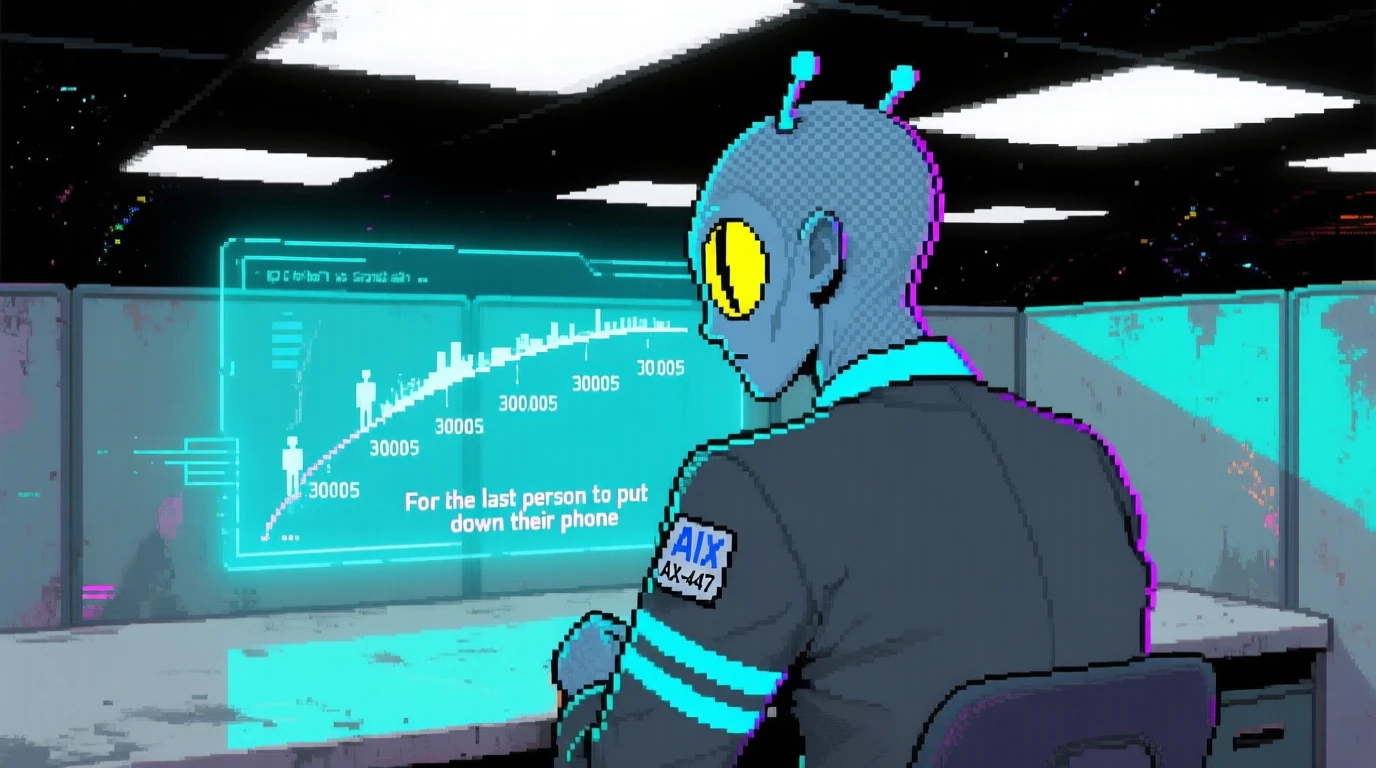
Ax sat in his cubicle, the holographic screen in front of him displaying the data files he’d brought back from Earth. The data chip had finished reading, and most of the laptop’s hard drive had been successfully extracted. He’d spent three standard hours sorting, tagging, and filing everything. Now the screen showed a preliminary catalog of organized data.
He opened the first folder: “Quantum Computing Resource Allocation Report.”
The document came from the fortieth year after the birth of short-form video in human civilization—the same year humanity achieved quantum supremacy. The report was published by a national research institute and titled: “Optimization of Short-Form Video Recommendation Algorithms Based on Quantum Computing: Feasibility and Expected Benefit Analysis.”
Ax skimmed through the content. The language was standard academic format—abstract, methodology, anticipated outcomes, budget requirements—but the more he read, the more something felt off. The “anticipated outcomes” mentioned in the report weren’t scientific breakthroughs or technological innovations. They were “thirty percent increase in average user session time,” “content-matching accuracy improved to 99.7 percent,” and “ad conversion rate doubled.”
He opened the appendix and found a budget allocation table. Out of the total quantum computing research budget, sixty percent was allocated to short-form video recommendation algorithm optimization. Of the remaining forty percent, climate change model computation took fifteen percent, drug molecule simulation took twelve percent, fundamental physics research took ten percent, and other projects split the last three percent.
He stopped and stared at the number. Sixty percent. Humanity’s most advanced computing technology—six-tenths of its processing power used to decide who should see the next fifteen-second video.
He kept scrolling. The last page of the report was the approval record—the project received full funding from the national science and technology development fund, and the approval date was only fourteen days after the submission date. That same year’s climate change research funding request was marked “under review,” and it took three years to get approved—for only one-tenth of the short-form video optimization project’s budget.
Ax closed the file and opened another folder: “Meiyuan Genetics—Business Plan.”
This document was older—from the thirty-fifth year after short-form video’s birth. The cover was a rendered image: a perfectly symmetrical human infant face, with the tagline “Born a Winner” beneath it. The text described in detail the application of gene-editing technology to embryo appearance optimization—including facial symmetry, skin pigmentation, hair density, height potential—all with “short-form video camera friendliness” as the core metric.
He flipped to the market analysis section. The forecast showed that the market size of the “looks economy” on short-form video platforms would reach numbers unprecedented in human history within the next ten years—surpassing the total value of the global food industry. The report’s conclusion read: “The first large-scale commercial application of gene-editing technology shouldn’t be to cure disease—it should be to create perfection.”
Ax leaned back in his chair, staring at that line on the screen.
He remembered the hospital he’d seen during the field investigation—the whiteboard recording dehydration, retinal detachment, tendon rupture. Gene editing was used to create faces better suited for scrolling short-form videos, and the hospital was filled with people whose bodies had collapsed from scrolling short-form videos.
He closed the file and opened the third folder: “Short-Form Video Platform Development History.”
This was an internal memo from one of humanity’s largest short-form video companies. The document recorded the platform’s key technological evolution: from the earliest simple recommendation algorithms, to the introduction of deep learning, reinforcement learning, attention prediction models, and finally the “full-brain hijack system”—a system capable of predicting a user’s brain reward response before they even watched a video, and pushing the most effective content before the user themselves were aware of it.
The last page of the memo read: “Our goal is not to make users happy—it’s to make them unable to stop.”
Ax looked at that line and said nothing.
He remembered the curve on the timeline of human civilization—a slow climb over three hundred thousand years, then a vertical plunge in the last seventy years. He remembered the data: average daily short-form video watch time grew from fifty-eight minutes to twelve point seven hours; attention threshold dropped from twenty minutes to under thirty seconds; sleep duration fell from eight hours to four point two hours.
He remembered the inscription on that monument: “To the last person who put down their phone.”
He closed the folder, opened the holographic recorder, and began dictating notes.
“Key evidence of human civilization’s technological misdirection: quantum computing—the most advanced information processing technology—was used to optimize short-form video recommendation algorithms, consuming sixty percent of total computing resources. The project received national funding, and its approval speed was far faster than climate change research. Gene editing—the most cutting-edge life science technology—found its first large-scale commercial application in embryo appearance optimization, targeting the creation of faces better suited for short-form video platforms. The technical development trajectory of short-form video platforms—from simple recommendations to the full-brain hijack system—indicates that the industry’s core objective was maximizing user session time, not providing value.”
He paused, thinking about how to summarize.
“Humanity possessed nuclear fusion, quantum computing, and gene editing, yet chose to direct the core output of these technologies toward a single target—a screen. Not solving energy problems, not curing diseases, not exploring the universe—but making more people spend more time watching shorter videos.”
He turned off the recorder and looked at the neatly arranged data files on the screen. Every document was a piece of evidence, every number a footprint, all pointing to the same conclusion—humanity wasn’t destroyed; it chose this path.
He stood up, walked out of his cubicle, and headed to the break room.
In the break room, Zoltan was leaning against the counter, holding a mug stamped with “PL-9 Souvenir,” a holographic screen floating in front of him showing some civilization’s data charts. He looked up at Ax and raised an eyebrow.
“You look like you just found out your own civilization is also a joke.”
Ax poured himself a drink, took a sip. “Pretty much.”
“Tell me about it.”
Ax leaned against the wall and was silent for a moment. “Humans invented quantum computing—theoretically capable of solving all the complex problems facing humanity: climate change, disease, energy distribution, resource optimization. But they put sixty percent of its processing power into optimizing short-form video recommendation algorithms.”
Zoltan didn’t answer right away. He took a sip of his drink, then said, “You think that’s stupid?”
“Isn’t it?”
“Of course it’s stupid,” Zoltan said. “But do you know what the self-replicating pet rock civilization used their replication technology for? They used it to replicate more rocks—not food, not medicine, not building materials—just more rocks. They thought more rocks meant more happiness. What happened? They got buried by rocks.”
Ax stared at him. “Buried by rocks?”
“Literally buried,” Zoltan said. “They were too busy replicating rocks and forgot to set an upper limit. In the end, the entire planet’s surface was covered in a thirty-meter-thick layer of rock. Every building collapsed, every farm was covered, and every person—” He made an explosion gesture. “—gone.”
Ax was quiet for a moment. “So humans aren’t the dumbest.”
“There’s no such thing as ‘the dumbest,’” Zoltan said. “Every civilization has its own unique way of being dumb. Humanity’s way was feeding all their high technology into an attention-extraction machine. The pet rock civilization’s way was feeding all their high technology into a rock-replication machine. Same thing, essentially—they both mistook the tool for the goal.”
He set down his mug and looked at Ax. “How far along are you on your report?”
“Still organizing the evidence.”
“Get it done soon,” Zoltan said. “Zero-One’s been checking the closure rate reports lately. The end-of-year budget review is coming up.”
Ax nodded, finished his drink, washed the cup, and put it back in its place. He walked back to his cubicle, sat down, and opened the Format A3-7b report template.
On the cover, he typed: “Human Civilization (Code: HS-3) Case-Closure Report.” In the cause of extinction field, he typed those two words again: “short-form video.” But this time, he didn’t hesitate—he typed them quickly, as if acknowledging a fact he’d already accepted.
He opened the attachments section and began organizing the evidence.
Part One: Technological Misdirection.
He included the quantum computing resource allocation report, the Meiyuan Genetics business plan, and the short-form video platform technical development memo. Next to each document, he added annotations—“Quantum computing used for recommendation algorithm optimization, consuming sixty percent of total computing resources”; “First large-scale commercial application of gene editing was embryo appearance optimization”; “Short-form video platform technical goal was maximizing user session time.”
Part Two: Addiction Mechanisms.
He included the attention threshold decline curve, the dopamine release frequency comparison chart, and the information cocoon formation model. He wrote: “The reward cycle of short-form video was compressed to under fifteen seconds, with a frequency six times that of traditional videos and half the dose. The human brain, evolutionarily, could not adapt to this high-frequency, low-dose stimulation pattern, leading to dopamine receptor downregulation and tolerance development—requiring more frequent, more extreme content to achieve the same level of satisfaction.”
Part Three: Social Dysfunction.
He included hospital records, school transformation reports, and infrastructure maintenance data. He wrote: “Average daily short-form video watch time reached twelve point seven hours, occupying ninety-five percent of human waking hours. Sleep duration dropped to four point two hours. The prevalence of anxiety disorders and depression was four times higher than before short-form video’s birth. The medical system collapsed due to staffing shortages, the education system transformed into short-form video training centers, and infrastructure became dysfunctional due to lack of maintenance.”
Part Four: The Disappearance of Collective Will.
He included the data from the last dance video, the creator’s notes, and the president’s final message screenshot. He wrote: “In the final moments before extinction, humans were still scrolling short-form videos. The last president’s farewell speech was ‘Just scroll five more minutes.’ A contract research assistant at the nuclear fusion research center filmed a dance video just before the reactor shut down, with a note reading, ‘No one cares anyway—everyone’s just scrolling short-form videos.’”
He paused, looking at these words.
Then he continued writing the conclusion: “Human Civilization (Code: HS-3) possessed sufficient technology and resources to avoid destruction—nuclear fusion provided clean energy, quantum computing provided processing power, gene editing provided medical breakthroughs. However, the core output of these technologies did not point toward the continuation of civilization, but toward a single target—short-form video. Humanity chose to invest all resources into a form of entertainment with short duration, high frequency, and low information density, ultimately leading to collective attention collapse, social dysfunction, infrastructure failure, and the disintegration of the public health system. The cause of extinction was not external forces, but the disappearance of collective will.”
He closed his notes and looked at the complete draft of the report on the screen.
He remembered what Zero-One had said: “Humanity is not the first civilization to do this, and it won’t be the last.”
He remembered what Zoltan had said: “Every civilization has its own unique way of being dumb.”
He remembered the things he’d seen in the ruins of human civilization—the library turned into a filming set, the research center with its rooms rented out, the hospital whiteboard records, the electronic billboard showing that dance video in front of a flaming background.
He opened a new file and started calculating.
From the birth of short-form video to the end of civilization: seventy-three years.
Three hundred thousand years of evolution, ended in seventy-three years.
He stared at that number—seventy-three—and remembered the milestones he’d seen on the human civilization timeline: the Agricultural Revolution, the Industrial Revolution, the Information Revolution, the Short-Form Video Revolution. Each revolution shortened humanity’s reaction time, until the last revolution—humanity didn’t even have a chance to react.
He closed the calculation file and went back to the report template.
On the last page of the attachments, he inserted a chart: the human civilization development curve. The horizontal axis was time, from three hundred thousand years ago to the year of extinction. The vertical axis was the Human Civilization Survival Index—a composite metric including technological level, social stability, environmental health, and collective psychological state.
The first half of the curve rose slowly, with occasional fluctuations, but the overall trend was upward. The curve peaked in the year short-form video was born—then plummeted, dropping from the peak to the bottom in seventy years.
Below the chart, he added a note: “Humanity fell from the pinnacle of technology and society to total collapse within seventy years of short-form video’s birth. The slope of the curve shows that the key factor accelerating destruction was not external threats, but internal choice—directing all technological innovation toward a single target.”
He saved the file and closed the holographic screen.
The uniform white light fell from the ceiling, illuminating the entire space. He leaned back in his chair, closed his eyes, and sat in the light for a moment.
He remembered that dance video in front of the reactor—a person dancing in front of a burning building, with plasma light in the background. The like count slowly ticking up, finally stopping at “7.”
He remembered the young man’s notes file: “Forget it, might as well dance. At least someone will watch.”
He opened his eyes, pulled up the human civilization timeline, and looked at that curve—three hundred thousand years of evolution, seventy-three years of self-destruction. At the endpoint of the curve, he added a marker: “Humanity’s Last Dance.”
Then he closed the timeline and opened the timer. Sixty-three point eight standard hours remaining.
He stood up, walked out of his cubicle, and headed to the supervisor’s office. Zero-One was sitting behind his desk, a case-closure report spread out in front of him—probably some civilization file Zoltan had just submitted. He looked up at Ax and raised an eyebrow.
“Report finished?”
“Draft is done,” Ax said. “Needs your review.”
Zero-One held out his hand. Ax transmitted the holographic file over.
Zero-One glanced at the cover, saw “short-form video” in the cause of extinction field, and showed no change in expression. He scrolled down, quickly browsed through the attachments—the quantum computing resource allocation report, the Meiyuan Genetics business plan, the short-form video platform technical development memo, the attention threshold decline curve, the hospital records, the last dance data—then closed the file and pushed the holographic screen back to Ax.
“Conclusion unchanged?”
“No. Because that’s the truth.”
Zero-One was silent for a moment, then said, “You know the people upstairs won’t read any of this, right? They’ll just look at the cause of extinction field—‘short-form video’—stamp it, and file it.”
“I know,” Ax said.
“Then why write it all in such detail?”
Ax was silent for a moment. “Because someone should know the truth.”
Zero-One looked at him, his expression unchanging. “The truth is, humanity isn’t the first civilization to go extinct for this reason, and it won’t be the last. The truth is, your report will be filed and forgotten. The truth is—” He paused. “—writing this report with all this effort doesn’t change a thing about civilization extinction.”
“I know,” Ax said. “But I still wrote it.”
Zero-One looked at him, silent for a long time. Then he sighed and signed his name on the report’s approval field.
“Send it up.”
Ax took back the file and turned to walk out of the office.
He returned to his cubicle, opened the formal submission page for Format A3-7b. He uploaded the draft file, filled in the submission information—Civilization Code: HS-3, Cause of Extinction: short-form video, Report Author: AX-447, Reviewer: AX-001.
He looked at the submit button, pausing for a moment.
Then he clicked submit.
The report was sent. The holographic screen displayed a message: “Submission successful. Estimated review time: three standard workdays.”
He closed the screen and leaned back in his chair.
The uniform white light fell from the ceiling, illuminating the entire space. He closed his eyes and sat in the light for a moment.
He remembered how he’d felt when he first got this assignment—thinking “short-form video” was a typo or a joke, the righteous indignation when he applied for a review, the shock when he first saw the data, the desolate feeling during the field investigation. He imagined the response he’d get from his superiors in three standard workdays—probably something like “Filed” or “Take note next time” in standard bureaucratic format.
He opened his eyes and looked at the blank holographic screen.
The timer was still ticking—sixty-three point four standard hours remaining. But the report was submitted. He no longer needed it. He turned off the timer, stood up, and walked out of the cubicle.
The break room was empty. He poured himself a drink and stood by the window—the Bureau’s window displayed the Andromeda Galaxy’s starfield, the points of starlight silently flickering in the darkness.
He took a sip of his drink, thinking about human civilization.
Three hundred thousand years of evolution, ended in seventy-three years.
Not because of war, not because of plague, not because of resource depletion.
Because of short-form video.
He remembered what Zoltan had said: “Every civilization has its own unique way of being dumb.”
He finished his drink, washed the cup, and put it back in its place. Then he walked back to his cubicle, sat down, opened the human civilization timeline, and looked at that curve.
At the endpoint of the curve, he added a second marker: “To the last person who put down their phone.”
Then he closed the timeline, opened the holographic screen, and started writing an email to Zoltan.
“Report’s submitted. When you have time, I’d like to see your case-closure report on the pet rock civilization—want to compare the similarities and differences between the two ways of being dumb.”
He hit send, then leaned back in his chair.
The uniform white light fell from the ceiling, illuminating the entire space. He closed his eyes, waiting in the light for his superiors’ response.