Chapter 1
Chapter One: Rust
Chapter One: Rust
At 5:12 in the morning, Gé Héngyuǎn crouched at the entrance of the old veterans’ housing block on Yongkang District 710’s main strip, pulling the battery module off its charging dock. He’d built the pack himself—three 18-volt tool batteries stripped and their thirteen cells re-strung in series to 48 volts, wrapped in fiberglass cloth and cinched with zip ties, the connector terminals hand-soldered. Every insertion required checking for oxidation on the contact points. His left hand did its usual tremor; he used his right to steady the module and press it into the cradle at the bottom of the cargo frame until the latch clicked, loud in the empty street.
Luò Cuò’s rig came in from the direction of Dawan Road before its headlight appeared—the brushed motor’s low-frequency hum arrived first. He stepped off and killed the throttle, the scar that ran from his left eyebrow to his cheekbone catching the last light of a dying street lamp, a dark channel carved in his face.
“Batteries topped up?” Luò Cuò asked.
“Eighty-three percent. Sun was weak yesterday.”
“Close enough.” He patted the tool bag strapped to his frame. “Etch bay today?”
Gé Héngyuǎn nodded. He’d run the numbers last night. The copper wire in the outer perimeter had been picked clean—not worth the trip. The CVD chambers on the production floor’s upper level had been stripped by another crew last month. What still held value was a few incompletely harvested tools in the etching bay. Risk rating: medium-high. The overhead steel trusses were heavily corroded; his last visual assessment had pegged structural integrity at roughly sixty percent. Within acceptable tolerance.
The rest of the crew filtered in. Five total, including him. Not more, not fewer—fewer than four couldn’t shift an etch chamber, more than six and the split wasn’t worth the overhead.
Luò Cuò was inventorying tools when he picked up a motor he’d removed from something and held it up with a crooked smile: “Brushed motor. Used to call these low-end. Now you can’t find them.”
“Think of it as civilization doing a full rollback,” Gé Héngyuǎn said, “and forgetting to write the migration script.”
Luò Cuò stared at him half a second, then laughed—the scar warped into a curve with his grin. “Don’t understand a word of that, but sounds genuinely terrible.”
The five rigs formed up and headed north on Zhonghua Road. The asphalt had cracked everywhere, weeds pushing up through the fractures, the tallest ones knee-high. They looped around a section of collapsed road base, their modified motors humming steadily at thirty kilometers an hour. The wind was warm—in the southern Taiwan summer, five in the morning already meant thirty degrees Celsius, the air like a damp towel pressed to the face.
Approaching the outer perimeter of the old Southern Science Park, Gé Héngyuǎn raised his right hand and the five rigs coasted to the roadside in order. He pulled the Faraday bag from beneath his frame—a heavy silver-fiber pouch with a zipper edged in conductive gaskets. Battery module out, into the bag, zip to the bottom. The others were doing the same.
The last kilometer they walked, pushing their rigs. On either side: abandoned fields, pampas grass over head height, the seed plumes gone silver in the early light. Gé Héngyuǎn’s steel-toed work boots stepped across cracked ridge lines, the sound of dry crumbling earth muffled in the grass like footsteps on a dried-out sponge.
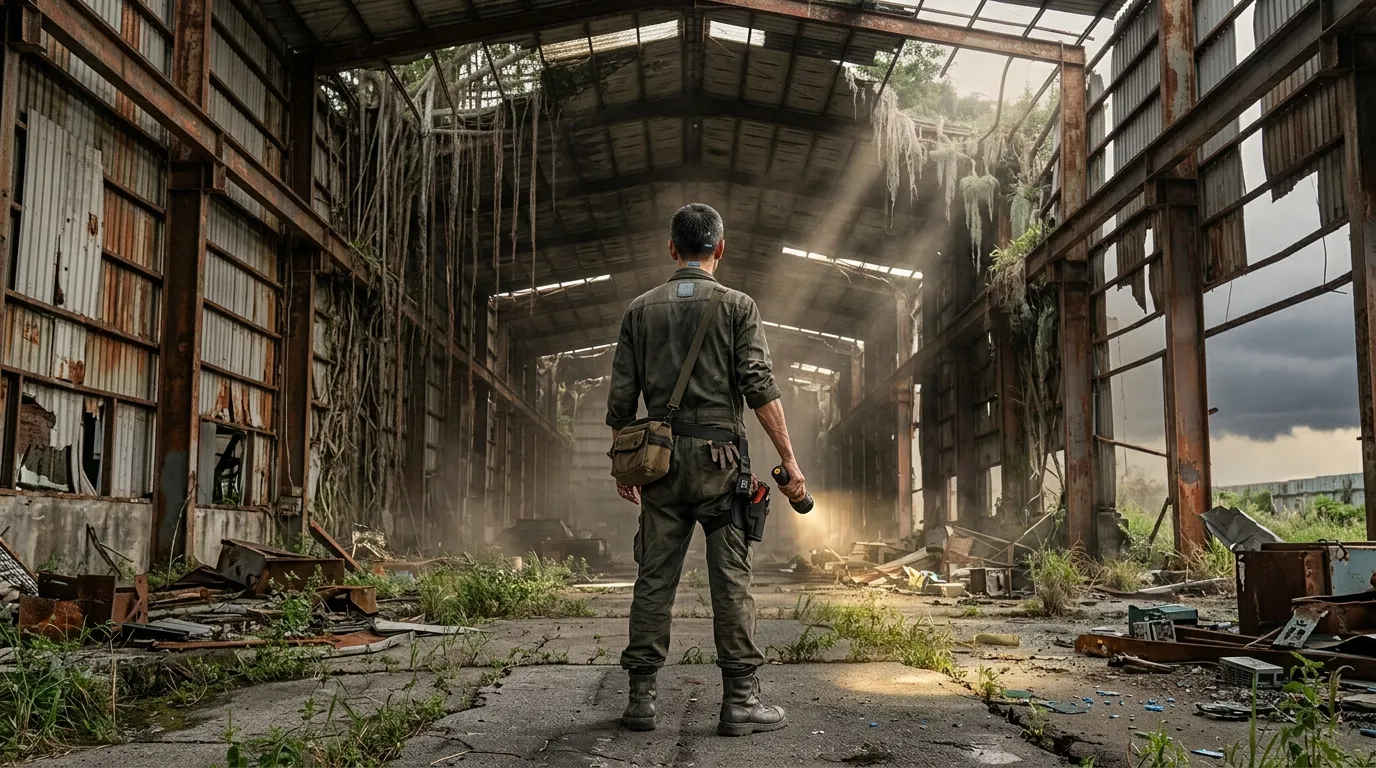
Fab 18 materialized above the pampas. Three hundred meters of steel skeleton like the ribcage of something enormous—the aluminum cladding had shed most of its panels, the few that remained hanging at angles, groaning at each breath of wind with a low metallic complaint. Banyan air roots dangled from cracks in the roof, gray-green, like water that had forgotten how to fall.
Gé Héngyuǎn stopped at the entrance for three seconds. His eyes tracked across the steel truss above the door frame—the rust had deepened from dark brown to orange-red, the surface rough as sandpaper. He put a hand on it. His fingertip came back dusted orange. Deep oxidation, but cut the surface and you’d still see metal core. Load-bearing, still. Marginally.
“Let’s go.”
The cleanroom had not been clean in a long time.
They shouldered the sealed door open—the frame had deformed and it took three people pushing at once—and a wave of damp and mold hit them, with something underneath it, an acidity at the base, like a rusty nail soaking in vinegar. The ceiling filtration panels had rotted from white to black-gray blotches, and water dripped from their edges onto the anti-static floor tiles, which had buckled almost entirely—step on one and it clapped, the lifted end snapping back.
Gé Héngyuǎn’s flashlight beam cut a solid channel through the dust. Particulates rotated inside the shaft like galaxies in miniature. He pushed the beam ahead and found the airlock at the far end of the cleanroom—the way into the etching bay.
His brain had already started without him. The building spread out in his mind as a topology map: load-bearing columns as backbone nodes, steel trusses as transmission paths, each rust point a potential single point of failure. He was evaluating which paths were redundant—if a node failed, could the load be redistributed to adjacent nodes?
Worst case: one truss section gives, pulls two adjacent anchor points loose with it. He scanned the ceiling. Truss spacing approximately four meters. If the middle section dropped, at his current reaction speed he’d need to clear two meters in one and a half seconds. Doable.
The etching bay was darker than he’d expected. A few gaps in the damaged ceiling let in light at angles, forming crooked shafts that fell across the rusted tool frames like spotlights on an abandoned stage. The chemical bite in the air was heavier—residual etching gases leaking slowly over a decade and a half, not lethal at this concentration but enough to make the nasal mucosa sting. He pressed the seal of his respirator tighter against his face.
“Two groups.” His voice came out muffled and mid-range through the mask. “Luò Cuò and I take the left side, third row. You three, right side. Meet at the airlock when you’re done.”
Third row, left side: two etch tools, their housings already stripped by previous scavengers, internal chambers and piping exposed. Gé Héngyuǎn crouched, flashlight clamped in his teeth, both hands reaching into the base of the tool. His fingers found cold stainless steel tubing—smooth, high-grade. 316L, which would run about 15 kT per kilogram in the market.
Luò Cuò worked the mounting bolts loose with an 18-volt impact driver, the whirr filling the bay with resonant echo. A bolt came free and dropped onto the floor grating—a single chime, like a struck bell.
Gé Héngyuǎn’s fingers stopped at a junction in the piping. He’d felt it. A vibration, not from Luò Cuò’s driver—this was coming through the metal itself. He pressed his whole palm flat against the surface.
Low frequency. Sustained. Coming from above.
He looked up. His flashlight caught the truss directly overhead. It was moving.
Not wind. Structural stress redistributing load.
“Luò Cuò—”
The words weren’t out when the sound of metal tearing opened up overhead. Not a single crack—a continuous ripping, like a zipper yanked at full speed, except each tooth was steel. Gé Héngyuǎn’s body moved before his mind gave the order. He dove sideways; his right shoulder hit the housing of an adjacent tool. Luò Cuò was half a beat behind—he jumped back, caught his work boot on a raised section of floor grating, nearly went down.
A truss section fell—three meters of I-beam, trailing concrete chunks and rotted filter material, landing exactly where they’d been crouching. It punched through the floor grating and opened a black shaft into the equipment level below. Dust detonated and swallowed the flashlight beams.
Silence.
Then the small sounds of debris settling, like the tail end of a hard rain.
“Sound off.” Gé Héngyuǎn’s voice was low, throat tight but steady.
“Here.” Luò Cuò, two meters away.
“Hurt?”
“No. Shit.”
The other three called from farther off. Everyone accounted for.
Gé Héngyuǎn stood. His left hand was shaking harder than usual—adrenaline. At the edge of his right eye, a point of light flared and vanished, a dead pixel in his vision. He blinked; it was gone. He raised his flashlight again and swept it across the fallen beam. The collapse had torn two adjacent anchor points loose, but the trusses one step further out were still holding. His topology map updated: this section’s structural redundancy was exhausted. The next collapse wouldn’t be localized.
“We’re done here.”
He didn’t explain. He didn’t need to. Luò Cuò was already packing up.
The midday light outside hit like a blunt object.
Walking out of Fab 18’s dark interior, the full sun landed directly on exposed skin. Gé Héngyuǎn blinked through several cycles before his pupils adjusted, contracting to pinpoints. The heat shimmer rising from the asphalt made the distant pampas grass undulate in his field of vision like a screen with too low a refresh rate.
They pushed their rigs through the last kilometer of the walking zone. Today’s yield was poor—half a length of high-grade stainless tubing, some ceramic liners from etch chambers, a manual valve assembly that still worked. Around fifty-odd kT for five people to split. Not enough. It was never enough.
The Faraday bags were opened, batteries restored to the rigs. Luò Cuò’s motor let out a screech on startup—the carbon brushes needed replacing.
“How many times did we almost not make it today?” Luò Cuò called back as he rode.
“Once. Almost had a segfault.”
Luò Cuò didn’t follow the second half, but he caught “almost.” He raised the eyebrow on the scarred side—alive is enough.
On the thirty-minute ride back, Gé Héngyuǎn said nothing. The rig shook over cracked pavement, vibration traveling up through the handlebars into his palms and along his forearms. Sweat traced his scalp and found his eyes; he wiped it away with a forearm—left a brown-gray smear on his sleeve, the dead fab’s dust mixing with the salt of his skin.
The cicadas kept up a constant white noise. Distant cumulonimbus were stacking on the horizon, their bases low and dark, but the rain wasn’t falling yet. The humidity in the air was a transparent wall; sweat emerged from his pores and just stayed on his skin, going nowhere.
He was thinking about the truss. Not fear—fear had been spent in the second he dove clear—but reconstruction. The failure pattern. The location of the fracture point. The residual load capacity of the adjacent nodes. He couldn’t go back to that section. The etch bay’s topology had entered unpredictable failure mode, same as a distributed system shedding nodes continuously—you can’t know in advance where the next timeout will occur.
He needed to reroute. The equipment level still had a few untouched units, but they’d have to come in from a different entrance, go around the collapse zone. Higher risk. Higher return—if he could reach the EUV light source assembly’s reflector, the molybdenum-silicon coating on those optics was worth upward of 300 kT in the market.
300 kT was six weeks’ runway.
The rigs stopped in the Yongkang streets. Just past one in the afternoon; the street was nearly empty—everyone sheltered from the savage midday heat. He pushed his rig into the ground-floor parking lean-to and pulled the battery to carry upstairs for charging.
Fourth floor. No elevator.
On the stairwell wall, someone had chalked this week’s exchange rates: 1 kT = 2 sweet potatoes. Next to that, a newer addition: EMF spiked in the south zone yesterday—go central. The chalk was fresh, the dust not yet smeared.
He keyed the lock—mechanical, aging spring, had to depress it fully then rotate ninety degrees before it gave.
On the shoe cabinet in the entryway: two pairs of small slippers. One pair aligned precisely—Gé Suǒ’s. One pair tilted at odd angles, one slipper half-hanging off the edge of the cabinet—Gé Luò’s.
“Ba.”
The voice came from the living room. Quiet in the careful way of someone who presses a door handle all the way down before pushing. Gé Suǒ sat on the living room floor, an half-dismantled circuit board spread out before him, a screwdriver in his hand. He didn’t stand up, didn’t smile, just raised his eyes to his father’s face for three seconds—his gaze landed first on the work boots (brown-gray dust), slid to the left hand (tremoring), and stopped on his face.
“I know,” Gé Suǒ said.
Gé Héngyuǎn wasn’t sure what he knew. He didn’t ask.
“Ba! You’re back!” Gé Luò erupted from the bedroom, footsteps loud as drumbeats. He was wearing a moisture-wicking shirt two sizes too large, the hem past his knees. “Did you hear that buzzing sound in the ruins today? Last time you said there was buzzing—was the buzzing square or round?”
”…Square.” Gé Héngyuǎn had been caught off-guard by the question for half a second, then answered automatically. He stepped out of his work boots in the entryway and walked barefoot on the concrete floor, the coarse texture coming up through his soles, cool.
“I knew it!” Gé Luò spun to face Gé Suǒ. “See? Square! I told you!”
Gé Suǒ didn’t react. He placed a glass of water in his father’s path—not handed over, not carried out to him, just set down in the exact spot between the entryway and the living room that Gé Héngyuǎn would have to pass.
Gé Héngyuǎn saw the glass as he walked by. He stopped, picked it up, drank. Warm. Boiled and cooled to exactly the temperature at which it was drinkable without waiting. Which meant Gé Suǒ had started waiting at least twenty minutes ago.
He wanted to say something. Thank you, or everything went fine today, or don’t worry. In the end he just set the empty glass back in its spot and went to sit in the living room.
The window beside the work cabinet faced south. The afternoon light pushed through gaps in the aluminum-foil blackout layer and painted thin lines of brightness on the concrete floor. In the distance, the outline of the Southern Science Park ruins shimmered and blurred in the rising heat, a row of gray saw-teeth. He’d just come from there. In a few more days he’d have to go back.
Gé Luò was saying something beside him—something about a gecko he’d seen downstairs with a detached tail, and how the tail was still moving, wasn’t that strange, why would it keep moving.
Gé Suǒ was quietly removing capacitors from the circuit board one by one, lining them up in a row. Metal and rust smell, machine oil, and underneath everything the faint steam of rice from the pot on the gas stove, still warm.
Gé Héngyuǎn leaned against the wall and closed his eyes.
Then the chip at the back of his neck pulsed.
Not pain. The micro-current stimulation of a system push notification—lighter than an ant bite, but nothing you could dismiss, because it bypassed every sensory organ and tapped directly on the spinal cord.
He opened his eyes.
In the lower right corner of his field of vision, semi-transparent text appeared. Not a projection—the chip stimulated the visual cortex directly to generate a false image, low-resolution, the edges jagged:
FIRMWARE UPDATE NOTICE
Version 12.7.4 → 13.0.0
Maintenance fee: 215 kT
Payment due: 30 days
Penalty: lockdown mode
He stared at it.
215 kT.
His total savings right now: 340 kT. Minus the firmware fee, 125 kT remaining. The twins’ basic living expenses ran approximately 90 kT per month. Meaning he had one month and ten days of buffer, on the precondition that his income over that period was not zero.
But what he’d brought back today hadn’t been split yet. The crew leader took twenty percent; the remaining four split the rest—standard. His share came to about ten kT, the others getting around eight each.
He ran the cash-flow model in his head, as fast as running a load test on a system, the result just as clear: if his scavenging income held at average over the next two months, he could make it to the next firmware update. Just. No buffer. Zero redundancy.
A system with zero redundancy is always exactly one unexpected event away from failure.
Like that truss today.
He extended his left hand and looked at it. The tremor was still there, worse than it had been before he left. Not a fear response—that was long spent. This was neurological debt accumulated through dongle duty, the same as technical debt: it only compounds, it never zeros out on its own.
The notification was still there in the lower right corner of his vision, semi-transparent text overlaid on his sons. Gé Luò’s voice continued—some new theory about gecko tails. Gé Suǒ had finished lining up his capacitors and was loading them one by one into a small tin box.
Thirty days.
Gé Héngyuǎn closed his eyes, and the text didn’t disappear. It wasn’t in front of his eyes—it was in his visual cortex. Eyes shut, it was still there.
He let his head rest against the wall. Concrete, rough against the back of his skull, a dull abrasion. Outside the window, the storm clouds had finally reached directly overhead. The light dropped a shade.
From somewhere in the distance, the first roll of thunder.