Chapter 2
Chapter Two: The Chip Tax
Chapter Two: The Chip Tax
Rain fell all night, and by morning it had stopped.
Gé Héngyuǎn stood at the fourth-floor window and watched the sky over Dawan Road. The cloud cover had torn open a seam, and gray-white light seeped through the gap and landed on the pooled water on the roof across the street—the glare was sharp. The air smelled washed, concrete and soil mixed together, a little cooler than usual.
His left hand rested on the window frame. Tremoring. A little better than yesterday, but still there. He made a fist, let it go.
Behind him: the gas burner click-click-clicking, then catching with a hiss. He turned to find Gé Suǒ standing on a low stool, tilting a plastic water pitcher into a pot. Slow, deliberate—both hands wrapped around it, angled precisely to the point just before spilling. He set the pitcher down, picked up three sweet potatoes from beside the stove, and lowered them into the water one at a time. Then he turned and looked at his father for a moment.
“Wait a moment.”
He went to the bedroom and came back with a pair of shoes—Gé Luò’s. He placed them at the bedroom doorway, toes pointing out, ready to step into.
“Gé Luò,” he said, toward the bedroom. Not loud, but clear.
A rustling, then the soft thud of something rolling off a bed.
“Mm—five more minutes—”
Gé Héngyuǎn squatted down to sort through his tool bag. The bits and pieces from yesterday’s scavenging run were still in there—a handful of capacitors, some tin-plated copper wire, parts from two manual valve assemblies. He separated them into different seal bags, pressed out the air, ran his thumb along the closures. This wasn’t what would pay the bills at the market, but every half a sweet potato counted.
Twenty minutes later they were out the door.
The Yongkang streets weren’t fully awake yet. Rain-wet pavement ran deep gray, the water snaking along the cracked fissures in slow braids, a low-resolution river system. The weeds along the roadside had been knocked down by the rain, their tips beaded. The air was cool, but you could feel the sun charging up behind the cloud layer—this coolness had maybe another hour before it was burned off.
Gé Luò walked ahead, feet hitting every puddle with precision—each step landing in the deepest part of each pool. He was wearing a pair of khaki work pants cut down from an adult’s pair, the cuffs rolled up three times, the canvas shoes showing mud-flecked.
“Ba—last night’s thunder, did you hear the last one? Not the boom one, after it—the eeeeee—really long—” He kept walking and walking and miming at the same time, both hands tracing a stretched oval in the air.
“I heard it.”
“That one was sticky,” Gé Luò said, with great seriousness. “Not like the buzzing from Fab. That one’s dry.”
Gé Suǒ walked on Gé Héngyuǎn’s right, his pace matching his father’s. He didn’t speak. His eyes swept the street on both sides—new chalk marks on the walls, a iron drum appeared outside one household, the aerial root from the banyan at the corner had grown another inch.
They passed a repair shop with its rolling door half-raised. From the dark interior: the shriek of an angle grinder, sparks jumping out into the damp air and dying before they landed. Gé Luò’s feet hesitated.
He tilted his head slightly, as if listening.
“Loud,” he said—but the way he wrinkled his nose wasn’t quite how someone wrinkles their nose at noise.
“Walk a little faster.” Gé Héngyuǎn put his hand on the back of Gé Luò’s head and gave it a gentle push.
Gé Luò shrugged, trotted two steps, and quickly settled back into the puddle-stepping rhythm.
The compute credit market occupied the old storefronts along the intersection of Dawan Road and Zhonghua Road—an entire row of them.
Every rolling door was half-raised, stalls extending from the indoor space out beneath the covered walkways. No digital boards—rates were chalked on blackboards in uneven handwriting, someone at each one currently erasing the last hour’s numbers and writing fresh: 1 kT = 2.2 sweet potatoes, eggs 1 kT / 3, 316L tubing 15 kT/kg. Chalk dust drifted and settled on the old newspapers layered across the stalls.
Sound. Sound in this place had weight—the low-register noise of thirty or forty people talking at once, the hum of a transformer running; above it, the bright ring of metal striking metal, the distant-and-muffled whine of a grinder, vendor voices worn hoarse from calling prices. The smell: sweat, cooking oil, metal dust compressed together, with a current of warmth threading through the crowd where someone at the far end of the walkway was frying rice cakes, the smoke threading in.
Gé Héngyuǎn carried the tool bag in his right hand, left hand free—habit. His left hand needed to be able to reach either child at any moment.
“Don’t get separated.”
“Okay—” Gé Luò’s attention was already pulling sideways toward something glinting on one of the stalls.
Gé Suǒ took a half-step closer to his father. Not nervousness. Getting into position.
They moved through the first rows of stalls, the barter section—plastic sheets on the ground piled with salvage: coils of copper wire, motor windings, valve handles in every size, hand-ground lengths of stainless tubing. The people sitting behind each stall were sun-darkened, their arms marked with the scars that came from dismantling industrial equipment. Someone was quietly negotiating:
“What’s the yield on this batch of copper wire?”
“Seventy percent and up. Check it yourself.”
“Fifty at most, look at the oxidation—”
Gé Héngyuǎn didn’t stop. He was heading for the credit exchange in back.
Around a corner marked by a hanging shade tarp, the credit exchange section was quieter than what they’d passed through, but the tension in the air was sharper. This was where compute credit transfers happened, not physical goods. A few folding tables pushed end-to-end formed a long counter with people lined up in front of it, some conferring over numbers with the intermediaries, some leaning toward another person until they were within thirty centimeters of their neck—near-field comms range.
Gé Héngyuǎn found the stall he always used. The broker was surnamed Zōu, fiftyish, a Constructors-licensed market administrator. He sat in a plastic chair behind a folding table with a chalk board propped on it showing today’s commission rates.
“Old Gé. What’s today’s yield?”
Gé Héngyuǎn took the sealed bags out of the tool bag one by one and laid them on the table. Uncle Zōu glanced across them, picked up the tin-plated copper wire, and bounced it in his hand.
“Three kT for the lot, ten-percent commission.”
“You’re low on the valve parts.”
“Valves are oversupplied right now. The south-side crew pulled a whole crate back last week, look—” Uncle Zōu gestured toward the next stall, where a pile of valve assemblies was indeed stacked to the floor.
Gé Héngyuǎn didn’t push back. Three kT wasn’t worth arguing for. His left hand twitched at his side—fingers lifted barely two centimeters before the tremor started. He pressed them down, extended his right hand instead, bringing it to within thirty centimeters of Uncle Zōu’s neck. Their chips entered near-field range.
Confirm transaction amount. Biophysical authentication—brainwave entropy, microvascular pulse, galvanic skin response, all three signals read simultaneously. A confirmation line floated across his vision:
TRANSACTION COMPLETE: +2.7 kT (fee deducted)Three seconds. The whole thing took three seconds.
“Ba, how many bowls of beef soup can you buy with one token?”
Gé Luò had appeared without announcement at the chalk board of the next stall, staring at the exchange rates written there.
Gé Héngyuǎn paused.
“About… half a bowl.”
Gé Luò looked at the numbers with profound contempt, mouth pulling down. “Then this thing’s basically useless.”
Uncle Zōu snorted a laugh, sending a breath of chalk dust off his board. “This boy speaks more plainly than any of us adults.”
The corner of Gé Héngyuǎn’s mouth moved. Almost a smile.
Then he heard the commotion.
Coming from the eastern end of the market. Not the steady buzz of bargaining—it was the sharp cries that were left after everything suddenly went quiet. Then a thud. Not metal. The sound of something soft hitting the ground.
The crowd started moving. Not the surging movement of curiosity—this was the parting movement, like water finding a stone in the current, both sides peeling away instinctively.
Gé Héngyuǎn grabbed Gé Luò’s wrist and checked over his shoulder for Gé Suǒ—half a step to his left, already in position.
“Don’t move.”
He saw it.
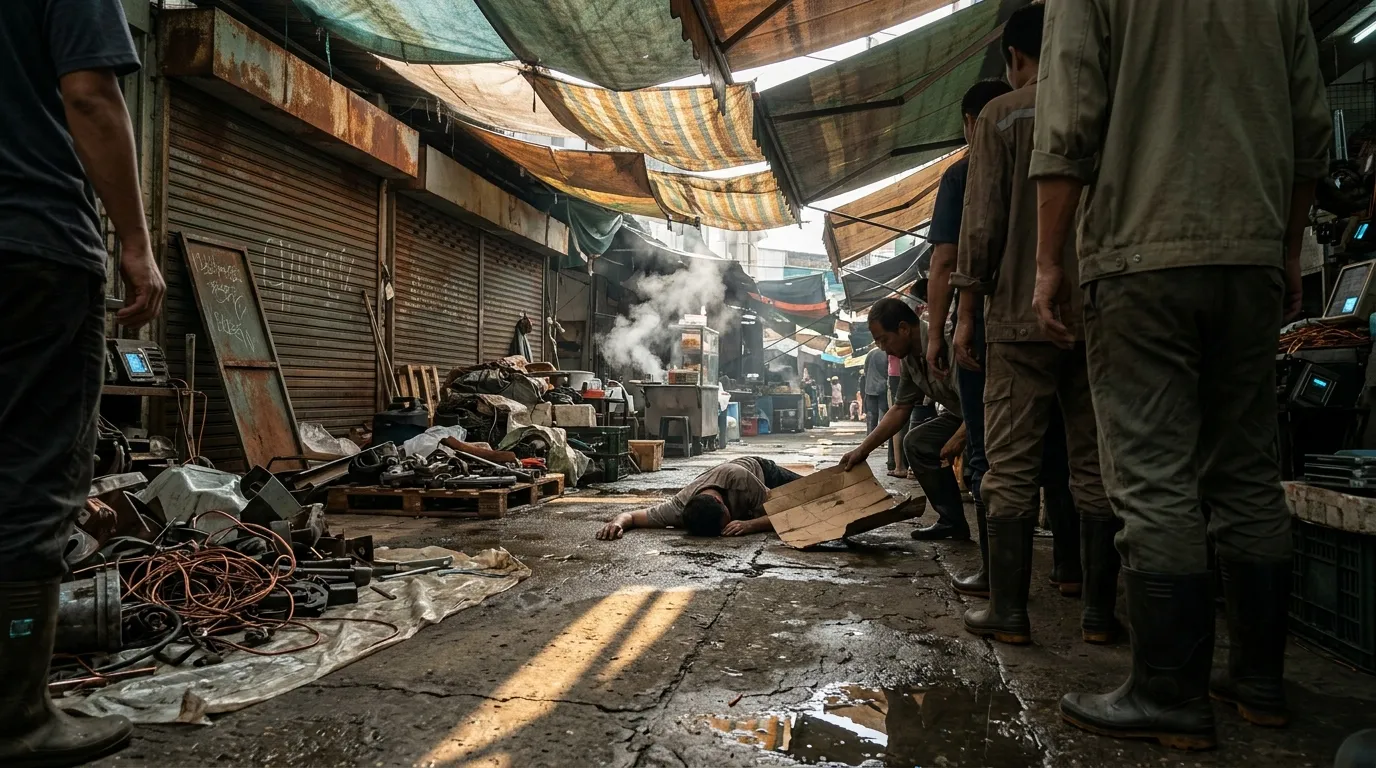
In the aisle at the east end of the market, a man was face-down on the ground.
Not a fall—falling people have struggle in them. This man had lost all tension in his body simultaneously, as if someone had pulled his power cord out of the wall in one motion. One arm was still extended in the position it had been in mid-transaction—hand open, fingers half-curled, suspended about ten centimeters off the ground because the angle of his arm pressing under his body happened to prop it up.
People around him stepped back two paces. A young woman’s hand had been halfway extended, then stopped in the air, then drew back slowly and disappeared into her pocket. No one reached down to help.
Then the man started to shake. Not the wide-arc convulsions of a seizure—this was finer, higher-frequency trembling, spreading outward from his neck down into his limbs, as if some signal was ricocheting through his nervous system unable to find an exit. His mouth was open. No sound came out.
“Lockdown.” Uncle Zōu’s voice came from behind them. Very quiet. Like a weather observation.
Gé Héngyuǎn’s grip on Gé Luò’s wrist tightened.
A person walked out of the market management lean-to—a Constructors operative, gray armband. He walked to the man on the ground, crouched, lifted his eyelid and looked, stood back up, and waved off the people standing nearby.
“Forced lockdown. Don’t touch him.”
The man on the ground had stopped shaking. His body was completely still—not relaxed still, held-in-place still. Eyes open, eyeballs motionless. His chest still rose and fell, but the interval was very long, like a machine in standby mode.
Gé Luò pressed himself behind Gé Héngyuǎn’s back. His hand was cold.
“Ba, what happened to him?”
“His chip locked up.”
“Will he be okay?”
Gé Héngyuǎn didn’t answer.
Voices nearby, low: “Word is he was doctoring his credits, the base station pushed it directly—” “That’s over, you can’t pay your way out of that kind—” “His wife just last month—” The end of that one was buried under other sounds.
The crowd slowly resumed its flow, like blood rerouting past a clot. Someone found a piece of cardboard and slid it under the man—not sympathy; they didn’t want him lying directly on the wet mud in the way. The sounds of trading started up again. Chalk scraped across a board. Everything back at normal speed. Except there was now an extra person on the floor.
Gé Héngyuǎn moved his sons out of the market, pace faster than it had been on the way in, left hand on Gé Luò, right hand on the tool bag, shoulders locked in a straight line. He didn’t look back.
About thirty meters out, he felt something tug at his sleeve on the left side. Gé Suǒ.
“Ba.”
Gé Héngyuǎn looked down.
“You’re holding too tight.”
Gé Suǒ wasn’t talking about himself. His eyes indicated the other side—Gé Luò’s wrist, still in his father’s hand, had gone red.
Gé Héngyuǎn let go. He looked at the red mark on Gé Luò’s wrist—five fingers, clear as pressed in by heat.
He crouched down. The crouch was slower than usual; his knees bent halfway, then stopped a moment—not his body. Something in his head, a wire that had been pulled taut all morning, slackened in that instant. He held Gé Luò’s wrist in both hands, his thumb covering the red marks, pressing very lightly.
His thumb was shaking. He watched it shake, couldn’t stop it.
“Sorry.”
When his voice came out, even he found it unfamiliar. Not the casual register of sorry, forgot the salt—it came from somewhere deeper, from the floor of his throat, rough at the edges. He tried to pull it back but couldn’t; after those two words came a gap, his mouth still open, breath off-rhythm, like an engine that had misfired and was turning over on empty air. He wasn’t apologizing. He was scared. The force with which he’d held that wrist and the force with which the Constructors operative had lifted the fallen man’s eyelid were separated by exactly one layer of something he’d been assuming was there.
Gé Luò studied him for three seconds, tilted his head, then pulled his wrist back and rubbed it with his other hand.
“Doesn’t even hurt.”
His voice came out half a beat faster than usual. Fast enough to cover something.
Gé Héngyuǎn took another few seconds before standing. His knees cracked.
On the walk home, the sun finally broke out of the cloud cover, and the wet pavement began to steam. Gé Luò walked a few paces ahead, kicking small stones along the road’s edge. He hadn’t mentioned the man from the market again; instead he’d started counting grass species on the roadside—this one’s pointy, this one’s round, this one is both pointy and round at the same time—
Gé Suǒ walked beside Gé Héngyuǎn, quiet for the whole stretch. When they reached the base of their building, he spoke.
“Does that man’s family know?”
Gé Héngyuǎn’s step slowed half a beat.
“I don’t know. Someone should notify them.”
Gé Suǒ was quiet for a few seconds.
“Downstairs Grandma said the man in the next alley, Uncle Chén, got deprecated.”
Deprecated. The word came out of Gé Suǒ’s mouth with no emotional register whatsoever—the way you would read a label. Gé Héngyuǎn hadn’t even processed it before Gé Suǒ spoke again:
“Will that man be like Uncle Chén?”
The tone was level, in the way that wasn’t appropriate for a nine-year-old. Like verifying a fact he’d already half-guessed.
“Third Tier is…” Gé Héngyuǎn paused. Choosing words. “It’s a place where certain people get sent after they lose the ability to keep their chips running.”
“What kind of place?”
“Not entirely certain.” That was the truth. The accounts in the community varied—life-support pods, consciousness escrow, forced labor—no one had actually seen it. They just knew that some people disappeared, and then never came back.
Gé Suǒ didn’t ask again. His gaze fell on the front steps of their building, and his lips moved slightly—filing what he’d just heard into some internal location.
Gé Luò had already run up the steps. He turned back to call down: “Come on—I need to pee—”
They went upstairs. Four flights. Gé Luò in the lead, footsteps bouncing off the stairwell walls, different echoes on each landing. Gé Suǒ in the middle, steady pace. Gé Héngyuǎn at the back.
He started the calculation while climbing.
Not something he chose to do—his brain ran the model automatically, the same way it had automatically assembled a topology map before walking into Fab 18:
Total assets: 340 kT. Firmware update fee 215 kT, leaving 125 kT. Today’s transaction: 2.7 kT. Plus yesterday’s scavenging split: 10 kT. Total: 137.7 kT.
Monthly necessary outlay: food at roughly 45 kT, power at roughly 6 kT (offset by their rooftop solar), miscellaneous at roughly 15 kT. Floor-level monthly spending 66 kT, but that was sweet potatoes and morning-glory greens only, nothing beyond bare necessity. In practice, the number ran about 90 kT.
137.7 divided by 90 = 1.53 months.
Compressing to the floor: 137.7 divided by 66 = 2.09 months.
Two months.
His feet stopped at the landing between the third and fourth floors.
Two months from now, his savings hit zero. The next firmware update would come due before that. By then he wouldn’t owe 215 kT—he’d owe 215 kT plus a two-month living-expenses gap. Running deficit somewhere around three hundred-odd kT. A hole being dug on top of a hole that hadn’t been filled yet. Recursion with no termination condition—
His left hand shot out and found the wall. Not bracing—gripping. His fingernails caught in the rough grain of the concrete.
From upstairs: the sound of Gé Luò getting the door open, then the slap of slippers running inside.
He became aware that his legs were losing their certainty. Not fatigue—four flights of stairs didn’t tire him. It was that something in his knees had momentarily decided it no longer wanted to hold. Earlier in the market, watching that man fall: the way his body lost every source of tension at once, all in the same instant.
He stood there. The wall surface grinding against his palm was the same as the wall surface that had ground against the back of his head last night.
Then he let go and kept climbing.
Evening.
The sweet potatoes were done, split into three bowls. Gé Héngyuǎn’s portion had been sliced thinnest—not deliberate; his hands had learned that cutting long before they were asked to think about it. On the side: a plate of stir-fried morning-glory greens, light on the oil, the wok heat not quite there, but the salt was right.
Gé Luò talked through the entire meal. The ice-pop cart at the market today was really cool, what were those ice pops even made of, why were some green and some white, was the green one better. Gé Suǒ ate quietly until his bowl was done, then pushed the last small piece of sweet potato in it into Gé Luò’s bowl. Gé Luò didn’t notice—still talking—and ate that piece along with everything else in his bowl.
Gé Héngyuǎn watched them.
Then he got up and cleared the bowls.
While he was washing up, he heard Gé Luò ask Gé Suǒ: “What do you think happened to that man?”
“Which man?”
“The one lying down at the market.”
Three seconds of silence.
“I don’t know.” Gé Suǒ’s voice.
“I think he was probably just really tired,” Gé Luò said. “Sometimes grown-ups get really tired and they just suddenly lie down.”
Gé Suǒ didn’t answer.
Gé Héngyuǎn turned off the tap. Drops fell from the tip of the faucet into the aluminum basin. One. Then another. Then stopped.
He stacked the bowls upside-down on the rack and dried his hands.
Both boys were curled in their thin blankets on the living room floor. Gé Luò had his eyes closed already, breathing quick—he always dropped off fast, like a machine that hits the power button and goes directly to off. Gé Suǒ’s eyes were still open, tracking the ceiling.
Gé Héngyuǎn sat down beside them. No light on; the moonlight came through the window filtered through cloud layers into gray-blue, just enough to see the outline of two small bodies.
Gé Suǒ’s gaze moved from the ceiling to his father’s face.
“Ba.”
“Mm.”
Pause.
“Nothing.”
Gé Suǒ turned on his side, facing the wall. Thirty seconds later his breathing had slowed.
Gé Héngyuǎn leaned against the wall, not lying down. The firmware notification was still there in the corner of his vision—by now he’d learned not to focus on it, letting it live in the visual background like a water stain that won’t come off no matter how you scrub.
He didn’t run the numbers again. He’d run them on the stairs. The numbers didn’t improve on repetition.
He watched the two sleeping shapes. Gé Luò’s mouth was slightly open, his breathing carrying a faint whistle—very thin, like the sound of a fine copper wire vibrating at resonance. Gé Suǒ’s hand was pressed flat against his own chest, fingers curled slightly—not a fist, but the gesture of someone holding on even in sleep, something too important to put down.
What Gé Suǒ had asked today was lodged in his head, and wouldn’t pull free. Not the question itself—the tone in which it was asked. No fear, no curiosity. The same register you’d use to verify a data point. Nine years old. He was already asking about worst-case outcomes in that voice at nine years old.
He thought of the man’s hand at the market—the arm still extended in mid-transaction, palm open, fingers half-curled, suspended ten centimeters above the floor. Three seconds earlier that hand had been making a deal. Three seconds later it had become something unrelated to the body it was attached to.
Gé Héngyuǎn looked down at his own hand. Left hand. In the faint gray-blue light, it rested quietly on his knee, not shaking.
This hand had tremored at the window frame this morning. This hand had gripped Gé Luò’s wrist at the market, leaving the five-fingered impression of a burn. This hand had clawed at the stairwell wall, fingernails catching in the concrete.
Sixty-two days from now, what would this hand be able to do?
Outside the window, no sound at all. Even the cicadas had given up.