Chapter 3
Chapter Three: Deep Layer
Chapter Three: Deep Layer
At 5:12 in the morning, Gé Héngyuǎn crouched at the kitchen counter and wrapped the last two rice balls in cling film, then set them in the handleless mini-fridge. Inside each one: pickled cucumber he’d traded two kT for from the aunt at the alley entrance three days ago—nothing special, but Gé Suǒ liked salt, and Gé Luò was easy, that kid could find something to chew on in plain white rice.
He wrote a note: Back before noon. Rice balls in fridge. Don’t use the stove.
He thought for a moment, then added a line: Suǒ, don’t dismantle the neighbors’ things.
The note went under the corner of the table. He glanced into the bedroom—two kids still buried in their blankets, the water stain on the ceiling like a lopsided map. The firmware countdown hung in the lower right of his visual field; he’d developed a kind of precision defocusing ability that kept the numbers permanently at the edge of his retina, the way a nearsighted person sees a sign at the end of the block: knows it’s there, doesn’t read it.
Sixty-one days.
The door lock was mechanical, two and a half turns. He left before full dawn. The streetlight at the alley entrance had been cut at some point during the night—only the metal post of its base was left, catching a thin reflection of nothing. His rig was parked downstairs, battery charged to seventy percent last night—no higher; the lithium iron phosphate cells he’d pulled from a scrapped Gogoro had already gone through three thousand cycles, their charge-discharge curve looking like the ECG of someone with heart disease.
He started the rig. The motor sound was just barely louder than a mosquito. He could ride the road to the Southern Science Park with his eyes closed.
The outer perimeter of Fab 18 looked like a melting iceberg in the 6 a.m. light—white cladding panels shed across whole sections, the rusted steel skeleton underneath showing through like bone poking out of skin. The western perimeter wall had collapsed for a stretch, the rubble compressed by repeated tire traffic into an unwritten passage.
Luò Cuò was already there. He was crouching beside his cobbled-together cargo trike, smoking. When he saw Héngyuǎn he tucked the cigarette behind his ear, stood up, and slapped the dust off his rear end.
“Morning.”
“What time did you get here?”
“Four-thirty. Couldn’t sleep.” Luò Cuò’s face looked thinner than usual in the early light, the scar from his left eyebrow to his cheekbone becoming a deep furrow at this low angle. “Other three are already here. Ā-Zhèn’s over there measuring rope.”
Héngyuǎn parked the rig, pulled the key, lifted the battery off. Not anti-theft—nobody stole rigs anymore—it was habit. The battery was the most expensive part of the rig, probably also his most valuable asset besides the two kids.
The five-man scavenging crew assembled on a concrete platform inside the perimeter wall breach. Crew leader Zhān Yù spread today’s route on the ground—not a map, but a cross-section diagram he’d drawn on the back of a cardboard box with a ballpoint pen, the lines crooked but the markings surprisingly precise.
“Today we go down through the B3 corridor to the equipment level,” Zhān Yù said, tapping a rectangle on the diagram. “Target is the EUV light source chambers on the south side, numbers S-12 through S-15. Someone reported back two weeks ago that the reflector modules over there were still in place, hadn’t been stripped.”
“Two weeks ago when?” Héngyuǎn asked.
“Two weeks ago.”
“Two weeks is enough for another floor to cave in here.”
Zhān Yù didn’t respond. He was the kind of crew leader who answered correct-but-useless observations with silence.
Luò Cuò was opening his tool bag beside them. The contents were arranged like surgical instruments—wrenches, screwdrivers, a modified electric ratchet, three Faraday bags in different sizes, a roll of copper mesh braid, two pairs of nitrile gloves, a small bottle of calcium hydroxide suspension. That last one was for staying alive—first aid for HF burns.
“You bring enough gloves?” Héngyuǎn asked him.
“Three pairs. You?”
“Two.”
Luò Cuò pulled a pair out of the bag and tossed them over. “Three. There’s HF residue down there. Two pairs isn’t enough. If the outer layer tears you might not feel it.”
That was Luò Cuò. He never said be careful—he just brought an extra pair of gloves. Héngyuǎn stuffed them into his chest pocket.
Zhān Yù laid out the assignments: he and Ā-Zhèn would handle anchor rigging and retreat coverage along the corridor, old Mò would hold the B3 entrance as lookout and relay, Héngyuǎn and Luò Cuò would go into the light source chambers and pull the reflectors.
“Before you enter the EMF hot zone,” Zhān Yù said, looking at Héngyuǎn, “all batteries out, bagged. The chip will throttle itself down, but the rig battery won’t—induced current can burn through your pocket.”
Héngyuǎn nodded. He knew all of this, but procedure was procedure. The point of procedure wasn’t to tell you things you didn’t know. It was to make sure the things you did know didn’t get skipped.
They started pulling batteries. Héngyuǎn disconnected the main harness from the lithium iron phosphate pack, wrapped the positive and negative terminals three times in electrical tape, and loaded it into the largest Faraday bag. The copper mesh face caught the early light and gleamed dark gold.
The moment he stepped inside the perimeter wall, he habit-scanned three directions—a drainage ditch behind the abandoned guardhouse on the left he could crouch into, twenty meters straight ahead was a row of concrete pillars in the old parking lot, and the perimeter wall breach itself was the exit on the right. Three escape routes. Enough.
Walking toward the B3 entrance, he noticed the firmware notification in the lower right of his visual field flicker once—the chip had detected rising ambient EMF and automatically started throttling down. Layer 3’s global positioning and communications modules were already offline, Layer 2’s physiological monitoring had dropped to minimum sampling rate. His neural chip was now roughly as intelligent as a fitness tracker from twenty years ago.
“Welcome back to the nineties,” Luò Cuò said, walking beside him—he’d obviously felt the throttle-down too. “Can’t even count steps.”
The B3 corridor was a roughly three-meter-wide underground passage that originally connected the main fab to the southern equipment zone. The ceiling was dense with pipes—coolant water, process gases, waste liquid recovery, electrical—like an entire city’s utility network hung upside down. Most of the pipes had already cracked or been cut by previous scavengers for the copper; the cut ends were furred with dark green oxidation. In some places pipes sagged down like tentacles growing from the ceiling, and you had to turn sideways to get through.
Héngyuǎn switched on his headlamp. The beam drove into the darkness and the dust was visible to the naked eye—not drifting, hovering, as if someone had dialed time down to slow in here. The air was damp, layered with a compound smell: mold, rust, and underneath it a thin sharp acidity that came and went.
His brain started up automatically.
Twenty years of systems architecture as occupational habit—he didn’t see this building the way other people did. To him, every wall, every column, every pipe was a node, and the nodes had dependency relationships. Load-bearing walls were core services; pull them and the whole system collapsed. Partition walls were edge microservices; strip them, no one cared. Pipes were inter-service communication—some were decorative logging pipes, no one noticed if they broke; others were the only data path, and cutting them killed everything upstream and downstream.
The problem was: too many nodes had already been pulled from this building. Scavengers had stripped the copper piping, earthquakes had cracked the load-bearing structure, chemicals had eaten the concrete. Fab 18 right now was like a distributed system where someone had randomly deleted thirty percent of the microservices—it was still running, but you had no idea whether the next deletion would trigger a cascade failure.
He stopped, swept his headlamp across the ceiling ahead. A steel pipe roughly fifteen centimeters in diameter crossed the corridor, both ends embedded in the walls. The concrete below it had radial cracks, like a spiderweb.
“This is part of the pipe support structure,” he told Luò Cuò. “Don’t touch it. It’s helping that H-beam above it share the shear load.”
“How can you tell?”
“The crack direction. If it were just an ordinary support bracket, the stress would be pure downward pull and the cracks would be concentric rings. Radial means there’s a horizontal component—it’s being used as a structural element.”
Luò Cuò glanced up at the ceiling and shifted half a step to the right.
They kept moving. Around the forty-meter mark, the corridor forked—left toward the chemical storage area, right toward the equipment level. The floor of the left corridor was visibly different—pocked and cratered concrete surface, like something had been gnawing at it.
“HF zone,” Luò Cuò said. “Floor’s been eaten down like that, had to be soaking for months. Don’t step on it. The concrete’s gone, load capacity less than thirty percent.”
Héngyuǎn smelled it—not the ordinary acid smell, but something deeper, sharper, the kind that lingered in the back of the nasal cavity like the sound of fingernails scraping a chalkboard. Then another smell overtook it: rotten eggs. Hydrogen sulfide. A specialty gas line had ruptured. Not a lethal concentration—they’d have been dizzy already if it were—but it meant the gas containment on this section had been incomplete when the site was abandoned.
They went right.
The equipment level entrance was a fire door; a previous crew had cut a gap in it with hydraulic shears, just barely wide enough to squeeze through sideways. The door frame was warped, a chunk of concrete had fallen from above it, exposing bent rebar underneath.
Before squeezing through, Héngyuǎn scanned one more time: the corridor behind was escape route one, the chemical zone to the left was impassable but in extreme circumstances he could jump across the honeycomb floor to the emergency staircase on the far side—escape route two, at the cost of possibly falling through the floor. Beyond the door, he didn’t know yet.
“I’ve been doing dependency analysis on microservices to figure out which wall falls first,” he said to Luò Cuò as he squeezed through the door frame, a protruding piece of rebar scraping across his backpack. “Who told me in my job interview twenty years ago that this skill had real-world applications?”
“It does have real-world applications,” Luò Cuò said, coming through behind him. “Just the wrong world.”
The equipment level opened up before them.
The headlamp beam was a white needle stabbing into endless dark, illuminating only a short stretch. But that short stretch was enough to explain everything—pipes. Everywhere. Ceiling, walls, floor, every direction in three-dimensional space had pipes running through it. Stainless steel, PFA tubing, borosilicate glass, galvanized steel. The thick ones over half a meter in diameter, the thin ones about chopstick-width. They interwove, branched, converged, sagged, forming a three-dimensional labyrinth that was impossible to make sense of without the schematics.
There was standing water on the floor. Not deep—below ankle level. The water surface reflected the headlamp, making the entire space look like it was extending downward, as if they were standing at the edge of some abyss.
Héngyuǎn forced himself to scan systematically. Not the full picture—the full picture would paralyze you. Focus on nodes.
First scan: structure. He located four main H-beam columns, spaced roughly twelve meters apart, the load-bearing skeleton of this level. Two of the column bases showed corrosion swelling, the concrete footings cracked, but the steel cross-section loss was visually under five percent. Acceptable. For now.
Second scan: chemical hazards. The acid smell was faint—the HF zone was next door, this side was mainly equipment cooling and vacuum systems. He put his headlamp close to the standing water and looked—clear with a yellow tinge, not a chemical spill color, more like rainwater seepage mixed with rust. Nitrile gloves stayed on.
Third scan: path. Toward the south-side light source chambers, he made out a relatively clear route—signs of human passage, the silt in the disturbed water more evenly distributed than on either side. Someone had been here before. But someone else’s footprints didn’t guarantee safety. They only guaranteed that someone had walked this way the last time.
“That way.” He pointed for Luò Cuò.
They threaded through the pipe labyrinth for roughly eighty meters. Héngyuǎn went first, updating the dependency map in his head at each structural anomaly—that bent support pipe had already lost its function, edge node, ignore; that crack in the wall was a shear crack, not a bending crack, meaning foundation settling rather than vertical overload, not going to collapse suddenly short-term, mark as low risk, keep moving.
His left hand started trembling again. Not badly, but conspicuous when he needed a steady grip on the flashlight. The beam shivered faintly on the wall, like the last few packets before signal decay. He wasn’t sure whether this was accumulated fatigue, stress, or the chip’s chronic wear on his nervous system—didn’t matter, the cause didn’t change the symptom. He switched the flashlight to his right hand, made a fist with his left and released it, three times. Muscle contraction could temporarily suppress the tremor—not a treatment, a workaround, like pushing a hotfix to production.
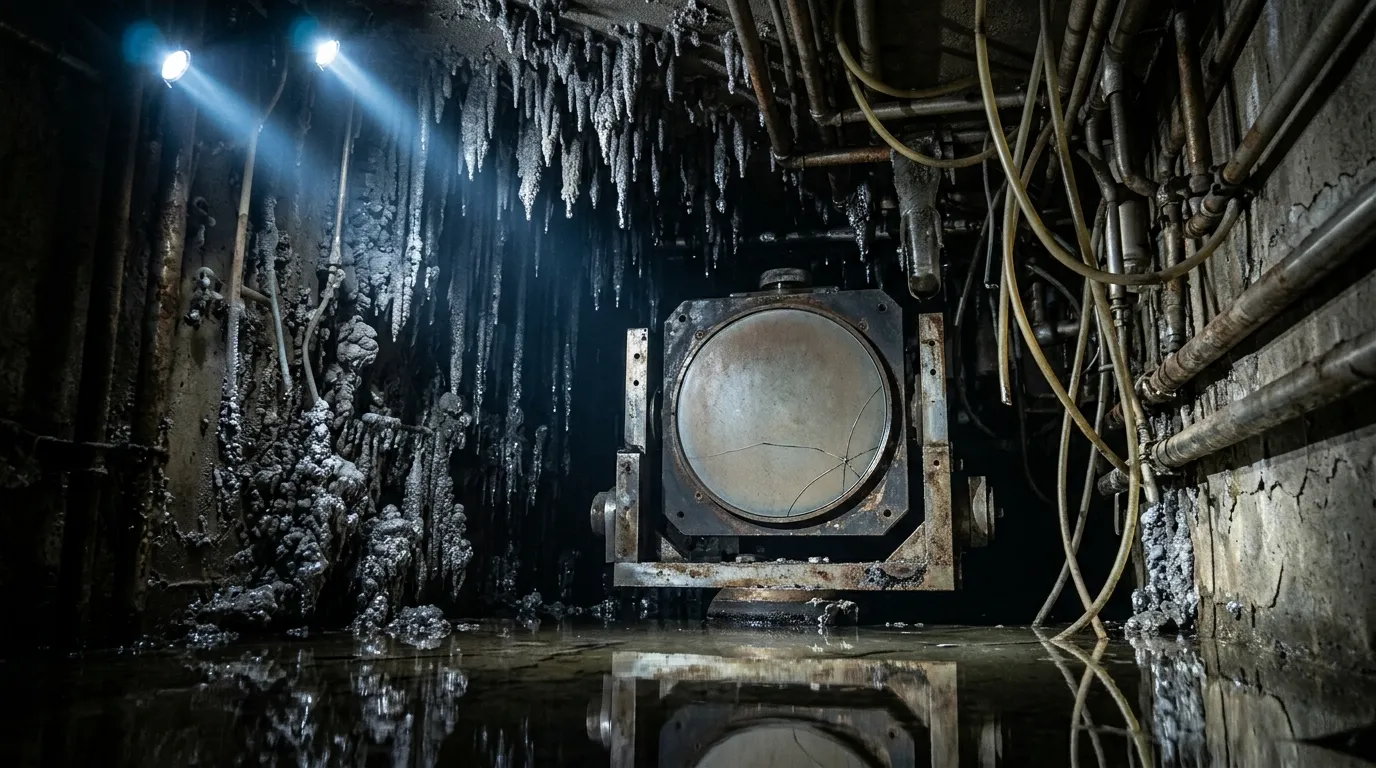
The door to S-12 light source chamber was gone. Not open—gone. Even the hinges had been stripped. The door frame was still there, with a label sticker faded to near-white, the ASML logo and a serial number still faintly visible.
Héngyuǎn and Luò Cuò both cranked their headlamps to maximum brightness.
The inner wall of the chamber was covered in a strange crystalline layer—gradations from gray-white to dark silver, giving off a faint metallic sheen in the light. Tin. EUV light sources used high-power pulsed lasers to strike tin droplets, generating extreme ultraviolet light. Fifteen years without maintenance: the residual tin vapor-deposited on the inner walls had grown into miniature stalactite formations, the longest roughly three centimeters, hanging from the ceiling inverted, a droplet of metal frozen at each tip that would never fall.
“Every time I come to a place like this,” Luò Cuò said, dropping his voice—not from fear of being heard, but because spaces like this made people instinctively lower their voices, “I feel like I’m walking into some kind of temple. The kind built to worship technology.”
“At peak output, the wafers run through this one chamber were worth thirty million US dollars a day.” Héngyuǎn’s headlamp had found the target. “Right now its most valuable part is over there.”
The beam stopped on the optics module at the far end of the chamber. The reflector assembly was mounted on a precision six-axis adjustment stage, the whole structure roughly the size of a desk. The mirror itself—he moved closer—roughly thirty centimeters in diameter, set in a circular mounting frame.
The moment he saw the mirror surface, his stomach dropped slightly.
A Bragg reflector’s surface should have a deep, near-perfect reflectivity—forty to fifty alternating molybdenum-silicon coating layers, each layer’s precision down to one-tenth of a nanometer, capable of reflecting seventy percent of extreme ultraviolet light back. It was one of the most precisely engineered mirrors humanity had ever made.
But the mirror in front of him no longer reflected anything. The coating was heavily oxidized, the surface presenting a dull gray-brown, like skin that had died and dried in place. Two fine but clear cracks ran from the edge inward to the one-quarter point of the mirror—probably stress damage from an earthquake.
The most expensive mirror in the room, and it couldn’t even show you itself anymore.
“Let me see.” Luò Cuò squeezed in beside him and reached out—not touching the mirror surface directly, but feeling along the edge of the mounting frame, fingertips traveling the metal like reading braille. “Mounting bolts are Torx T-30, six of them. The connection between the adjustment stage and the base…” His hand went around the back; he was half draped over the equipment now. “Twelve M8 hex bolts. But the two against the wall—shit, those two are rusted into one piece. Can’t get those off.”
“Don’t pull the adjustment stage. Just take the mirror out of the mounting frame directly.”
“The frame precision has a fixed value. Forcing it could—”
“The frame isn’t worth anything. The mirror substrate is. That’s Zerodur ultra-low-expansion glass—thermal expansion coefficient approaching zero. This material is out of production. Even with the coating gone, grind it down and recoat it, still worth something.”
Luò Cuò looked at him. “Weren’t you in software when you worked in semiconductor?”
“A software engineer who doesn’t understand hardware is just writing poetry on a black box.”
Luò Cuò made a sound that might have been agreement and might have been resignation, which he seemed to accept as an answer. He reached into his tool bag for the electric ratchet and fitted a T-30 bit. The ratchet sound bounced off the tin-crystal walls of the chamber into a metallic hum.
First bolt loose. Second bolt. On the third, the ratchet slipped—the bolt head had corroded and deformed. Luò Cuò’s expression didn’t change; he swapped to a slightly larger bit, caught the remaining edges, added a little pressure. Third bolt came out. Fourth, fifth, sixth.
“Frame’s loose.”
They lifted the mirror from the mounting frame with care. The mirror was heavier than Héngyuǎn had expected—Zerodur’s density was similar to ordinary glass, but thirty centimeters diameter times nearly four centimeters thick worked out to roughly seven kilograms. He held it in both hands and felt that cold, unusually stable weight. This glass had been engineered so its molecular structure barely changed volume with temperature; at zero degrees Celsius and at fifty, the dimensional difference was less than a thousandth of a human hair’s width.
Humanity built a mirror that was nearly immune to the physical world, so it could etch smaller letters onto silicon wafers. Then humanity abandoned the whole factory where the etching happened.
Luò Cuò went to check the other three chambers—S-13 through S-15. When he came back, his expression told Héngyuǎn everything before he opened his mouth.
“Thirteen’s mirror is gone, someone pulled it earlier. Fourteen’s whole module is under the collapsed ceiling—we can’t shift it, just the two of us. Fifteen…”
“What about fifteen?”
“Cracked. Clean through, split in half from the middle. Total write-off.” Luò Cuò reached into his tool bag for a cigarette, glanced at the pipes overhead, and put it back. “One trip down, one mirror, and it’s damaged goods. My annual bonus was better than this.” He ran a finger along the scar from his left eyebrow to his cheekbone.
One mirror. Poor condition. Heavy coating oxidation plus edge cracks—if it had been pristine, this mirror could have fetched three hundred-plus kT. But now, a substrate with cracks meant elevated risk in the re-grinding process, precision not guaranteed. He could estimate the reclamation price: eighty to one hundred kT. Crew leader’s twenty percent cut. Take-home sixty-four to eighty.
He wrapped the mirror in the anti-shock foam he’d brought and loaded it into his backpack. Seven kilograms pressing on his back, not heavy exactly—more the feeling of something that weighs what it weighs but makes you feel hollow. He headed out.
They retraced their route. Héngyuǎn at the back, Luò Cuò leading. The mirror’s weight in his backpack swayed slightly with each step; without thinking, he steadied the strap with his right hand, the way you would handle something fragile. It was fragile. Just not the glass part—that had already broken.
About thirty meters into the return through the equipment level’s pipe labyrinth, Héngyuǎn heard it.
Not a sound—an absence of sound.
He stopped. Luò Cuò walked two more steps before noticing and turned back.
“What?”
“Listen.”
Neither of them spoke. Around them, only the faint sound of standing water slowly recovering its surface after being disturbed by their boots. Then Héngyuǎn heard what he’d been waiting for: a low, deep metallic groan from somewhere above them. Not a collision, not friction—the kind of sustained, near-infrasonic rumble that steel makes when stress is redistributing itself internally.
He looked down at the standing water. Ripples on the surface—not the ones they’d made walking; those had already settled. These were new, very low frequency, like something enormous was moving very, very slowly.
The dependency map in his head snapped from background to foreground.
The nodes he’d flagged on the way in started blinking—the column bases with corrosion swelling, that wall with the shear cracks, a roof slab and steel beam somewhere above that he couldn’t see but knew was there. He ran a failure propagation simulation in three seconds: if the roof beam above them was shifting from thermal expansion or long-term creep, it would transfer load to—
“Left. Now.”
Luò Cuò didn’t ask why. They cut left around a fat pipe; Héngyuǎn swept his headlamp across the ceiling of the left side passage—pipe support welds intact, concrete uncracked, load path independent.
Less than five seconds after they turned into the left passage, a massive sound erupted behind them. Not an explosion—a heavy, bone-fracture kind of cracking. Then the thud of something large hitting water, and the impact wave pushed forward and climbed over their ankles.
Dust came from every direction. Héngyuǎn used his sleeve to cover his nose and mouth, his other hand pressing the backpack down—the mirror. He waited for the dust to thin and pointed his headlamp at the corridor they’d just left.
An H-beam had dropped from the ceiling, punched through two tiers of pipe supports, and was lying across the corridor. The concrete chunks it had dragged down were piled in the standing water, the surface turbid as mud. Where they’d been standing thirty seconds earlier, half a ton of steel and concrete was now pressing down.
Luò Cuò looked behind him, then ahead, and said something in Taiwanese. Then: “That route’s done.”
“Not taking that route.” Héngyuǎn’s headlamp was already scanning for a new path. In the left passage ahead—he remembered from the second scan on the way in—there was a branch corridor he’d tagged as non-target path and not taken, but he remembered it ran north. The B3 entrance was on the north side. “This corridor should connect back to the B3 main passage in about forty meters.”
“Should?”
“Ninety percent. Equipment-level floor plans in fabs always use loop layouts—maintenance routes can’t dead-end.”
“What about the ten percent?”
“The ten percent is that someone stripped this section down to nothing and the path has already caved.”
“Fair enough,” Luò Cuò said, falling in behind him. “You go first.”
Héngyuǎn led. The left passage was a third narrower than the main corridor, the pipes denser, a few places where they had to duck. But the structural condition was much better—a secondary passage away from the main equipment zone, nothing worth stripping, so preserved intact. Forty-odd meters in, the passage connected exactly where he’d predicted, to another section of the B3 main corridor.
Luò Cuò exhaled long and slow. “You walked this path before?”
“No. But I tagged the entrance.”
“What is your brain made of?”
“Same as yours. Just running different daemons.”
Passing the B3 corridor fork, Héngyuǎn’s headlamp swept across the left passage leading toward the HF zone—the pitted floor looked like the inside of some creature’s hive in the light. The beam passed the deeper end of the corridor without meaning to, and in his peripheral vision he caught the outline of a door. Not a fire door—heavier, looked like it had a sealing strip. Something was posted on the door, but he didn’t stop.
The seven kilograms in his backpack reminded him of current priorities. He filed the image into his mental cache—not memorized, tagged. Pending confirmation. Low priority.
They climbed out of the B3 corridor; light poured through the gap in the fire door and Héngyuǎn squinted. The air outside was nothing like underground—hot, humid, with wind, carrying the smell of concrete that had been baking in the sun. He looked up at the sky. To the southwest, clouds were stacking like a mountain range forming.
“Rain coming.” Luò Cuò was looking at the sky too.
Zhān Yù and the others were already waiting at the corridor exit. Héngyuǎn gave a brief report of the collapse—a steel beam had come down in the B3 south side equipment level, that route was out for now. Zhān Yù’s expression darkened briefly but he didn’t say anything. He drew an X on the cardboard cross-section with his pen.
The haul report went quickly: Héngyuǎn and Luò Cuò had one EUV reflector in poor condition; Ā-Zhèn had recovered twelve kilograms of stainless steel pipe fittings and a small coil of PFA tubing along the way back; old Mò had found a complete industrial-grade UPS circuit board at the relay point. Héngyuǎn ran through the numbers in his head—mirror roughly one hundred kT, pipe fittings and PFA roughly twenty, UPS board maybe fifteen, combined under one-forty. Crew leader’s twenty percent cut, leaving just over one hundred ten, split by contribution ratio. He and Luò Cuò had done most of the work on the mirror; his share would come out around fifty-odd kT.
He ran the countdown in his head. Sixty-one days, two kids, firmware update fees, basic living expenses, rig maintenance. The mirror’s proceeds would push the countdown back by maybe three days. Four at most, if nothing unexpected happened this month.
Not enough. Not even close.
The first raindrop hit the iron roof of the parking lot shelter like someone flicking a rifle casing with their finger. Then a second, a third—then no fourth. It went straight to a full roar. Afternoon thunderstorms in southern Taiwan never gave you a transition, like a drummer who never learned the concept of a crescendo: either nothing or everything, full volume.
Rainwater hit asphalt that had been baking all day and white steam rose from every surface. Iron sheeting, concrete, rusted steel frame, the metal body panels of their rigs—everything was smoking, as if the whole abandoned factory had been set on fire and then drenched.
Héngyuǎn stood under the shelter, watching the rain wall. The mirror pressed quietly against his spine inside his backpack. The darkness and the heaviness of the hours underground were being scoured out right now by the rain’s volume—not release, replacement. One kind of pressure exchanged for another.
Luò Cuò came and stood beside him, also watching the rain. A silence stretched.
“I heard something.” Luò Cuò’s voice went under the rain; Héngyuǎn had to turn his head to catch it.
“What?”
“Word going around in Yongkang. They say the government’s rezoning the district boundaries. The new line would cut our section out.”
“Cut out meaning what?”
“Eminent domain. Land reclaimed and redeveloped. Residents required to vacate within the deadline.”
Héngyuǎn turned to look at him. Luò Cuò’s expression hadn’t changed; his eyes were fixed on some point in the rain—or no point at all.
“A rumor?”
“The aunt in the district office overheard it. Not an official notice. Someone’s phone call she caught.”
A rumor. Not a fact. But in a world where half of all information traveled by word of mouth, the accuracy rate of rumors was uncomfortable.
Héngyuǎn said nothing. His brain had already started calculating automatically—eminent domain meant relocation, relocation meant a security deposit and at least two months of new housing credits, cheapest bracket starting around three hundred kT. His current savings, plus today’s earnings, plus projected income over the next sixty-one days—the numbers arranged themselves in his head, subtracting, zeroing out. However he arranged them, the equation resolved to a negative number.
He watched the rain form a curtain off the edge of the shelter roof, and through the curtain Fab 18 blurred into a white outline, like a photo that had been overexposed—all the detail washed out.
Sixty-one days. One broken mirror. One blocked escape route. One eminent domain order that might come, might not.
The rain had no intention of stopping.