Chapter 4
Chapter Four: Eminent Domain
Chapter Four: Eminent Domain
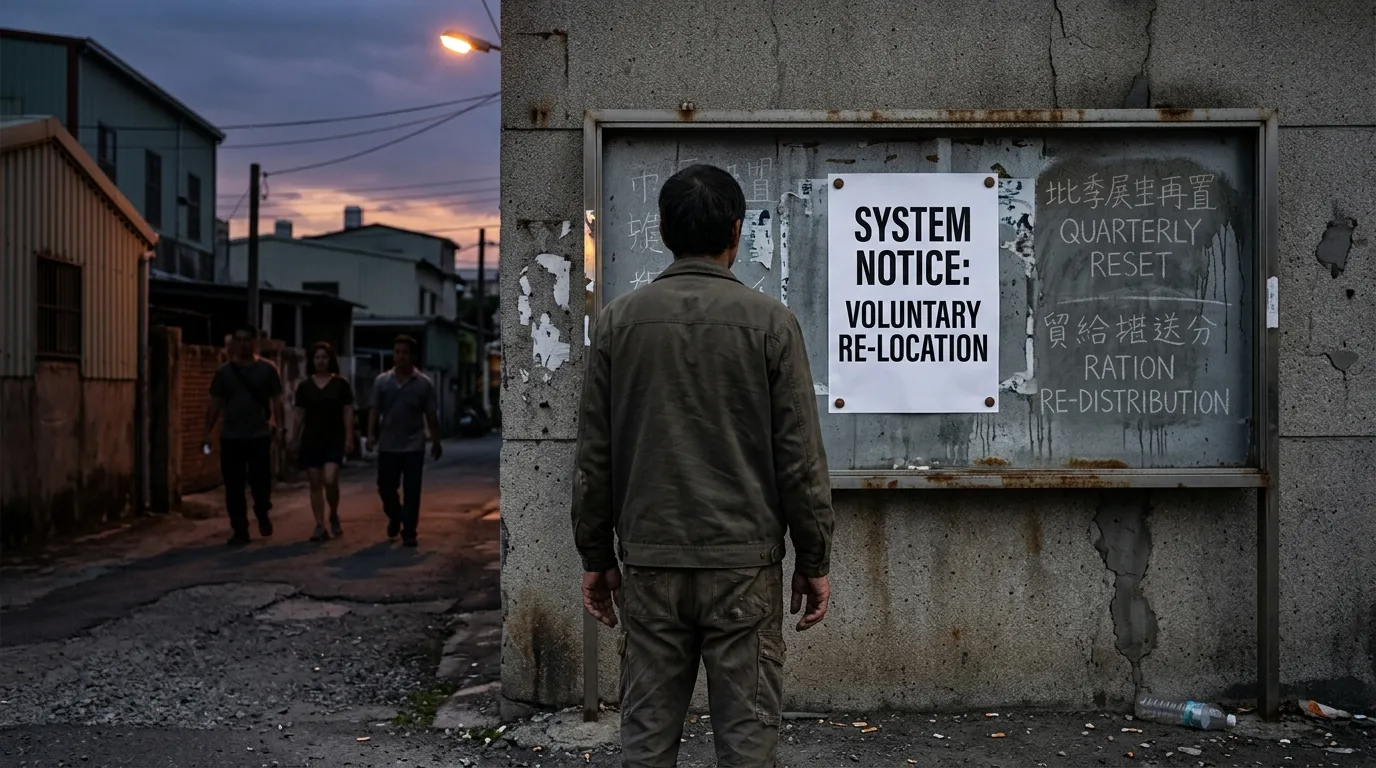
At 6:17 in the evening, Gé Héngyuǎn stood at the exterior wall of the Yongkang District administrative office and finished reading the notice.
The notice had been printed on a laser printer—not many offices left that could scrape together a toner cartridge these days. A3 size, black text on white, pinned at the exact center of the bulletin board with four rusted thumbtacks. The charcoal-scrawled exchange rate tables and scavenging route markers around it had been pushed to the edges, like a group of children shoved off the swings by a grown-up.
Yongkang District Zone 710 Rezoning Announcement — Transitionist Infrastructure Expansion Project No. 117
The language was clean, precise, without affect. Every sentence the product of a legal team that had weighed each word: “In accordance with Article 42 of the Computing Infrastructure Priority Act…” “Existing residential occupancy rights within the affected zone will be terminated…” “Relocation to be completed within sixty days of this notice…” “Residents who fail to vacate within the deadline will be deemed to have voluntarily surrendered Second Tier living rights and will be processed through the Third Tier placement system in accordance with standard procedure.”
Sixty days.
He’d already known—three days ago, when Luò Cuò told him under the Fab 18 shelter, he’d known it wasn’t a rumor. But there was a distance between knowing it’s coming and it’s here, and that distance had just been closed by a sheet of A3 paper.
At the bottom of the notice, in small print, the stated purpose of the seizure: “To accommodate expansion of the cooling circuit for the mid-to-southern supercomputing data center, Zone 710’s underground utility infrastructure and surface area will be redesignated as outer-loop cooling system corridor.” Héngyuǎn parsed it without difficulty—they needed water. A lot of water. The underground water network beneath the Yongkang District section of southern Taiwan happened to have a main trunk line running through it, and the volume of water required to cool those server clusters running calculations around the clock was worth uprooting everyone who lived above it.
On the bulletin board beside it, in slightly smaller font: Firmware Maintenance Rate Adjustment Notice. Base update fee adjusted from 215 kT per quarter to 645 kT, effective from the next update cycle.
Six hundred forty-five.
He stared at that number. His brain’s calculation engine tried to start and then stalled. Not because the math was beyond it—because the answer was too clear to need calculating. His entire current savings plus all projected income for the next sixty days couldn’t cover a single new firmware update. The equation didn’t need to be solved because the right side already had impossible written on it.
People were stopping at the bulletin board one by one. Someone was reading it aloud, word by word, like reciting a prayer. An old woman in flip-flops pressed her fingertips to the notice, tracing the edge of the three characters “sixty days,” as if she didn’t believe the ink on the paper had actually dried.
Héngyuǎn turned and walked away. The light on the street was shifting from orange to dark. He saw at least three people in the alley across the street walking toward the district office, a particular urgency in their stride that he recognized. News here traveled on foot.
When Héngyuǎn reached his front door, the neighbor’s kid was crouching on the stairwell landing waiting for him. “Uncle Luò told me to tell you—Zhān Yù’s place, eight o’clock.” Then the kid was gone, flip-flops smacking down the stairs.
8:03 p.m., Héngyuǎn walked into Zhān Yù’s fourth-floor apartment. Under ten square meters packed with seven people—some on plastic stools, some standing against the walls, Zhān Yù sitting at the dining table with a photocopy of the notice spread out on it, torn down from the district office board.
Héngyuǎn found a spot in the corner, his back against a metal tool shelf. The room smelled of cigarette smoke, sweat, and something harder to name—the smell of fear in an enclosed space.
Seven people. The scavenging crew’s core five, plus the scavenger from the adjacent alley, Chén Shuò, and his partner, a short man with the nickname “Meter.”
Zhān Yù opened. His voice was the same as when he ran operations: level, steady, no affect. “You’ve all seen the notice. Sixty days. Firmware fee up three times. Say what you think.”
Silence for about five seconds. Five seconds in this room felt like five minutes.
Chén Shuò spoke first. Early forties, his right corner of his mouth habitually turned up when he talked, making every sentence sound like sarcasm. “What I think is—I can’t fucking afford to move. Three hundred kT starting point. Anyone here got more than three hundred saved? Stand up so I can bow to you.”
No one stood up.
“Then we’ve got two options,” Chén Shuò continued, his fingers tapping on his knee. “One: run. East side, word is there are still unzoned sections around old Kaohsiung Harbor. Two: register.”
Register. The word dropped into the room the way a coin drops into a well.
“Register for a life-support pod.” Meter finished the sentence. His voice was unexpectedly calm, like someone who’d been thinking it over for a long time. “Go Third Tier. At least you get fed, at least you get a roof.”
“Get fed, get a roof.” Ā-Zhèn snorted through his nose. He was the youngest in the crew, twenty-six, his arms covered in scavenging scars. “You go in and get your consciousness drained and you call that a roof? You ever seen anyone come back out? You ever seen one person who came out and still knew where they lived?”
“I didn’t say it was a good option. I said it was an option.”
“That’s not an option. That’s a hole.”
Luò Cuò hadn’t said anything. He was sitting on a low stool by the window, both hands resting on his knees. Héngyuǎn noticed his right thumb slowly working across the back of his left hand—a small movement he’d never seen Luò Cuò make before.
“Can’t run either.” Old Mò finally spoke; he was sixty-one, the oldest in the crew, his voice like sandpaper on wood. “That section around old Kaohsiung Harbor started getting rezoned two months ago. My brother-in-law lives there—called me last week asking if I had any spare room here.”
Héngyuǎn, in his corner, ran the involuntary calculation he couldn’t stop: if sixty days passed without moving, without registering, without running—what happened? The notice spelled it out clearly. Deemed to have voluntarily surrendered Second Tier living rights. Credits account frozen, residential rights deregistered, system status switched from active to deprecated. Then a politely worded notification directing you to the nearest Third Tier placement center.
“So you’re all saying—accept it?” Ā-Zhèn’s voice climbed half a register. “They take our land, take our money, now they want our lives—we just lie down and let them?”
“What I’m saying—” Chén Shuò stood up, the movement sharper than his words—“is what have you got? What do you have to fight them with? Do you have an army? Do you have compute credits? You can’t even pay next month’s firmware, what are you going to fight them with? Your pipe-pulling arm?”
“At least I’m still standing.”
“Standing and waiting to die is still standing. Impressive.”
“Enough.” Zhān Yù’s palm came down flat on the table. Not hard, but it landed precisely in the gap between everyone’s voices. The room went quiet. “Arguing doesn’t make money, doesn’t make time. What I need to know is—who’s going, who’s staying. Not deciding tonight, but I need to know in two weeks. The crew needs to be reorganized.”
He looked at Luò Cuò. Everyone looked at Luò Cuò—because Luò Cuò was the person in the crew with the most weight, after Zhān Yù, and everyone knew he hadn’t said a word.
Luò Cuò drew his gaze in from the window. Nothing to see outside; it was fully dark.
“My daughter is thirteen,” he said, his voice quiet but every word landing steady. “Staying with my older sister in Chiayi. I send her seventy percent of my credits every month. If this place goes, I’m fine—I’ve slept on the street before. But my daughter’s firmware comes due next year, and her school has maintenance fees. I can’t gamble her money on a future where I might or might not be able to move.”
He paused. A lot was packed into that pause.
“I need two weeks to think. Not to think about whether to go—to think about how to go without it hitting my daughter.”
No one replied. Luò Cuò’s words sat in the room like a measuring stick, marking out the actual stakes for everyone present.
Héngyuǎn thought of Gé Suǒ and Gé Luò. Nine years old. Three to five years from implant age. They didn’t need firmware fees yet, but they needed food, a roof, a father still standing.
Meter broke the silence in an odd way—he laughed. Not bitterly. Something from further away. “So if I register for a life-support pod, am I volunteering to become training data?”
Chén Shuò glanced at him: “At least you’d be high-quality training data.”
No one actually found it funny. But a few mouths moved.
The meeting broke up without a conclusion. As people filed toward the door, Ā-Zhèn slid up next to Héngyuǎn and lowered his voice: “Old Gé, I heard from people who’ve been around longer—Fab 18 still has things nobody’s touched in the deepest part. Below the equipment level. Another floor. Sealed.” Héngyuǎn didn’t respond. Ā-Zhèn didn’t wait for him to; the people behind him pushed him out the door.
Passing Luò Cuò on the way out, Luò Cuò’s hand came up and landed on his shoulder, and held there longer than usual.
“Your two boys,” Luò Cuò said, low. “You figure out what to do with them?”
“No.”
“Mm.” Luò Cuò took his hand back. That was the lightest word he’d said all evening, and the heaviest.
It was nearly ten when Héngyuǎn got home. The lock turned two and a half times; as the door swung open he heard Gé Luò’s voice floating out of the bedroom—not words, humming, a formless melody, something he’d apparently invented himself.
The living room light was off. Only the fluorescent strip above the kitchen counter was on, its white light cutting the space in half—bleached near, full dark beyond.
Gé Suǒ was sitting at the dining table. A sheet of paper on the table, covered in dense handwriting. His posture was the same as his father’s—spine straight, shoulders slightly inward, as if protecting something in his chest.
“Did you eat?”
“We ate. The rice balls from the fridge, and bamboo shoot soup Grandma Chen gave us.” Gé Suǒ’s voice was level, but he didn’t look up.
Héngyuǎn walked over. The paper on the table was torn from Gé Suǒ’s notebook, pencil-written in rows: move, register, sixty days, third floor notice. A nine-year-old, faster at gathering information than any base station.
Héngyuǎn sat down across from Gé Suǒ.
The humming from inside stopped. Gé Luò’s head appeared in the doorway: “Ba—you’re back! Grandma Chen gave us so much bamboo shoot today, did you know? Like a lot, I ate three bowls—”
“Go brush your teeth.”
“But I don’t want to—”
“Gé Luò. Brush your teeth.”
Gé Luò’s expression flickered—not hurt, more the precise nine-year-old radar detecting this is not the moment to push it and auto-correcting. He pulled back into the bedroom; water from the faucet followed a few seconds later.
Two people left at the dining table. The fluorescent ballast made a continuous, nearly inaudible hum.
Gé Suǒ flipped the notebook page face-down to cover the writing. Then he raised his head and looked at his father.
Héngyuǎn saw something in those eyes he didn’t want to see—not fear, not sadness. Waiting. The readiness of someone who had been thinking about the question for a long time, had arranged it into order, and was only lacking the moment to ask it aloud.
“Ba.”
“Mm.”
“Are we going to end up like those people?”
Those people. The deprecated ones. The ones locked down at a street corner, yanked offline all at once. Gé Luò called it grown-ups getting very tired and lying down.
Héngyuǎn opened his mouth.
We won’t—two syllables, he’d said them countless times. One of the core functions of a father was simplifying the world into a version the child could bear.
But this time his vocal cords didn’t engage.
One second. Two seconds. The fluorescent hum filled the room.
He couldn’t say it. Not because he didn’t want to—because he couldn’t do it anymore. We won’t was stuck in his throat, not up, not down, and the weight of two syllables had suddenly become the weight of everything.
Gé Suǒ looked at him. No follow-up question. No impatience. The waiting in those eyes slowly, like a water level dropping, became understanding.
A nine-year-old had understood his father’s silence. That understanding was crueler than any answer would have been.
The tremor in Héngyuǎn’s left hand under the table was something else—not the fine vibration he was used to. Something he’d been holding down had finally cracked open from inside, the reverberation traveling through nerve endings to his fingertips. He didn’t make a fist. Didn’t press it down with his right hand. He let it finish.
The fluorescent hum. From inside, Gé Luò turned over on the bed; the boards gave a soft creak.
Then he did something he never did.
He reached across the table and took Gé Suǒ’s notebook, flipped it face-up. Read it, line by line. Gé Suǒ’s handwriting was unnaturally neat—each character the same size, evenly spaced, as if the grid lines on the paper were a constraint it couldn’t escape. The contents were information fragments collected from various sources, arranged by a logic only Gé Suǒ understood.
Héngyuǎn finished reading. He took the pencil from Gé Suǒ’s pencil case and wrote one line at the bottom of the page, in the blank space below the last entry.
Gé Suǒ tilted his head to read it.
What Héngyuǎn had written was: Fab 18, deep level. Within sixty days.
The words Ā-Zhèn had dropped on his way out—Fab 18 deepest section, below the equipment level, one more floor, sealed—overlapped now with the door he’d glimpsed in the HF corridor three days ago, and that door rose in his mental priority queue from low to possible last option.
He stood up and put the pencil back in the case.
“Go to sleep.”
“Ba.” Gé Suǒ folded the notebook page twice and put it in his pocket. “You too.”
Héngyuǎn didn’t answer. He walked to the kitchen and washed his hands. The water was cool. His left hand had stopped shaking.
From inside, Gé Luò was already asleep, breathing light and even. Héngyuǎn turned off the tap and dried his hands on his trousers, then crossed to the window. The aluminum foil reflected the fluorescent light like a low-grade mirror. He saw his own outline: blurred, distorted, but still standing.
Fifty-eight days. Six hundred forty-five kT. One sealed door.
He started reconstructing Fab 18’s floor plan in his head—three-dimensional, from ground level down, every floor, every load-bearing path, every possible corridor. B3, the HF zone, the heavier door with the sealing strip at the end of that deep corridor. He’d seen it and walked past it.
Now he stopped. The tag changed from low priority to next step.