Chapter 5
Chapter Five: Dream Within a Dream
Chapter Five: Dream Within a Dream
The ground was warm.
Her fingertips woke before her mind did—five fingers spread flat on some smooth surface, and when she pressed her palm down it gave the faintest push back, like the give of muscle over bone. Not stone. Not metal. Something she couldn’t name, something that didn’t belong on a floor.
She opened her eyes.
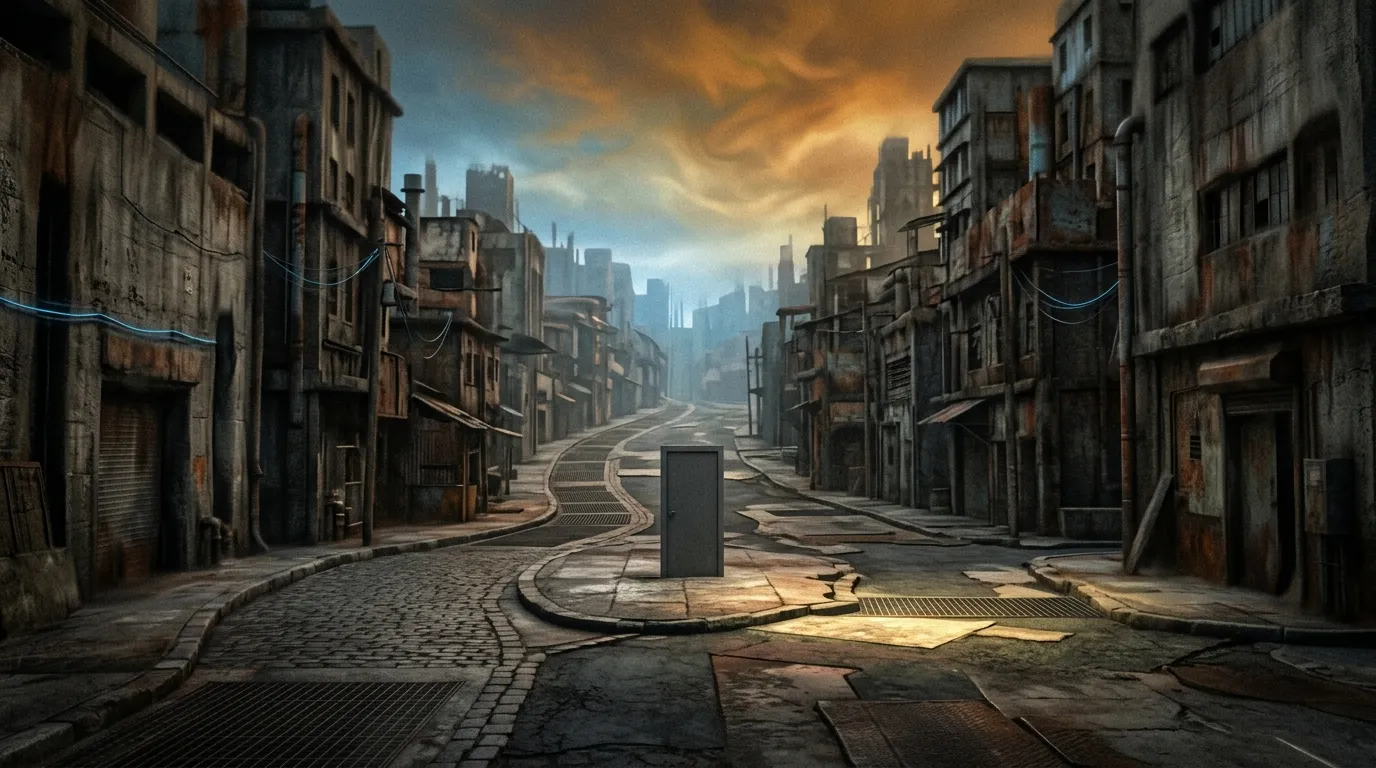
Gray-blue light seeped in from every direction, sourceless, without angle, as if the air itself were glowing. Ahead of her, a street stretched forward between buildings whose edges blurred at their margins—someone had smudged them with a thumb while the paint was still wet. The street’s angle was slightly off. Not quite straight: a barely perceptible arc, so that the far end looked higher than the near.
She didn’t know who she was.
The recognition didn’t trigger panic. It was like standing in an empty room and noticing there were no furnishings—not stolen, just never placed. Empty, but not hollowed. A page that had never been written on.
She pushed herself upright. As her knees left the ground there was a faint adhesive sound. She stood. Her center of gravity self-corrected; spine straight, shoulders drawing slightly back.
The first thing she did was survey the space. Not idly—her eyes moved on some inbuilt program: ground material first, then light source direction, then the dimensions of the space. The street was six paces wide. The buildings ran four stories. The sky—not sky, a field of color without clouds, gray-blue and amber blending at altitude like two liquids poured into the same glass before stirring.
The ground material shifted beneath her at the third step. The smooth warmth vanished; in its place, metal grating—a crosshatch pattern pressing up through the soles of her feet, cold and hard. She crouched and tapped it once with a fingernail. The sound was dull, no resonance. Solid underneath.
No.
She tapped again, shifted half a step right and tapped once more. This time the sound was slightly different—a very thin air-pocket echo beneath it. Not solid. There was a space down there. She marked the location in her mind, stood, and kept walking.
In the distance: sound. Low-frequency, sustained, like an entire city compressed into a great container that was breathing. Hmmm—hmmm—hmmm. The rhythm was steady; the gap between each pulse was precisely long enough to make you think it would stop. It didn’t stop.
A building wall beside her bulged slightly as she passed.
She stopped, turned. The wall had returned to its original shape—gray, rough, something like concrete but not quite. She stared at it for three seconds. Nothing happened. She walked two steps forward and caught in her peripheral vision the same expansion—like the rise of a ribcage, an inhalation, then a slow exhale.
Her lips moved. Not speech—she hummed a sound, involuntarily. A few notes at uncertain pitches, as if something had traveled from very far away and arrived half-scattered by wind. She didn’t notice she was doing it.
The amber in the sky had deepened.
An exit. She knew there was an exit. Nobody had told her—it was some part of her that lay beneath consciousness, sending a signal. Like hunger. Like thirst. She needed to find it, but she didn’t know where it was, where it led, or how she knew it existed.
The first obstacle appeared at the fourth intersection.
Four streets converged into an irregular plaza. At the center stood a door—freestanding, no wall, no frame, just a dark-gray panel with handles on both faces. She walked around it. Both sides were identical. Push? Pull? She tried. It didn’t move.
At the base of the door there was a row of symbols she didn’t recognize, arranged in the manner of writing but in no language she could identify. She crouched and examined them, her fingers tracing the grooves of the marks without meaning to—
“You’re back.”
She straightened sharply.
A person stood at the edge of the plaza. Gray clothing, gray hair, a face so evenly smooth in the diffuse light that all its details seemed to have been erased by one uniform pass. As if someone had turned down the contrast just enough.
“You don’t remember me,” the person said. Not a question.
“I don’t remember anyone.” Her voice was dry. Her throat felt like it was being used for the first time.
The person tilted their head. The movement was too fluid. No hesitation, no micro-adjustment of muscle—the motion of something rehearsed so many times that all the friction had been stripped out.
“The door opens from the inside,” the person said, then turned and walked into a side alley. Gray clothing merged with gray wall; within three paces the boundary between them was gone.
The door opens from the inside.
She stood looking at the door without walls for a long time.
Then she changed direction. She stopped looking at the door. She started looking at the ground.
Think it backwards. The phrase surfaced from somewhere that didn’t exist, clear as if spoken into her ear by someone else. She didn’t know where it came from. But her entire mode of thinking inverted with it.
If the door could only be opened from inside, the question wasn’t “how do I open the door”—it was “how do I get to the inside.” But the door had no walls. Both faces were outside. So “inside” wasn’t a spatial concept.
What kind of concept was it?
She crouched, pressed her palm flat on the ground. Warm. The same material as when she first woke. She closed her eyes. Her fingers tapped the ground—test, listen, shift, tap again. The way she’d done it when she found the hollow before, but this time she was looking for something specific.
Tap. Solid. Tap. Solid. Tap—
Hollow.
She traced her fingernail around the perimeter of the area in a complete circle. A section of ground roughly half an arm’s length across, its surface identical to the surroundings, but hollow below. She pressed the heel of her hand down. The ground depressed, then slid open like a released trapdoor.
Below: an opening just wide enough for one person to pass through.
Not downward. Upward.
Gravity had inverted at the lip of the opening. She reached her hand in and felt her fingers pulled gently up—and that up was the opposite direction from the ground where she stood. On the other side of the opening, the base of the door was directly above her head.
The door opens from the inside. “Inside” meant the other side of the floor.
She lowered her legs into the opening. At the boundary where gravity flipped she felt an instant of weightlessness—stomach contracting, sense of balance briefly gone—then her feet landed on the “ceiling,” or rather: she had stood up on the other face of the door.
The handle was right in front of her.
She pulled. The door opened. On the side she had come from—from the world she’d left—the door had been opened from inside.
Beyond the door, the street was narrower. The buildings taller. The amber in the sky had deepened another layer.
She walked through.
When she looked up, the gray-blue was gone. The whole sky was amber, like a thin film of honey over the city. She had no memory of the transition—only the awareness that she had been walking, unraveling one obstacle after another, and each time she glanced back at the sky it was darker than before.
Some obstacles yielded to logic. Some yielded to the body.
A section of ground turned fluid—her foot sank in to mid-ankle as she stepped, viscous, warm. She tried to run, but speed wasn’t the problem. The problem was rhythm. The ground was oscillating at its own frequency; she had to plant each step on a crest to avoid being swallowed. The first step sank. The second, her sole found the beat—the way a body knows the answer before the mind does. From the third step she ran, each footfall landing in the moment of crystallization, like stepping on water at the precise instant it freezes.
She went deeper. The streets narrowed. The walls began to glow faintly from within, phosphorescence from inside stone. The air temperature was falling. The low hum had grown more distinct—she could now hear that it wasn’t a single tone but many layers stacked together. A chord, but every voice singing the same note.
Then she saw it.
A light. Not the sourceless, directionless gray-blue—a focused, gathered white light pouring from an arched opening. Its edges were sharp, geometric, throwing a clean-cut shape on the ground before her.
The exit.
She knew it was the exit. Not deduced—her body telling her, the way an animal scents water. She ran.
Three steps.
The fourth step fell through—not because the ground vanished, but because her foot passed through it. She looked down and saw her right foot sinking into what had been solid surface, as if stepping into shallow water.
No. The ground wasn’t changing.
She was.
Sound went first. The low hum that had been the backdrop of the whole journey—as if someone were slowly turning down a volume dial. Hmmm—hmm—hm— and then silence. A silence she had never experienced, absolute and total. Not quiet. Hearing itself had been switched off. She opened her mouth and screamed; her throat was vibrating, but nothing came back to her ears.
She reached toward the light.
Then spatial sense went. Distance became unreliable—the exit appeared near, then impossibly far, three steps away or three kilometers away, she couldn’t tell. Her legs were still moving but she wasn’t sure she was getting closer. The boundaries between ground, walls, and sky began to blur, all surfaces slowly dissolving into the same substance.
Her fingers were still moving. Fingertips still felt air—no, not air anymore, something denser, like reaching into warm water.
Warm. Like the ground under her palm when she first woke.
Vision went after spatial sense. Not blackness—color being stripped away layer by layer. The amber first, then gray, then the sharp edge of the white light, until even the distinction between light and dark was gone. Not darkness. Absence.
Her hand made a movement she hadn’t chosen—fingers curling gently downward, as if touching something small, something curved, something that wasn’t there. She didn’t know why she did it. Her fingers remembered a shape, but the shape had no name.
Only touch remained.
There was still a trace of warmth in her palm. Not from outside—it seeped from some corner of memory, bypassing all the areas that had been emptied, finding one last path to the surface of her skin.
As if someone were holding her hand.
She tried to grip. Fingertips drawing in, searching for the outline of a hand that wasn’t there.
Someone is waiting for me.
The thought arrived without warning, clear enough to pierce through everything that was dissolving. Not reasoning, not memory—a certainty from somewhere beneath memory. Something she couldn’t name that was being taken away.
Then that, too, was gone.
Touch ebbed from her fingertips outward. Warmth evaporated from her palm. Her hand still held that drawing-in shape, but there was nothing left to hold.
What remained at the end wasn’t sensation. It was a shape—the small curve her fingers had memorized. It outlasted every other sense by one more moment.
One moment.
Then nothing. Not an ending. A reset to zero.
The ground was warm.
Her fingertips woke before her mind did.