Chapter 6
Chapter Six: Relics
Chapter Six: Relics
Dust doesn’t drift here. It accumulates.
5:40 in the morning, and Gé Héngyuǎn stood alone at the entrance to Fab 18’s B3 corridor, adjusting his headlamp to medium brightness. The beam cut in; the dust particles inside the shaft were absolutely still, like something in solid suspension. The air had the compound smell he knew from memory: mold, rust, acid. Today there was a new layer underneath it—sweet, rotten, something organic decomposing slowly in a corner he couldn’t see.
He hadn’t brought the crew. Just himself, one flashlight, a tool bag, three Faraday bags—standard scavenging kit; electronics in an EMF zone without shielding might as well stay in the ground—and a small bottle of calcium hydroxide suspension. At the bottom of the pack he’d laid an oilcloth sheet, purpose TBD, but he had the habit of giving every variable a contingency.
His rig was parked outside the gap in the perimeter wall. He’d stopped a kilometer out, pulled the battery, sealed it in the Faraday bag, pushed the last eight hundred meters on foot. The chip was throttled down—Layer 3 closed, Layer 2 at minimum sampling.
Before entering the corridor he scanned three directions. Two exit routes. One short of his standard. Today’s risk budget was already above standard; the exit math reflected it.
He turned sideways to squeeze through the gap in the fire door. A rebar edge caught his pack—last time it was Luò Cuò’s pack that got caught. No sound of anyone following.
The B3 corridor structure matched his memory closely enough. He reinitialized the dependency graph in his head, updating each node: the load-bearing pipe rack was still standing, the fractures hadn’t spread. The section of steel beam that had dropped on the south end he didn’t need to approach—today’s route went left, toward the HF zone.
Toward the door.
At the junction, he stopped at the mouth of the left corridor and shone his headlamp in.
Honeycomb ground. The concrete had been etched by hydrofluoric acid until it had the texture of a lunar surface; load-bearing capacity was under thirty percent. Every step was a bet that the floor wouldn’t give way.
The acid smell sharpened immediately. Hydrogen sulfide—the rotten-egg bite—was seeping from cracked specialty-gas lines, sharp but not lethal at this concentration. At the back of his nasal cavity, the faint suggestion of garlic: arsine residue. That one could kill.
He pressed a damp cloth against his nose and mouth and loosened the cap on the calcium hydroxide suspension by one turn—not to use it, but to ensure that if he needed it he could open it in two seconds.
His left hand tremored slightly. He ignored it. Not the moment for a workaround. He let the tremor run in the background like a process that wasn’t using much CPU.
He started walking. Not walking—calculating. Each footfall preceded by the headlamp sweeping the target surface, assessing the degree of honeycomb damage. He kept to the left wall—the pipe runs overhead formed a partial shield against direct drip from the chemicals, making the ground conditions marginally better. The concrete had spalled off the wall itself, exposing rebar underneath. The rebar wasn’t rusted: HF-etched metal came out with an unnatural cleanliness, like a surgical blade.
Forty meters. Fifty meters. His world contracted to the diameter of the headlamp beam: one meter. Outside the beam, nothing existed. He kept his breathing shallow—every deep breath meant more residual gas.
At sixty-three meters, he saw the door.
Thicker than he remembered. The headlamp hit its surface—brushed stainless steel, completely at odds with the surrounding concrete walls. A black rubber gasket ran around the entire perimeter, mostly intact, with a short section lifted at the lower right corner. The handle was heavy-duty, a lever type, not a knob. No electronic lock, no card-reader bracket. Pure mechanical.
A placard was mounted on the door. White background, red text, faded but still legible: B2-SERVER / NON-PROCESS ZONE / AUTHORIZED PERSONNEL ONLY. The last line had been scratched off. Only “AUTHORIZED” remained.
B2. Basement level two.
Ā-Zhèn had been right. There was another floor below the equipment level.
He laid his hand on the lever. Cold metal conducted through the nitrile glove into his palm. The lever was heavy but not seized by rust. He applied steady, even pressure—not a sudden force—and it moved. The gasket dragged across the door frame and produced a long, low hiss, like a sealed container taking its first breath after a decade.
The door opened about thirty centimeters before stopping. Rubble had wedged under the door track. He crouched, worked the debris free with a screwdriver, and the door moved another twenty centimeters. Just enough to turn sideways and squeeze through.
Behind the door: a staircase going down.
The stairs were short—roughly two flights. The concrete treads were intact—this section had been sealed away from the HF zone’s chemical damage. The air changed immediately: cold, dry, carrying the particular smell of stale dust in a closed space. The acid and the rotten-egg smell were cut off by the door. He pulled the cloth away from his face and took a deep breath.
Clean.
Footsteps echoed back from the stairwell walls, emptier and harder than they sounded above. Heart rate at seventy-something. He brought his attention back to the steps.
At the bottom: a corridor, narrower than the B3 passage, the ceiling half a meter lower, but structurally intact in a way that felt like a different building. The anti-dust paint on the walls had yellowed with age but was uncracked. The floor was dry. The conduit runs were all enclosed in metal-capped raceways—power, network, cooling, three parallel tracks extending to the far end of the corridor.
The cover on the network raceway had been pried open at one section in the middle. He moved closer: fiber optic cable, all of it cut. Clean cuts—deliberate. Someone had intentionally severed every network connection on this floor.
Physical air-gap.
At the end of the corridor: a fire door, unlocked. Beyond the door—
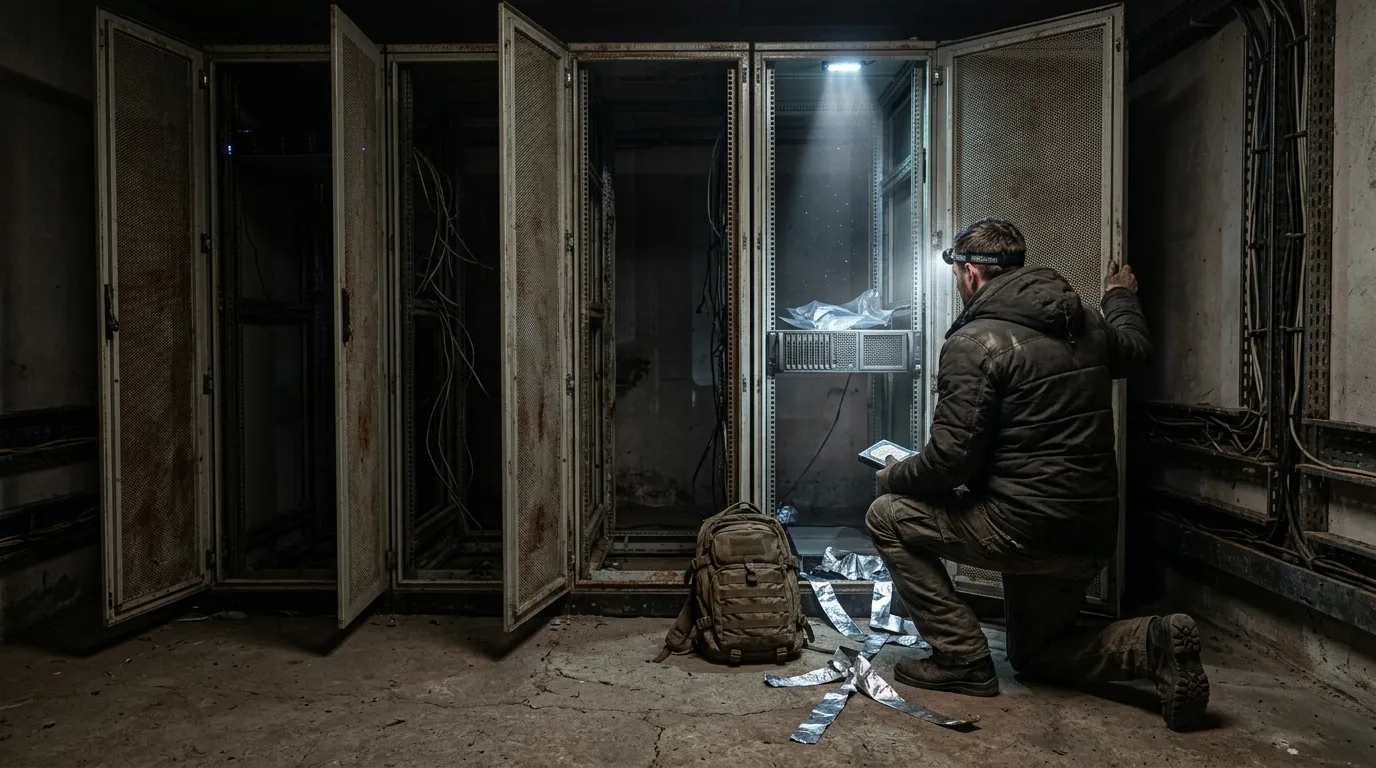
A server room. Not large, maybe twenty square meters. Four rows of standard 42U racks, sixteen total, surfaces uniformly gray with dust. Most cabinet doors were open, their interiors bare—the equipment had been removed before the seal-up.
He walked the rows. Empty. Empty. Empty. Third row, last rack—the door was closed.
More than closed. The door had something on it: aluminum foil tape. Someone had sealed every seam of the cabinet door with aluminum foil tape—even the top ventilation slots were covered completely. Layer on layer of tape in places, three or four sheets thick at some joints, edges pressed tight, leaving no gaps.
His hand stopped on the tape. Something in his brain began calculating rapidly.
Aluminum foil tape. All seams and openings sealed. A metal cabinet body. Continuous conductive enclosure.
Faraday cage.
Someone had converted this cabinet into a Faraday cage.
His heart rate climbed from seventy to eighty. He noticed. He didn’t suppress it.
He started pulling off the tape. The adhesive was still there, but the backing had become brittle—it tore with a dry, crackling texture. He worked from the door seam outward, strip by strip. Silver fragments of tape fell to the floor, catching the headlamp and scattering the light.
The last strip came off. The cabinet latch was loose; his thumb pushed it open.
There was something inside.
Not much. A 2U server—old model, the kind with a pressed-steel-plate chassis, not the thin aluminum sheet of modern units. Beside the server, in an anti-static bag, a graphics card—he recognized the shape of the heatsink through the bag without needing to open it. On the shelf below: an external hard drive, a coiled network cable (not connected), and an A5-sized notebook.
He didn’t touch the server first. He touched the notebook first.
The cover was black hardboard, no markings. He opened to the first page. Someone had written one line in blue ballpoint:
“If you found this, you probably need it.”
The handwriting was neat but not labored. He flipped through a few pages—dates, temperature logs, abbreviations and codes. An engineering journal. The handwriting in the last few pages was visibly rushed, like someone working against a deadline. He didn’t read further. Not now.
He set the notebook down and reached for the server. The front panel had a power button, but no power. He went around to the back—the power cable was plugged into an uninterruptible power supply, its battery indicator lights all dark. Dead. Normal: lead-acid batteries with no charge for ten years couldn’t possibly be alive.
He didn’t need to boot it up. He needed the hard drive.
A screwdriver, the side panel off. The internals were immediately readable: motherboard, CPU cooler, two memory sticks, one SATA solid-state drive, a power supply. Minimal dust—the Faraday cage’s seal had kept it out.
He extracted the solid-state drive. Samsung, 860 EVO, 1TB. SATA interface. Old hardware. But solid-state drives had no moving parts—as long as the flash memory’s charge hadn’t decayed below threshold, the data was still there. He scanned the inside of the cabinet—a small packet of desiccant. Temperature and humidity close to ideal storage conditions. Ten years, in this environment, NAND flash would hold.
The way the drive was mounted wasn’t standard—the screw holes didn’t align; it had been zip-tied to the drive bay instead. Installed after the fact. Someone had loaded this drive into this server after the factory evacuation.
Then he opened the anti-static bag.
NVIDIA GeForce RTX 3060. 12GB GDDR6.
His hands stopped.
Not the tremor—stopped. Completely still. Every running process suspended simultaneously. CPU usage dropped to zero.
Twelve gigabytes of VRAM. Local inference.
He set the card down and picked up the drive again. This time he used a screwdriver to lift one corner of the label on the drive’s casing—on the back, written in fine-tipped marker in extremely small characters:
llama-7b-q4.gguf / llama.cpp / README
Cold boot. What came online first wasn’t emotion. It was calculation.
Seven billion parameters. Q4 quantization. GGUF format.
A four-bit quantized 7B model: approximately 3.5 to 4 GB. GGUF was llama.cpp’s native format, supporting both pure CPU inference and GPU offloading. The RTX 3060’s 12GB of VRAM—more than enough. It could load the entire model into VRAM. Inference speed would reach thirty-plus tokens per second.
A completely local large language model.
No network required. No API. No server connection of any kind. No traffic generated. No logs left. In a world where all AI ran through centralized compute pipelines, where all inference was logged and monitored—this thing should not exist.
His knee touched the ground. Not a kneel—his legs gave out. The body reacted before the mind, the support strength in his thigh muscles draining away at some point, and he was down on one knee, right hand bracing the edge of the cabinet, left hand holding the drive.
The drive weighed under a hundred grams. His hand felt a ton.
That engineer—the one who had stayed after everyone else evacuated, loaded a hard drive into a server, sealed the cabinet with aluminum foil tape to make a Faraday cage, cut every fiber optic line, and left a notebook behind—that person had known exactly what they were doing. They had known ten years ago: someday, someone would need an AI that couldn’t be seen.
He rested the drive on his knee and covered it with his palm. Cool. Inside the flash memory chips under his palm, billions of floating-point numbers lay quietly on silicon substrates—every value a four-bit approximation of a neural network weight. A sleeping, miniature, compressed intelligence.
Seven billion parameters. Seven percent of a human brain—a lean deployment, trimmed to its essential modules. Complex reasoning would produce errors. Long contexts would drift. But it would run. Completely offline, it would run.
One card, one drive. An AI that existed on no network anywhere.
How long he crouched there he couldn’t say. His brain completed cold boot and entered full-speed operation—not emotional excitement, but the state that had appeared only a few times in his twenty-year career: when a systems architect sees an impossible solution become possible and the brain automatically begins computing all downstream consequences.
In a world where compute credits were currency, he had found a mint that nobody knew about.
No. Better than a mint. A mint could be discovered. This couldn’t.
He stood up. His knees were stiff. He began systematically breaking down his haul: the drive and the graphics card wrapped in oilcloth and packed into the deepest part of the bag, surrounded by the soft padding of the tool bag; the notebook tucked into the chest pocket. He considered the motherboard and power supply for three seconds—too large for this trip. The board and PSU were replaceable; this model and this card were not.
He took one last look at the cabinet. The silver fragments of aluminum foil tape lay scattered across the floor like shed skin.
The UPS battery indicators were still dark. He pushed the cabinet door back. No tape left to reseal it—but there was nothing left inside that needed protecting.
The return trip was faster.
Not because the danger had decreased—the HF zone’s honeycomb floor wasn’t going to solidify just because he was in a better mood. It was because his route choices were more decisive. The three-second judgment calls on the way in now took one second. Not recklessness—the contents of his pack had changed the risk equation. The return item in the calculation had shifted from uncertain to certain, the denominator had changed, and the whole calculation’s threshold had moved with it.
Through the HF zone. Sixty-three meters. Same wall-edge route, same step-by-step calculation. His left hand’s tremor came back as he rounded a corner, fingertips scraping concrete, leaving a fine white trace. He let it tremble.
He pulled the sealing door closed behind him from the inside, but didn’t reseal it. Closed was enough. When he came back—and he would come back—he’d need fast entry.
B3 corridor. Junction. Right turn. Toward the exit.
Squeezing through the fire door gap, the pack against his back was much lighter than when he’d gone out this way before—no seven-kilogram reflector mirror this time. But the hand gripping his pack strap was tighter than before.
Outside light made him squint. Not morning light anymore—it was full day, the sun at east-southeast, well past nine at minimum. He’d been underground more than three hours.
To the southwest, clouds had piled into a mountain of the wrong color—base gray-black, peaks brilliant white, as if lit from within. The barometric pressure was falling; his temples ached faintly at the edges. Southern Taiwan’s afternoon thunderstorms never ran late. Sometimes they came early.
He pushed his rig through the last eight hundred meters at a jog and put the battery back in. The motor’s starting hum had never sounded so good—not because the sound had changed, but because his ears had.
The rain fell as he reached the Dawan Road intersection.
No warning. One second the air was only heavy and hot; the next, the whole world was punched through with water. Drops hammered on his helmet like sustained rifle fire, visibility cut off at twenty meters by the rain curtain.
He moved his pack from his back to his chest and wrapped both arms around it. Oilcloth around the graphics card and the drive, three layers of cushioning, any impact absorbed by those layers before it could reach the billions of sleeping parameters inside.
The rig moved south down Zhonghua Road through the downpour. Water was up to the hubs. In the distance, thunder—low, grinding, like some massive structure fracturing far underground.
Twenty minutes later, at his front door. Soaked through, water running off his trouser cuffs and pooling on the tile, spreading slowly outward.
Inside the pack against his chest, a drive weighing under a hundred grams existed quietly. Seven billion weights, a complete copy of an open-source model, a relic left by an engineer who had placed a bet ten years ago on the future.
Gé Héngyuǎn’s left hand was shaking. He didn’t stop to let it finish. He shifted the pack to his other arm and used his right hand to open the front door.
The lock turned two and a half times.