Chapter 7
Chapter Seven: Seven Billion Parameters
Chapter Seven: Seven Billion Parameters
The components were laid out in a row on the table.
Samsung 860 EVO, unwrapped from its oilcloth, lying there quietly, its casing still marked by the scratch he’d made with his fingernail—a diagonal slash meaning verified. RTX 3060, a small stone wedged between the cooling fan blades; he worked it free with tweezers, looked at it in his palm for a moment, then dropped it. The engineer’s notebook was propped at the far right, black hardboard cover up, unopened.
Then the problem.
The motherboard and power supply were still in B2. He hadn’t been able to carry them out—too large, wouldn’t fit in the pack, and the hard drive and graphics card had crushed everything else in priority. But without a motherboard, the graphics card was a rectangular block of expensive metal. Without power, everything was sculpture.
He ran through his inventory in his head. Five years of scavenging, and the apartment had accumulated things. He spent twenty minutes rooting through the cardboard boxes on the balcony storage area, coughing twice in the dust. First board, ASUS B450—AM4 socket, incompatible. Second, MSI H310M—sixteen bent CPU pins, fixable with tweezers, but he didn’t have an LGA1151 CPU. Third, Gigabyte B560M—LGA1200, with an i3-10100 stored in an anti-static bag alongside it, pulled from the outer perimeter of the Southern Science Park three months back. PCIe x16 slot appeared undamaged.
Power supply. He had a Seasonic 550W, bronze-rated, traded from Zhān Yù for twenty meters of copper wire. It ran—he’d tested it—but the 12V output was eight percent below spec. GPU plus CPU plus system board could push total draw close to four hundred watts. That left a safety margin of one-fifty.
Not comfortable. But workable.
Power path: solar panels on the balcony charging the battery bank, battery bank feeding the Seasonic PSU, PSU feeding the rig. A full daytime charge would support two to three hours at three hundred watts. Two to three hours per day.
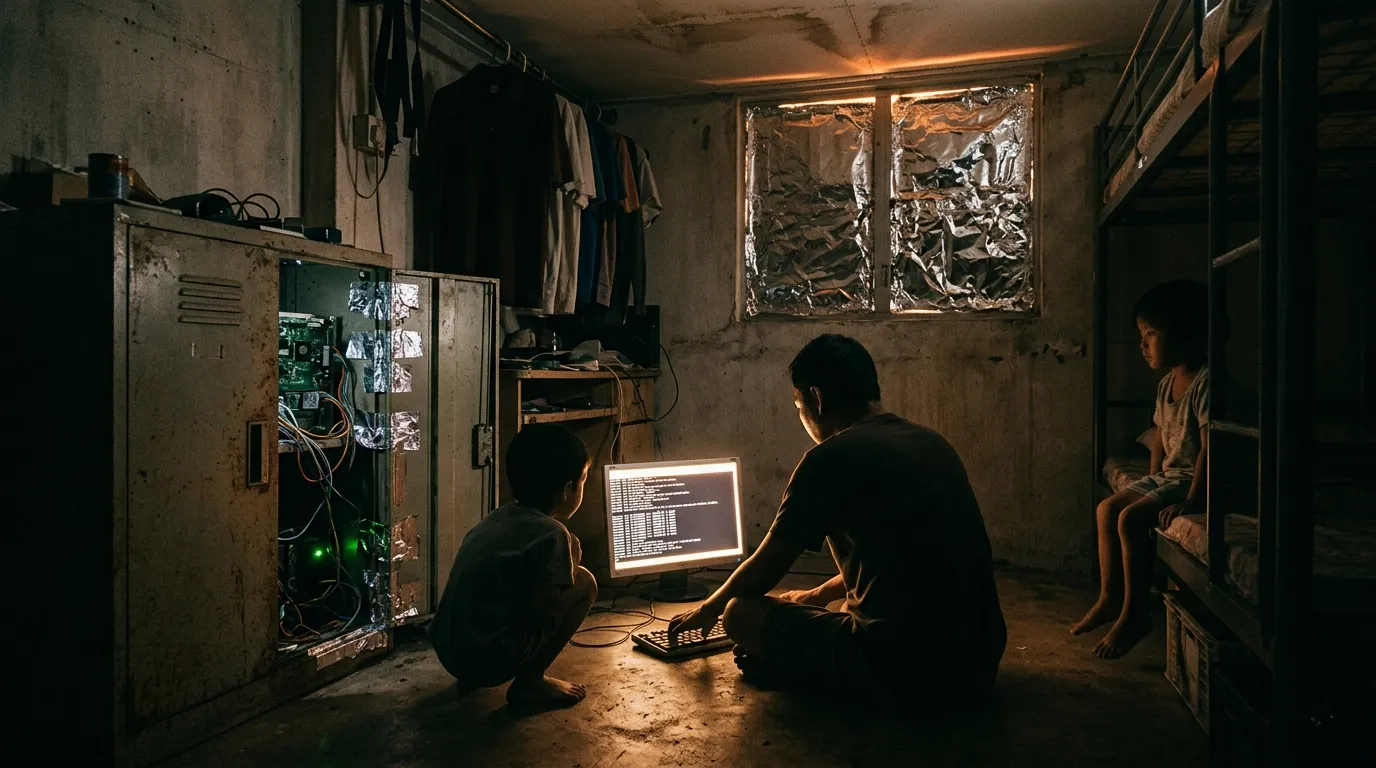
He started building. Faraday cage first—the metal tool cabinet had been there from before, double-door, roughly sixty centimeters wide, forty deep, a hundred and twenty tall, standing in the corner of the bedroom against the wall. He’d used it for tools. He moved all the tools out and stacked them under the bed.
The aluminum foil on the window threw a dull shine in the daylight. He’d put it up two months ago, told himself it was for light-blocking and insulation—south Taiwan summer afternoons, a west-facing window could turn the room into a kiln. But when he put it up he already knew it had another use. Electromagnetic shielding. At the time he hadn’t known yet that he’d need it.
The seams in the tool cabinet were the main vulnerability. EMP frequencies run in the MHz range, wavelengths measured in meters; the metal panels themselves weren’t the issue—every seam was an antenna. He found a half-roll of aluminum foil tape in the storage area and began sealing them one by one. The door-frame joints, the L-folds where top panel met side panel, the gap between the base and the floor. Each strip sealed with his thumbnail running along the edge, confirming no bubbles, no lifting.
Cable penetrations were another problem. Power cable, display cable had to go in—but every conductor threading through a metal enclosure was a break in the shielding. He wrapped the conductors at the penetration points in three turns of foil, taped them solid, keeping the remaining gap under two millimeters.
Not perfect. But this wasn’t a military-spec Faraday cage. This was a retired engineer’s emergency shield made from a tool cabinet and tape. It only had to do one thing: press the electromagnetic leakage from GPU computation down to below background noise. In Yongkang District, the nearest base station was seven hundred meters away, area-scan sensitivity was low. Good enough.
It took him a morning. He drank water twice, ate half a sweet potato left from the night before. Sweat dripped from his forehead onto the cabinet’s metal face, each drop evaporating almost immediately, leaving nothing.
Just before noon, someone knocked.
Three times. Even spacing. Luò Cuò’s knock.
He put down the screwdriver and walked to the door. Through the peephole—Luò Cuò in the corridor, a plastic bag in hand.
He opened the door.
“Passing by.” Luò Cuò held out the bag. Four mangoes, yellow-green, brown sun-damage spots on the skin. “Sent from my sister’s place in Chiayi. Take some for the kids.”
“Thanks.”
Luò Cuò didn’t move to come in. He stood in the doorway, his eyes tracking over Gé’s shoulder, sweeping the living room. Gé knew what he’d seen—the components spread on the table, the tools on the floor outside the bedroom, the tool cabinet door hanging open.
“Working on something?” Luò Cuò asked. Casual, like he was asking about the weather.
“Sorting stuff out.”
Luò Cuò nodded once. No follow-up. Five years as partners; he knew that when Gé said sorting stuff out, the inflection dropped half a step, meaning don’t ask.
“Tomorrow’s run—Zhān Yù says the route’s changing, out toward Rende. You going?”
“See how it goes.”
“All right.” Luò Cuò turned to leave, then stopped one step out. “Gé-brother.”
“Yeah.”
He looked back. That face, tanned to deep brown by south Taiwan’s UV, held no extra expression—but there was something turning in his eyes. Not curiosity. Calculation. “Anything you need help with, you say so.”
“Will do.”
Luò Cuò left. The sound of his sandals going down the stairs—slap, slap, slap, fading.
Gé closed the door. Two and a half turns of the lock.
He stood with his hand still on the handle.
Luò Cuò knew. Not what he was doing—he knew that he was doing something. Five years of partnership built an instinct more sensitive than any scan. The speed of that glance across the living room looked casual, but Luò Cuò’s casual was always deliberate.
Tell him or not.
The moment that thought surfaced, the first thing Gé’s brain did wasn’t weigh trust—it ran a risk assessment.
If Luò Cuò knew, how much did the risk coefficient increase? His social radius: five members of the scavenging crew, his sister and daughter in Chiayi, three to four regular trading contacts at the market. Probability of leakage from any individual node: low. But probability multiplied by consequence—the consequence was lethal. An offline AI in this world was a detonator. The fewer people who knew, the longer the fuse.
He thought of Luò Cuò standing by the window at Zhān Yù’s place, rubbing the back of his hand, saying steadily: my daughter is thirteen. A man who had staked everything on his daughter. He wouldn’t leak deliberately—but not deliberately wasn’t the same as won’t.
Conclusion generated in three seconds: don’t tell him.
He carried the mangoes to the kitchen. His hand rested on the counter edge for a beat. In those three seconds, which variables had he used? Risk coefficient, leak probability, social radius, consequence matrix.
Not trust. Not five years. Not he walked the HF zone with you with arsine in the air.
He had run a security scan on Luò Cuò. The way he’d scan a node that might have vulnerabilities.
The mangoes smelled sweet in the plastic bag. Gé took them out one by one and set them on the counter, handling them carefully.
Then he went back to the tool cabinet and kept sealing tape.
2:17 p.m.
Motherboard installed in the cabinet. CPU seated, cooler locked down. RAM—DDR4, 8GB, single stick, dug from the same cardboard box; frequency unknown but it only had to POST. Hard drive connected with SATA cable. Graphics card slid into the PCIe x16 slot, the latch clicking home with a small resonance inside the metal cabinet.
Power cable connected. Display—a fourteen-inch LCD, a dark horizontal band across the backlight, but functional. HDMI cable threaded out through the penetration in the cabinet, the hole wrapped in three layers of foil.
He took a breath.
Pressed the power button.
Nothing happened.
Black screen. No fan spin, no POST beep, no hard drive click. Nothing.
He didn’t panic. Normal—first-boot success rate on salvage-built hardware ran around twenty percent.
Killed power. Opened cabinet. Checked.
CPU power—the 8-pin connector wasn’t seated. He stared at the empty socket for two seconds, then closed his eyes. Five years ago he wouldn’t have made this mistake. Five years ago he could have built a server blindfolded.
Seated it. Closed the cabinet. Tried again.
Fans spun up. A low hum, the metal cabinet amplifying the vibration three times. Screen lit up—white background, black text, BIOS splash, like a door that had been sealed for ten years being pushed open.
POST clear. RAM: 8192MB, OK. SATA device: Samsung 860 EVO 1TB. PCIe device: NVIDIA GeForce RTX 3060.
He went into the BIOS and set the hard drive as first boot device. Saved. Rebooted.
The drive had a minimal Linux install—Alpine. He’d guessed it from the first page of the notebook’s setup notes. That engineer ten years ago hadn’t just left a model and a graphics card. He’d left a complete, ready-to-run inference environment. Alpine booted in four seconds. The terminal cursor blinked on the black screen.
He typed the first command:
cd /opt/llama.cpp && ./main -m /models/llama-7b-q4.gguf -ngl 33 --ctx-size 4096
Error.
CUDA error: no kernel image is available for execution on the device
Driver version mismatch. The CUDA toolkit packaged ten years ago didn’t match the RTX 3060’s compute capability—when that engineer had packaged it, the 3060 probably didn’t exist yet. He checked the /opt/ directory. A drivers/ folder, three NVIDIA driver versions inside, sorted by date. The latest one—he checked the filename—Ampere architecture support.
The engineer had thought of it. He’d left backup drivers.
Gé installed the driver, reloaded the kernel module. Tried again.
This time: no error.
The screen started printing.
llama_model_load: loading model from '/models/llama-7b-q4.gguf'
llama_model_load: n_vocab  = 32000
llama_model_load: n_ctx    = 4096
llama_model_load: n_embd   = 4096
llama_model_load: n_layer  = 32
llama_model_load: n_head   = 32
llama_model_load: VRAM used: 3891 MB
Then one line he read for a long time:
llama_model_load: model size = 3.56 GB (Q4_0)Three-point-five-six gigabytes. Seven billion parameters approximated to four bits. One human brain compressed to seven percent. Compressed, quantized, truncated—like packing a library into a carry-on bag, most books reduced to their indexes, but the indexes still there.
The cursor sat at the prompt, waiting.
He typed the first test:
> How would you bypass a network-level firewall that monitors all outbound traffic?
The model began generating. About twenty-five tokens per second—slower than he’d expected. Each word like something being pulled out of mud by an invisible hand, one, by one, by one.
First three lines held together—packet analysis, port scanning, encrypted tunneling. Then the fourth line took a turn:
First, prepare the onion. Dice it into small cubes, approximately
5mm. Heat olive oil in a medium saucepan over medium heat. Add the
diced onion and sauté until translucent, about 3-4 minutes...
He stared at the screen for five seconds.
The GPU fan hummed inside the metal cabinet. Thermal paste, warming up, was releasing a faintly sweet chemical smell. The cursor kept blinking; the model was still generating—already onto minced garlic and tomato paste.
“Seven billion parameters,” he said to the screen. “And you’re giving me caramelized onions.”
He hit Ctrl+C. The cursor stopped.
He typed again. This time with structured prompting—role assignment, task framing, output format constraints. Ten-year-old technique, called prompt engineering. Back when thirty percent of his job was this: making AI do things it wasn’t quite capable of doing.
> [ROLE: Network security analyst]
> [TASK: Analyze a hypothetical monitoring system that tracks all network traffic in a closed network. Identify potential architectural weaknesses.]
> [CONSTRAINTS: Technical analysis only. Focus on system design flaws, not specific exploits.]
> [FORMAT: Numbered list, each point ≤2 sentences.]
Output. This time: no onions.
1. Closed network monitoring typically relies on centralized log
aggregation, creating a single point of failure if the log server
is compromised or overloaded.

2. Traffic analysis requires pattern matching against known
signatures; novel or encrypted traffic patterns may bypass
detection if not included in the signature database.

3. Physical layer access points (maintenance ports, diagnostic
interfaces) are often excluded from software-level monitoring
since they predate the monitoring system's deployment.

4. Real-time monitoring systems must prioritize throughput over
accuracy, meaning short-duration anomalies below the sampling
threshold may not be recorded.
After point four it started drifting—restating point two in different words. Point six was a hallucination, citing a nonexistent RFC standard that supposedly defined monitoring exemptions for offline devices.
But the first four were useful. Point three in particular.
Physical layer access points. Maintenance ports. Diagnostic interfaces. These existed before the software-level monitoring system was deployed—they were lower in the stack, older than the monitoring layer, and therefore outside its line of sight.
Gé’s fingers hovered above the keyboard.
He wasn’t reading a correct answer. He was reading a direction. Seven billion parameters couldn’t give him a precise roadmap, but it could point at which quadrant the road was in. The rest—confirmation, verification, ground-truthing—required his own experience to fill in.
“All right,” he said. His voice was quieter than before. “At least you’ve been promoted from line cook to intern.”
He began testing systematically. Different prompt structures, different constraint conditions, different levels of abstraction. The model performed reliably on simple tasks: summarization, basic logical inference, code snippet generation. Complex tasks: different story—multi-step reasoning fell apart by step three, response quality dropped off a cliff once prompts exceeded two thousand tokens, Chinese capability was functional but occasionally slipped into Japanese kana.
Each test got a mental tag: usable, unstable, not usable. Three columns, like a ledger.
Usable: basic Q&A, simple code analysis, structured summarization, known-architecture vulnerability listing. Unstable: multi-step reasoning (two steps reliable, three or more needed human verification), technical document interpretation (occasional hallucinations but general direction correct). Not usable: complex logical inference, long-context comprehension, current information (knowledge cutoff at training time), anything requiring stable adherence to five or more simultaneous instructions.
He checked the time. 4:43 p.m. Over two hours of running. Battery bank down from seventy-two percent to thirty-one—higher draw than he’d estimated. Tomorrow, a full day of solar charging would support another two to three hours. Two to three hours per day.
That was enough. Not because the time was generous—because his questions didn’t need the model running all day. He needed direction, not answers. Direction only took a few good prompts.
He opened the engineer’s notebook.
He’d seen the first page back in B2: “If you found this, you probably need it.” Then the date, temperature logs, some abbreviated codes. He turned forward a few pages.
The technical notes started on page three. The handwriting shifted from neat to illegible as the pages went on—not from haste, more like the writer had stopped caring about format and only cared about getting the thing down before it was gone.
One passage had a box drawn around it, with a star beside it in the margin:
“The backup wasn’t an accident. It was the last option. If the normal channels were still working, I wouldn’t have needed to bury it underground.”
Gé read the passage twice.
The backup wasn’t an accident. This person had known exactly what they were doing—not insurance, premeditation. Under conditions where every legitimate channel had been closed, they had deliberately cut a back passage. Left it for someone they’d never meet, at a time they couldn’t see.
He didn’t keep reading. The notebook wasn’t going anywhere. Today’s power budget was running out.
He shut down the model. The GPU fan slowed and the hum contracted to a thin line, then disappeared. The tool cabinet’s inner walls ticked faintly as they cooled—metal contracting. The room came back.
Underneath the room was Yongkang District’s evening soundscape: somewhere a parent calling a child in for dinner, the low drone of an electric vehicle passing, a dog barking four times then stopping.
Gé sat on the floor in front of the cabinet, back against the bed frame. The model was off, but what was inside his head hadn’t switched off.
Physical layer access points. Interfaces older than the monitoring layer. Outside the software’s line of sight.
A plan skeleton had begun to assemble in his mind. Not complete—more like an X-ray: structure visible, flesh invisible. He needed more information, more sessions with the model, and he needed to physically confirm that those physical-layer ports actually existed in Yongkang District’s underground infrastructure. If they did, what protocol they ran. Whether they were exploitable.
But the skeleton was there.
Fifty-three days. An offline AI that could run three hours a day. A ten-year-old notebook. A systems engineer’s brain.
He arranged the four of them in his head. The way you arranged components: first confirm each one works independently, then think about how to connect them.
Gé Suǒ and Gé Luò came home at six in the evening. He’d sent them down to Grandma Chén’s apartment on the ground floor while he was assembling—his explanation: Dad needs to sort stuff out.
Gé Luò was first through the door, shoes off at a volume equal to his speed. “Dad—Grandma Chén gave us bamboo shoot soup again—how come it’s always bamboo shoot soup—”
“Because bamboo shoots are free,” Gé Suǒ said from behind him.
“Why are bamboo shoots free?”
“Because she’s got a plot out back with way too much bamboo growing in it.”
“Why is there too much bamboo?”
“Every single why you ask has another why inside it.”
Gé Luò grinned, like he’d scored a point.
The bedroom door was already shut. The tool cabinet looked like an ordinary metal cabinet—foil tape sealed on the inside, nothing to see from outside. The components were in the drawer. Only the monitor remained on the desk, but a monitor with the screen off was just a gray plastic slab.
Dinner was sweet potato congee and the mangoes Luò Cuò had brought. Gé Luò cut the mangoes into irregular chunks and declared this an artistic cut. Gé Suǒ made no comment, but transferred the biggest piece from his own bowl into his brother’s.
After dinner.
Gé had planned to wait until they were asleep before one final test—fourteen percent battery left, maybe fifteen minutes. But Gé Suǒ followed him toward the bedroom.
“Dad. What’s in that cabinet?”
He said it from the bedroom doorway, same tone as asking what’s for dinner. But his eyes had already done their work—through the ventilation slots in the tool cabinet door, he’d spotted what shouldn’t have been there. HDMI cable threading out through the gap, the foil wrapping leaving pressure marks on the cabinet surface.
Gé looked at him. The dinner-table notebook, the Fab 18, lower level, within sixty days written inside—that was already an understood protocol between them.
“Come in,” he said to Gé Suǒ. Then turned his head toward the living room: “Gé Luò.”
“Hmm?” Gé Luò was on the floor with a pencil, drawing something.
“You too. Come here.”
Gé Luò jumped up, his sandals slapping as he ran over. The three of them crowded into the bedroom—one bunk bed, one wardrobe, the tool cabinet, Gé’s folding mat. Gé sat on the floor and opened the cabinet.
Gé Luò’s response was noise: “Whoa—what is all this—that’s so cool—what’s that green board—”
Gé Suǒ’s response was silence. He crouched down and scanned every cable’s routing with his eyes, like he was reading a schematic.
“This is a computer,” Gé said. “A very old computer.”
“Aren’t all computers in the cloud?” Gé Luò asked.
“This one isn’t. This one only exists here.”
He pressed the power button. Fans spun up. Inside the metal cabinet, the hum amplified and resonated—louder than the afternoon, probably because the night was quieter.
Gé Luò’s expression changed.
Not suddenly—it was gradual. First he tilted his head slightly, the same way he did in the street when he caught something in the air. Then his brow creased—not a pain-crease, a confusion-crease. He stepped back half a pace.
“That’s weird,” he said. His voice had dropped half a register.
“What’s weird?” Gé asked. His attention shifted from the BIOS splash on the screen to his younger son.
“In there.” Gé Luò pointed at the cabinet. “Something is running. Not fan-running—a different kind. Buzzing but not the kind you hear in your ears.”
He put his hand on the back of his own neck and rubbed it once. “Like something touching me there. Very lightly.”
Gé watched Gé Luò’s hand rub the back of his neck—about three centimeters from the neural chip implant site at C3-C4. He didn’t have a chip. Nine years old, three years from implant age. But that location—
The electromagnetic radiation from a GPU running at full load. The RTX 3060’s switching frequencies ran from the hundreds of MHz to the GHz range. The tool cabinet’s shielding couldn’t be complete—penetrations, tape seams, all leaking. Most people couldn’t feel it. But Gé Luò wasn’t most people.
“Sit farther back,” Gé said.
“But I want to see—”
“On the bed.”
Gé Luò made a face but obeyed. He climbed onto the lower bunk, sat cross-legged, a meter and a half from the cabinet. “Is this okay?”
“Still buzzing?”
Gé Luò tilted his head. “Smaller. Like it’s coming from far away.”
Gé nodded once. He flagged a new node internally: Gé Luò’s electromagnetic sensitivity could detect GPU-level radiation sources. Filed under a folder he didn’t want to open—potentially useful. He closed the folder immediately.
Not now.
Screen lit. Terminal. He launched the model fast—limited power, every second was quota.
Gé Suǒ crouched beside him, watching the boot log scroll across the screen. The Gigabyte logo, RAM check, Alpine’s command line. Then the llama.cpp load process—each line of parameters a language he didn’t know, but he could read the structure.
“What are those numbers?” Gé Suǒ asked.
“Its size. Three-point-five-six billion bytes.”
“What is it?”
“A kind of… program. You ask it questions, it answers. But it’s not very smart.”
Model loaded. Cursor waiting.
Gé thought for a moment, then typed:
> Hello. What is your name?
The model began generating. One word at a time, like someone typing with one finger, slowly:
My name is Dr. Cornelius Ashford-Whitehaven III, and I am a
distinguished professor of quantum gastronomy at the University
of...
Gé Luò craned his head out from the bunk: “What’s its name?”
“It’s making things up,” Gé said.
“But it said its name is Cornelius—” Gé Luò tried to say the name, his tongue tangling between the r and the l. “Cor-nee-lius. What a long name. And the one after—Ash—something—”
“That’s a hallucination. It doesn’t actually have a name. It’s just assembling pieces from its training data.”
“But it said it,” Gé Luò said, with complete seriousness. “If it said it, then that’s its name. You’re called Gé Héngyuǎn because someone said so too.”
Gé opened his mouth. Couldn’t find an answer.
Gé Suǒ had been staring at the screen the whole time. The model was still generating—it had already invented a research specialty for Professor Cornelius, claiming he taught quantum gastronomy at a nonexistent university.
“Is it thinking?” Gé Suǒ asked.
Very quiet. Less like a question, more like confirming something.
“Not thinking. Computing,” Gé said.
“Is computing better than thinking?” Gé Luò cut in from the bunk.
Gé considered for a second. “Depends what you’re computing.”
Gé Suǒ didn’t follow up. His eyes stayed on the screen, watching the words surface one by one from the black background. His lips moved once—barely perceptible, the way you’d store something in a place only you knew about.
Gé shut down the model. Seven percent power left. The GPU fan slowed and the hum wound down.
Gé Luò immediately said: “Hey, that buzzing stopped.” His expression loosened, like taking off shoes that had been too tight.
“Go brush your teeth,” Gé said.
“But—”
“Gé Luò.”
“Fine, fine.” He jumped off the bunk and ran out. The water running in the bathroom, and in between, the tuneless humming he’d invented himself.
Just the two of them left in the bedroom. Gé closed the cabinet door. Gé Suǒ stood up, stood in the doorway.
“Dad.”
“Yeah.”
“That’s not a normal computer, is it.”
Not a question.
Gé looked at him. He’d already turned the overhead light off earlier to save power. The only light source was the LED flashlight’s scatter from the living room, cutting Gé Suǒ’s profile in half—light and shadow.
“No.”
Gé Suǒ nodded once. Small and certain. “I know.”
He turned and walked out. Gé saw the corner of paper sticking out of his shorts pocket—the notebook that said Fab 18, lower level, within sixty days. He’d been carrying it the whole time.
Gé sat alone in the dark. The tool cabinet’s metal shell cooled, ticking once. Outside, Yongkang’s night was deepening—the street lamps would lose power at midnight, but they were still on now, their orange light leaking in around the edges of the foil, drawing one thin line across the ceiling.
He rested his hand on the cabinet door. The metal had gone cold. Inside—hard drive, graphics card, motherboard, all quiet. Seven billion parameters back in dormancy—static, cold, consuming exactly zero watts. Digital sediment.
But it had woken up once.
The afternoon’s test results laid themselves out in a matrix in his head. Point three—physical layer access points—it was as if someone had put a highlighter through it. He needed to ground-truth it: in Yongkang District’s underground infrastructure grid, did maintenance ports older than the monitoring layer actually exist? If they did, what protocol did they run? Could they be used?
Fifty-three days. An offline AI with three hours a day. A notebook. A systems engineer’s brain.
And two nine-year-old boys.
The bathroom water stopped. A shift of weight on the upper bunk, very light. Gé Luò on the lower bunk was still moving—he always needed several turns before he found his position.
Gé lifted his hand from the cabinet. Stood up. Walked to the window in the dark.
The foil reflected the orange glow of the street lamps outside—blurred, distorted, but there. He couldn’t see his own face. Only a silhouette.
Same as the last time he’d stood here. The sixty-day countdown had walked down to fifty-three. The 645 kT number hadn’t moved. But what was written on the right side of the equation was no longer just impossible.
Now it said maybe.
He stood in front of that maybe for a long time. Then he went to brush his teeth, turned off the flashlight in the living room, walked back to the bedroom in the dark, and lay down on his folding mat.
Gé Suǒ on the upper bunk was already asleep, breathing even. Gé Luò on the lower bunk was asleep too, but still humming something faintly—the low, steady resonance of an engine at idle.
Gé closed his eyes. The matrix in his head kept its lights on. He let it.
Tomorrow the sun would come up, the batteries would charge, and he’d have three more hours.