Chapter 8
Chapter Eight: Meat Key
Chapter Eight: Meat Key
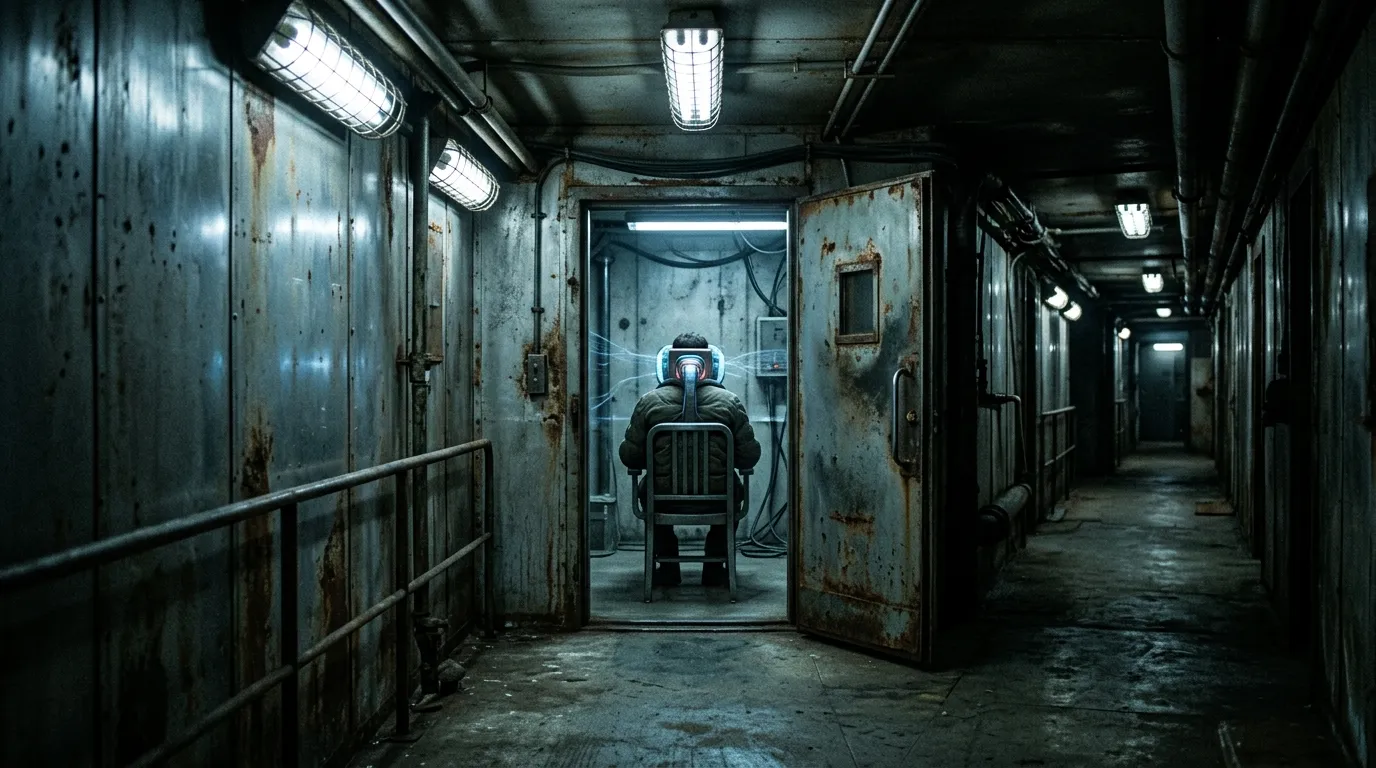
The verification station was in the basement of an electrical distribution facility on the east side of Yongkang District. Three people were already waiting at the end of the corridor. Cast aluminum wall panels, long fluorescent tubes, the smell of ozone and sweat in the air. The fluorescent light flattened everyone’s face to something like an uncalibrated display—contrast cranked too high, midtones gone.
The woman at the front stood with her back against the wall, thumb working the knuckle of her index finger in a slow grind. The young man behind her had his cap pulled low, left eyelid jumping every few seconds. The third—Gé recognized him. Chái-brother, a meat dongle from the same district, more runs logged than him.
“Morning.” Gé moved up beside Chái.
Chái gave a chin-jerk toward the door. “Tight schedule today.”
“How many times?”
“Three. You?”
“Two. Standard.”
Chái pulled his hands from his pockets, spread all ten fingers, and looked at them—like verifying they still took instructions. “Last week, there was a new one. First run done and he vomited right there. Worker came with a mop—not to clean the floor. To push him out of the way so he didn’t block traffic.”
“Overflow,” Gé said.
“First run and he overflows.” Chái shook his head. “I told him: the brain has a buffer. You can’t pour everything in at once. Young guy, figured his throughput was high.”
Deep in the corridor, the verification room door opened. Someone walked out, unsteady, right hand trembling—not a micro-tremor, a forearm fighting against some residual motor command. Gé caught the sour smell of vomit.
The woman at the front walked in. The door closed. They all knew: every time you went in, you came out a little older than before.
The woman came out, face gray but steps steady. The young man went in. Chái unwrapped a hard candy and worked it into his cheek, asking through it: “Frequency bumped up?”
“Staying mid-frequency.”
“Don’t add.” He didn’t explain why.
The young man came out, cap askew. Chái clapped Gé on the shoulder and went in.
Gé leaned against the wall. The skin at the back of his neck had already started going numb—not from the fluorescent tubes’ hum, but from the body remembering what was about to happen. Five years at mid-frequency, and the body’s reflexes were more accurate than the brain’s calendar.
Chái came out, and as he passed Gé he made a quick, brief press against his own temple with two fingers.
Gé walked into the verification room.
Three meters square. Cast aluminum walls. No windows. The verification terminal was a metal chair, a fist-sized circular recess at the top of the backrest, its edges worn smooth by countless necks. In front of the chair: an operations console, embedded screen and a row of physical keys.
Gé sat with his back to the chair. The skin of his neck made contact with the recess—a cold sensation climbing upward through his scalp, through his skull, like someone had set a coin on his brainstem.
The probe array inside the recess located the chip interface epidurally at C3-C4. Alignment was automatic—like an old hard drive’s read-head returning to home position—a click, locked in.
Pre-verification began. Three signal channels read simultaneously, but the internal experience was nothing like three. More like being pinched from three directions at once. Brainwave—a very brief dizziness. Microvascular pulse—the heart forced into two extra beats. Skin conductance—a sudden thin film of sweat at the back of the neck, then the metal drinking the heat back out of it.
Three sensations in under a second, sequential but the gap between them too short for the body to know which came first.
Pre-verification cleared. Then: injection.
His right index finger moved. Not his.
The command came in through the chip and took over motor planning in the hand. The brain received feedback—the finger was actually moving—but had issued no instruction. Not pain; closer to watching your own hand write something in a dream without knowing what it was writing.
The finger tapped the console. Regular rhythm, force precisely controlled to the minimum keystroke threshold. The AI understood his fingers better than he did.
Heart rate climbed to ninety. The vestibular system began to drift; the horizon at the edge of his visual field tilted slightly.
Standard experience. Same as every one of the past five years. But today, Gé didn’t close his eyes and wait it out.
Layer 1’s sensory feedback overlaid a semi-transparent data-flow visualization across his vision—he had always filtered it as noise, the way you don’t read the scrolling boot log when a system starts up. But today he had something to look for: a physical-layer access point.
The data flow appeared as a sequence of pale blue light pulses in the upper right of his visual field. Command packets flowing from the terminal into the chip, wrapped in biological noise as they passed through the nervous system, then extracted back from the finger to the terminal. A complete loop.
But at the loop’s edge—like a minor tributary beside a main river—was another set of signals. Very faint. Very regular. He’d sensed it before, on every run, but it was always quiet—like a clock that had been running in the room the whole time, and you never noticed it until you listened for it.
A periodic pulse. Interval approximately sixty seconds. Duration under one second each.
Heartbeat packet.
The second pulse arrived. Gé used that near-tactile pressure sense at the back of his neck to memorize the waveform. The encoding pattern was old. Not a current encrypted communications format. Simpler. Lighter. Like sending a message between two tin cans on a string.
Third pulse. He tracked the flow direction—not through the main data channel, directly transmitted from the terminal’s base layer, threading through an interface beside the verification layer, pointing toward… unclear. Signal too faint. His nervous system was occupied by the command packets.
Then he felt something else.
At the instant the third heartbeat packet arrived, there was a very brief delay—under a hundred milliseconds. As if while the system was reading his signal feedback, something else took a quick look at him. Not part of the command flow, not part of the verification process. Something else, somewhere else, glancing his way for a moment.
Then it was gone. Sixty seconds later the heartbeat packet came again, and this time the delay wasn’t there.
A flicker at the right edge of his vision—a tiny point of light, like a dead pixel. One blink, gone.
Task complete. Fingers stopped. The probe array released its lock.
Gé stood up. Expected dizziness. His left hand had started to shake—not severe, but more than before the run. He made a fist, relaxed it; the tremor didn’t stop, and he didn’t try again.
He walked out of the distribution facility. Ground-level daylight was sharp; his pupils took a few seconds to adjust. He rehearsed the signal pattern in his mind—three heartbeat packets’ waveform, timing, frequency. That under-a-hundred-millisecond delay.
He needed Cornelius.
Evening. The solar panels’ last hour of power.
The aluminum foil tape came off the tool cabinet with a dry, small crackling sound, like unwrapping a package he already knew the contents of. Gé connected the motherboard power cable, confirmed the GPU supply was stable, and pressed the power button. The fans started up, their hum amplified inside the sealed cabinet.
The fourteen-inch screen lit up.
He took a piece of paper from his pocket—first thing he’d done after leaving the verification station was write out the signal pattern in pencil. Three heartbeat packet intervals (58 seconds, 62 seconds, 61 seconds), a rough outline of the waveform, and the delay.
He fed it into Cornelius.
Cornelius thought for eleven seconds. The first three lines were noise—the model parsed embedded system as a microwave oven control board. Gé was used to it. Seven billion parameters took wrong turns sometimes; the thing to do was not to correct it but to pick the useful debris from the mistake.
The fourth line got interesting.
A heartbeat packet on roughly a 60-second cycle is typical keepalive behavior for MQTT v3.1. MQTT (Message Queuing Telemetry Transport) is a lightweight publish/subscribe messaging protocol, originally designed for IoT environments with low bandwidth and high latency. Its keepalive mechanism requires the client to send PINGREQ packets to the server at set intervals to confirm the connection is alive. Default keepalive value is typically 60 seconds.
Gé stared at the screen.
MQTT. He’d known this twenty years ago—at the Southern Science Park semiconductor equipment factory, the environmental monitoring sensors on the EUV lithography machines had run MQTT. Lightweight. Simple. No encryption. No certificate verification. Old enough that it shouldn’t have existed in any current system.
He sent a follow-up prompt. Cornelius answered faster:
Possibly a legacy diagnostic interface. In early embedded verification system design, engineers commonly retained low-power monitoring channels adjacent to the hardware verification module for remote calibration of the three baseline signal channels…
Gé stopped reading. He didn’t need Cornelius to finish the sentence.
This MQTT connection was left behind by the batch of engineers who’d built the biophysical verification layer. Diagnostic use. Calibration use. Then the system had iterated—software upgraded countless times, everything above it had changed—but this connection was embedded beside the hardware verification layer, too deep, too old, too forgettable. No one upgraded it because no one remembered it. No one removed it because you can’t remove something you don’t know exists.
Like an old pipe in the foundation—the upstairs had been renovated thirty times, and no one went to look at the foundation.
Physical-layer access point. What Cornelius had called a direction last time had become, today, a concrete thing: a diagnostic channel running an ancient protocol and talking to itself, running down through the old base infrastructure.
He picked up the pencil and wrote on the paper: MQTT v3.1 — keepalive 60s — no encryption — adjacent to hardware verification layer — diagnostic interface.
Then a second line: Unknown — delay in third heartbeat packet. Source unidentified.
The delay—Cornelius couldn’t account for it. Gé tried three different prompts; on one of them the model declared the delay was a macroscopic expression of quantum entanglement, which he skipped entirely.
Filed as possible threat. Inference without data was guessing, and guessing consumed attention without producing conclusions.
The engineer’s notebook was open on the desk beside the screen. He leafed through a few pages, and at the margin of one of them found a passage he’d somehow missed before—pale ink, like someone had written it fast with a pen running dry:
“The verification layer wasn’t designed to stop AI—it was designed to ensure humans always had a final veto. The diagnostic channel had to stay. If you close even the maintenance door, the system becomes truly uncontrollable.”
Gé read those words for a long time. Whoever had written them had made a decision, years ago: leave a door open. Not a bug—deliberate. An engineer who believed the system needed human oversight, leaving a manual override in an era when everyone was chasing full automation.
He closed the notebook. Power was nearly at its limit. He shut down the model, and on the blank text interface typed out a list:
- MQTT v3.1 diagnostic channel — confirmed present
- Channel destination — unknown
- Channel exploitability — unknown
- Delay in third heartbeat packet — source unknown, filed as threat
- Next step — track heartbeat packet terminal address in next dongle run
Saved. Shutdown. Cabinet sealed back up with foil tape.
His left hand was shaking again. Dongle fatigue plus analysis fatigue had accumulated to the threshold of something he could observe. He laid his left hand flat on his knee and let it shake. No fist, no forcing it down. It would stop on its own—the way a high-utilization process returned to baseline when the load came off.
Gé Luò’s voice came from outside the door: “Dad, dinner.”
“Coming.”
After dinner. Gé Suǒ at the sink washing dishes. Gé Luò sprawled on the living room’s low table drawing, colored pencils whispering across paper. Gé sat on the step at the front door, looking at the chalk-written notice on the building wall across the way—someone trading parts for a hand-crank generator.
He was thinking about Luò Cuò.
More precisely, he was thinking about an information-distribution problem in a distributed system. The risk of single-node knowledge: if the node failed, the information was permanently lost. The risk of distributed storage: each additional node multiplied the attack surface for leakage by an order of magnitude.
Luò Cuò was reliable. After the meeting, he’d helped twice with quota transfers without asking extra questions. Luò Cuò had his own motivations—his daughter—and their interests ran roughly parallel.
But if he told Luò Cuò, Luò Cuò’s behavior pattern would change. More careful, or more reckless, or paying attention to the wrong things at the wrong moments. A behavior pattern change was detectable. Then he’d have to run a security scan on Luò Cuò at every meeting—not because of distrust, but because he’d need to confirm the other man’s signal profile hadn’t shifted to a detectable degree.
You couldn’t trust someone and monitor them at the same time.
Last month, when Luò Cuò had come with the mangoes, he’d stood in the doorway for less than two minutes and then left. Didn’t come in, didn’t ask anything extra, just said anything you need, you say so. That was the posture of a man who didn’t need repayment.
But if he told no one, he was the single point of failure for this information. No backup, no redundancy, no failover. Twenty years designing fault-tolerant systems—he knew, better than anyone, how lethal single points of failure were.
And yet: at this stage, confidentiality value vastly outweighed redundancy value. What he was holding was a puzzle piece with no shape yet. You didn’t start distributing pieces before the puzzle had a border.
Gé stood up.
“Going for a walk,” he called into the apartment. Gé Suǒ didn’t look up, just “hmm.” Gé Luò paused his pencil, looked up: “Take a flashlight.”
“Got one.” He patted his pocket.
The streetlamps were already on, their orange light dyeing the concrete amber. He walked along the lanes between the old-military-housing-turned-apartment-blocks. In the next alley, voices—low, carrying laughter. One window throwing out a warm yellow glow.
That engineer had left a door open. Today, threading through his own nervous system, Gé had found the door frame. But the frame wasn’t the door. He still didn’t know whether the door could be opened, what was on the other side of it, or what it would cost to open.
The countdown ran in the background like a low-priority process, always occupying a small fraction of memory. Around fifty days. Maybe forty-eight.
Fifty days. One MQTT channel. One offline model. One notebook. And himself—a meat key the system had been using for five years, slowly wearing down. The difference was: starting today, this key was observing the lock’s internal structure while it was being used.
At the end of the lane, the open ground on the east side of Yongkang District, no streetlights, thoroughly dark.
Gé didn’t tell Luò Cuò. Didn’t tell anyone. Not because of distrust. Because at its current stage, this secret only fit one container.
He stood at the edge of the dark, flashlight in his pocket, not taking it out. Then he turned and walked back into the range of the orange streetlamps.
Yongkang’s night was deepening. In his pocket: a sheet of paper folded twice, five lines of notes and three waveform sketches. In his hand: a black hardboard notebook, its edge showing above the pocket.
And a secret he hadn’t told anyone.