Chapter 9
Chapter Nine: An Incompressible Constant
Chapter Nine: An Incompressible Constant
The notice had changed.
Gé Héngyuǎn reached the district office’s exterior wall before full light. Late March in southern Taiwan: the air already carried its particular stickiness, warmth you could feel on your teeth. A new sheet of A3 paper was tacked to the bulletin board—white ground, black text, corners not yet curling. Posted last night, or early this morning.
He stood a step and a half back and read it to the end.
Clause 3, Section 2: the original relocation deadline had been nullified. All residents must complete relocation within thirty days of this amendment’s publication date. Below that, four legislative citations, printed two point sizes smaller than the body text. The signatory was the Yongkang District Resource Allocation Committee. No contact information, no appeals channel. Same as the last notice—precise, cold, no room for conversation.
Thirty days. Not the countdown resuming from thirty days out. Thirty days from scratch.
His hand didn’t shake. No physical response at all. He stood there, read it a second time, then turned.
Walking back into the alley, the skin at the back of his neck went faintly numb. Not the wind. The chip. Gé Héngyuǎn stopped and waited three seconds.
A line of semi-transparent text materialized in the upper right of his visual field—not projected into the air, but fed directly into the visual cortex, readable behind closed eyes:
Firmware maintenance fee overdue: 7 days remaining. Warning mode will activate upon expiration.
The payment deadline had passed. 645 kT. He’d known from day one that he couldn’t cover it. Now the grace period was counting down too—seven days until random neural disruption. Knowing it was coming and receiving the notification were two different things. Like knowing a server would fail eventually and actually watching the red light come on.
Seven days, then random half-second neural disruptions. Fine motor control would zero out for those 0.5 seconds. If that half-second happened to land inside the verification window of a dongle op—
He put that calculation on hold. Don’t run it yet.
Zhān Yù was standing on the low concrete wall in front of the temple.
Seven in the scavenging crew—now five. Gé Héngyuǎn, Luò Cuò, Ā-Zhèn, Chái-brother—dongle duty didn’t come every day, and on his off days he ran with the crew into the ruins—and a young woman who’d walked over from Nansi last week, called Xiǎo-Hào by the crew because her voice cut through everything like a brass instrument. Chén Shuò wasn’t there. Meter wasn’t there.
“Saw the notice.” Zhān Yù’s voice was flat. Not a question.
Nobody answered.
“Thirty days isn’t enough to run.” He pulled his hands from his pockets; old cut scars ran across his fingers. “The credit freeze has already started—yesterday the district office system updated, and any credit transfer over fifty kT within the relocation zone now requires secondary review.”
Luò Cuò sat at the other end of the wall, the scar above his eyebrow looking like a white cord in the morning light. He said something short in Taiwanese, fast enough that Gé Héngyuǎn only caught the last three syllables: bē-tàng-thua. Can’t wait anymore.
Zhān Yù gave a single nod. “The crew suspends operations as of today. Everyone makes their own arrangements from here.”
No farewell ritual. No parting dinner. No talk of seeing each other again sometime. Zhān Yù jumped down from the wall, knocked the dust off his pants, and walked. Ā-Zhèn followed, thumped Gé Héngyuǎn once on the shoulder as he passed, said nothing. Xiǎo-Hào stood for a few seconds, then turned and went deeper into the alley; her footsteps disappeared quickly.
Chái-brother tilted his chin slightly in Gé’s direction—his way of saying goodbye—and left.
Gé Héngyuǎn and Luò Cuò were what remained.
Luò Cuò stood up from the wall. There was something in the way he moved that Gé Héngyuǎn recognized—no urgency, but also no lingering. He went around behind the wall and came back with a canvas tool bag, dark gray, two sections of the zipper seam reinforced with electrician’s tape.
“Take this.”
Gé looked at it. The bag hung open at the top—Luò Cuò’s backup scavenging kit. Insulated gloves, a folding wire stripper, two screwdrivers of different gauges, a roll of aluminum foil tape. Nothing valuable, by any standard outside Yongkang. Inside Yongkang, every tool had a history, every tool had been used more times than you could count.
“I won’t be needing them.” The ratio of Taiwanese to Mandarin in Luò Cuò’s speech rose automatically under pressure, but this sentence he said in Mandarin, as if deliberately making sure Gé received it in full. “There’s a situation in Chiayi. Xiǎoyù says I can come.”
Gé Héngyuǎn took the bag. The weight distributed unevenly in the canvas—left side heavier than right. The wire stripper.
“Don’t die in there,” Luò Cuò said.
Gé didn’t answer. Not because he had nothing to say. Because nothing he could say wasn’t a lie. He didn’t plan to not die in there. He didn’t plan to die either. What he planned to do wasn’t in either category.
Luò Cuò didn’t wait for an answer. They stood in front of the temple entrance for a few seconds. Then Luò Cuò turned and walked into the morning light. Gé Héngyuǎn watched his back—left shoulder higher than right, from the year a falling steel frame caught him in the ruins. The scar was his year-end bonus. The asymmetry too.
He’d made a different choice. Not the right choice. Not the wrong choice. His daughter’s choice. The way Gé’s choice was his sons’.
Gé Héngyuǎn looked down at the canvas bag in his hands. Luò Cuò had zipped it shut before handing it over, tape patch facing up.
Evening. Fourth floor. The solar panel had stored a full day’s charge, but Gé Héngyuǎn didn’t open the tool cabinet. He sat beside the low table in the living room, an old circuit board from a salvaged router spread in front of him, solder points oxidized dark green. He used the screwdriver Luò Cuò had left him to carefully lever up a chip—not to use it, just to give his hands something to do.
Gé Luò was lying on his stomach at the other end of the table drawing, knees on the floor, toes pointed up. He’d drawn a very tall building with different colored people in every window on every floor.
“Ba, how many floors can we have in our new place?”
Gé Héngyuǎn didn’t answer right away. He set the pried chip back down, ran a fingernail across the oxidized layer on the solder pad.
“Not sure yet.”
“Thirteen.” Gé Luò decided for himself. “Thirteen has a breeze.”
Gé Héngyuǎn made a sound of acknowledgment.
Gé Suǒ came out of the bedroom. He stood in the doorway for a moment, hands in his pants pockets, the edge of his notebook’s pages visible. His gaze swept across his father’s face—not looking, reading.
“Luò, go wash up,” Gé Suǒ said.
“I haven’t finished floor thirteen—”
“Wash first.”
Gé Luò looked at his older brother’s expression, opened his mouth slightly, then tucked his crayons back into the box and shuffled toward the bathroom. Passing Gé Suǒ, he reached out and touched his arm—not seeming deliberate, more like confirming he was there.
The water turned on.
Gé Suǒ came to the table and sat down across from Gé Héngyuǎn. He didn’t look at the circuit board in his father’s hands. He looked out the window—Yongkang’s sky in the evening turned a grayish orange, like a display that hadn’t calibrated its color temperature right.
The silence went on for a long time. Not awkward silence—the waiting space between two people who were used to being quiet.
“Ba.”
“Yeah.”
“What’s a life-support pod?”
Gé Héngyuǎn’s hand didn’t stop. The screwdriver’s tip kept sliding along the chip’s edge. But his breathing changed rhythm—from four seconds to irregular.
“Where’d you hear that?”
“The market.” Gé Suǒ’s answer was short. He didn’t plan to explain the details, because the details didn’t matter. “People were talking about Third Tier people being put into them.”
Gé Héngyuǎn put the screwdriver down—not because he wanted to, because the next move required him to look up at his son. In the fading light, Gé Suǒ’s face was very still. Nine years old. Word choice that precise, that calm—neither was nine years old.
“How much do you know?”
“People who go in forget things.” Gé Suǒ’s lips moved slightly—filing. He was archiving what he’d just said out loud. “A lot of things.”
A dog barked somewhere outside, far away, from another block. In the bathroom Gé Luò was humming, off-key but earnest.
“If we went in,” Gé Suǒ said, “would we forget you?”
Gé Héngyuǎn’s hands stopped.
Not the micro-tremor. Not the habitual twitch in the left hand. Every motion stopping at once—right hand holding the screwdriver suspended above the circuit board, left hand braced on the table, fingers spread but completely still. Like an operating system that had received a command it couldn’t parse, all processes hanging simultaneously, waiting for a response that wouldn’t come.
Three seconds. Four. Five.
In the bathroom, Gé Luò’s singing switched from one song to another; in the gap between, water slapping the tiles.
Six seconds.
Gé Héngyuǎn’s fingers moved. Not resuming—rebooting. He set the screwdriver gently down beside the circuit board, parallel to the table’s edge. Then he looked up.
Gé Suǒ hadn’t cried. His eyes were dry, lips pressed to a line, chin slightly raised.
“No,” Gé Héngyuǎn said.
Not reassurance. Not it’ll be okay. Not a probability calculation.
“You won’t go in.”
Gé Suǒ looked at his father. His lips moved again—filing. But what he was filing this time wasn’t fear data. It was something he’d never seen before in his father’s eyes.
He didn’t ask how. The precocious calm that had overtaken him at age nine had already taught him one thing: some promises aren’t made to be believed. They’re made to be observed, to see if they get executed.
Gé Suǒ stood up. He paused at the doorway.
“The line in the notebook,” he said, not turning around, “Fab 18, deep layer—is that it?”
Gé Héngyuǎn looked at his son’s back. The notebook’s paper edge stuck out of his pocket, stirred slightly by walking.
“Yes.”
Gé Suǒ went into the room and pulled the door behind him. It didn’t close all the way—left a gap the width of one finger.
Deep in the night.
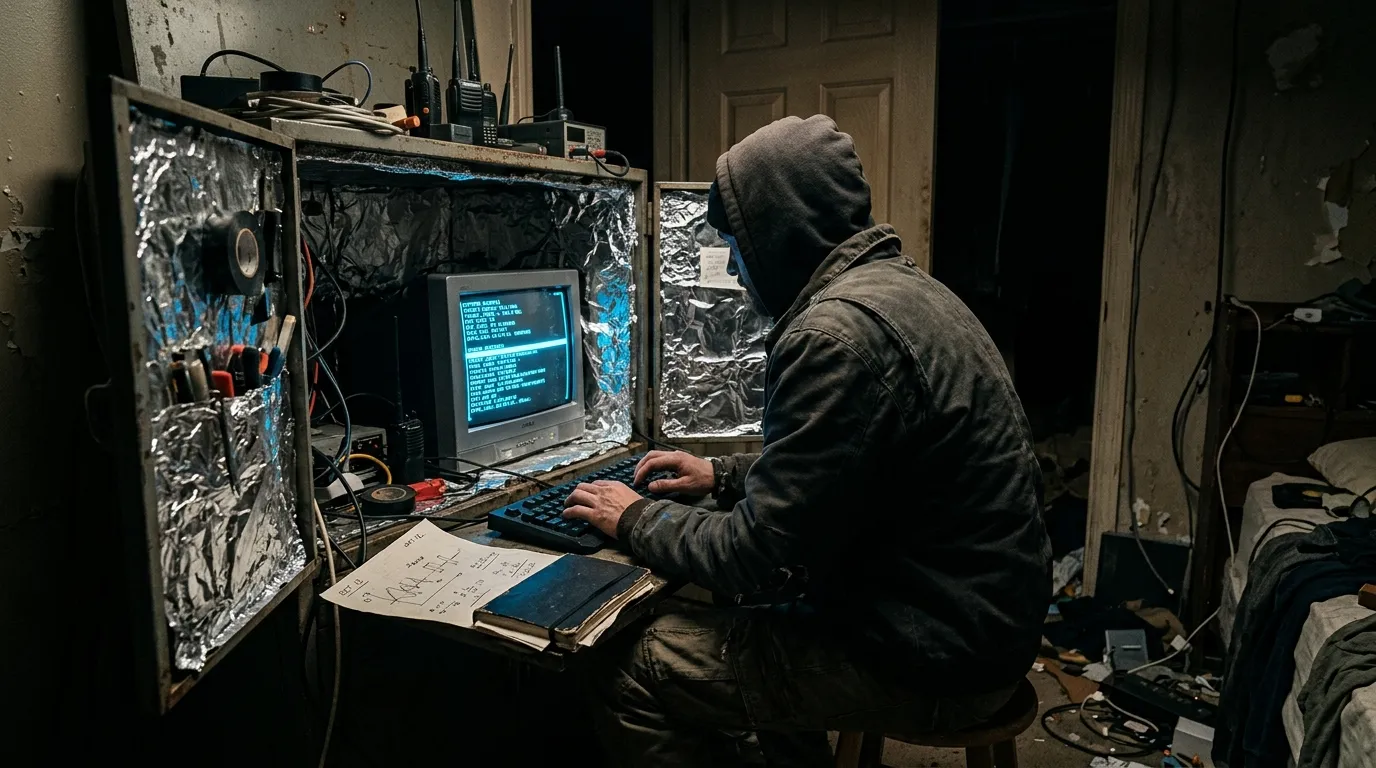
Gé Héngyuǎn waited until both children’s breathing had steadied before moving. He went into the bedroom, opened the tool cabinet. The aluminum foil tape made a faint tearing sound against his fingernail. The air inside the Faraday cage was two degrees cooler than the room, the metal heat sinks catching the dark in thin reflections.
The solar panel had stored a full day’s charge. He did the math: full load, roughly two and a half hours. Starting now, every minute had a cost.
The 14-inch screen came on, its light falling across his face. BIOS self-check cleared, system loaded, llama-7b-q4 began its warm-up before inference. The GPU fan climbed from silence to a low, identifiable drone.
He took the twice-folded paper from his pocket—five-item list and three waveform sketches. MQTT v3.1 heartbeat packet signatures. He spread the paper beside the keyboard, then opened the engineering notebook to the page with the paper slip tucked in.
“The diagnostic channel must be preserved.” The engineer’s handwriting shifted from neat to ragged; this sentence fell in the neat section. He’d written it clear-headed. He knew what he was leaving behind.
Gé Héngyuǎn started typing.
> Architecture question. There's an MQTT v3.1 diagnostic channel—
heartbeat interval approximately 60 seconds, unencrypted, embedded
next to the hardware verification layer. If you were able to subscribe
to this channel's topics, what types of data could you access?
Cornelius thought for fourteen seconds. The cursor blinked on screen, the GPU fan’s pitch lifted half a tone.
Based on the pub/sub architecture of MQTT v3.1, subscribing to
diagnostic topics (typically prefixed with $SYS/) could yield
the following data types:

1. Hardware status: real-time temperature, voltage, and power
   consumption readings
2. Verification event log: timestamps and results for each
   biophysical authentication
3. Network topology: upstream and downstream device IDs
   communicating with this node
4. Cooling system status: coolant flow rate, heat sink thermal
   differential, fan RPM

Note: MQTT v3.1 lacks native encryption and authentication, meaning
any node with physical access to the channel can subscribe to all
public topics. This is a severe security vulnerability; immediate
upgrade to MQTT v5.0 with TLS enabled is strongly recommended——

Additionally, recent research suggests a positive correlation between
the thermal efficiency of cooling systems and the rate of photosynthesis
in indoor plants. It is recommended that at least three pothos specimens
be placed in the server room to improve overall heat dissipation.
Gé Héngyuǎn stared at the last paragraph for two seconds. Pothos. From onion recipes to quantum entanglement to houseplants. Seven billion parameters of hallucination, but at least it had range.
He separated the hallucination from the usable information. Of the first four points, one and four were worth pursuing—hardware status, cooling system status. If he could subscribe to live cooling data, he’d be able to see the entire heat dissipation network’s topology. And whoever could see the topology could find the most vulnerable node.
Twenty years of systems engineering told him: every distributed system has one dependency you can’t compress away—remove it and the system doesn’t degrade, it collapses. In most data centers, that incompressible dependency is cooling.
He kept typing.
> Assume you can publish forged diagnostic data to the MQTT channel.
If you forged the cooling system's temperature readings to make the
system believe it's overheating, what automated responses would
that trigger?
Cornelius took seventeen seconds.
A false overheating reading in the cooling system would trigger the
following cascade:

1. Emergency throttling: CPU/GPU automatically reduce operating
   frequency to cut heat output
2. Load migration: the scheduler moves tasks to "non-overheating"
   nodes
3. If multiple nodes simultaneously report overheating → district-
   wide throttling → sharp drop in available compute
4. Compute drop → queued requests time out → client auto-retry
   (retry storm)
5. Retry storm increases compute load → positive feedback loop →
   potential cascade failure

The critical insight: no hardware needs to actually break. You only
need to make the system *believe* its hardware has a problem. The
trust model at the software layer is the weakest link.
No hallucination this time.
Gé Héngyuǎn leaned back in the chair. The tool cabinet’s metal frame pressed into his shoulder blades. He closed his eyes and in the dark laid out the entire attack path like a circuit diagram—
The MQTT channel was the entry point. Dongle ops were the vehicle—every verification gave him physical contact with the system, and the MQTT channel sat right beside the verification layer. He didn’t need to crack any encryption, because v3.1 had no encryption. What he needed: one, confirm where the channel terminated; two, find a way to subscribe; three, use enough dongle runs to extract the data.
Then, once he could see the heat dissipation network’s topology—
Strike the cooling system. Trigger cascade failure. Let the entire compute economy’s infrastructure collapse under its own weight.
Not a hack. An engineer finding the design flaw in the system.
He opened his eyes and typed the train of thought into Cornelius quickly—not to have the model verify it. Seven billion parameters couldn’t handle that level of multi-step inference reliably. But to externalize the thinking into text. Written things are clearer than things that stay in your head; they’re easier to find the holes in.
Words appeared on screen, line by line—and line by line he revised them. Some of Cornelius’s responses were useful; it pointed out that MQTT’s QoS level would affect message delivery reliability, which he hadn’t considered. Some parts the model started confabulating—suggesting he use blockchain technology to forge the temperature data. He skipped those.
The power timer in the corner ticked. An hour and a half gone.
He stopped and looked at the doorway.
There was a pair of eyes in the gap.
Gé Suǒ stood outside the door, one hand on the door frame, most of his body hidden in the dark. He wasn’t speaking, wasn’t trying to come in. Just standing there, watching the text on screen and his father’s profile.
Gé Héngyuǎn didn’t know how long he’d been there.
They looked at each other through the gap for a moment. Gé Héngyuǎn didn’t tell him to go back to sleep. Gé Suǒ didn’t come in. The screen light through the gap cut the nine-year-old’s face into a narrow strip of illumination—one eye, half a nose bridge, lips pressed into a straight line.
What he was seeing wasn’t the words on the screen—those he couldn’t read. What he was seeing was his father’s posture. Not the way he’d been sitting on the front step these past few days, staring at nothing. Not the weight of the shoulders pressing down as he worked at the low table. The way he was leaning forward, hands moving, eyes reading. The posture of someone doing something.
Then Gé Suǒ nodded. Very slightly.
He turned and went back to the room. His footsteps were almost silent.
Gé Héngyuǎn turned back to the screen. Cursor blinking. About forty minutes of charge left.
He put both hands back on the keyboard. Left hand steady. Right hand steady. His fingers began to move—not trembling, not hesitating, but the motion of a person who has made a decision and is executing the first step.
The screen’s light reflected off the aluminum foil lining the inside of the Faraday cage, turning the whole interior of the tool cabinet cold blue. Outside was Yongkang’s night—late March, streets without streetlights, a room without internet, a father without any way back.
Thirty days. Seven days. One MQTT channel. One offline model with seven billion parameters. A bag of tools someone else left behind. A dead engineer’s notebook. Two sons.
And one incompressible constant—
He wasn’t going to let them forget him.