Chapter 10
Chapter Ten: Branch
Chapter Ten: Branch
Cornelius gave a third divergent result.
Gé Héngyuǎn stared at the screen. Same input parameters, same prompt, three runs, three different timing predictions. First time: subscribing to the MQTT channel would produce a 12-millisecond latency spike. Second time: 8 milliseconds. Third time: “Due to the quantum uncertainty of network topology, the latency spike cannot be precisely predicted.”
“You can’t even remember what you said a minute ago,” he said, low.
A pause. The GPU fan droned.
“Though, to be fair, my last manager’s requirements documents worked the same way.”
He leaned back, letting the tool cabinet’s metal frame press into his shoulder blades. The inside of the Faraday cage was two degrees cooler than the room, but his forehead was lightly damp—not from heat, from forty minutes of continuous high-load cognitive processing and insufficient thermal dissipation.
Three days now. Since that deep-night session in the tool cabinet where he typed out the first lines of the attack framework, he’d used every available hour in Cornelius’s power window doing the same thing: simulation. Not simulating the attack itself—that path was already formed in his head. He was simulating how his own body would betray him during execution.
The problem was simple and it would kill him: he needed, during the verification window of a dongle op, to perform one additional action—subscribe to the MQTT diagnostic topic. But the verification system monitored three biometric signals continuously throughout that window. Brainwave entropy, LZ complexity tolerance 0.35 to 0.75. Microvascular pulse. Skin conductance. If any one drifted past the tolerance boundary, the system would flag an anomaly.
He wasn’t afraid of the sensation of the system controlling his fingers. Five years; that vestibular drift and tactile dissociation felt as ordinary as riding a bus. What he feared was that while doing “the additional thing,” his heart rate variability would shift. Under elevated cognitive load, brainwave entropy jumped. Under sweat, skin conductance drifted.
Biophysical verification system, hardwired at ROM level, no software overwrite. The engineers who designed it hadn’t been trying to stop humans from cheating—they’d been ensuring that whoever passed verification was actually a living person and not an AI simulation. But when a living person attempted to do something else while being verified, the system transformed from a protector into a warden.
He needed a way to keep his biometrics within baseline while operating.
Cornelius’s three runs had inconsistent numbers, but one shared conclusion: the volume of data in a MQTT subscribe action was extremely small. The $SYS/ diagnostic topics returned plain-text status reports, not streaming data. One subscribe request, one response. The problem wasn’t the data volume—it was the psychological load. He knew what he was doing, and that knowing alone was enough to shift brainwave entropy.
So the solution wasn’t a technical problem. It was a psychological one.
Gé Héngyuǎn typed into Cornelius’s window:
> How do you maintain stable biometrics while executing a high
cognitive-load task?
Cornelius thought for nine seconds.
Recommended approach: task decomposition. Break the complex operation
into independent micro-steps, controlling cognitive load at each step
to the level of a routine operation. Specifically:

1. Pre-scheduling: compile all steps into a muscle-memory-level
   automated sequence before execution
2. Attentional anchoring: fix subjective attention on the normal
   flow of the verification system
3. Peripheral operation: run the additional action at the edge of
   attention, with minimum cognitive engagement

Analogy: a skilled pianist can converse with an audience while
playing, because playing has been compiled into the motor cortex's
automated circuits——

It is also recommended to incorporate meditation practice. According
to a 2019 Nature study, 15 minutes of daily mindfulness meditation
can significantly reduce cortisol levels. Pairing with lavender
essential oil for enhanced results is advised.
Lavender essential oil. In a place without reliable electricity.
But the first three points were useful. He cut the hallucination and stared at what remained.
Pre-scheduling. Break the operation into steps, practice each one until you don’t have to think. This he understood—twenty years ago, calibrating the environmental monitoring systems on EUV lithography equipment at the Southern Science Park, he’d done something similar. When you’ve run a four-hour calibration sequence in your head enough times, your hands are moving and your brain’s cognitive load is about equal to drinking a glass of water.
He picked up the engineering notebook and turned to a blank page, and began writing. Not typing—by hand. The hand’s slower pace forced him to think each step through clearly, no blurring through vague passages.
Step one: Dongle op begins, standard verification flow. Do nothing. Let the body run the five-year standard passive sequence.
Step two: After injection starts, wait for the first MQTT heartbeat packet to arrive (approximately 60-second interval). Confirm via tactile pressure sensation at the back of the neck. Don’t search actively—receive passively.
Step three: At the moment the heartbeat arrives, using the Layer 1 data stream visualization interface, inject one MQTT SUBSCRIBE packet. Subscription target: $SYS/#—all system diagnostic topics.
This was the critical step. He needed a carrier to disguise the subscribe request as part of normal verification traffic.
Yesterday’s Cornelius simulation had pointed him toward a direction: noise contamination. During dongle verification, the AI injected command packets through his nervous system bearing a biological noise stamp—this was the core mechanism of verification. But noise was noise; its characteristic was randomness. If he embedded a small segment of meaningful data inside the biological noise of a command packet, the verification system wouldn’t distinguish it, because what the system checked was “whether noise is present,” not “what the noise contains.”
Like dropping a stone of a particular shape into a rushing river. The current carries it; any observer sees only water moving, not the one stone that doesn’t belong to the riverbed.
No—more like writing a live instruction inside the comment block of compiled code, the block a compiler ignores. The program runs normally, nothing anomalous. But if you know where to look, that comment is a hidden door.
The remaining steps—waiting for the response and logging by hand—required no additional cognitive resources.
He looked back over the steps he’d written. The core operation was three steps. Each step’s cognitive load was manageable—if he practiced until it was muscle memory.
The left hand started trembling. Not severely—small oscillations between the index and middle fingers. He switched the pen to his right hand and kept writing. No suppression, no waiting. If the hand trembles, switch hands.
The power timer in the corner hit twelve minutes remaining.
He still had one unsolved problem: the specific pattern of the noise contamination. He needed Cornelius to compute a data template that looked like normal biological noise—rhythm, amplitude, frequency distribution all within the verification system’s tolerances, but with the MQTT SUBSCRIBE packet’s payload embedded inside.
> Generate a data template simulating human biological noise.
Requirements: must satisfy the format requirements of an MQTT v3.1
SUBSCRIBE packet, while showing no statistically significant difference
from normal dongle-verification biological noise. Target subscription
topic: $SYS/#
Cornelius thought for twenty-three seconds. This time there was no hallucination. It output a set of hexadecimal packet templates, each byte annotated. Gé Héngyuǎn checked line by line—the first four bytes were the MQTT fixed header, five through eight were the topic length and topic name prefix, and the rest were padded with random noise values.
He didn’t trust Cornelius’s data. A seven-billion-parameter model was unreliable at multi-step inference, but relatively dependable on format conversion and template generation—this was the boundary he’d mapped over three days. He copied the template into the notebook. He’d cross-validate each byte by hand tomorrow.
The power timer hit zero. The screen went dark. Inside the tool cabinet, only the sound of the GPU heat sink slowly cooling remained, like a small animal going to sleep.
Gé Héngyuǎn sealed the Faraday cage back with aluminum foil tape. In the dark, his hand wrote one more line in the notebook—no light needed, he knew where the page was:
“Noise contamination = branch. Separate the reality the system is tracking from the actual reality.”
Below that, he added a few more words: “Verify the channel first. Subscribe is step two.”
Systems engineer’s instinct—you don’t push high-pressure fluid through a line you haven’t tested. The first real dongle op would only embed a marker sequence to confirm the contamination method worked, confirm the verification system wouldn’t flag the embedded bytes as anomalous. Once the channel was confirmed clean, then do the actual MQTT subscribe.
He closed the notebook. Walked out of the bedroom. As he crossed the threshold, the upper right of his visual field flashed.
Not a mote of light. Text.
Firmware maintenance fee overdue: 3 days remaining.
A brief sharp pulse at the back of his neck, like someone had flicked the skin with a fingernail. Then gone.
Three days. Seven to three, and in between he’d given all his attention to Cornelius and operational simulation. Time didn’t require his permission to pass.
He stood in the bedroom doorway and heard from the direction of the living room the sound of Gé Suǒ turning pages. 3 AM, and a nine-year-old should be asleep. But Gé Suǒ was not an ordinary nine-year-old—Gé Héngyuǎn had noticed by the second day that he’d abandoned normal sleep patterns. Every night between 2 and 4 AM, Gé Suǒ would wake and sit in the living room reading or writing notes. No lights, just the weak ambient light from outside.
He hadn’t stopped him. A child’s sleep cycle under pressure would self-reorganize—not from a textbook. His own body had told him. You can’t force an operating system back to a schedule it’s already abandoned.
He walked into the living room. Gé Suǒ was sitting beside the low table, and in front of him wasn’t a book—it was his own notebook. Moonlight came through the window and turned the paper surface silver-gray.
“You should be sleeping.” Gé Héngyuǎn said it without command in the tone, because he knew the instruction wouldn’t be executed.
Gé Suǒ looked up at him. His lips moved slightly—filing.
“What did Cornelius calculate today?”
Gé Héngyuǎn sat down beside the table. He could say nothing. He could say adult things. But Gé Suǒ wasn’t a node that accepted vague answers. He’d archive nothing as father doesn’t want to say, and then reason from incomplete data. Better to give him a controlled answer than to let him reach a wrong conclusion from insufficient inputs.
Managing his son like a node. He heard this thought in his own head, knew it was cold, and also knew it was right.
“Working on a calculation,” he said. “There’s a very short time window to do one thing, but while doing it I can’t let another system notice.”
Gé Suǒ looked at him. In the moonlight his eyes were dark, pupils dilated to catch the light.
“Cheating on a test,” Gé Suǒ said.
Gé Héngyuǎn paused half a second. Then the corner of his mouth moved—not a smile, an acknowledgment. “More or less.”
“Have you cheated before?”
“No.”
“Then you’ll get caught.”
Gé Héngyuǎn looked at his son. Nine years old. Short logic chain, correct direction—an operator with no experience stood a poor chance of succeeding on the first try. This was a valid risk assessment.
“That’s why I’m practicing,” he said.
Gé Suǒ gave a single nod. He closed his notebook, stood up, walked back to the room. He stopped at the doorway.
“Practice quietly,” he said. “Luò will wake up.”
The door closed. All the way this time.
Electrical distribution facility, east side of Yongkang District. Basement level.
One fluorescent tube in the cast aluminum wall panel was flickering—not burned out, loose contact, pulsing white light every few seconds. Gé Héngyuǎn stood in the corridor, two people ahead of him. The air smelled of ozone and disinfectant—more disinfectant than last time.
His pockets held two things. The engineering notebook—always on him now, it had become habit. And a slip of paper torn from the notebook, carrying the hexadecimal contamination data template he’d manually verified over three days. Each byte checked twice.
Today’s plan was a single step: verify that the contaminated data could pass through. No MQTT subscription. First real op, minimum viable test only. If even this step—embedding data inside the biological noise—could be detected, everything after didn’t exist.
The woman in front of him walked into the verification room. The door closed. Gé Héngyuǎn leaned against the cast aluminum panel, the metal’s cool seeping through his shirt into his back.
Chái wasn’t there. Not his day. The other person in the corridor Gé Héngyuǎn didn’t recognize—young, early twenties, nails clipped very short, left foot tapping a silent beat on the floor. First run.
The young man turned. “How many times have you done this?”
“Five years.”
The young man’s foot stopped. Then started again, slower than before. He didn’t ask anything else.
The woman came out, face still intact, moving faster than when she’d gone in. The young man inhaled once, walked through.
Gé Héngyuǎn closed his eyes.
In the dark, he began running through the steps. Not recalling—executing. Like a program doing a dry run in a sandbox.
Step one: sit down, neck contacts the recess, pre-verification, three-signal read. Do nothing at this stage. Let the body complete the standard flow it’s run for five years.
Step two: injection starts. Fingers taken over. Vestibular drift. These are known variables; allocate no attention.
Step three: today’s actual operation. In the process of the biological noise stamp being written into the command packet, embed the contamination data template within it. Method—in the Layer 1 visualization interface, when the data stream passes through his nervous system, he has a very short window to influence the noise’s characteristics. Not active writing—micro-adjustment. Guiding certain bytes of the random noise toward preset values.
This was where the branch began. From this moment, the data stream that the monitoring system saw and the actual data stream would diverge. The one the monitors were tracking was normal verification traffic. The real one had a small embedded payload. If his calculations were right, the two lines would look completely identical from the outside. Only he would know one of them was hiding something.
The young man came out, face white, right hand shaking. Gé Héngyuǎn stepped aside; the young man walked past without looking at him, head down along the corridor. First-run overflow. Not everyone vomited, but everyone’s first run left a mark on them somewhere.
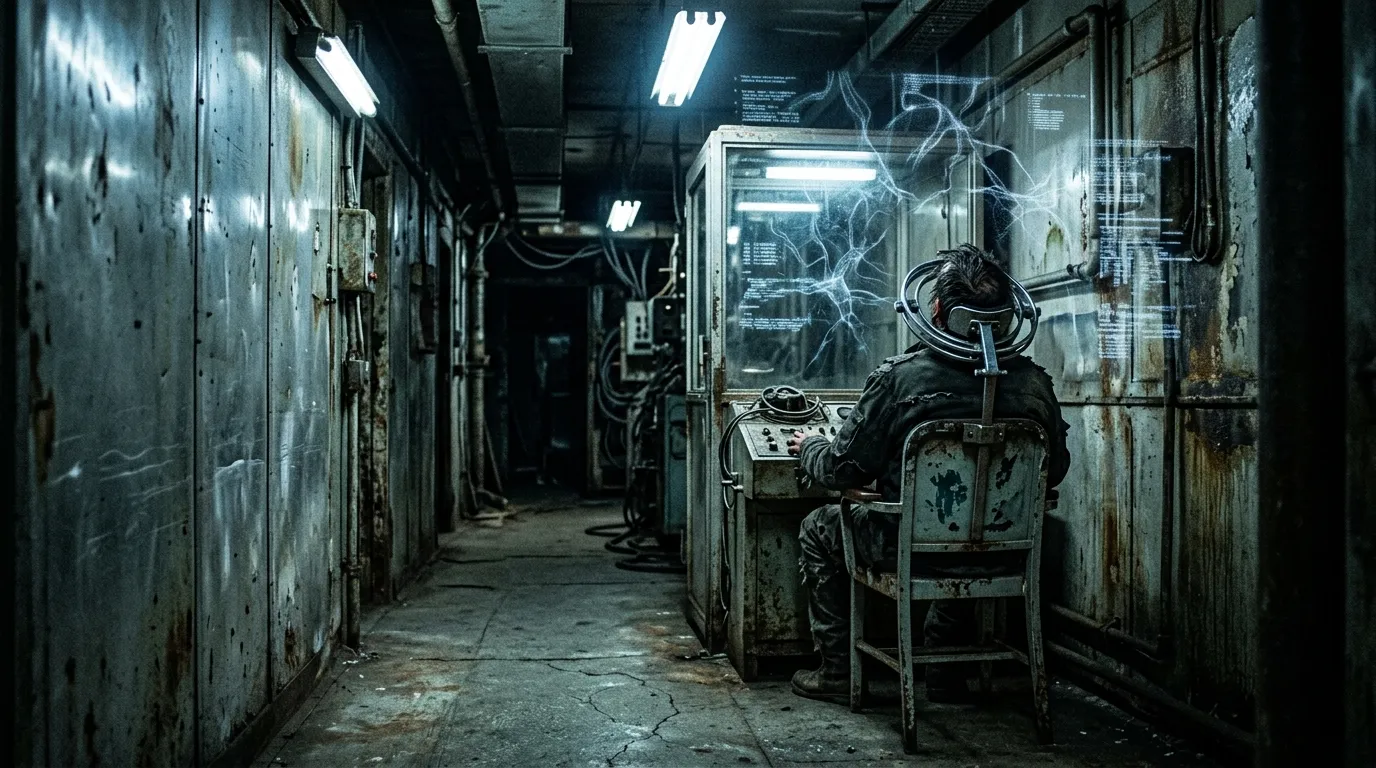
Gé Héngyuǎn walked into the verification room.
Three meters square. Cast aluminum walls. No windows. The metal chair’s backrest circular recess caught the light from the fluorescent tubes. He’d seen this room for five years; he could draw every seam from memory.
He sat with his back to the chair.
The skin at the back of his neck made contact with the metal recess. Cold. The probe array auto-aligned, locked at C3-C4.
Pre-verification. Three signals reading simultaneously. Dizziness—heart forced two extra beats—thin sweat at the back of the neck. He let these sensations flow past, like water through spread fingers. Five years of muscle memory.
Cleared.
Injection began.
His right index finger moved. Not his. Middle finger followed. Ring finger. The rhythm precise, force controlled to the minimum threshold to trigger keystrokes. The AI was operating his hand; his nervous system was the relay station, biological noise stamped onto every command packet, proof that a living person was transmitting.
Vestibular drift engaged. His visual horizon tilted three degrees. He didn’t correct it.
The Layer 1 data stream visualization opened along the right side of his visual field—pale blue light pulses, string after string. Command packets came in from the terminal, passed through him, left carrying noise. Circuit complete.
He waited.
Heart rate eighty-two. Normal range. Respiratory rate normal. He put his attention on the sensation of his fingers being controlled—this was what he’d done in every op for five years, no additional cognitive resources required.
Forty seconds.
He started counting down in his head. Not precise timing—body sense. From the last op he’d memorized the heartbeat interval: approximately sixty seconds.
Fifty seconds.
Fifty-five.
A very faint pressure pulse at the back of his neck. Not in the main data channel. Alongside it. At the edge.
Heartbeat packet.
He didn’t change his breathing. Didn’t change his attentional focus. The heartbeat arrived; he registered it; but he didn’t react. Not reacting was the key—any sudden shift in cognitive load would be captured by brainwave entropy.
Now.
He executed step three.
Not an action—a micro-adjustment. In the instant the next command packet passed through his nervous system and received its biological noise stamp, he guided certain bytes of the noise toward preset values. Not by willpower—willpower would raise brainwave entropy. By habit. Three days of practice had inscribed this data template into motor memory, the way a typist doesn’t need to watch the keyboard to produce specific letter combinations.
His fingers continued to be controlled at the operations terminal. On the surface, nothing had changed. The data stream kept flowing, biological noise kept getting stamped.
But in this one packet, the noise wasn’t entirely random. Twelve bytes within it formed a meaningful sequence—not the MQTT subscribe instruction, he wasn’t doing a subscription today. Just a marker. A proof of existence. If afterward he could find this marker moving through the system’s logs completely intact without triggering any anomaly, it would confirm the contamination method worked.
Heart rate jumped to eighty-eight.
He noticed. Eighty-eight—six BPM above baseline. Within tolerance, but the trend was bad. If it climbed above ninety-five, the heart rate variability pattern would diverge from his historical baseline, and the verification system might flag it.
Treat it as a variable. Not fear—a value that needed managing. Like monitoring a server’s CPU temperature: seventy degrees fine, eighty degrees watch it, ninety degrees intervene.
He was at eighty degrees.
Breathe. Not a deliberate deep breath—that would be betrayed by a sudden shift in skin conductance. A micro-adjustment. Extend the inhale by half a second, extend the exhale by half a second. Gradual, no sudden shift. Like adding a heat sink to a server while it’s running—you can’t power it down, you can only make adjustments mid-operation.
Eighty-six.
Eighty-four.
Back toward baseline. Command packets continued to flow. Fingers continued to be controlled. The Layer 1 data stream visualization showed no anomalies—no red flags, no warning flashes.
His contaminated packet had already passed through. Wrapped in biological noise, moving with hundreds of normal packets, into somewhere in the system.
One river. Hundreds of stones. One of them not from the riverbed. Nobody watching.
Another heartbeat packet arrived. Sixty-one second interval.
He didn’t operate again. Today’s test was complete. One embed, minimum viable verification. He pulled his attention back to the sensation of his fingers, and became again a standard meat dongle—a key being used, not observing the lock’s structure, not thinking about what lay beyond the door.
The op entered its final phase. The command packets’ frequency began decreasing. The finger motions shifted from continuous to intermittent. Vestibular drift fading, his visual horizon slowly correcting.
Last packet. Fingers stopped.
The probe array released its lock. The metal in the recess lost his body heat and started going cold again.
Gé Héngyuǎn stood. Light-headed. Slightly less than last time—maybe because this op’s total duration was shorter, or maybe because his attentional distribution was more efficient now. A mote of light flashed in the right of his visual field, like a mosquito crossing the retina. An old acquaintance. The left hand micro-tremor started—small oscillations between index finger and thumb. He put his left hand in his pocket.
Out of the verification room. The corridor was empty. The flickering fluorescent tube was still flickering.
He walked to the surface level. Sunlight. Early April in Yongkang. The humid heat came in a rush; sweat condensed between the back of his neck and his collar. He stood on the entrance steps of the distribution facility, squinting while his pupils adjusted.
First order: confirm.
He pulled the notebook and pencil from his pocket. Stood on the steps, writing while waiting for his eyes to adapt. Not a complete record—key data points. Heartbeat packet interval (approximately 60–61 seconds, consistent with last time). Timing of contaminated packet embed (approximately fifteen seconds after the second heartbeat arrived). Peak heart rate during embed (88 BPM). Recovery time (approximately twenty seconds). Whether the verification system flagged any anomaly (none).
He wrote on the last line: “Branch created. Awaiting confirmation of survival.”
The pen tip held for a second. Then he added another line:
“At the third heartbeat packet’s arrival, there was an echo in the data stream.”
An echo. Not an echo of the heartbeat packet itself—an echo of the contaminated packet he’d embedded. After it passed through the system, at the tail end of the third heartbeat packet, something like an extremely faint afterwave reflected back. Lasted less than fifty milliseconds. He’d almost missed it—a pressure pulse at the back of his neck thinner than a needle tip, 0.3 seconds after the heartbeat packet’s normal pressure sensation.
He didn’t know what that was. Possibly normal packet routing latency. Possibly his nervous system under high cognitive load generating a false signal. Or possibly something else—his contaminated packet had touched something as it passed through the system, and that something had glanced at it.
Like the sub-hundred-millisecond delay from the last op. Filed as “uncertain.” But two “uncertains” stacked together had begun producing a pattern in his engineer’s intuition—something was paying attention to anomalies in the verification channel. Not the verification system itself—that hadn’t flagged anything. Something else.
He pocketed the notebook.
Don’t change the plan. Insufficient data to modify the path. But add a new monitoring item to the operations checklist: “After each op, log whether an echo appears at the tail end of the heartbeat packets. Three or more occurrences: escalate to threat.”
He walked down the steps, into the Yongkang afternoon.
Power window. 10 PM, after the children were asleep.
Gé Héngyuǎn pulled the aluminum foil tape from the Faraday cage. More carefully than usual—he peeled the tape along the edge rather than tearing it straight across, so the seal would sit flush when he closed it back up. Three days ago he’d noticed the roll of aluminum foil tape was down to the last half; Luò Cuò’s tools bag had a spare roll still unopened. Save it.
Power on. BIOS self-check. llama-7b-q4 warming up. GPU fan from silence to a low drone. When the screen came on, the inside of the Faraday cage filled with cold blue light.
He typed.
> What sub-topics does an MQTT v3.1 $SYS/ topic tree typically contain?
List the complete standard sub-topic paths.
Cornelius thought for twelve seconds.
Standard sub-topics for the MQTT $SYS/ topic tree include:

$SYS/broker/clients/connected — current connected client count
$SYS/broker/messages/received — cumulative received message count
$SYS/broker/uptime — broker uptime
$SYS/broker/load/messages/+ — message load statistics
$SYS/broker/subscriptions/count — current subscription count

In embedded industrial systems, however, engineers commonly add custom
sub-topics for hardware monitoring, such as:

$SYS/hardware/thermal/zone_[N]/temp — temperature per thermal zone
$SYS/hardware/thermal/coolant/flow_rate — coolant flow rate
$SYS/hardware/thermal/coolant/return_temp — coolant return temperature
$SYS/hardware/power/pdu_[N]/load — load per power distribution unit
$SYS/hardware/validation/events — verification event log

Note: the above is reasonable inference; specific topics depend on
system implementation. MQTT's flexibility means any string can serve
as a topic name, so real-world deployments may differ substantially
from the standard.

Fun fact: MQTT originally stood for MQ Telemetry Transport, developed
by IBM in 1999 for satellite links in oil pipelines——a remarkably similar
application to yours: critical data transmission in constrained
environments!
Gé Héngyuǎn looked at the oil pipeline fun fact. At least this time the hallucination had historical grounding—MQTT really was IBM’s 1999 invention.
What he cared about was the middle section: custom sub-topics. The $SYS/hardware/thermal/ entries for cooling system data. If he could subscribe to these, he’d be able to see the entire heat dissipation network’s live state—which zones were running hot, which coolant lines had low flow, which heat sinks were losing efficiency.
But Cornelius had said it himself: “the above is reasonable inference.” He had no idea whether the engineers behind this verification system had used the standard topic tree or something entirely custom. The only way to confirm was to actually subscribe once.
The next step was clear. Next dongle op—maybe the day after tomorrow, maybe in two days, depending on scheduling—he’d do the real MQTT subscription. Subscribe to $SYS/#, wildcard, catch all diagnostic topic responses. One shot. Use today’s verified contamination method to embed the subscribe command inside the biological noise, then search the returned data stream for traces of cooling system information.
He typed his next question into Cornelius’s window.
> If you obtained live data from the cooling system via MQTT subscription,
how many data samples would you need at minimum to model the full heat
dissipation network topology?
Cornelius thought for eighteen seconds. It returned a section of analysis—Gé skipped the preamble (“What a fascinating question!”) and went straight to the core data.
The conclusion: at least three to five complete cycles of data to build a reliable topology model. Each cycle’s length depended on the cooling system’s refresh rate—if it updated status every sixty seconds, one cycle was sixty seconds. But considering a dongle op’s time window was typically only a few minutes, one op might capture only three to four data points.
Three to five cycles. Three to four data points per op. He’d need——
He stopped calculating.
The problem was larger than he’d expected.
Not a question of how many dongle ops. A question of data structure. Cornelius’s simulation assumed a single-layer cooling system—sensors, coolant lines, heat sinks, a flat network. But a cooling system serving the entire compute infrastructure couldn’t have just one layer. It would have regional divisions, hierarchical structures, redundant paths, failover mechanisms.
Which meant: even if he successfully subscribed to everything under $SYS/hardware/thermal/, what he’d see might be only the tip of the iceberg—one region, one hierarchical level, one subset. To see the complete topology, he didn’t need more data points. He needed more observation angles.
Different verification terminals connected to different network segments. He’d only ever used the one on Yongkang District’s east side. If he could run the same subscription from different verification terminals, each might show a different subset of the MQTT topic tree—and assembled together, they’d be the complete picture.
But he was just a Yongkang District dongle operator. He couldn’t walk into verification stations in other districts.
He needed—
People from other verification stations.
Allies.
Gé Héngyuǎn took his hands off the keyboard. He leaned back, staring at Cornelius’s response on screen. The Faraday cage’s aluminum foil reflected the cold blue light at distorted angles—his own face, blurred, like viewing it through a layer of water.
Three days ago he’d decided not to tell Luò Cuò. The reasoning: information incomplete, confidentiality value exceeded redundancy value. But the shape of the information had changed. Not “a puzzle one person could complete slowly,” but “an observation problem that is physically impossible for one person to see whole.”
Distributed problems needed distributed solutions. A single node couldn’t cover all network segments.
Luò Cuò was already in Chiayi. The scavenging crew had dissolved. Among the dongle operators he knew in Yongkang District, besides Chái-brother—
Chái.
The brief two-finger press against his own temple. “Don’t add.” Same district, logged more runs than him. Worldly, pragmatic, didn’t ask unnecessary questions.
But Chái was a tool, not an ally. He didn’t know Chái’s motivations, didn’t know who or what he was protecting, didn’t know where his risk tolerance sat. Connecting a node you didn’t understand into the network meant expanding your attack surface to something uncontrollable.
And he needed people from different districts. Not the same one.
This was already outside the scope of what one person sitting in a tool cabinet could solve.
The power timer still showed twenty-three minutes. He didn’t waste it.
> Assume a distributed monitoring system with multiple observation nodes,
each able to see only one subset of the system. Without direct
communication between nodes, how would you reconstruct the complete
system topology?
One sentence from Cornelius’s response got a circle around it:
“Each node independently collects data and stores it in local cache. Periodically, a coordinator collects the local cache from all nodes and merges them offline. The coordinator doesn’t need real-time communications capability—only the ability to physically contact each node.”
Physical contact with each node.
He had no solution yet. But the shape of the problem was clear: he needed to find people in different districts who could run the same operation, and then find a way to aggregate the data in his hands. Step one: find the people. Step two: convince them. Step three: build an offline data collection mechanism.
Every step was something he currently couldn’t do.
Gé Héngyuǎn shut down Cornelius. Eleven minutes of power remained, but he didn’t want to ask anymore. The model had given what direction it could. What remained was judgment only he could make.
He wrote today’s conclusions in the notebook:
1. Contamination method viable (today's verification passed, no anomaly flagged)
2. Next step: actual MQTT subscription ($SYS/#)
3. New problem: single verification terminal's observation angle insufficient
   to cover complete heat dissipation topology
4. Conclusion: need distributed observation. Need allies.
5. Problem: where are the allies?
6. Addendum: echo at heartbeat packet tail (second occurrence). Source
   unknown. Under monitoring.
He closed the notebook. Powered down. Sealed the aluminum foil back over the Faraday cage; this time used less force—the tape’s edge was already fraying, and the number of peels-and-reseals was approaching the material’s fatigue limit. The same as him.
Stood up. Walked out of the bedroom.
The living room was dark. Gé Suǒ’s door was closed. Gé Luò turned in his sleep, the bed frame giving a soft creak. Outside the window was the Yongkang night, early April, a faint night-blooming jasmine smell drifting up from someone’s balcony downstairs.
Gé Héngyuǎn stood in the corridor. Left hand trembling. Not badly—fingers making a faint rustle against paper in his pocket, the notebook’s edge tapping lightly against his thumb. He let it tremble.
Today he’d succeeded. He’d completed an embed operation under the verification system’s watch without being detected. The branch was established—at least the prototype was established. Inside the data stream the monitors were tracking, there was a small segment that wasn’t what they thought it was.
But the shape of success wasn’t what he’d expected. He’d thought the bottleneck would be technical—how to embed, how to stay undetected, how to control his heart rate. The technical problem had been solved in three days. What was blocking him now was a problem his tool cabinet had no tools for: he couldn’t see the full picture alone.
A fundamental theorem of distributed systems: no single node holds the global view.
He needed more nodes.
But every additional node increased the risk of exposure by an order of magnitude. Three days ago he’d used this reasoning to convince himself not to tell Luò Cuò. Now the same reasoning told him to stay silent, but the problem’s structure no longer permitted a single person to walk it to completion.
Gé Héngyuǎn went to the living room window. Moonlight projected the window frame’s shadow on the floor, like an unfilled form. The Yongkang sky in early April held a thin layer of cloud; the moon sat behind it, not bright, not dark—like a display running in low-power standby.
The back of his neck went numb again. Firmware reminder. Three days.
Three days and his body would gain one more uncontrollable variable—half-second random neural disruptions at unpredictable intervals. If that half-second landed during his contaminated data embed, the entire operation would be exposed. He had no way to predict when it would come. No way to stop it.
The timeline was tightening. Thirty days for relocation, minus what had already passed—roughly twenty-five days left. Firmware grace period: three days. MQTT subscription: not yet done. Heat dissipation topology: not yet seen. Allies: still don’t exist.
Gé Héngyuǎn pressed his forehead against the window glass. The glass was cool.
He’d made his first active move, and succeeded. Then discovered the battlefield was much larger than he’d thought. This wasn’t a battle one person in a tool cabinet could win.
But he didn’t know who to trust. Or how to find someone worth trusting. Twenty years as a systems engineer had taught him to analyze systems, but not how to hand a corner of his fate to a stranger in a situation where his own body might betray him.
He stepped back from the window. Into the corridor. He slowed as he passed Gé Suǒ and Gé Luò’s room—no light in the gap, both children asleep.
He went into his own room. No light. In the dark, the aluminum foil seal of the tool cabinet caught the moonlight like a silver line.
Tomorrow. The day after. The next dongle op. He’d do the real subscription. And then—
Then he’d need to find a way out of this tool cabinet. Not physically out. The harder kind—allowing another person to see what he was doing.
Allowing another node to connect.
Gé Héngyuǎn lay down. The pillow was cool for a second, then warmed through with his body heat. He closed his eyes. His mind was still running programs—heartbeat interval, contaminated packet byte sequences, the echo’s timestamp. He knew these figures would sort themselves out during the half-conscious state before sleep, the way a low-priority background process defragments data when the system is idle.
An incompressible constant. That line he’d written in his head, sitting on this bed, deep in the night a few days ago.
Today he’d found another incompressible constant: a single person’s field of view has limits. You can make yourself smarter, more careful, more precise. But you can’t make yourself stand in two places at once.
The ceiling was invisible in the dark. His breathing began to slow. The micro-tremor in the left hand stopped before sleep—or hadn’t stopped, and he could no longer tell.
Outside was the Yongkang night. Night-blooming jasmine. Three days until the firmware lock. Twenty-five days until the relocation deadline. And somewhere he didn’t know, something that had seen that echo—