Chapter 11
Chapter Eleven: The Unnamed
Chapter Eleven: The Unnamed
The water was cold.
Her lungs woke before her mind did — her chest wrapped in a dense, downward pressure, something wedging between her ribs, forcing the diaphragm to respond. Inhale. The air flooding her throat tasted of metal and damp salt. Not ocean salt. The salt of something sealed, recirculated too many times.
She opened her eyes.
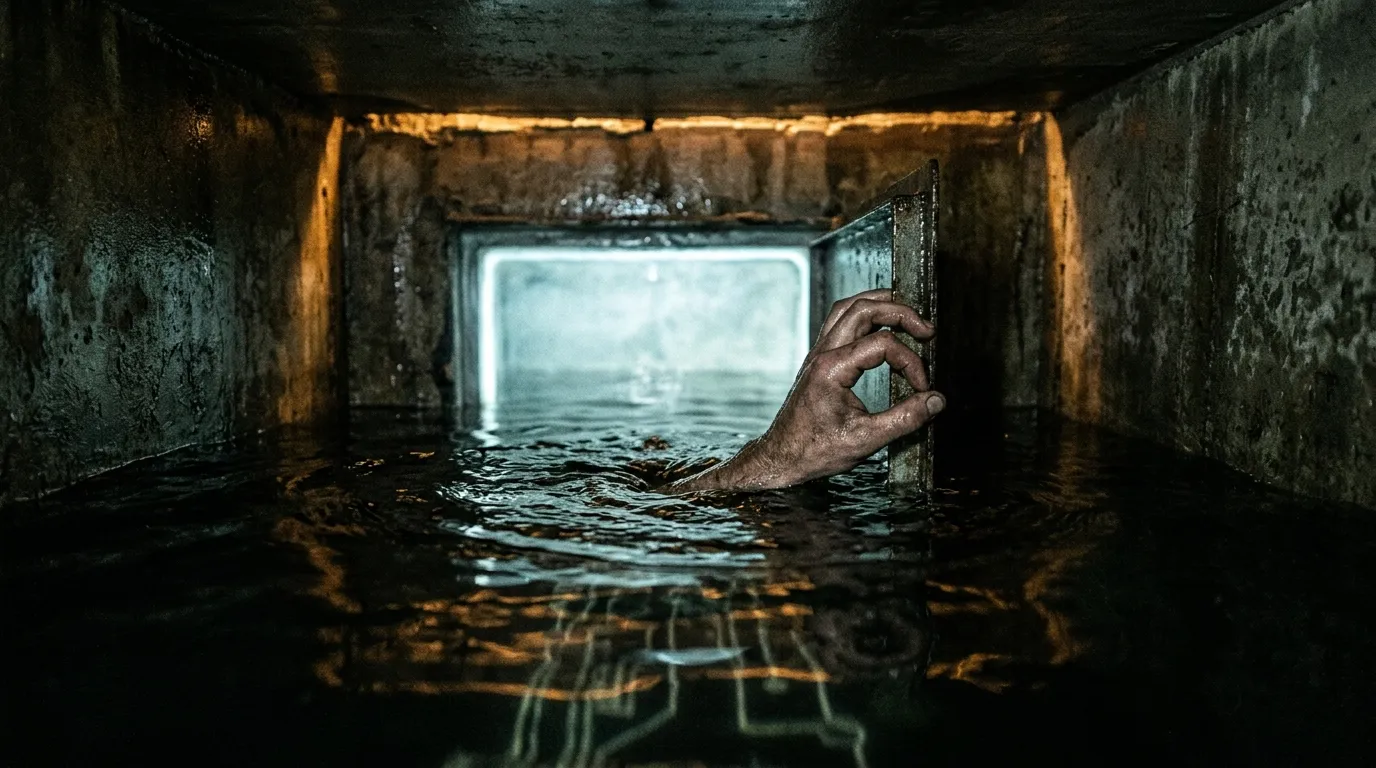
The ceiling was low. An arm’s length straight up — rough, like unpolished concrete, and when her nail dragged across it a fine powder fell onto her face. Four walls narrowing inward, forming a rectangle barely wide enough to take three steps across. No windows. No door. Light seeped from where wall met ceiling, a dim yellow, the last effort of an incandescent bulb at the end of its life.
She did not know who she was.
This produced no emotion. Like opening a drawer and finding it empty — not cleared out, just never filled. She accepted the empty, then turned her attention toward what she could work with.
Water, at her ankles.
Shallow. Just covering the arch of her foot. But when she looked down the surface was rising — not rippling, a steady, soundless tide. From some invisible seam at the base of the walls, water was seeping in without pause.
Her first move was to crouch, press her palms flat on the submerged floor. Cool. Smooth. Not concrete — a dense material with very fine joins, like a surgical table. She ran her fingertips along the floor, reading the direction and spacing of the seams. Three interlocking panels, running east-west, each roughly one arm-span wide.
Then the walls. She stood, rapped her knuckles against the right wall. Solid. The left. Solid. The wall directly ahead — she knocked three times, and the third knock returned a half-beat longer than the others. A cavity. Space behind it.
Her fingers worked across that wall’s surface. The rough texture shifted at one spot — a hand-sized patch, slightly smoother than its surroundings, slightly recessed. She pressed.
Nothing happened.
The water covered her ankles.
She took a breath and stepped back to look at the full wall.
The cavity was lower-left. The pressure point was upper-right. If they were mechanically linked, the linkage had to run diagonally through the wall. She knocked again, listening to how the sound traveled — lower-left, midpoint, upper-right. Not a straight line. A path that bent somewhere in the middle, with a node at the center.
She found the second recess at the midpoint. Smaller than the first. Both at once? Her reach just barely spanned the distance. She spread her arms, left hand at the midpoint, right at the upper-right, pressed both simultaneously —
From somewhere deep in the wall: a low mechanical sound. Something rotating a quarter turn, then catching.
Then a second sound — from behind her. She turned. On the far wall, the outline of a rectangle roughly half her height was slowly emerging, light leaking through the gap.
A door. Behind her.
Her fingers slipped off the wall — arms stretched to their limit, muscles shaking, failing to hold. The instant her fingers left the recesses, the light dimmed. The rectangle dissolved back into the surface.
The water was at her shins.
Her lips moved slightly. A few notes rose from somewhere deep in her throat — not words, fragments of a melody, uncertain in pitch, as if something had been scattered by wind until only the skeleton remained. She did not notice herself humming.
Think it backwards.
The phrase surfaced from the blank, clear enough to feel like someone else’s voice. But it immediately changed how she was approaching the problem.
The door had opened while she held the positions. Her hands slipped, the door closed. A sustained-pressure mechanism — it required continuous contact to stay open.
So the real question was: how do you keep the trigger points depressed without standing in front of that wall.
She looked around the space. Walls. Ceiling. Water.
Water.
Water had weight.
She crouched, submerged her hands. The water was already at her knees, still rising. She used her palm to gauge the ascent rate — slow. Very slow. Many breaths per finger-width of gain. At this rate, by the time the water reached the upper trigger, she might have no room left to stand.
She rose and took measurements again. The lower recess sat at about waist height from the floor; the upper at shoulder height. If the water continued rising — the pressure might eventually hold the lower recess down on its own. But when the water reached that level, the ceiling would be very close, and her breathing space would be compressed to almost nothing.
Two contradictions: she needed the water high enough to hold the trigger, but water at that height might drown her first.
The contradictions dissolved into a single variable: speed. Time.
The water was rising too slowly. If it could go faster —
Her attention returned to the wall. Two triggers. The upper opened the door. What did the lower do? She’d pressed both simultaneously and the door had opened. If the lower wasn’t for the door —
Maybe it controlled something else.
She waded back to the wall. The water’s resistance slowed her, and the cold was seeping through her shins into the bone. She pressed only the lower recess.
She didn’t watch the door. She watched the water.
The intake rate changed. Faster.
She released. The rate returned to what it had been.
The lower recess was a water valve. Holding it accelerated the flood.
She pressed the upper to confirm. The door opened. She held her fingers in the recess — the door stayed open. She lifted her fingers and the door closed.
She straightened, and the structure rearranged itself in her mind. The entire mechanism’s logic unfolded before her like a transparent blueprint: hold the valve to accelerate intake → water rises to the level of the upper trigger → water pressure holds the switch down continuously → door stays open → she crosses. But holding the valve meant the water would reach the ceiling faster — she was accelerating her own suffocation.
Trading her death for a window of escape.
No — not death. Precision. How long to hold the valve to bring water to the upper switch. How much breathing room would she have once it got there. Whether that room was enough to wade from this wall to the door on the other side.
A word surfaced from her mouth, not belonging here.
“Fault tolerance.”
It struck the walls of the sealed space and came back three layers thick.
The fault tolerance margin was nearly zero.
The water was at her thighs. The dim yellow light fractured off the water’s surface, and the whole space began to pulse with unsteady reflections. The ceiling’s light-seeping seams stretched into warped lines across the water below, like a circuit diagram in the process of collapse.
She made the decision.
Left hand on the lower recess. The water rushing through the base of the wall lurched from a seep into a surge — audible now, water under pressure. Cold water climbed along her waistline, submerging her ribs one by one. Her breathing shifted automatically to shallow and fast, her chest fighting to stay above the surface.
She began counting.
One. Two. Three. Water past her ribs. Four. Five. Six. Water at her sternum.
The humming stopped. Not by choice — the cold locked her throat, and her airway automatically rerouted everything to breathing rather than sound.
Seven. Eight. Nine. Water over her collarbones.
She tilted her head back. Her mouth and nose were barely a hand’s width from the ceiling. The dim yellow light was close now, the seam’s glow a thin line cutting across her forehead.
Ten.
The water covered the level of the upper trigger. She felt a vibration through her fingertips in the far wall — mechanical movement. The door opened.
She released her left hand, turned, kicked off the wall.
The water’s resistance was enormous. Every step like pushing through something half-solid. Her lips pressed against the last few centimeters of air between the ceiling and the surface, nostrils facing upward, eyes open underwater — stinging, but she could see. The rectangle of light on the far wall. The door. Open.
Two steps. One step.
Her hand found the door frame. Fingers hooked over the edge.
Then her hand did something extra.
Not gripping the frame — fingers curling slightly downward, a gentle reaching motion, as if feeling for something small, curved, something that wasn’t there.
Warm.
Her fingers remembered a shape. Curved, soft, like the top of something living — warm, with a faint rise and fall to it, like breathing. Not the door frame. Not the wall. Something she had touched so many times that the shape had been pressed into the grooves of her palm.
Water flooded her mouth.
She choked once, her fingers clenching on instinct — but not around the door frame. Closing into a ring, the arc between thumb and forefinger precise as a measurement, as if she had made this gesture a thousand times before.
Then the reset began.
This time it didn’t start with sound.
Touch went first. The temperature of the water peeled away from her skin — not the water disappearing, but her ability to perceive it shutting down layer by layer. Starting at the extremities, fingertips and toes, the cold receding. Then the torso, the pressure of the water peeling away like clothing being removed. Finally, her face. The water on her lips, the water in her nose — all of it becoming “not there.”
But the curved warmth didn’t go with them.
Her fingers held their shape — thumb and forefinger forming a small circle, nothing inside, but warm. Every other sensation had zeroed out, and only this one small patch of heat remained, stubbornly in place, as if it had put down roots.
Then hearing went. The sound of water, the echoes, her own heartbeat — drawn away.
Sight went last. Not blackening. The dim yellow light bled away in layers — hue first, then brightness, then the edges of shapes. The door frame, the walls, the reflections on the water’s surface — like a photograph being bleached out.
Before sight went completely, she saw something.
Not anything in this room. An image, seeping out of some cleared-out region, the way a previous photograph’s exposure bleeds into the one printed over it —
Light. Warm. Not the dim yellow of this place. Afternoon light, passing through something semi-transparent, carrying motes of dust. Inside the light, a silhouette. Not a complete figure — only the line of someone’s shoulders, and above the shoulders a blurred mass of dark.
She knew it was a person.
She knew she recognized that person.
She did not know who it was.
The image never sharpened to the point of pain. It was crueler than that — it was blurred, and it refused to leave. Like a fishbone caught in the throat of memory, impossible to swallow, impossible to cough out. Each time she tried to bring it into focus it stepped back. Each time she gave up focusing it pressed closer.
Not someone is waiting for me.
This time more specific. Heavier. As if her body were trying to tell her something, and the thing was too large to fit inside any word.
Her lips moved. No sound — hearing was already gone. But the muscles in her throat remembered a shape, her lips remembered an opening-and-closing sequence. Two syllables. She did not know what she was saying.
The curved warmth finally began to go.
Not suddenly. Degree by degree, as if something were removing it with enormous care — afraid that if it moved too fast, something might break. The warmth retreating from her fingerpads to her fingertips. From the fingertips to the edges of her nails.
The last trace of warmth hung at the tip of her right index finger.
Her consciousness was nearly blank by then. But that trace of warmth remained. Like a lamp burning down to its end, the wick already carbonized, only a last ember glowing at the top.
It held on a moment longer.
Longer than last time.
Then blank. Not an ending. A reset.