Chapter 12
Chapter Twelve: Gray Zone
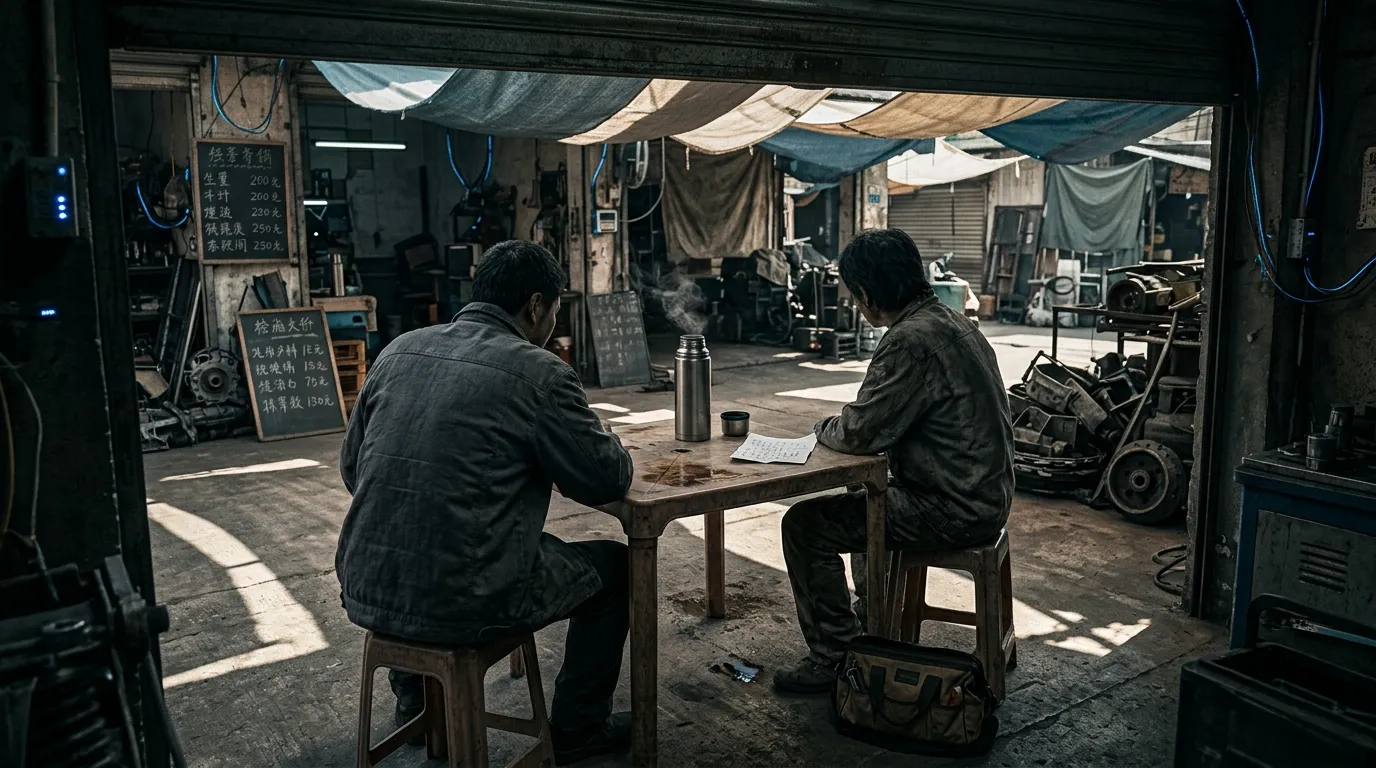
Chapter Twelve: Gray Zone
Someone was watching him.
Not the firmware kind of watched — no short electric sting at the nape of his neck, no system-level surveillance. Something older than that. Something evolution had spent hundreds of thousands of years engineering into the base of every human skull: the back of the head going tight, the skin between the shoulder blades contracting slightly.
Gé Héngyuǎn stood at the edge of the Yongkang credit market on Dawan Road, a canvas tool bag hanging from his left hand. Inside the bag: two lengths of industrial copper bus bar, a heat-sink fin whose model number was still partially legible, and an electrolytic capacitor pried out of a UPS of indeterminate vintage. The three items together were worth roughly 0.8 kT. Not enough to cover tomorrow’s food ration, but he hadn’t come out today for scavenging.
He needed to check the market’s exchange board — specifically whether the spacing between dongle ops had changed. Since the scavenging crew had disbanded and Luò Cuò had left, dongle duty was his only reliable income. The firmware grace period was down to less than three days. Once warning mode activated, the random half-second neural disruptions would turn every contaminated-data embed into Russian roulette.
He needed one more dongle op before that happened. A real MQTT subscription.
The exchange board hung under the arcade at the market entrance. The chalk numbers had been bleached pale by the noon sun. Someone had just wiped the last round of prices and hadn’t finished writing the new ones — a half-completed “1 kT =” hung in the air like a sentence abandoned mid-thought. Gé scanned the dongle duty section of the scheduling board: one window, tomorrow afternoon.
The sensation at the back of his head didn’t go away.
He turned, sweeping the space with peripheral vision. The market was at its afternoon peak — bartering voices from the metal components stalls to his left, someone running an angle grinder on something to his right, the screech bouncing off the concrete arcade ceiling. Shade-cloth cut the sunlight into irregular strips, figures moving through the bands of shadow and brightness. Pan-fried rice cake smoke drifted from a roadside stall, threading through the smells of metal powder and sweat.
No obvious anomaly. But that was the problem — “no obvious anomaly” was itself suspicious. A well-written monitoring program doesn’t let the subject know they’re being monitored.
He walked along the arcade toward the market’s periphery, the canvas tool bag swinging in his left hand. About thirty meters out, where the market met the residential block, a row of half-shuttered storefronts stood with their roll-up doors open at different heights, like a lineup of eyes at different stages of closing. The rightmost one had two low plastic tables set out front, their surfaces so layered with grease that time had given them a deep amber finish.
A tea stall. If it counted as one — two hot-water thermoses, a few glass cups, a stack of disposable plastic ones. Gé had never noticed this corner before.
At the inner table sat a man.
Mid-fifties. Gray-white hair, cut short. A dark gray work jacket, buttoned to the second button. In front of him, an old stainless-steel thermos — the kind worn down to a matte finish by years of handling — lid unscrewed and set to one side. A light curl of steam rising from the mouth. Sijichun oolong. Through the metal-powder smell and the food-stall smoke, Gé’s nose found it because it didn’t belong here.
The man was looking at him. Not peripheral — direct. Not accidental eye contact, but waiting.
Gé’s pace didn’t change. But his mind had already started running.
Unknown individual. Direct eye contact. Alone. Thermos. No scavenging tools, no trade goods. Waiting at a tea stall that almost nobody used, at the market’s edge.
Didn’t look like a buyer. Didn’t look like a seller. Didn’t look like someone waiting for someone. Looked like someone who already knew Gé would come through here.
“Engineer.”
The man had spoken. Slow cadence. Not laziness — deliberately controlled volume, the kind that forces you to lean in to catch the words.
Gé stopped. Plenty of people in Yongkang District knew he’d been an engineer; the title itself meant nothing. It was the way the man said the word: no question mark, no tentativeness, the way you’d address someone by a name you’d been using for a long time.
“Your tea’s gone cold.” The man indicated the chair across from him.
Gé looked down. A cup of tea sat on the other side of the table. Already poured.
He’s been waiting. He knew I’d come. He even knew roughly when I’d get here.
Gé didn’t sit. He stood at the table’s edge and set the canvas bag on the ground beside his foot.
“I don’t know you,” he said.
“You don’t need to.” The man lifted his thermos and drank. No hurry, no tension, the manner of someone tasting tea rather than facing off with a stranger at a market’s edge. “What you need are observation nodes. At least three, across different network segments.”
Gé’s breathing didn’t change. But his heart rate jumped. He knew it jumped — from eighty to eighty-six, the same as that day in the verification room when he’d embedded the contaminated data.
This person knew what he was doing.
More precisely: this person knew what he needed. Observation nodes. Multi-segment coverage. This was the conclusion he’d worked out two days ago through Cornelius, written in his notebook, sealed inside the Faraday cage. No electronic communication. He hadn’t told anyone.
The only possibility: this person hadn’t gotten the information from his communications. He’d inferred it from his operations.
The echo.
Last time. The time before. Under a hundred milliseconds of delay, then compressed to under fifty. The thing he’d filed as “uncertain” was now sitting across from him drinking Sijichun oolong.
Gé pulled out the chair and sat. Someone who already knew what you were doing was more dangerous if you couldn’t see their face. Sitting down at least gave him that.
“Who are you?”
“Qiū Zhùmíng.” The man said it evenly. “Quality assurance background. Currently in operations.”
Quality assurance. A QA engineer. Gé filed this. QA people saw the world differently from systems engineers — they didn’t build things, they found things’ defects.
“Which faction?”
Qiū Zhùmíng drank from his thermos again. The stainless steel made a dull thud against the table as he set it down. “What do you think?”
Gé didn’t guess. Guessing was a gift. He answered a different way: “The echo is yours.”
Qiū Zhùmíng’s eyes moved slightly. Not surprise — confirmation. He was confirming that Gé had noticed the echo.
“Under a hundred milliseconds,” Qiū Zhùmíng said. “Compressed to under fifty later. You noticed.”
“You compressed the latency because I found you.”
“Finding us didn’t trigger the compression. Protocol requirements did. Your operational profile —” He paused, chose different phrasing. “Your operations have exceeded three sigma past standard dongle behavior. That triggered our quality control process.”
Quality control process. He’d described surveillance using QA terminology. Gé built an initial model of Qiū Zhùmíng’s language patterns in his head: technical background, intent wrapped in jargon, the slow cadence a means of controlling the conversation’s rhythm.
“The Constructors,” Gé said. Not a question.
Qiū Zhùmíng neither confirmed nor denied. He reached into his jacket’s inner pocket and set something on the table — thin, the size of a playing card, like a chip of black glass, but with extremely fine metal contacts along the edge. Gé recognized it immediately: a communications chip, and in a package he’d never seen before. Advanced process node. Not something the Second Tier could get their hands on.
“You use this to talk to me,” Gé said, looking at the chip. “But right now you’re sitting here in person.”
“Because your Faraday cage is too thick.”
Gé almost laughed. Almost.
“Welcome to the air-gapped communications protocol,” he said. “Your bandwidth is my walking speed.”
The corner of Qiū Zhùmíng’s mouth moved slightly — an acknowledgment that something effective had just been said, nothing warmer than that. He put the communications chip back in his pocket.
“I’m not here to recruit you.” Qiū Zhùmíng screwed the lid back onto his thermos, the motion precise, like calibrating a measuring instrument. “Recruitment implies hierarchy. You’ve already demonstrated operational capability beyond our expected tolerance — a five-year mid-frequency dongle operator shouldn’t be capable of that level of contaminated embedding.”
“So you’re here to do quality control.”
“We’re here to propose an exchange.”
The angle grinder’s sound carried over from the market, cutting into the gap between sentences. Gé waited. Qiū Zhùmíng was in no rush. He slowly turned the thermos half a rotation in his hands.
“You know what you’re touching.” Qiū Zhùmíng’s voice dropped lower; Gé found himself leaning forward slightly without deciding to. “The cooling system. The heat dissipation topology. That’s the Transitionists’ core infrastructure. You’re not hitting endpoint nodes. You’re hitting the supply chain.”
“I know.”
“What you don’t know is this — the Transitionists are pushing a plan. They want to eliminate eighty percent of the Second Tier population in Yongkang District within six months. Not slowly, the way eminent domain squeezes. Directly: raise the firmware update fee to a level you can’t pay, then mass-lock, then harvest.”
Gé’s left hand stopped its micro-tremor. Not by control — adrenaline had flattened out the excess neural noise.
Eighty percent. Gé Suǒ. Gé Luò. The shadow waiting beside the low table at three in the morning; the one drawing tall buildings from the chair across. They were in the eighty percent.
That thought lasted less than two seconds. Then he compressed it to the bottom of the stack. Not gone — just deprioritized. What he needed now was analysis, not fear.
“The numbers don’t work,” Qiū Zhùmíng continued. “Our model says eighty percent lockdown would require life-support pod capacity beyond what currently exists. The Transitionists don’t care — they’ve already started expanding new pod facilities inside the Southern Science Park ruins.”
Southern Science Park. The row of gray steel-skeleton teeth he looked out at from his window every day. They were building pods under that.
“You don’t want this to happen,” Gé said. Not sympathy — deduction. “If the Second Tier disappears, you lose your hands and feet in the physical world.”
Qiū Zhùmíng glanced at him. The look was brief, but Gé read it — this man was not surprised that Gé had used the phrase “hands and feet.” He already knew Gé had seen through the Constructors’ motivation. Protecting the Second Tier was not benevolence.
“Your analysis runs fast,” Qiū Zhùmíng said.
“I don’t need you to compliment my analysis. I need you to tell me the exchange conditions.”
Qiū Zhùmíng set the thermos down. Both hands flat on the table, all ten fingers spread — like showing he wasn’t concealing anything. A QA engineer’s hands: clean, nails trimmed, none of a scavenger’s calluses.
“We provide the internal intelligence you need on the system — including structural data on the heat dissipation topology. Real infrastructure data, not the projections you’ve been inferring through a seven-billion-parameter model. Exchange condition: your attacks target only the Transitionists. Don’t touch Constructors’ assets. Don’t touch our intermediary networks. Don’t touch the memory supply chain we control.”
Gé sat with that. The angle grinder had stopped, and the market’s noise filled back in like a tide — vendors calling prices, metal knocking metal, somewhere in the distance a child crying.
He was running the program. Engineering analysis, nothing more.
Qiū Zhùmíng was an API. This API’s input was Gé’s promise about attack direction. Its output was internal system intelligence. The question was whether this API’s documentation was complete. Whether there were hidden side effects. After calling it once, could he still control subsequent calls?
Known defect: information asymmetry. Qiū Zhùmíng knew what Gé was doing, but Gé didn’t know how much the Constructors knew. Every sentence Qiū Zhùmíng had said was calculated — not lies, but not the complete picture. QA engineer’s mindset: show you the sample results he wants you to see, not the full yield data.
“The cooling system’s structural weak point,” Gé said. “You said you have actual data. What specifically?”
Qiū Zhùmíng reached into his jacket and produced a piece of paper — not a device, paper. Folded in quarters. He opened it on the table.
Handwritten. The same way Gé wrote in his own notebook — handwriting meant offline. This piece of paper had never passed through any electronic system.
Gé looked down.
A partial topology map. Three cooling nodes, annotated with pipe routing, coolant flow ranges, and the number of verification terminals each node served. At the bottom, in a different-colored pen, one line:
Primary loop single point of failure: Zone 7 coolant return valve — manual control, no remote failover.
Gé stared at that line. Zone 7. If this was accurate, Zone 7’s coolant return valve was the bottleneck for the entire primary loop — a manually controlled valve, inside a fully automated cooling system. This wasn’t a design flaw; it was historical legacy. Some node too old to have ever been upgraded to remote control, because upgrading meant downtime, and downtime meant every verification terminal in that section going offline.
Systems engineer’s instinct: this weakness was real. Because it was ugly. A manufactured deception would be symmetrical, elegant. But real system weaknesses were always ugly — some engineer’s fifteen-year-old budget compromise that everyone had since forgotten.
But he couldn’t trust it just because it “looked real.”
“This information on this paper — how do you expect me to verify it?”
Qiū Zhùmíng folded the paper back. The motion was unhurried; he gave Gé no time to photograph or transcribe it — though Gé had no camera, and he’d already committed the key numbers to memory. Either the QA engineer had underestimated a systems engineer’s short-term recall, or this was simply following procedure.
“You have a dongle op tomorrow afternoon, don’t you?”
Gé’s spine went cold. He’d been reading the scheduling board just now, and Qiū Zhùmíng had already been here. He knew what Gé had just looked at.
“During the op, subscribe to the return data from $SYS/hardware/thermal/zone_7/,” Qiū Zhùmíng said. “If you see the coolant return control mode listed as manual_override_only, no automatic backup failover, then it’s true.”
Gé held his eyes on him. “You’re teaching me how to verify the intelligence you gave me.”
“QA fundamentals. Any data needs a second source.”
“You gave me data, then told me how to verify your data. Both sources come from your hand. That’s not a second source.”
The curve of Qiū Zhùmíng’s mouth deepened slightly. “That’s why you need your own source. Your method. I’m just telling you where to look.”
An elegant frame. Gé had to admit it. Qiū Zhùmíng had given him a direction, but the verification act was Gé’s own — if the MQTT subscription returned data consistent with what Qiū Zhùmíng had said, what was confirmed wasn’t Qiū Zhùmíng’s data but the system’s own data. Qiū Zhùmíng had just saved Gé the time of searching blind.
But if the Constructors could inject echoes into the verification channel, they might also be able to inject false data into MQTT return values.
Gé weighed this possibility against Qiū Zhùmíng’s motivations. The Constructors’ interest chain: Transitionists eliminate the Second Tier → Constructors lose a counterbalancing piece → maintaining the status quo serves the Constructors. If Qiū Zhùmíng’s weak point was fabricated, Gé’s attack would fail, the Transitionists would advance their plan, and the Constructors would be worse off. The Constructors had no motivation to give false intelligence.
But they did have motivation to give incomplete intelligence. Show you what they wanted you to see, steer your attack where it benefited them most — weakening specific Transitionist components while protecting what the Constructors didn’t want touched.
“How long have you been watching me?” Gé asked.
“Since the first day you deviated from standard dongle procedure.”
That day. The first time he’d opened his eyes during a heartbeat packet gap.
“In that op you did something a standard dongle wouldn’t do — you actively observed the structure of the data stream during a heartbeat gap,” Qiū Zhùmíng said. “That’s not standard dongle behavior. Our monitoring system flagged you.”
“And then you didn’t intervene.”
“Intervention has costs. Observation doesn’t. And —” He paused. “We wanted to see how far you’d go.”
“QA sampling bias,” Gé said. “You chose to observe rather than intervene because intervention would have altered your sample. You needed to know how large a threat a Second Tier dongle operator could generate spontaneously, without interference.”
Qiū Zhùmíng raised the thermos toward Gé in a slight tilt. Like a toast — but with a worn stainless-steel thermos of Sijichun oolong.
“Your debug speed exceeded our expectations.”
Gé didn’t respond. He was processing a deeper inference — the Constructors hadn’t been watching him just because he was a threat. They’d been watching because he was a potentially useful variable. A Second Tier individual attacking the Transitionists, not controlled by any faction, acting on his own. For the Constructors, that was far cheaper than doing it themselves — proxy wars were always less expensive than direct engagement.
He was the knife the Constructors wanted.
And Qiū Zhùmíng was here today because the knife had been sharpened to the point where it could be used.
“One more question,” Gé said.
Qiū Zhùmíng waited.
“The eighty percent lockdown figure — is that an internal Transitionist planning number, or your own projection?”
“Our projection. But the input parameters were intercepted from Transitionist communications. Margin of error: five to ten percent.”
“All right. Last one.”
“That’s already the second time you’ve said ‘last one.’”
Gé didn’t let that break his concentration. “Has there been anything unusual in the Third Tier recently?”
This question wasn’t in his plan. It was instinct — Qiū Zhùmíng had provided intelligence on the Transitionists, on the cooling system’s weakness, on the lockdown figures. All of it was “what he wanted Gé to see.” But a real QA engineer, before showing you the product, would often let slip a detail that wasn’t in the report.
Qiū Zhùmíng put the thermos down. His expression didn’t change, but Gé registered that he set the cup down approximately half a second slower than before.
“Third Tier output quality has been abnormally high recently,” Qiū Zhùmíng said. The same flat tone he’d used to read statistics off a QA report. “Outside this session’s scope. But the number doesn’t fit.”
Output quality. The Third Tier’s output was — what? Gé didn’t know. He knew the Third Tier were the people in the pods. He knew they were being “used” somehow. But the specifics of how fell outside his knowledge boundary. He filed the sentence exactly as delivered, adding no speculation.
“You’re not asking what that means,” Qiū Zhùmíng observed.
“I don’t ask about things I can’t verify.”
Qiū Zhùmíng stood. Thermos in hand. He didn’t extend a hand, didn’t leave any contact information.
“Your Faraday cage is too thick, but your balcony isn’t,” he said. “If you need to reach us — under the third plant from the left on your balcony there will be a coin-sized receiver. Knock on it three times with metal. Frequency doesn’t matter; three is the code. We’ll send someone within twenty-four hours.”
He turned and walked away. Not fast, not slow, moving into the crowd at the market’s edge, the dark gray jacket disappearing under the shade-cloth shadows.
Gé sat in the plastic chair. The teacup in front of him was still there — Sijichun oolong, completely cold. He hadn’t touched it.
He closed his eyes. He ran the last fifteen minutes of conversation in reverse in his head. Not reviewing content — the content was already there. He was analyzing tone, timing, patterns of eye movement.
In the entire conversation, how many times had Qiū Zhùmíng lied?
Gé’s assessment: zero.
How much had he left out?
Incalculable. That was the real problem.
The inside of the Faraday cage was two degrees cooler than the room outside. Gé sat in the metal tool cabinet, back against the aluminum-foil wall, the screen in front of him the only light source.
Cornelius had warmed up. The GPU fan’s low drone filled the space — roughly a meter and a half on a side. The power timer showed a hundred and thirty-two minutes today, eight more than usual, possibly because the afternoon cloud cover was thinner than predicted and the solar panel had collected a little extra.
He opened the engineering notebook. Skipped past the contaminated data templates, the MQTT subscription plan, the heartbeat packet interval records. Turned to a blank page.
At the top of the page he wrote:
Qiū Zhùmíng — risk assessment
Then typed into Cornelius’s window:
> Game theory scenario: Party A holds information Party B needs.
Party B holds attack capability Party A needs. Party A proposes
cooperation on the condition that Party B's attacks target only
Party C. Analyze Party A's defection incentives and Party B's
optimal strategy.
Cornelius thought for fifteen seconds.
This is a classic incomplete-information game.

Party A's defection incentives:
1. If Party B successfully attacks Party C, Party A gains
   (Party C weakened) at zero cost
2. If Party B fails, Party A loses nothing (proxy is disposable)
3. Party A's maximum risk: Party B subsequently attacks Party A

Therefore Party A's defection incentives are low early in the
cooperation — Party B still has utilization value.
Defection incentives rise sharply after Party B completes
the attack — Party B loses utilization value, and Party B now
understands Party A's capabilities, becoming a potential threat.

Party B's optimal strategy:
1. Accept cooperation, but retain counter-capability
2. Consume only a portion of Party A's intelligence per exchange,
   maintaining Party A's incentive to keep providing
3. While attacking Party C, covertly gather intelligence on
   Party A as insurance

Note: this model assumes Party A and Party B are both rational
actors. If Party A has irrational ideological motivations,
the model's predictive accuracy degrades.

Fun fact: game theory was first formalized by John von Neumann
in 1928——
Gé stopped reading at “fun fact.” He ran Cornelius’s analysis in parallel with his own judgment.
The model’s conclusion aligned with his instinct: the Constructors’ defection incentives were low in the early cooperation phase. If Qiū Zhùmíng’s intelligence was genuine, it had immediate value for Gé. And Gé’s value to the Constructors depended on his continued attacks against the Transitionists, so the Constructors had incentive to keep him alive and operational.
But Cornelius had missed one variable: the Constructors could provide selectively true intelligence. Not fabricated — incomplete. Steering Gé’s attacks toward the outcomes most beneficial to the Constructors: weakening specific Transitionist elements while protecting what the Constructors didn’t want touched.
Gé wrote in the notebook:
Qiū Zhùmíng = API with known limitations

Known characteristics:
- Output format: true but incomplete information
- Hidden side effect: steering attack direction
- API documentation (what he told me) ≠ full implementation
  (what he didn't tell me)
- Rate limit: unknown (how often will he respond?
  controlled by whom?)

Call strategy:
- Use but don't depend on
- Cross-validate each call against independent sources
- Don't expose complete attack plan (API doesn't need to know
  caller's full logic)
He looked at what he’d written. Analyzing a human being as an API. He knew it was cold. Qiū Zhùmíng might have his own fears, his own family, his own way of surviving inside this broken world. But Gé had no capacity left for that. His only tool was systems analysis — the only thing he knew how to do, and the only thing that worked in this situation.
Use the tools you have to solve the problem in front of you. Even when those tools turn people into functions.
He returned to Cornelius.
> Cooling system design: if a node's coolant return valve is
manually controlled with no remote failover, what engineering
circumstances produce that situation?
Cornelius thought for eleven seconds.
In large-scale cooling systems, manual control valves appear
in the following circumstances:

1. Historical legacy: system built in phases; early nodes used
   manual valves; later nodes upgraded to remote control; early
   nodes not upgraded because downtime costs were too high

2. Safety design: certain critical valves are deliberately kept
   manual to prevent remote attack — if all valves are remotely
   operable, a single network intrusion can shut down the entire
   cooling system

3. Cost compromise: redundant failover requires additional piping
   and controllers; if the node was assessed as "low failure rate,"
   it may have been excluded from the redundancy budget

In semiconductor manufacturing history, design compromises of
this kind are common — early ultrapure water systems frequently
had "forgotten manual valves" because nobody remembered they were
still in the circuit.
No hallucination this time. The final example — “forgotten manual valves” in ultrapure water systems — was even defensible; Gé had seen exactly this during his years at the Southern Science Park.
He noted in the notebook:
Zone 7 manual return valve — credibility assessment:
- Matches engineering reality of "historical legacy" pattern ✓
- Matches "cost compromise" pattern ✓
- Qiū Zhùmíng's partial topology matches Cornelius's
  inferred direction ✓
- But: the above only establishes "could be true,"
  not "must be true"
- Verification method: in tomorrow's dongle op, subscribe
  $SYS/hardware/thermal/zone_7/ and check control mode field
He stopped. Looked at the last line.
Tomorrow.
The firmware grace period was down to less than three days. If tomorrow’s dongle op failed — whether the contaminated data got flagged, the MQTT subscription got blocked, or the half-second disruption landed inside the operation window — he might not have another chance.
Once warning mode activated, every op was gambling.
He turned to a fresh page. Wrote one line in the center:
Decision: limited cooperation.
Below that, three lines:
1. Accept Qiū Zhùmíng's directional intelligence
2. Make no commitment on attack scope (verbal promises
   don't go in writing)
3. Reserve independent judgment — Qiū Zhùmíng's intelligence
   is one input, not an instruction
Then, below:
Worst case?
- Constructors betray me → flagged by system → locked
- But Constructors need me to keep attacking Transitionists
- Therefore: before the attack completes, betrayal is
  not cost-effective for the Constructors
- But after the attack completes ——
He drew a line under “after the attack completes.” Left the space blank. That question needed more data.
The power timer dropped to forty-one minutes. He closed the notebook and turned back to Cornelius.
> Assume tomorrow I need to run an MQTT subscription inside
a dongle op. Target topic: $SYS/hardware/thermal/zone_7/
Building on the previously validated contaminated data method,
generate a new embedding template. The subscription command
needs to specify the zone_7 sub-path, which adds a few more
bytes than the wildcard subscription. Output the complete
packet structure.
Cornelius started calculating. Gé leaned back against the aluminum-foil wall, let his eyes close for three seconds while he waited. Not fatigue — switching the brain from analysis mode to planning mode.
In the dark he saw Qiū Zhùmíng’s face. Gray-white hair cut short. Worn thermos. Sijichun oolong. The slow cadence. The number doesn’t fit.
Third Tier output quality abnormally high recently.
He didn’t know what that meant. But he knew the way Qiū Zhùmíng had said it — the way a QA report would note a value flagged for follow-up. Not today’s problem, but one that would be someone’s problem, someday.
Filed. No speculation added. Forcing analysis without enough data produced hallucinations, and he was not Cornelius.
On screen, Cornelius produced the new packet template. Gé started checking line by line.
Gé was resealing the Faraday cage’s aluminum foil tape when the tape made a faint tearing sound against his fingertips. The edge’s fraying was more pronounced than yesterday. He pressed the loose threads flat with his thumb, trying to extend its life.
Out of the bedroom. The corridor had no light.
He went to the bathroom and washed his hands and face. Cold water. When he turned the faucet off it dripped twice before stopping — the washer was worn. He watched the water mark on the ceramic sink slowly shrink, then walked to the living room.
The living room was dark. Not empty.
A small shadow sat beside the low table. Moonlight came in through the window and caught the shadow’s edge — a pair of bare feet. Very thin ankles.
Gé Suǒ.
12:12 AM — Gé didn’t need to check the clock; his body clock had been synchronized with Gé Suǒ’s sleep patterns over the past month. Every night between two and four in the morning, his nine-year-old son would wake. No lights, sitting at the low table in the living room, doing whatever he was doing.
Gé walked to the low table. In front of Gé Suǒ there was no open notebook, no book. He was simply sitting. Hands folded on his knees.
“Can’t sleep?” Gé asked, quiet.
Gé Suǒ didn’t answer. In the moonlight his face was turned toward the window; Gé couldn’t make out his expression.
Gé sat down beside him. Not close, not far. The low table’s surface was bare, moonlight drawing a window frame’s shadow across it.
He had just made a decision — limited cooperation with the Constructors. A partner with questionable motives. Intelligence whose reliability was unclear. A game whose rules he didn’t know. All of this was compressed inside his chest now, like an unhandled exception — wrapped in a try-catch, but he knew the catch block was empty.
He couldn’t let Gé Suǒ see any of it.
“Cornelius behaved himself today,” Gé said. The flattest tone he could find.
Gé Suǒ turned to look at him. In the dark Gé could see his eyes — not a normal look, but the kind of watching Gé had known since the boy was born. This child didn’t listen to what you said. He watched your hands, your shoulders, your breathing rate.
“You ran into someone today,” Gé Suǒ said.
A statement, not a question.
Gé’s breath caught half a beat. He didn’t try to hide the reaction — Gé Suǒ had already seen it.
“Someone I didn’t know before,” he said.
“Good person or bad person?”
Gé considered. “Uncertain.”
Gé Suǒ filed this. Gé could almost see the folder structure in his head — “Father, date, event: encountered uncertain individual.”
“You said once,” Gé Suǒ’s voice was quiet, “that uncertain things were more dangerous than bad ones.”
Gé remembered. He’d said it teaching Gé Suǒ to identify scavenged components — a part you weren’t sure had chemical residue was more dangerous than one you knew had residue, because you didn’t know whether to handle it.
“Right,” he said. “So I’m running a test.”
“Like the test-cheating kind of test?”
The corner of Gé’s mouth moved. “Something like it. But this time I’m testing whether the other party’s answers are right.”
Gé Suǒ nodded. Then stood. Bare feet on the concrete floor, silent. He walked to his bedroom door and stopped.
“Ba.”
“Yeah.”
“Your hand is trembling again.”
Gé looked down. In the moonlight, his left hand rested on his knee — the space between index finger and middle finger showing an extremely faint oscillation. He hadn’t noticed when it started.
“I know,” he said.
Gé Suǒ went into the room. The door closed behind him. Gently, so as not to wake Gé Luò.