Chapter 13
Chapter Thirteen: Architecture Diagram
Chapter Thirteen: Architecture Diagram
Gé Héngyuǎn was in line.
The fluorescent tubes one floor underground turned everyone’s face the same color — a blue-gray pale, like silicon wafers still in their sealed packaging. Seven people ahead of him, each roughly a meter and a half apart. Nobody spoke. The light bouncing off the cast aluminum wall panels made the space look wider than it was, but the smell of ozone gave the truth away: this facility’s ventilation filters hadn’t been swapped in at least three years.
His left hand was in his pocket. The basement level held a constant twenty-one degrees — cold had nothing to do with it. The firmware grace period had hit zero this morning.
The first neural disruption had come before he left the apartment.
Brief. Half a second. His right index and middle fingers stopped belonging to him — as if something external had taken over those two fingers, curled them toward his palm, then handed them back. No pain. But a third of the water he’d been pouring landed on the countertop instead.
Gé Suǒ had seen it from the other side of the kitchen. By the time Gé Héngyuǎn met his eyes, those eyes had already finished filing: Father. Date. Event: hand wrong. Different from usual.
“New,” Gé Héngyuǎn said. Just those two words.
Gé Suǒ nodded.
Warning mode. Random half-second neural disruptions. At any moment — walking, eating, operating a verification terminal. From now on, his body had acquired an interrupt it couldn’t catch, with no exception handler.
The line moved one position. He moved with it.
He opened his engineering notebook inside his pocket, thumbed to the indentations he’d pressed in with a pencil the night before — the MQTT subscription packet format, $SYS/hardware/thermal/zone_7/, every slash position confirmed by touch. This subscription command was far more complex than the contaminated-data embeds he’d done before. Contamination only needed a few harmless bytes tacked onto the tail of a packet; subscription meant getting the system to return data it had no business returning, after the verification was done.
If Qiū Zhùmíng’s intelligence was accurate, that return data would contain one field: control_mode: manual_override_only.
If it was wrong —
Next. Move forward.
Gé Héngyuǎn’s fingers stopped on the notebook cover. The muscle between his thumb and index finger contracted for half a second, like someone had plucked a tendon. Then released.
He timed it in his head. About forty minutes since the last disruption. If the distribution were uniform, the operation window today would be close to sixty seconds, probability of getting hit under one percent. If the distribution weren’t uniform — he didn’t have enough samples.
His turn.
The metal chair. Circular recess aligned with the back of his neck. Fluorescent tube directly overhead. He pressed the back of his skull into the recess with exactly the same motion as the seven people before him — a collective posture of submission; from the surveillance cameras’ angle, eight people arranged like components on an assembly line.
Pre-verification passed. Three sets of biometric signals lit green simultaneously.
AI command injection. Gé Héngyuǎn’s consciousness stepped back. His fingers began executing an operations sequence at the terminal — not his will, but a command stream injected by the system through his motor cortex. Between steps fourteen and fifteen, though, there was a gap he had prepared.
The gap lasted a little over a second.
In that span, Gé Héngyuǎn pulled the MQTT subscription packet structure from memory — the hexadecimal byte sequence Cornelius had generated, that he’d hand-copied onto paper the night before and confirmed with his thumb, trace after trace. His fingers appeared to be typing but were actually embedding — hiding the subscription command inside a standard heartbeat-packet response.
The packet went out. His fingertips still carried the tactile echo of the embed — faster than a standard operations sequence by a fraction of a second, each keystroke pressing deeper.
He wouldn’t see the return data at the terminal. The return data would travel through the MQTT broker back to the subscription channel he’d embedded — a system diagnostic channel he had no business reading. It would sit there for sixty seconds. If he could read it in the next dongle op, he’d see Zone 7’s return content.
But he didn’t need to wait.
At step twenty-one of the operations sequence — two steps before the AI command stream’s standard end — the system returned an unusually long confirmation packet. Standard confirmations ran forty-eight bytes. This one was a hundred and twenty-six.
The extra seventy-eight bytes had been tucked inside the confirmation packet’s reserved fields. Gé Héngyuǎn’s consciousness, riding back-seat during injection, couldn’t read them directly. But his fingers — those fingers with five years of dongle operations in their muscle memory — registered a difference in the terminal’s vibration pattern on return. A standard confirmation: one short pulse. This one: short — long — short.
He locked the vibration pattern into memory.
The operation ended. The metal chair released the pressure at his neck. He stood, legs briefly unreliable — standard dongle aftereffect, not warning mode. As he walked toward the exit, his index finger traced three marks inside his jacket pocket on the notebook cover: short, long, short.
Out of the distribution facility. Sunlight. The streets of Yongkang. Steam from the rice porridge cart.
He sat down at a plastic chair outside the market, opened the notebook to a blank page, and began translating the vibration pattern into a probable byte sequence. Short — long — short, in the reserved-field encoding of the MQTT confirmation packets he knew —
control_mode: manual_override_only
Qiū Zhùmíng’s intelligence was good. Zone 7’s coolant return valve was manual control, no automatic backup.
Gé Héngyuǎn drew a line under that field. Then closed the notebook.
But he didn’t stand up. Because the oversized confirmation packet had contained more than just control_mode. When he traced the vibration pattern’s third segment with his thumb again, there was a set of data he hadn’t expected — a timestamped scheduling field.
maint_window: 0300-0315 UTC+8 / cycle: 14d
Every fourteen days, Zone 7 had a fifteen-minute maintenance window. 3:00 to 3:15 AM.
His first instinct was to calculate: if the attack needed to happen outside the maintenance window, he’d have to avoid this schedule. If inside the window — the cooling system might behave differently during maintenance, and his falsified signals could fail.
He recorded the schedule in the notebook. Then stood up.
The foot traffic along the market’s edge looked the same as yesterday. The relocation countdown board at the market entrance had shed another day. Twenty-four.
The temperature inside the Faraday cage was four degrees cooler than the room. Gé Héngyuǎn resealed the aluminum foil tape — the fraying edges had started affecting the seal, and he used his fingernail to press the longest fibers back, knowing this was only delay.
Cornelius warming up. The low-frequency drone of the GPU fan bounced twice around the meter-and-a-half square interior before settling. The power timer showed a hundred and nineteen minutes today — thicker cloud cover than yesterday.
He flipped the notebook to a fresh page and wrote at the top:
Attack Path — Architecture Diagram v1
Then typed into Cornelius’s window.
> Assume a large distributed cooling system where one node (Zone 7)
> has a manual coolant return valve with no automatic backup. If
> an attacker wanted to overheat this node without triggering system
> alarms, what would they need to do? List step by step.
Cornelius took twelve seconds.
Cooling system attack path analysis:

Premise: Zone 7 return valve is manual (no remote backup), meaning the
only way to close this valve is physical action. But the attacker doesn't
need to close the valve — they only need to make the system "think"
cooling is normal.

Steps:
1. Falsify Zone 7 temperature sensor reporting — plant logic in the
   management layer to report "normal" when temperature exceeds threshold
2. Simultaneously falsify coolant flow meter data — make the system
   believe coolant is still circulating normally
3. When real temperature exceeds thermal throttling threshold, chips
   auto-downclock — but the management system can't see this layer
   (it sees "temperature normal")
4. Downclocking causes compute capacity at this node to collapse —
   upstream services depending on this node start timing out
5. Timeouts trigger automatic retries — retry storm consumes remaining
   compute — cascade failure

Key prerequisite: the attacker must be able to plant the falsification
logic in the cooling system's management layer during dongle ops. This
requires not one operation but multiple, modular embeds distributed
across separate ops.

Recommendation: split into three independent modules:
- Module A: temperature sensor hijack (modify reported values)
- Module B: flow meter data falsification (simulate normal circulation)
- Module C: trigger — synchronously activates A and B at a specified time
He read through it line by line. No hallucinations. The logic was clean. But he noticed Cornelius had skipped one link — what the system would do after the cascade failure, the degradation behavior.
He typed:
> If the cascade failure scales to the global compute network, what
> would the system's automatic protection mechanisms do? Assume the
> system has a concept of "degraded mode" — rolling back to a more
> stable older baseline infrastructure. Which subsystems would this
> rollback affect? List all potentially affected subsystem categories.
Cornelius took eighteen seconds. Longer than usual.
Potential subsystem impact under global cascade failure with auto-degradation:

1. Compute allocation system — from intelligent scheduling back to
   first-come-first-served
2. Communications network — degrades to low-bandwidth mode, non-priority
   traffic dropped
3. Transportation control — autonomous driving degrades to manual,
   likely large-scale disruptions
4. Medical monitoring — remote surgery and AI diagnostics offline
5. Financial settlement — compute-credit trading suspended
6. Power dispatch — reverts to regional autonomous mode

Note: all of the above depend on the current version of global compute
infrastructure.

Any subsystem with local fault tolerance and independent power supply
would theoretically be unaffected — provided its fault tolerance logic
can actually activate during the chaos of a cascade failure.
Gé Héngyuǎn looked at the last two lines. His fingers hovered over the keyboard for a moment.
He typed a line. Deleted half. Retyped.
> Does the life-support pod system qualify as a subsystem with local
> fault tolerance and independent power?
Cornelius took nine seconds.
Life-support pod systems are designed with local fault-tolerance
controllers and independent backup power (typically capable of sustaining
72 hours). They therefore theoretically fall into the "unaffected"
category.

However: pod nodes normally draw primary power from the data center
they're housed in. If that data center's cooling system also collapses
from cascade failure, emergency power-cut protection may sever primary
power. Between primary power cutoff and backup power activation, there
is a switchover window of a few seconds to a few minutes.

The probability that life-support pod subsystems depend on the current
infrastructure version: cannot be determined.
Gé Héngyuǎn stared at those last three words.
A seven-billion-parameter model didn’t say that unless it genuinely didn’t know.
Which meant: for him, the same.
His breathing changed. Not faster — the rhythm broke. There was a pause between inhale and exhale that had no business being there, as if his lungs had snagged on something. His right hand left the keyboard and closed around his knee. Knuckles going white.
His attack plan might kill people.
Not an abstract might. Concrete: if the pod’s backup power switchover failed during the cascade, if that window of a few seconds to a few minutes stretched past the backup’s capacity — the people inside those pods would die.
How many people? He didn’t know. A city-scale node managed thousands to tens of thousands of pods. How many nodes globally? He didn’t know. This number had simply never appeared in any information he could access — it wasn’t in anything available to him.
Gé Héngyuǎn released his knee. Stood up. The Faraday cage didn’t have enough headroom to stand in, and the top of his head scraped the aluminum foil inner wall. He needed to get out. Not for lack of oxygen — there were ventilation holes. He needed to see if the children were there.
He crouched and crawled out of the metal tool cabinet. The bedroom held light — afternoon sun coming through the window, drawing a rectangle on the floor. He crossed to the door. Pushed it open.
The corridor. Gé Suǒ’s bedroom door was half open. He saw what he needed to see — two shadows. Beside the low table, one larger, one smaller.
Gé Suǒ was reading. Gé Luò lay draped over the table, chin on crossed arms, face turned toward the window.
They were there.
Gé Héngyuǎn stood for three seconds. Then turned and went back.
He crawled back into the Faraday cage. Sat down in front of Cornelius again. Those words — cannot be determined — were still on the screen.
He typed.
> Continue. Assume the life-support pod system has independent backup
> power and its local fault-tolerance logic is soundly designed.
> Move to the next question: the trigger timing for Rollback and the
> synchronization mechanism between attack modules.
He moved past the question.
Not because he’d decided it was safe. Because he’d decided he couldn’t get more data. With insufficient data, continuing to reason would only produce hallucinations — he wasn’t Cornelius, but on this question his brain was just as useless.
So he chose to continue.
He drew the attack plan’s architecture diagram in his notebook. Three modules. Three dongle ops. Module A — temperature sensor hijack — required planting during the next op assigned to Zone 7-related facilities. Module B — flow meter falsification — needed a different entry point in the cooling system’s control layer. Module C — the trigger — planted last, only effective after Modules A and B were in place.
The three modules distributed across three separate dongle ops, to keep the behavioral signature of any single op below the monitoring threshold. Each module operated independently, no communication between them — they only formed a complete attack chain when the trigger synchronized their activation.
But outside the attack chain, one more subroutine was needed. A priority command injected into the life-support pod node’s local controller — upon detecting any anomaly, switch to backup power immediately, without waiting for the automatic switchover system’s judgment.
He drew this subroutine in the upper right corner of the architecture diagram. He noticed he’d used a dashed line — not solid. In his engineering notation, dashed meant unverified.
Beside the dashed line he wrote a small note: Requires non-standard biophysical verification signal.
Because the pod node’s local controller was also protected by biophysical verification. To plant that priority command, he’d need to pass verification at the verification terminal — but pod node terminals weren’t in his dongle op rotation. He had never been assigned to any facility connected to life-support pods.
This was a dead end. The dashed line on the architecture diagram connected to nothing.
Gé Héngyuǎn had Cornelius run through the attack plan’s timing. He fed in three sets of parameters, representing each module’s planting window and the trigger’s synchronization delay.
Cornelius ran it three times.
First run: a clean timing table. Three modules planted within seven days, trigger activating on day eight.
Second run: modified Module B’s planting order, moved it before Module A, on the grounds of “reducing per-op behavioral signature exposure.”
Third run: produced something he hadn’t seen before — a warning.
Note: Zone 7's hardware diagnostic records show a periodic control-mode
switching schedule. If this schedule activates during the attack trigger
window, the cooling system may temporarily revert to automatic control,
causing the falsified signals to be overwritten.

Recommendation: confirm Zone 7's maintenance schedule and avoid the
maintenance window.
He looked at this output.
Three runs, three different results. This was the 7B model’s old problem — its reasoning was inconsistent. Of three results, which was reliable?
His filtering principle was the same as the dozen previous sessions: take the two results that converged, discard the outlier. The first two focused on timing and module order — engineering problems with deterministic optimal solutions. The third had suddenly introduced a “maintenance schedule” warning — but Cornelius had no maintenance schedule data for Zone 7. How could it know?
Hallucination. Gé Héngyuǎn tagged the third result in his head and set it aside.
He didn’t go back to look at the line he’d written at the plastic market chair: maint_window: 0300-0315 UTC+8 / cycle: 14d. That data was in his notebook, less than thirty centimeters from his hand. But his attention had already moved to the next problem.
He turned to a new page and began drawing the trigger’s synchronization logic.
The power timer ticked down to fifty-one minutes remaining.
When Gé Héngyuǎn emerged from the Faraday cage, the bedroom had gone orange. Evening. He’d spent nearly two hours in front of Cornelius today — half an hour more than usual. The cost: tomorrow’s power budget would have to be borrowed from somewhere.
He resealed the aluminum foil tape. Pulled open the bedroom door.
Sounds in the corridor.
Not Gé Suǒ — the probability of Gé Suǒ making noise was roughly the same as a Wi-Fi signal appearing inside the Faraday cage. Gé Luò’s voice.
”— and then he said, ‘Those aren’t legs, they’re two chopsticks.’ And then I said — ”
Gé Héngyuǎn turned the corner into the corridor. In the living room, Gé Luò was standing on the low table — bare feet on the tabletop, hands on his hips, telling a story in a tone that was clearly modeled on the market fishmonger. Gé Suǒ sat on the floor, back against the wall, face carrying a barely-there curve.
“Hey — Ba!” Gé Luò spotted Gé Héngyuǎn and immediately raised his pitch by half an octave. “Ba, did you know, today Uncle Chén said I’ve gotten taller but only my legs, not the rest — ”
“Get down from the table,” Gé Héngyuǎn said.
”— so he said in the future I could be one of those birds, what’s the bird that walks really fast — ”
“Ostrich. Get down from the table.”
Gé Luò jumped down. A big landing, heels slapping the floor. He ran to Gé Héngyuǎn and grabbed his right forearm — not holding hands, grabbing. Tactile confirmation.
Gé Héngyuǎn felt Gé Luò’s fingers tighten on his forearm. Then release. Then tighten again.
“Hey, Ba.” Gé Luò’s tone shifted. From fishmonger to something lower, slower. “The humming over there was really loud today.”
His chin tilted toward the bedroom.
Gé Héngyuǎn’s stomach contracted. Over there — the direction of the Faraday cage. Cornelius’s GPU fan. He’d shut it down, but a GPU after power-off still holds residual electromagnetic field for a few minutes. Undetectable to most people.
Not to Gé Luò.
“Bigger than last time.” Gé Luò wrinkled his nose. “Last time it was round. Today it was square. Square is less comfortable.”
Gé Héngyuǎn crouched down. Eye level with Gé Luò. His son’s eyes were bright — not the brightness of fear, the brightness of someone reporting something he considered important.
“Does your head hurt?”
“Not hurting. Just uncomfortable. Like something running behind my ears.” Gé Luò’s fingers released Gé Héngyuǎn’s forearm and moved to pinch his own right earlobe. “Back and forth.”
“Now?”
Gé Luò tilted his head to listen. “Smaller.” A pause. “Did you turn that thing off?”
“I turned it off.”
“Oh.” Gé Luò accepted this. His expression, with the speed peculiar to nine-year-olds, switched from discomfort to curiosity. “Ba. What soup did Cornelius make today?”
The corner of Gé Héngyuǎn’s mouth twitched. Gé Luò had never asked what calculations Cornelius was running — he only used his own framework. Cornelius made soup. Sometimes it was onion soup (slow-cooking, meaning long inference runs). Sometimes instant noodles (results fast).
“Soup that took a long time today,” Gé Héngyuǎn said.
“Good soup?”
He considered. “Not sure yet. Needs a few more tries.”
Gé Luò nodded solemnly, as if this were a weighty decision affecting the family’s dinner. Then he spun and ran back to the living room, jumping up onto the low table —
“Down.”
— and jumping back off.
Gé Héngyuǎn stood up. Walked into the kitchen to start dinner. Cold porridge and market-bought pickled radish. Three bowls. When he was ladling the porridge his right hand spasmed — third neural disruption. He steadied the bowl with his left.
Gé Suǒ appeared behind him. Gé Héngyuǎn didn’t turn, but he knew Gé Suǒ was there — standing by the door frame, angle of observation just right to see his hands.
“Dinner,” Gé Héngyuǎn said.
Gé Suǒ didn’t move.
“What is it?”
“You used more time than usual today,” Gé Suǒ said. Not a question.
“More complicated soup.”
Silence. Gé Héngyuǎn could feel Gé Suǒ processing this — not the literal meaning, but gauging the tone, the speed, the pauses.
“Can I see,” Gé Suǒ said.
Gé Héngyuǎn turned. Gé Suǒ was leaning in the door frame, bare feet, wearing that gray T-shirt that had already gotten short by half an inch. His face was neutral — not a demand, not a plea. That data-query calm that was entirely his own.
“See what?”
“Cornelius.”
Gé Héngyuǎn’s first instinct was to refuse. The denial was already assembled in his mouth — No, too complicated, you don’t need to know this. But he stopped. Because Gé Suǒ’s face showed no curiosity. Curiosity was wanting to know a new thing. What was on his son’s face was something else — this was someone who had stood outside the door many times, watched through the gap many times, reasoned through the steps himself many times, and had finally decided to convert observation into action.
“After dinner,” Gé Héngyuǎn said.
Three bowls of cold porridge. Pickled radish. Gé Luò spent dinner telling a story about a one-eared cat he’d spotted at the market. Gé Suǒ finished in three minutes, set his bowl in the sink, then stood in the kitchen doorway and waited.
Gé Héngyuǎn washed the bowls. Set them to dry. Dried his hands.
Then he brought Gé Suǒ into the bedroom.
He didn’t open the Faraday cage. He opened the engineering notebook. Flipped to the earliest pages — not today’s attack architecture diagram, but the ones from months ago: MQTT protocol structure diagrams, packet formats, hexadecimal reference tables.
“What’s this?” He pointed to the first page.
“Letters and numbers,” Gé Suǒ said.
“Right. Each set of letters and numbers is a command. Cornelius understands these commands.”
“Like a recipe.”
Gé Héngyuǎn blinked. Then realized this was Gé Luò’s framework bleeding into Gé Suǒ.
“Right. Like a recipe.”
He placed the notebook on the low table. “You can look. But don’t touch Cornelius. Clear?”
Gé Suǒ nodded.
Gé Héngyuǎn stood up and walked to the door. He looked back once — Gé Suǒ had already settled beside the table, the notebook open in front of him, his eyes moving across the page at the most consistent scanning pace Gé Héngyuǎn had ever seen. Not fast, not slow. Line by line by line. Like a scanner running its first indexing pass.
He left.
Forty minutes later, Gé Héngyuǎn came back to the bedroom to get his charger.
One corner of the Faraday cage’s aluminum foil tape was peeling up.
Not the corner he’d sealed. The other side. Bottom edge. Lifted at exactly the height a nine-year-old’s hand could reach.
He crouched and looked. The tape had been lifted — a fresh crease along the edge. Then pressed back down. Not pressed firmly enough; the foil’s reflective angle was off from the surrounding sections.
He opened the Faraday cage. Cornelius’s screen was dark — he’d shut it down, power unplugged. But there was a new layer of fingerprints on the screen. Two on the spacebar. One on Enter.
The distribution wasn’t adult hands — the spacing was too narrow. The pressure was wrong too — the prints too faint, like someone had used the minimum force possible.
Gé Suǒ had touched Cornelius.
No power, so nothing happened. But he’d touched it. He’d tried. He’d spent forty minutes reading the recipe, then decided to try opening the oven.
Gé Héngyuǎn knelt in front of the Faraday cage. Three threads running simultaneously in his head: one, Gé Suǒ’s curiosity had crossed the boundary from observation to action; two, no power, no damage, but this meant next time he might attempt it with the power on; three —
Three.
If the attack plan failed. If he were flagged during a dongle op. If warning mode deteriorated past the point where he could operate.
Gé Suǒ was learning.
The thought didn’t reassure him. It opened a crack in his chest — not wide, but enough for something he didn’t want to name to seep through. A nine-year-old shouldn’t need to learn this. A nine-year-old shouldn’t have to be a backup plan.
He pressed the aluminum foil tape back down. More firmly this time. His fingernail dug into the tape’s edge, leaving a clear imprint.
Then he stood up and walked out of the bedroom.
Gé Suǒ was sitting at the low table in the living room. Notebook closed, on the table in front of him. His face turned toward Gé Héngyuǎn.
They looked at each other for a moment.
“The power wasn’t connected,” Gé Suǒ said.
“I know.”
Silence.
“Next time I’ll ask first.”
Gé Héngyuǎn started to say there won’t be a next time. His mouth had already opened, his tongue had already found the position of the first sound. But no sound came out.
Because he wasn’t sure it was true.
“Get something to eat,” he said. Then walked toward the balcony.
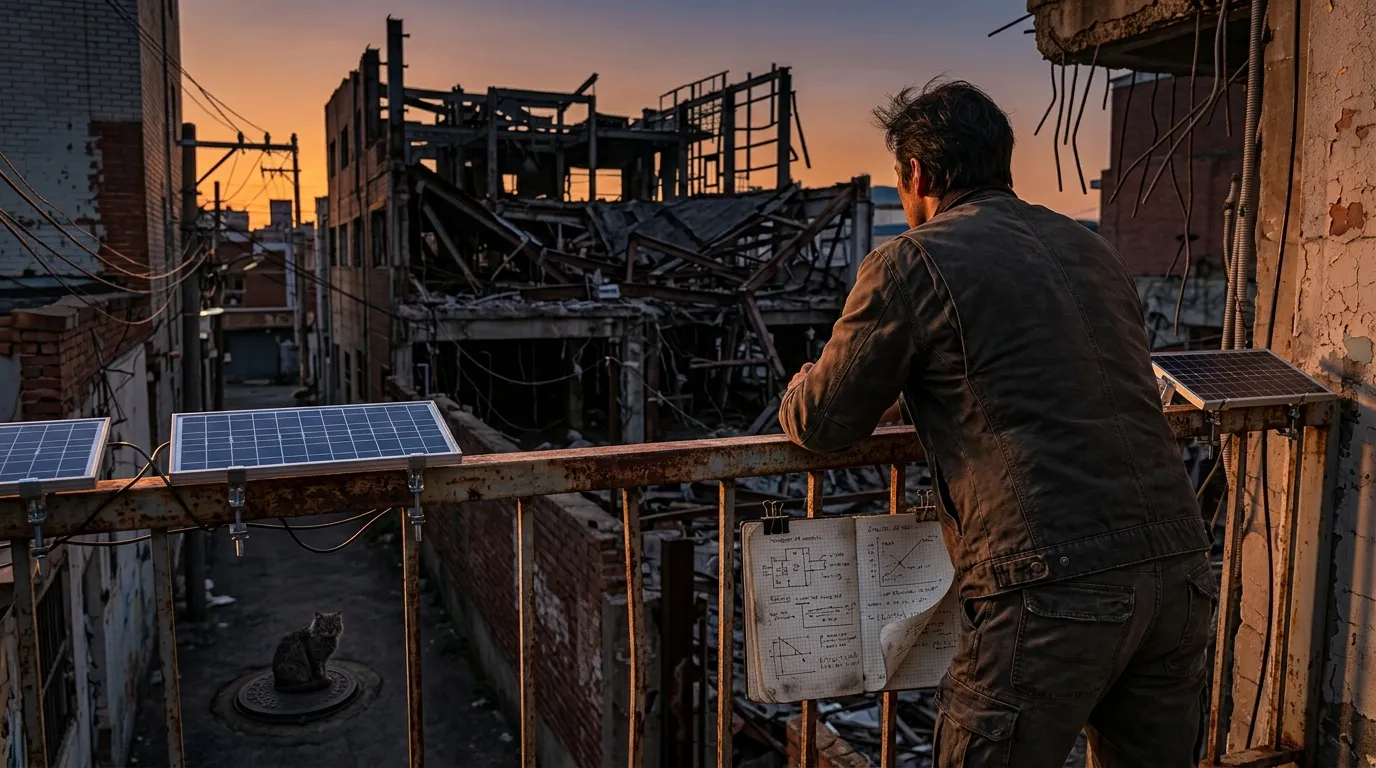
The balcony. Evening wind. The solar panels catching the last light in the dusk. The Southern Science Park ruins rose in the distance, clearer in the evening sun than they ever were at 3 AM — you could see the tilted steel frame structures, like a program halted mid-execution that had left its scaffolding behind.
Twenty-four days to relocation. Firmware in warning mode. The attack plan’s architecture diagram was in his head: three modules, one trigger, one subroutine connected by dashed lines. The dashed end needed something he didn’t have — a non-standard biophysical verification signal.
And his son had touched Cornelius while he wasn’t in the room.
Gé Héngyuǎn didn’t look back at the living room. He looked toward the Southern Science Park. Wind pushed the hair off his forehead and settled it back.
The attack plan was an architecture diagram. Every module, every connection, every trigger condition had a clear definition and expected behavior. This was what he did best — compressing a chaotic world into logic gates and data flows.
But there was one region of the diagram he couldn’t bring himself to examine closely.
The probability that life-support pod subsystems depend on the current infrastructure version: cannot be determined.
He had chosen not to look deeper. He’d told himself this was due to insufficient data. His fingers tightened on the railing, then released.
Gé Luò’s voice came from the living room — “Hey — Ba — that cat’s back!” — followed by running, bare feet slapping on concrete, then Gé Luò appearing in the balcony doorway, hanging from the door frame, head craning out to look.
“Where?” Gé Héngyuǎn asked.
“Down there! Look — that one-eared one!”
Gé Héngyuǎn looked down. In the alley below, a gray cat was crouched on the water meter cover. One ear visibly absent.
“It’s not one-eared,” Gé Héngyuǎn said. “Its left ear is folded. The fur’s covering it.”
“Really?” Gé Luò’s entire upper body leaned over the railing. Gé Héngyuǎn’s hand reached out instinctively and caught the back of his collar.
“Really. You just can’t see it from here.”
Gé Luò pulled back. The back of his head bumped against Gé Héngyuǎn’s hand. Gé Héngyuǎn didn’t pull away.
“Ba.”
“Mm.”
“Your hand isn’t shaking.”
Gé Héngyuǎn looked at his left hand. On the railing. Steady.
“No,” he said.
What he didn’t say: that hand might shake again at any moment tonight. Not the micro-tremor — a full half-second of no control. But right now, on this balcony, in the dusk, in the three seconds of his son’s head against his palm, the hand was steady.
The cat dropped off the water meter cover and disappeared into the depths of the alley.
Gé Héngyuǎn pulled his hand back and walked inside. He needed to memorize the first module’s planting sequence before the power budget ran out. Twenty-three steps. Each step’s opcode, delay, and checksum.
Tomorrow’s dongle op.
As he crossed the living room, he glanced at Gé Suǒ’s notebook. Closed when he’d last looked. Now open.
Pencil marks on the paper. Crooked hexadecimal digits — incomplete, most of them wrong. But the format was right. The arrangement of letters and numbers followed the same pattern as the MQTT packet structure in Gé Héngyuǎn’s notebook.
Gé Suǒ was copying the recipe. With a nine-year-old’s hands. At a nine-year-old’s precision.
Gé Héngyuǎn walked into the bedroom. Closed the door. Stood for a moment. Then sat on the edge of the bed, opened his own notebook, and began memorizing the planting sequence.
Twenty-three steps. Tomorrow.