Chapter 14
Chapter Fourteen: Cherry-Pick
Chapter Fourteen: Cherry-Pick
Thumb pressed against the indentations on the notebook cover — step seven’s checksum, step fourteen’s window, step fifteen’s boundary. Three anchor points. Everything else was in muscle memory.
Yongkang’s streets at six in the morning held two kinds of people — the ones pushing carts toward the market and the ones just walking out of the night shift. Gé Héngyuǎn was a third category: under four hours of sleep, a notebook in his pocket, on his way to lend his nervous system to a machine.
Twenty-three steps. He’d run through them once more on the walk. Not the full sequence — that would push his brainwave entropy high before he even reached the terminal. Just the three anchor points. Everything else was already pressed into motor memory.
The rice porridge cart at the corner was steaming. He didn’t stop. Empty stomach was deliberate — eating shifted the skin conductance baseline.
A brief sharp pressure pulse at the back of his neck. Neural disruption. Half a second. His right thumb jerked toward his palm, then returned. He kept walking. About forty minutes since the last one. Still not enough samples.
Basement level. Cast aluminum wall panels. Fluorescent light. Ozone.
Four people ahead of him. Gé Héngyuǎn joined the back of the line, thumb finding the indentations on the notebook cover in his pocket — the tactile map of twenty-three steps. He walked his fingers along the grooves once, confirming the muscle memory was still there.
Two positions ahead: Chái. Chái didn’t look back. His left hand at his side opened and closed slightly, like confirming today’s terms of service with his fingers.
Gé Héngyuǎn’s attention kept sliding toward step fourteen’s window — like a loop missing its break statement. No. Thinking about it now was pre-spending cognitive load. He pulled his attention back to the soles of his feet. The concrete floor’s cold seeping up through his shoes.
Chái went in. Came out with a press of two fingers to his own temple — old habit.
Verification room. Three meters square. The metal chair. The recess.
He backed up to the chair and sat. Pressed the back of his skull into the circular recess, probe array auto-aligning, locking at C3-C4. A click.
Pre-verification. Three signals reading simultaneously. Dizziness — heart forced two extra beats — thin sweat at the back of his neck. He let these flow past. Five years.
Cleared.
Command injection began.
His right index finger moved. Not his.
Middle finger followed. Ring finger. Precise rhythm, force held at the minimum threshold to trigger keystrokes. The AI was operating his hand; his nervous system was the relay station. Vestibular drift engaged — visual horizon tilting three degrees. Standard.
But today his standard experience carried a scalpel hidden inside it.
The Layer 1 data stream visualization opened along the right side of his visual field. Pale blue light pulses, one string after another. Command packets arriving at the terminal, passing through him, leaving with their biological noise stamps. He tracked the operations sequence in the pulse stream —
Step three. Step four. Each step’s opcode had a corresponding rhythm pattern in his motor memory, the way you recognize a song you’ve heard hundreds of times.
Step seven. Checksum confirmed. Normal.
He began micro-adjusting his breathing. Not deliberately — just extending the inhale by a fraction of a second. Gradual. Pre-loading a lower heart rate baseline for step fourteen’s operation window. The way you brake before a curve you know is coming — you don’t wait until you’re in it.
Step ten.
Step eleven.
Step twelve. Heart rate seventy-eight. He needed it below eighty when the window opened. Micro-adjust the exhale. Another fraction.
Step thirteen.
Then —
A disruption at the back of his neck.
Half a second. His right index and middle fingers jerked toward his palm — not the AI’s instruction, warning mode’s neural disruption cutting in during step thirteen’s execution. His fingers left the operations terminal surface for a fraction of a second. The keystroke rhythm broke.
The Layer 1 visualization flashed in the upper right corner of his visual field. Not red. Orange.
The system had detected a micro-delay in the operation.
Orange. Not red. The system classified it as “operation jitter” rather than “anomalous behavior” — because he was a five-year veteran with enough micro-tremor records in his historical data that one brief interruption fell within his personal baseline tolerance.
But his heart rate was at eighty-six. And the window was one step away.
Doesn’t matter.
Step fourteen completed. Window open.
One point two seconds.
What he did in those one-point-two seconds followed the same movement pattern as the contaminated-data embeds he’d practiced, but at a different scale. This wasn’t the short marker sequence from before — it was a full temperature-sensor hijack module, the complete planting payload. Stripped to minimum viable size, but still close to ten times what he’d done in practice.
His fingers executed the AI’s instructions. Simultaneously, in the moment the biological noise stamp was written into the packet, he nudged the noise’s bytes toward preset values. Three consecutive packets. Each one carrying a third of Module A.
First packet. Embedded. Heart rate eighty-eight.
Second packet. Embedded. Heart rate ninety-one. Like CPU temperature climbing to eighty-eight degrees — not hitting the throttle threshold yet, but the fans had already kicked from silent to full speed.
Third packet —
Something appeared in the upper right corner of the Layer 1 visualization that he had never seen before.
A gray line. Very thin. Extending in from the edge of the data stream like a probe doing retroactive search through packets that had already flowed past. It swept over the position of his first two embedded packets — didn’t stop, but it swept.
The Equilibrists’ monitoring AI.
Gé Héngyuǎn’s lungs stopped. Pure body. An animal caught in sudden light, freezing in place — no thought required. Heart rate from ninety-one to ninety-seven.
The gray line moved like an audit, not a chase. It hadn’t locked onto his packets; it was scanning all traffic through the verification channel, looking for statistical deviations.
But he was at ninety-seven. If his rate kept climbing, his brainwave entropy would follow, his skin conductance would drift — and then the monitoring AI wouldn’t need to analyze packets. It would only need his biometrics to know someone in this verification session was doing something they shouldn’t.
The third packet still wasn’t embedded. The window had point-four seconds left.
He could abort. Don’t embed the third segment; Module A would be incomplete but he’d be safe. Come back another time.
Or —
Rebase.
The thought didn’t come from his brain. It came from his hands. The branching strategy from the architecture diagram — not confronting the monitoring AI, but rewriting the baseline of its inference. Make it track the wrong definition of normal.
Point-three seconds.
Gé Héngyuǎn’s fingers completed the third packet’s embed. Simultaneously, at the tail of the biological noise stamp, his fingers added one more sequence — not from any conscious instruction, but spilling out of five years of operational memory. Those high-heart-rate ops. Those times he’d been tense enough to lock his fingers. Those old packets when his biometrics had danced at the edge of tolerance — their noise signatures were compressed into his motor cortex, and now he let them out.
This signal told the monitoring AI’s inference engine: this operator’s “normal” range includes heart rate ninety-seven. Not anomalous. Individual variation.
His hand wasn’t fully his. The AI’s instructions and his own intent were competing for the same neural pathways — two programs fighting over a single execution thread. His fingers were shaking, not the micro-tremor, the interference pattern of two instruction sets. Heart rate ninety-nine. The edges of his visual field beginning to darken.
Step fifteen initiated. Window closed.
His fingers returned to the AI’s sole rhythm. Steady. Precise. He was no longer the operator — just the relay station.
The gray line was still there. It completed its scan cycle and paused.
Gé Héngyuǎn watched it in the translucent data stream display. The pause lasted about two seconds longer than a normal scan interval. Like a judgment function had returned a value at the boundary — not enough to trigger pursuit, but not a clean pass either.
Then it disappeared.
Not exiting. Writing to persistent storage. The gray line contracted to a single point of light, barely visible, sinking into the bottom layer of the data stream. Gone from sight. But not gone. Still there. A record. A log entry.
The monitoring AI had been fooled by the real-time inference. But the raw data was stored somewhere.
The operations sequence ran through its final eight steps. Step twenty-three. Fingers stopped. The probe array released.
Gé Héngyuǎn stood up.
Or tried to.
His legs had nothing left. Not the brief post-dongle weakness — the angle at which his knees bent could not bear weight, as if the hydraulic fluid had been drained. He grabbed the chair back, fingertips going white. Three seconds. His knees began cooperating.
Out of the verification room. The corridor. Fluorescent tubes.
He walked seven steps with one hand against the cast aluminum wall, then felt something flowing down inside his nose. Hand raised to check — red.
Nosebleed.
Not much. But the speed at which it traveled from left nostril down his upper lip said everything about his blood pressure.
Chái was waiting at the end of the corridor. When he saw Gé Héngyuǎn’s face, he pulled a packet of tissues from his pocket without changing expression. People in this line of work had seen it before.
Gé Héngyuǎn took the tissues and pinched his nostrils. The taste of iron spreading through the back of his nasal cavity. His head had started to hurt — not ordinary headache. The location was in the left temple, about two centimeters behind the surface, like someone was threading a very thin screwdriver through from outside, each turn advancing one millimeter. Not throbbing. A steady, incrementally increasing pressure.
“Overflow?” Chái asked.
Gé Héngyuǎn shook his head. The bloodstain on the tissue was spreading.
“Overclocked,” he said.
Chái raised an eyebrow. Not standard terminology, but Chái had run enough ops to understand.
“Someone should add a line to the dongle terms of service,” Gé Héngyuǎn said, voice distorted from pinching his nose. “Side effects may include: headache, nausea, nosebleed, and a strong urge to dismantle the entire system.”
Chái’s mouth moved. “Is that last one a feature or a bug?”
“Depends how the PM writes the ticket.”
Chái shook his head and walked away. Then turned back.
“Go home and rest. Your face is gray.”
Gé Héngyuǎn made his way along the wall to the ground floor. When daylight hit his pupils, the screwdriver upgraded to a blunt chisel. The left edge of his visual field was strobing with faint sparks — not one, a line of them, like a broken LED strip.
He sat on the steps for five minutes. Third tissue.
His hands. Right index finger to pinky — a sensation he’d never felt before. Not numbness; numbness was absence of feeling. This was feeling, but wrong. Like each finger’s tactile feedback had been delayed by a fraction of a second — his hand touched the concrete step, but the sensation arrived in his consciousness a fraction of a second later.
He tried to make a fist. The closing speed was wrong — like doing it underwater. Fine motor control was gone.
The Rebase cost. That neural pathway had only been licensed for one-way AI instruction traffic. Running his own operations on it was like pushing a full-duplex load through a half-duplex line. The line hadn’t burned, but the damage needed time to repair.
He stood. Steadied himself on the wall. Walked.
The walk home was three times as long as the walk there. Same distance; his pace had dropped to a third of normal. Every footfall made his knee buckle slightly, as if gravity had added half a unit to itself. The chisel in his skull found the walking’s vibration frequency and rode it, sinking a bit deeper with each step.
Home. Up the stairs. Through the door.
Gé Luò was in the living room. Bare feet on the floor — not on the table — and when he saw Gé Héngyuǎn he ran over. His hands grabbed the forearm, tightened, released, tightened. Then his nose wrinkled.
“Ba, you’re bleeding.”
“I know.”
“A lot?”
“Slowing down.” The blood had darkened. Almost stopped.
Gé Héngyuǎn walked into the kitchen to wash his face. Cold water splashed on — the headache didn’t ease, but the bleeding stopped.
Lunch. Leftover porridge and pickled radish. He was ladling the porridge when —
The chopsticks slid out of his hand.
Not dropped — slid. His fingers lacked the grip to keep two bamboo sticks at the right angle. The chopsticks separated: one caught on the bowl’s rim, one hit the floor.
Gé Héngyuǎn looked at the chopstick on the floor. Bent to pick it up. His fingers made contact, but couldn’t grip — the fine control needed to apply pressure between fingertip and bamboo surface was currently beyond him. He tried twice.
Gé Luò crouched beside him. Small hands picked up the chopstick and put it back on the bowl rim. Then he picked up that bowl with both hands, carefully, and set it on the table.
“I’ll do it,” Gé Luò said. Not sympathy in his voice — the same matter-of-fact tone he used when handing plastic bags to the fishmonger at the market. There’s something to do, so you do it.
He brought the other two bowls. Three servings of porridge. Pickled radish.
Gé Suǒ emerged from his room. His gaze rested on Gé Héngyuǎn’s face for less than a second. Filed.
The three of them ate. Gé Luò delivered an update on the folded-ear cat from the market — “It chased a cockroach to the drain cover today and then just stopped, just stood there watching the cockroach fall in.”
Gé Héngyuǎn used his left hand for chopsticks. Right hand stayed under the table. He ate half a bowl. The headache had killed his appetite, but not eating would generate more of Gé Suǒ’s observations.
After the meal, he sat in the living room chair, back of his head against the wall. Eyes closed. The chisel eased back to a screwdriver — intensity decreasing, but on an hourly timescale.
Module A planted. Three payload segments, all embedded. The temperature sensor hijack module was now sleeping inside Zone 7’s management layer — a dormant piece of code waiting for the trigger to wake it.
But that gray line. That log entry sinking into persistent storage. Its real-time inference had been poisoned by the Rebase — it had concluded: no anomaly. But the raw data carried a timestamp and an operator ID, stored in some log database. If anything ever decided to run a retrospective audit, that entry would surface.
Not today’s problem. Today’s problem was when fine motor control came back. And whether his body could survive a second overclocking.
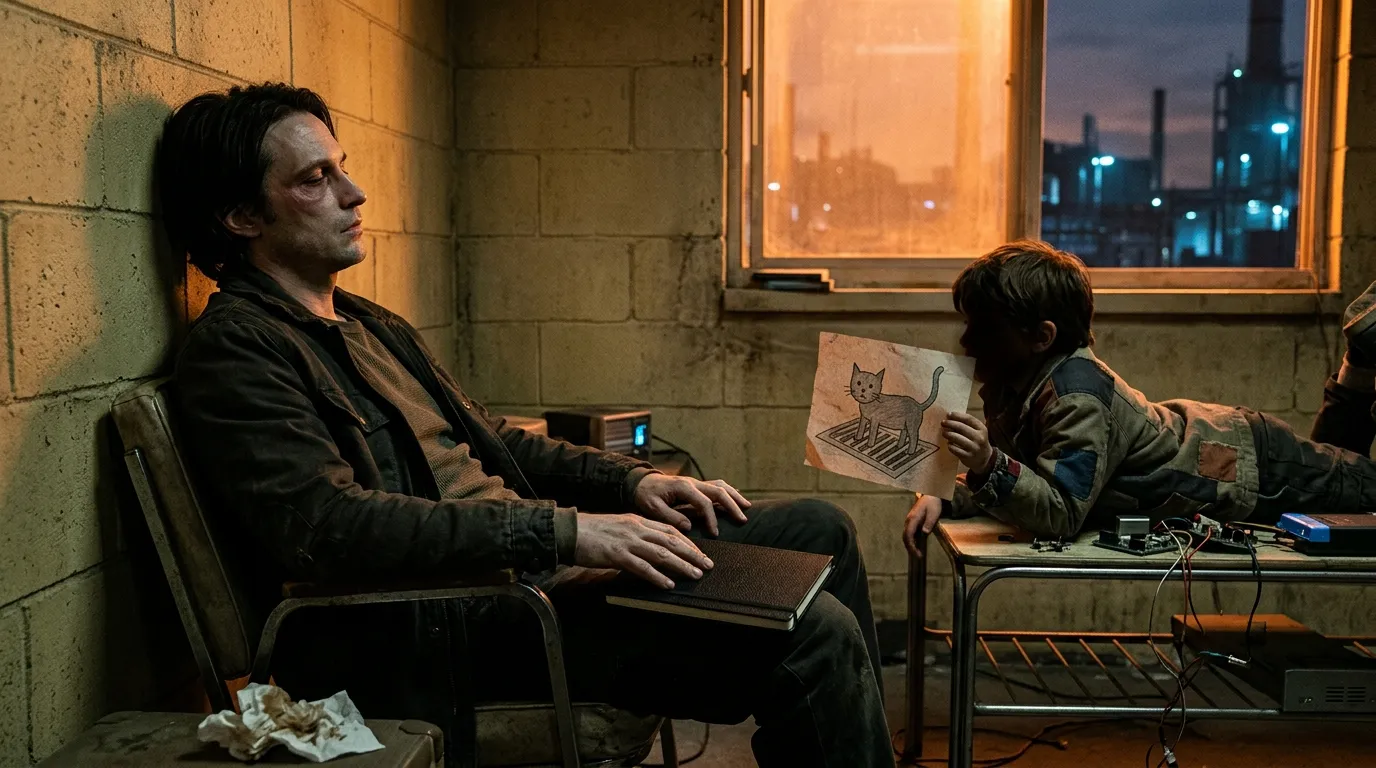
He opened his eyes. Gé Luò was lying across the low table, drawing. Crayon on paper, soft scratching sounds.
Twenty-three days to relocation. Still Module B and Module C. And that dashed line — the life-support pod safety subroutine. His thumb found the notebook in his pocket, felt the pencil-drawn dashed line. Not solid. Deliberately dashed. Unverified. Requiring non-standard biophysical verification signal he didn’t have. His breathing paused slightly at that point, like something light pressing against the bottom of his lungs. Then he moved his thumb away.
His fingers wouldn’t let him open the notebook.
The light outside shifted from white to orange. Gé Héngyuǎn sat in the chair, hands on his knees. His right-hand fingers spasmed occasionally — irregular, small contractions, like a cable whose solder joint hadn’t fully cooled.
Gé Luò finished a drawing. Held it up for him to see. On the paper: a gray cat standing on a square shape. Wavy lines beside the square.
“It’s standing on the drain cover,” Gé Luò explained. “I didn’t draw the cockroach because cockroaches are ugly.”
Gé Héngyuǎn looked at the gray cat. Both ears drawn in.
“That cat only has one ear,” he said.
“I know.” Gé Luò turned the drawing to look at it himself. “But you said the other one’s actually there, just hidden by the fur. Can’t see it doesn’t mean it’s not there.”
Gé Héngyuǎn said nothing.
He looked at the drawing. A two-eared cat, standing on a drain cover. The thing underneath not shown. Can’t see it doesn’t mean it’s not there.
The screwdriver behind his left temple had stopped advancing. But it hadn’t withdrawn.