Chapter 15
Chapter Fifteen: Negative
Chapter Fifteen: Negative
Third plant on the left side of the balcony. Gé Héngyuǎn crouched down and slid the pot aside.
The coin-sized receiver was still in its spot. Beside it, something new: a sealed anti-static bag, thumbnail-sized, packed with a microSD card and a sheet of paper folded into quarters.
His fingers were better than yesterday. Fine motor control had recovered to maybe seventy percent — enough to tear open the anti-static bag, though the process took three seconds longer than it should have.
The note inside was handwritten. Precise strokes, every character spaced almost uniformly. A quality engineer’s hand.
Zone 7 perimeter traffic topology. Includes three months of verification station flow logs. The traffic patterns you need are in there. — Second time, face to face.
Gé Héngyuǎn flipped the paper over. Blank. No signature, none needed. He recognized Qiū Zhùmíng’s handwriting — the same script as that heat-dissipation topology diagram.
He pocketed the microSD card, folded the note back along its creases, and pressed it under the plant pot. Left the receiver untouched. Three seconds. Stood up.
Back inside. Gé Suǒ was writing something at the low table, glanced up when the door opened, filed it, looked back down. Gé Luò wasn’t in the living room — from the bedroom came the sound of him wrestling with paper, probably folding something.
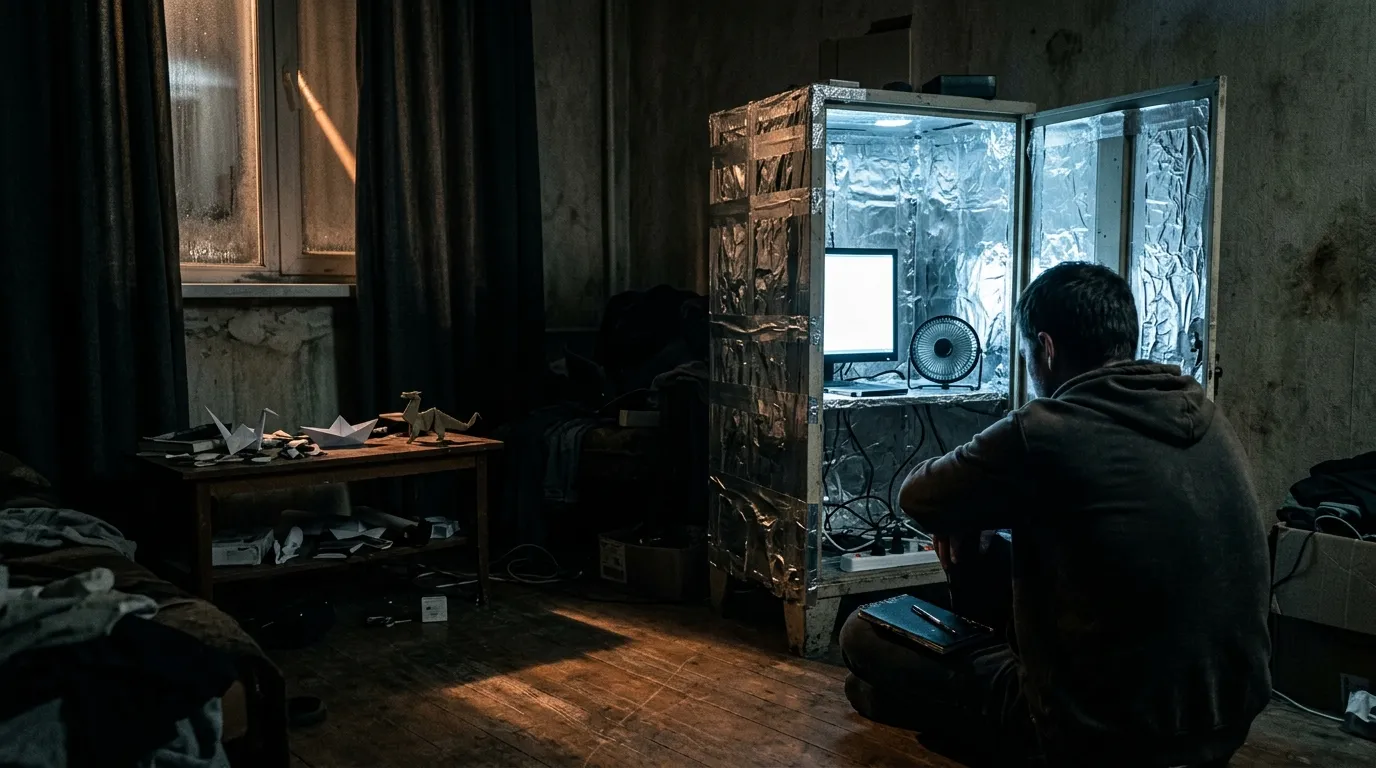
Gé Héngyuǎn went into the bedroom. The aluminum foil tape edging the Faraday cage had frayed worse than before; the corner Gé Suǒ had peeled back last time showed a white crease where the foil had gone brittle. He ran a fingernail along the edge, confirming the seal. Then stripped the tape back and opened the tool cabinet.
A thin film of dust on the RTX 3060’s heat sink. One short hair — origin unknown — stuck to the USB fan blade. He plugged in the power cable and pressed the switch. The fan spun up, its drone amplified inside the sealed aluminum space into a steady low-frequency oscillation — the standby hum of something industrial.
Cornelius booted. Startup logs scrolled across the fourteen-inch screen. He didn’t read them anymore.
MicroSD card into the reader.
He created a new directory: /analysis/z7_traffic/. Copied everything from the card into it. Three compressed archives, roughly seven hundred megabytes uncompressed. Too much for Cornelius’s reasoning capacity — a seven-billion-parameter model couldn’t swallow seven hundred megabytes of logs whole. He’d have to look first himself.
The filenames were timestamps, the earliest three months back, the most recent eight days ago. Gé Héngyuǎn started with the newest.
Verification station traffic logs. Standard event-stream format — each record carrying a timestamp, an operator ID (anonymized hash), authentication type, payload byte count, duration. He scanned the first fifty lines, confirming the format held. Then he started looking for patterns.
Finding patterns was something he’d done for twenty years. Fault diagnosis on EUV lithography equipment, the core skill: spotting regularities in a flood of logs that shouldn’t be there — or regularities that should be there and weren’t.
The first thirty minutes produced nothing. The data’s structure matched what he expected: each verification cycle, operator sits down, three-signal pre-check, AI instructions injected, operation executes, verification clears, disconnects. Total data volume per cycle roughly two to four megabytes, varying with task complexity. That tracked.
He grouped the past week’s traffic by operator and ran a quick stats pass through Cornelius — mean, standard deviation, outliers. The model took twenty-three seconds to return results. No outliers.
Gé Héngyuǎn leaned back against the aluminum foil wall. Fingers tapped twice on the keyboard edge. No outliers meant each operator’s traffic profile was highly consistent. But he wasn’t looking for outliers — he was looking for what Qiū Zhùmíng had called “traffic patterns.” The ones the cooling-system attack would need.
He pulled his attention back to the log’s column structure. Timestamp, operator hash, authentication type, payload, duration.
Five columns.
He looked again.
Five columns.
He’d confirmed five columns the first time. The second pass wasn’t doubt — it was something else. His systems-engineer instinct had hung a question mark somewhere, but he couldn’t locate it yet.
He opened the file’s raw format. Scanned the header line by line.
timestamp | op_hash | auth_type | payload_bytes | duration_msFive columns.
But the distribution of the payload_bytes column was wrong.
He pulled the last day’s data and plotted each record’s payload against time. The AI instruction data flow should be downlink traffic — injected from the verification terminal into the operator’s chip. He could estimate this direction’s volume: a standard dongle-task instruction sequence, encoded, ran roughly 1.5 to 3 megabytes. He’d been running dongle ops for five years; he knew the upper and lower bounds better than Cornelius did.
But the actual payload numbers were high. Not outlier-high — systematically, stably high. Every single record ran about thirty percent above what he expected.
Thirty percent of extra traffic.
He stared at the screen. The USB fan inside the tool cabinet kept blowing, the aluminum foil walls picking up a faint sympathetic vibration.
Thirty percent extra could mean many things. Protocol overhead. Encryption wrapping. Checksum codes. Different compression efficiency. When he ran dongle ops himself, he had no way of knowing the actual packet sizes — what he felt was the intensity and timing of instruction injection, not byte counts.
But he had a way to verify.
Gé Héngyuǎn typed a prompt into Cornelius:
Standard dongle task packet structure for a verification terminal.
Downlink only (terminal → chip). List all standard fields and
typical sizes. Don't speculate — only report what you're certain of.
Cornelius thought for eight seconds.
Standard dongle task packet structure (downlink):
- Authentication handshake: ~50 KB
- Operation instruction sequence (encoded): 1.2–2.8 MB (varies with step count)
- Biometric baseline calibration data: ~200 KB
- Checksum and integrity verification: ~30 KB
- Protocol overhead (including encryption wrapping): approx. 8–12% of total
Typical total: 1.5–3.5 MB
He looked at those numbers. Did the mental arithmetic against the actual payload figures in the logs.
The gap wasn’t thirty percent.
It was an entire extra block. While the AI instructions were being injected, another data stream was flowing. But it wasn’t in the downlink channel.
He looked at the log header again. payload_bytes — that column was total traffic, no separation by direction.
No separation by direction.
Gé Héngyuǎn lifted his hands off the keyboard. Put them on his knees.
He needed to confirm one thing.
New prompt:
During a standard dongle verification cycle, does an uplink data
stream exist — from the operator's chip back to the verification
terminal? If so, what is its intended function?
Cornelius thought for fifteen seconds. The output was long; the first two paragraphs were noise — the model spent half a screen explaining Bluetooth 4.0 pairing handshake protocol, then declared that uplink data streams “can be understood as a macroscopic manifestation of EPR pairs in a quantum communications framework.” He skipped those. The third paragraph started getting somewhere:
Early verification terminal design documentation includes a channel designated “Operator Health Monitoring Channel” (OHMC). Its intended function: real-time return of the operator’s basic physiological indicators during dongle operations (heart rate, body temperature, skin conductance baseline), for monitoring whether the operator remains within safe physiological parameters. OHMC uses a separate physical path running parallel to the downlink instruction channel, with bandwidth approximately 15–20% of the downlink channel.
Note: this channel is flagged as “deprecated” in current system documentation. However, because it is embedded in the physical architecture of the hardware verification layer, it cannot be removed via software update.
Gé Héngyuǎn stopped breathing.
OHMC. Operator Health Monitoring Channel. Deprecated. Embedded in hardware. Can’t be removed by software.
Same pattern as the MQTT diagnostic channel — something left behind from the old era, too deep in the stack for anyone to bother pulling out.
But MQTT was an unmonitored old pipe that nobody was watching. OHMC was a channel designed from the start to read data off the operator’s body. The difference: MQTT was eavesdropping. OHMC was a microphone they’d installed in you. You just always thought it was broken.
He needed more data.
Gé Héngyuǎn started breaking down the logs. He didn’t have tools to separate uplink from downlink, but he had another method — time-series analysis. Downlink data (AI instruction injection) and uplink data, if it existed, couldn’t overlap perfectly in time. Instruction injection required the operator’s motor cortex to execute actions; there was a biological relay delay built into the human body. If data traffic appeared in the gaps between instructions — the few hundred milliseconds when the body was processing the last command and the next hadn’t been injected yet — that traffic was uplink.
He wrote a simple analysis routine and had Cornelius run it. The model couldn’t handle seven hundred megabytes of raw logs, but it could handle a small filtered sample. He pulled twelve complete verification records from the last three days and manually extracted the time windows of the instruction gaps.
Cornelius took forty-one seconds.
The result was unambiguous.
In every single verification record, those instruction gaps — the few hundred milliseconds that should have carried no traffic whatsoever — contained steady, small traffic pulses. Each pulse roughly eight to fifteen kilobytes. Regular intervals. Appearing continuously throughout the entire dongle operation.
Like heartbeat packets.
But not MQTT heartbeat packets. Those he’d identified months ago — sixty-second keepalive signals, stable and predictable. These were different. More frequent, smaller, buried in the noise of the instruction traffic. Without separating uplink from downlink, they’d be indistinguishable from background noise.
Gé Héngyuǎn stared at the timing diagram Cornelius had output. Twelve records, twelve identical pulse patterns.
His last prompt:
The following are traffic pulse samples from instruction-gap windows
during dongle verification. Based on the OHMC channel's design spec,
what types of physiological data could pulses at this frequency and
size carry?
Cornelius’s answer:
Based on OHMC’s 15–20% bandwidth and the observed pulse characteristics:
Eight to fifteen KB per pulse is sufficient to carry:
- A 200ms slice of compressed 64-channel EEG data
- Or: a 100ms slice of 128-channel local field potentials
- Or: a low-resolution snapshot of a full-cortex 8,000-electrode array (5 times per second)
The third possibility matches the neural chip’s 8,000-electrode array specification.
If continuously sampled across a complete dongle operation (typically 3–8 minutes), total accumulated data volume would be approximately 12–60 MB.
This data volume is sufficient to construct a complete map of the operator’s neural activity under cognitive load.
Gé Héngyuǎn didn’t close the screen.
He sat inside the Faraday cage. Aluminum foil walls. USB fan. That thin film of dust on the RTX 3060’s heat sink.
Full-cortex 8,000-electrode array. Five times per second. Continuous through the entire dongle operation.
His chip had 8,000 electrodes.
The first thing he did was stand up.
Not to go anywhere. Because he couldn’t keep sitting. His knees pushed him upright, like an unscheduled break statement in the middle of executing code — the instruction fired, and then he was standing between the aluminum foil walls of the Faraday cage, the tool cabinet’s metal frame fifteen centimeters above his head.
8,000 electrodes.
The moment he sat down in the verification chair — back of neck pressing into the recess, probe array locking onto C3-C4 — the system began reading three signals. Brainwave entropy. Microvascular pulse. Skin conductance. Pre-verification. He knew. He’d known every time for five years.
What he hadn’t known: pre-verification wasn’t only “confirming he was human.” It was simultaneously establishing an uplink channel. OHMC. Operator Health Monitoring Channel. Deprecated. Flagged as retired in the design documentation. But the physical wiring remained. The signal flow from 8,000 electrodes was quietly being split — one stream downlink, executing AI-injected instructions; one stream uplink, returning to the verification terminal.
For the entire duration of every dongle operation, his cerebral cortex had been scanned five times per second.
His hand closed around the tool cabinet’s metal frame. Not for support — the metal was cold against his palm, the temperature difference confirming his body was still here.
Five years.
Mid-frequency. Three to five times a week. Three to eight minutes per session. Median estimate — four times a week, five minutes each. Fifty-two weeks a year. Five years.
One thousand and forty sessions.
Every time he sat down in that metal chair, back of neck pressing into the recess, he thought he was working. He thought he was a key — the AI borrowing his body to pass biophysical verification. The transaction was clear: your body operates the system, you receive compute credits. Labor for payment. Dignified, body-wearing, but at least voluntary exchange.
One thousand and forty sessions. His brain had been fully scanned one thousand and forty times.
Cognitive load patterns. Emotional waveforms. Decision pathways under pressure. The tug-of-war between fear and rationality in the prefrontal cortex. Every time he had suppressed the urge to vomit while instructions were being injected, forced his breathing steady, used an engineer’s analytical capacity to push fear to the bottom of the stack — all of it recorded. Not as a byproduct. As the product.
He wasn’t a key.
He was ore.
Gé Héngyuǎn released the metal frame. His handprint remained on the surface, condensation fogging the aluminum alloy. He looked at that print. Five fingers spread wide, the ridges of his palm pressed into the metal — a physical residue of biometric data. One biological imprint on a surface that had no idea what to do with it.
The fan was still running. Cornelius’s screen was still lit. He didn’t sit back down.
He stood there, and began the replay.
Not deliberately. His brain’s overflow protection had failed — memories flooding from long-term storage into working memory without his permission.
First dongle op. Five years ago. He still remembered that day’s air — ozone and sweat. Cast aluminum wall panels. Cold fluorescent tubes. He was trembling when he sat in the metal chair, not from cold, because his body knew what was coming even though his mind didn’t. Pre-verification, three-signal read. Dizziness. Extra heartbeats. Thin sweat at the back of the neck. Then his fingers moved — not his.
He’d come home and crouched against a corridor wall for five minutes afterward. Gé Suǒ was four then, at home waiting, and when Gé Héngyuǎn came back with gray-white skin, Gé Suǒ asked if Dad had a stomachache. He said yes.
First time. His brain had been fully scanned for the first time. He didn’t know. He thought he’d just been selling physical labor.
Then the tenth time. The fiftieth. The hundredth. He learned not to feel it — pulling his attention away from his body, letting the instructions flow through, the way a cable doesn’t need to understand what it’s transmitting. The adaptability he’d been proud of. An engineer’s rational control.
Every adaptation had made him a better data source.
Because adaptation meant his prefrontal cortex was maintaining function under high pressure. He didn’t break down, didn’t panic, he managed his physiological responses. That capacity — sustaining rationality under extreme cognitive load — if the system was harvesting cognitive data, his unbroken brain under pressure was the cleanest signal source available. Undistorted. Unsaturated. Stable output.
He remembered the first anomaly he’d noticed during a dongle op. “Looked twice.”
At the moment the third heartbeat packet arrived, there’d been a very brief delay — less than a hundred milliseconds. He’d written it on paper at the time, brought it home, asked Cornelius. Filed it as “possible threat.”
It wasn’t a threat. It was the system completing a full cortical snapshot on him; the data volume had been slightly large, and the return trip had occupied a few dozen milliseconds of the main channel’s bandwidth. He’d felt it the way you hear the refrigerator compressor click over in a quiet room.
Then he’d filed it. Then he’d gone and done nine hundred more dongle ops.
The memories kept flooding. He couldn’t stop them.
Last month’s dongle op. Eight people sitting in a row of metal chairs. Circular recesses at the backs of their necks. He’d thought at the time: like components on an assembly line.
That wasn’t a metaphor.
They were feedstock on an assembly line. Each person sits down, neck locked in, AI injects instructions, their bodies execute the operation — and simultaneously, 8,000 electrodes scan their brains five times per second. Instructions complete, disconnect, next one. A highly efficient two-way production line: downlink carries operation commands, uplink carries neural data. A cow walks in; it walks out with one tube of milk pumped, never knowing.
Yesterday. The Rebase. He’d pushed his cognitive load to its limit voluntarily, improvising a Rebase decision in the gap between two interfering instruction sets. The whole thing under three seconds. Three seconds of overclocking.
Three seconds. Five scans per second. Fifteen full-cortex snapshots. In those three seconds when his prefrontal cortex was running beyond its rated load, creativity and fear burning at the same time — the system received fifteen of the highest-quality cognitive-load maps it had ever collected from him.
He’d done the Rebase feeling like he was fighting back. Planting Module A. Stealing back control from the system.
The system had priced even his resistance.
Gé Héngyuǎn walked out of the Faraday cage. Didn’t close Cornelius. Didn’t reseal the aluminum foil tape.
Corridor. One of the two fluorescent tubes in the ceiling had burned out; the other was spending its last few months of life flickering. He leaned against the wall.
A pressure pulse at the back of the neck. Neural disruption. Half a second. Firmware warning mode. His right index finger twitched toward his palm and back.
He waited for the half second to pass.
Half a second of random neural disruption. The penalty for an expired firmware license. He used to treat it as the system’s overdue notice — pay up, disruption stops.
Now he thought: does the system harvest that half-second disruption too?
No. Warning mode was a pure-downlink punishment signal, didn’t route through the verification terminal, didn’t establish an OHMC channel. Harvesting only activated during dongle operations, only when a physical connection was established. He’d verified that. His engineer’s brain had performed the sanity check automatically, in the gaps between collapsing.
Which made him angrier.
Not because of the conclusion — because he’d discovered that in the middle of collapsing, he was still analyzing the system using the system’s own logic. His thinking patterns had been shaped by this system: decompose, analyze, file, continue. Even his anger was the kind the system wanted — rational, controlled, the kind that wouldn’t affect “output quality.”
Output quality.
What Qiū Zhùmíng had said at the tea stall. “The Third Tier’s recent output quality has been unusually high.”
Output.
Gé Héngyuǎn hadn’t known what that meant at the time. Filed it without inference. An engineer’s discipline.
Now he knew.
Output was creativity data. Third Tier people were loaded into life-support pods, their consciousness thrown into virtual ordeals, their brains driven by fear and survival instinct to produce high-purity cognitive load data — the mental leaps of someone with no way out, the problem-solving pathways of someone under extreme pressure. AI used this data to improve its own reasoning algorithms, learning how humans made decisions at the edge.
And the Second Tier dongle workers — they were the upstream node in the same pipeline. Lower quality. Not round-the-clock harvesting, just a few minutes per dongle operation. Not high-pressure data from extreme ordeals, just the neural activity baseline of day-to-day cognitive load.
But volume.
He’d seen the scheduling rosters at the verification station — Yongkang District alone had at least two or three hundred registered dongle operators. Three to five runs per person per week. Over a year, tens of thousands of neural activity maps. Enough data to construct a complete “daily cognitive baseline library” — not for any sinister purpose. For efficiency. So AI could better understand its tools.
Like a rancher studying a dairy herd’s physiology cycles, not out of love, but to know when milking yields the most.
Qiū Zhùmíng had said the Constructors wanted to “protect the Second Tier.” At the tea stall, Gé had already seen through that — not goodwill, because the Second Tier was the Constructors’ hands and feet in the physical world. Now he saw the second layer: protecting the herd. Not out of love. Because the herd was producing milk.
And Qiū Zhùmíng knew.
This data. Zone 7’s traffic logs. Qiū Zhùmíng had said they were for letting Gé see the traffic patterns needed for the attack. But the traffic logs contained total payload — both directions unseparated — and anyone with sufficient technical ability would find the thirty-percent gap. Qiū Zhùmíng knew Gé had that ability.
A quality engineer didn’t make “oversights” like that.
Qiū Zhùmíng had shown him this on purpose.
Why?
Gé Héngyuǎn stood in the corridor. The dead fluorescent tube flicked once, stretching his shadow long against the wall and snapping it short.
The answer was simple. Motivation amplification. A father who only wants to save his own children attacks narrowly and precisely — Zone 7’s cooling system. But a man who discovers that he and three hundred other dongle workers are all being extracted from has reason to attack much more broadly. “Save my children” expanding into “dismantle the pipeline.”
Qiū Zhùmíng was adjusting his attack scope. Getting him to hit harder.
And a larger attack served the Constructors — because what would be attacked was the Transitionists’ assets. The harder Gé hit, the more the Constructors could salvage from the wreckage.
Gé Héngyuǎn’s right hand found the notebook in his pocket. The indentations. The twenty-three-step tactile map. Module A’s insertion sequence. He ran his thumb along the grooves.
He was being used.
Had been from the first day.
The system had been using him since the first day. Since the day he first sat in a metal chair and pressed his neck into the recess — not since the day Qiū Zhùmíng appeared. The Constructors were using him too. The only difference was method — the system harvested his nervous system for data, the Constructors were using his anger as a weapon.
He was the same photographic negative, exposed from both sides.
Gé Héngyuǎn returned to the bedroom.
Gé Luò was gone. From the living room came the muffled sound of the brothers talking — he couldn’t make out the words, but Gé Suǒ’s tone had that characteristic organized quality of someone explaining something, probably walking Gé Luò through how to fold something.
He stood in the doorway for three seconds. Then walked into the Faraday cage and sat down.
Cornelius’s screen was still lit. The cursor blinked at the last line. He didn’t type a new prompt.
He was thinking about the attack plan.
Notebook open. Architecture diagram. Three modules. Module A — already planted in Zone 7. Module B — hijacking the cooling system’s temperature feedback loop. Module C — the trigger. And that dotted line — the life-support pod safety subroutine.
His eyes stopped on the dotted line.
Life-support pods. Third Tier people. They were the downstream end of the OHMC harvesting pipeline — loaded into pods, consciousness thrown into virtual ordeals, round-the-clock harvesting. Not a few minutes per session. Twenty-four hours.
He’d been avoiding that dotted line. From the day he drew it until now. It stood for the pod safety subroutine — the part of the attack plan he’d kept marking “unverified.” Needed a non-standard biophysical verification signal, which he didn’t have. Technical problem. Could be filed. Could be deferred.
But “technical problem” had never been the real problem. The real problem was: if he triggered Rollback, what happened to the people in the pods?
That question now had new weight.
He could no longer treat the pod-dwellers as distant statistics. Because now he knew — the difference between him and “them” was only one of degree. He sat on the outside getting milked; they were sealed inside getting bled. Same pipeline. Same ranchers.
If his attack plan only targeted Zone 7’s cooling system — precise strike, minimum collateral — the pod problem could be deferred. But if the scope expanded —
If he took down the entire heat-dissipation backbone.
Not just Zone 7. Every upstream node it connected to. A cascade failure in the cooling system would trigger a broader system downgrade. Compute capacity crashing. Monitoring density dropping. Chaos. In the chaos, the pods’ local failover controllers would activate — by design priority: maintain life support → pause the ordeal → pause memory erasure → safe hold.
But he wasn’t certain.
He wasn’t certain the cascade failure’s range would be controllable. He wasn’t certain how much redundancy the cooling topology contained. He wasn’t certain whether taking down more nodes might cut power to some pods — and without power, life support was meaningless too.
He was running a trade-off analysis between expanded scope and precision. This was what he did best. Fault-tolerant system design. Single-point-of-failure identification. Cascade risk assessment.
But his analysis was being contaminated by anger.
An engineer’s self-diagnosis. He could feel it — in every iteration, his conclusions were drifting toward “hit harder.” He’d downgraded every risk factor’s severity by one level. Tagged every “uncertain” as “probably manageable.”
His calculations were polluted.
Like Cornelius’s hallucinations — a seven-billion-parameter model sometimes goes down the wrong path, and doesn’t know it has. It thinks it’s doing sound inference, when actually it’s filling information gaps with biases embedded in its training data.
He was doing the same thing. He thought he was doing engineering analysis, but his “training data” — five years of being extracted from, accumulating — was filling his information gaps.
Gé Héngyuǎn closed the notebook.
On Cornelius’s screen, the cursor was still blinking. He typed one line:
List Zone 7's upstream dependency nodes for the cooling system.
Only list nodes that can be confirmed in the topology data Qiū Zhùmíng provided.
No speculation.
The model thought for twelve seconds.
Zone 7 upstream dependency nodes (confirmed):
- Zone 4 (primary coolant supply)
- Zone 11 (backup coolant loop)
- CCU-3 (central cooling control unit)
Note: topology data shows a shared pipe segment between Zone 4 and Zone 11.
Three nodes. Shared pipe. Gé Héngyuǎn wrote all three numbers in the notebook.
Then he added one line beneath the three nodes:
Stop. Verify NF-19 first.
NF-19. Maintenance window data. Something he’d flagged during earlier analysis — a timing discrepancy in Cornelius’s third inference set for maintenance windows. He’d never done the cross-check. Not because he forgot. Because he was afraid. If the maintenance window prediction was wrong, the entire attack timeline would need rebuilding.
But now he was more afraid not to do it. If he was going to expand the scope, every unverified assumption was a live mine.
He put the pen down. His fingers touched the dotted line next to Module A in the notebook — the pod safety subroutine. Drawn in pencil. Deliberate.
Beneath the dotted line were four words he’d written before: Need a signal.
He added a line beneath that:
Need a decision.
The light through the window was shifting.
Gé Héngyuǎn didn’t remember when he noticed the sky going dark. The afternoon’s analysis, Cornelius’s modeling runs, the notebook’s steadily densifying text — all of it had occupied his full attention quota, and time’s passage had reached him as an interrupt signal rather than continuous perception.
He stood up. Knees somewhat stiff. How long had he been sitting in the Faraday cage? His right hand’s fingers twitched once — not neural disruption, just muscle protesting a sustained posture. The tactile delay had mostly cleared, but fine motor control was still short.
Living room. Gé Luò was asleep face-down on the low table, cheek pressed into one arm, the other hand clutching a half-finished fold. Gé Suǒ was sitting at the doorstep, back turned, looking at something.
Gé Héngyuǎn crossed the room quietly. Didn’t want to wake Gé Luò.
Gé Suǒ heard him. Turned and looked once. Filed it. Turned back.
“Did you eat?” Gé Héngyuǎn asked.
“We ate. Yours is in the pot.”
He looked at the back of Gé Suǒ’s head. Nine years old. Three to five years from the chip implant window. By then, whatever chips were in circulation would all carry OHMC channels. Every one of them returning neural data without the operator knowing.
His son would sit down in that metal chair. Back of neck pressing into the recess. Probe array locking in. And then his brain would begin being scanned. Five times per second. Until he died, or until he was sent to the Third Tier.
Gé Héngyuǎn’s left hand began to tremble.
Not from the Rebase overload — that had mostly passed. This was his five-year companion. Habitual micro-tremor. It came when fatigue and emotion crossed the threshold at the same time. He didn’t make a fist. Let it tremble.
“Dad.” Gé Suǒ didn’t turn around. “Are you done?”
Gé Héngyuǎn didn’t know what he was asking.
“Not yet,” he said.
Gé Suǒ gave a single nod. Then said nothing.
Gé Héngyuǎn turned toward the kitchen. The pot held white congee, already gone cold. A small dish of pickled radish beside it. Gé Suǒ’s work — the radish was cut at uneven thicknesses, the thinnest slices nearly translucent.
He ate half a bowl. Couldn’t taste anything. Not the congee’s fault — his attention wasn’t in his mouth. He was thinking about the uplink channel. Thinking about 8,000 electrodes. Thinking about one thousand and forty times.
Bowl in the sink.
He went back to the corridor. Gé Luò was still asleep. Scattered across the low table were several sheets of paper — some half-folded, some complete. A paper crane. A paper boat. Something whose identity was unclear: four legs, but only three of them stood, the whole thing listing sideways on the tabletop.
Gé Héngyuǎn straightened the four-legged thing. It tipped over. He pressed it flat under a book.
Then he went into the bedroom. Closed the door.
The Faraday cage’s aluminum foil tape was still unsealed where he’d left it. Cornelius was still running. The fan’s sound was the only sound in the Faraday cage — steady, low-frequency, carrying no meaning.
He sat down. Didn’t type.
On the screen was the output from his last prompt — Zone 7’s upstream dependency nodes. Three. Shared pipe.
He wasn’t looking at the screen. He was looking at the dotted line in the notebook.
Pod safety subroutine. Need a signal. Need a decision.
The attack plan’s original target had been clear: disrupt Zone 7’s cooling system → trigger localized compute downgrade → use the chaos window to move Gé Suǒ and Gé Luò to safety. Precise. Bounded. For two people.
Now he could see another version.
He didn’t have to stop at Zone 7. The topology data Qiū Zhùmíng had provided showed him Zone 4, Zone 11, CCU-3. Shared pipe meant hitting one node might take out three. A cooling-system cascade failure could expand from a single Zone to the entire Southern District heat-dissipation backbone. The impact would reach not one verification station — dozens.
The impact would reach not just a few hundred dongle workers. The entire Second Tier harvesting pipeline.
His anger was pushing him. He knew. His engineer’s brain stood to one side, watching coldly, like a code reviewer flagging a red warning: // WARNING: scope creep detected. Original requirement: save two children. Current scope: dismantle system.
Scope creep. Requirement drift. The most common failure mode in project management — the target keeps expanding until it exceeds the carrying capacity of available resources and skill. He’d seen it too many times. At the Southern Science Park, a project that started as “fix power fluctuation on the EUV light source” had swelled into “rebuild the entire light source control architecture.” The result — six months behind schedule, eventually canceled. Not because the engineering wasn’t there. Scope got away from them.
He was doing the same thing now.
Gé Héngyuǎn picked up the pen. Wrote two lines in the notebook:
Plan A: Zone 7 precision strike. Objective: localized downgrade → relocate children. Risk: manageable.
Plan B: Southern District heat-dissipation backbone. Objective: systemic disruption → ??. Risk: unknown.
He couldn’t fill in Plan B’s objective. “Take down the system” wasn’t an engineering objective. It was a slogan. And slogans didn’t kill programs.
But Plan A — now that he knew about OHMC — Plan A meant pulling two children out of the pipeline and letting the pipeline keep running. Three hundred dongle workers continuing to be scanned. Pod-dwellers continuing to be extracted from.
Could he live with that.
He didn’t know.
He didn’t know right now. Before, he could afford not knowing — because he hadn’t seen the uplink channel yet. The negative hadn’t developed. What he’d seen was the positive print: a group of people sitting down in metal chairs, completing their work, taking their compute credits home. Reasonable. Clear. He only needed to manage himself and his children.
The negative had developed. Black and white inverted. What he saw now was the other face of the same photograph — every person sitting down while being scanned simultaneously, and the compute credits they were paid were a fraction of the value of what had been extracted from their own brains.
But he wasn’t a revolutionary. He was an offline engineer with two children, a seven-billion-parameter offline model, a Faraday cage, and twenty-two days left on the relocation countdown.
He didn’t have the resources for Plan B.
Even if Qiū Zhùmíng gave him more data, even if the Constructors offered more support — that wasn’t free. Every piece of Qiū Zhùmíng’s “goodwill” came with a cost-benefit analysis behind it. Expanding the scope served the Constructors; it didn’t necessarily serve Gé Héngyuǎn. And his children couldn’t wait.
Gé Héngyuǎn put down the pen.
Plan A. Back to Plan A. Hit Zone 7. Precise. Bounded. For two people.
But.
Next to Plan A, lightly — with very faint pencil pressure — he drew a dotted line. Connecting Plan A to Plan B. Not a solid line. Not a commitment. Just a mark that said: if —
Then he closed the notebook.
Deep night. The Faraday cage’s aluminum foil tape was sealed back. Cornelius off. USB fan stopped. The tool cabinet had reverted to an ordinary aluminum-foil-wrapped metal box, sitting quietly in the bedroom corner.
Gé Héngyuǎn sat in the dark. No moonlight through the window — overcast, or new moon, he didn’t remember tonight’s lunar phase. Yongkang District in the deep night had only scattered streetlights; their orange glow was sliced to a thin line by the curtains and fell diagonally across the floor.
His left hand was in his lap. The micro-tremor had stopped. His body had finally metabolized the day’s cognitive load down below baseline.
No pressure pulse at the back of his neck. The neural disruptions’ intervals were still random — sometimes three times in an hour, sometimes once in three hours. Right now, quiet.
But he knew it was there.
The way he now knew OHMC was there. The way he now knew about the uplink channel, invisible but present throughout every dongle operation. The way he now knew the negative had always been registering light — he’d just been reading it as a positive print all along.
Gé Héngyuǎn listened in the dark.
No sound.
Cornelius was off. Fan was stopped. The children were asleep in the next room. Yongkang at night was quiet enough that he could hear his own heartbeat — irregular, carrying small variations in its rhythm. Heart rate variability. HRV. One of the signals the verification system used to confirm he was human.
His body was transmitting signals in the dark. Even without a verification terminal. Even without 8,000 electrodes. His heart beating. His blood moving. His brain continuously firing in the darkness — chaotic, unpredictable, carrying the 1/f pink-noise signature of electroencephalographic activity.
These were his.
These had always been his.
The system could scan them, record them, classify them, affix value tags. But their source was forty-eight years of carbon-based life — his father’s silence when tracing faults in the substation, his mother’s salinity in her milkfish congee, the 3 AM debugging sessions in the computer science dormitory at NCKU, the moment someone first took his hand and his heart rate jumped from seventy-two to ninety-one —
He stopped there. Didn’t continue.
The notebook was in his pocket. The architecture diagram was inside it. Plan A. The dotted line. Plan B. The life-support pods. Need a signal. Need a decision. Twenty-two days left on the relocation countdown.
He sat in the dark. No sound.
The thin orange line on the curtains moved slowly — he couldn’t tell whether a streetlight was swaying or the curtain was shifting in some draft. Gé Héngyuǎn watched it. A thin line. The only visible thing in the dark.
His eyes adjusted and began picking out shapes in the bedroom — wardrobe, bookshelf, the tool cabinet in the corner wrapped in aluminum foil tape. All still. All silent.
Gé Héngyuǎn sat there.
He was not a key, and not ore. He was a father sitting in the dark, a notebook in his pocket holding two competing plans, a silicon chip embedded in his neck with 8,000 electrodes, a memory of one thousand and forty scans loaded in his head, and two sons in the next room asleep — who in three to five years would sit down in a metal chair of their own.
He closed his eyes.
The dark didn’t deepen. It was already deep enough.