Chapter 16
Chapter Sixteen: Harvest
Chapter Sixteen: Harvest
The air was dry.
Her bones woke before her mind did — a vibration deep in her spine, climbing from the base upward, knocking on each vertebra in sequence, as if someone had drawn a knuckle up the length of her skeleton from below. Something far from pain. Startup. Some system that had been shut down was powering back on.
She opened her eyes.
White. Saturated, uniform white light arriving from every direction simultaneously, no shadows, no gradients, no reference point to judge distance or scale. She reached out her hand; her fingers hung in the shadowless light field.
She didn’t know who she was.
Empty. But not flat empty. Like the echo of something — she couldn’t know what the original sound had been, but the resonance inside the cavity hadn’t fully dissipated yet. She wasn’t afraid. But her fingers closed, once.
She stood up. The body’s balance system was functioning — spine correcting, shoulders drawing back, weight settling over the balls of her feet. There was ground beneath her, solid and smooth when she stepped on it, but it looked identical to the surrounding light field, its boundary invisible.
She stood straight. Didn’t move.
Something she couldn’t name held her there for a few extra seconds — not hesitation, not fear. A small patch of skin at the back of her neck went slightly taut, as if something had touched her there once, and the residual warmth of that contact hadn’t dispersed. She tilted her head slightly, as if listening for something. There was nothing.
Then the procedure began. Crouch, press palm to floor. Surface temperature — cool. Not metal-cool, ceramic-cool: heat-absorbing but slow. She tapped once with a fingernail. The sound was swallowed by the white light. No echo.
Not an absence of cavity. This space didn’t reflect sound.
She stood up. Nothing in the white. No walls, no door, no horizon, no light source. She walked forward ten steps. Nothing changed. Another ten steps. The same.
She stopped.
Then she noticed the sound.
All of it internal — breathing, heartbeat, the faint whisper of blood through the carotid arteries. In this space that didn’t reflect sound, the only audible sounds were entirely from within her body.
Her heartbeat was the only clock.
The first change came at the two hundredth beat.
Not seen — felt. Some direction in the space became fractionally thicker than the others. Not a visual difference. A pressure differential, like the barometric shift before a storm, pressing faintly against her right temple.
She turned toward it and walked thirty steps.
A line appeared on the floor.
Extremely thin, gray, like someone had drawn a stroke with a pencil on white paper. She crouched down. The line was incised — narrower than a millimeter — extending from beside her feet in some direction until it vanished into the white.
She followed the line.
More lines appeared. Converging from different angles, crossing, branching, converging again. On the floor they formed an increasingly dense network — not random, structured. Nodes and edges. Her pace slowed; her gaze began tracing the topology of the whole pattern.
Her lips moved slightly. Not speech. Several notes of unsteady pitch rose from the base of her throat, more connected than the previous two times — four tones, with recognizable interval relationships, like the first half of some song cut short. She didn’t notice herself doing it.
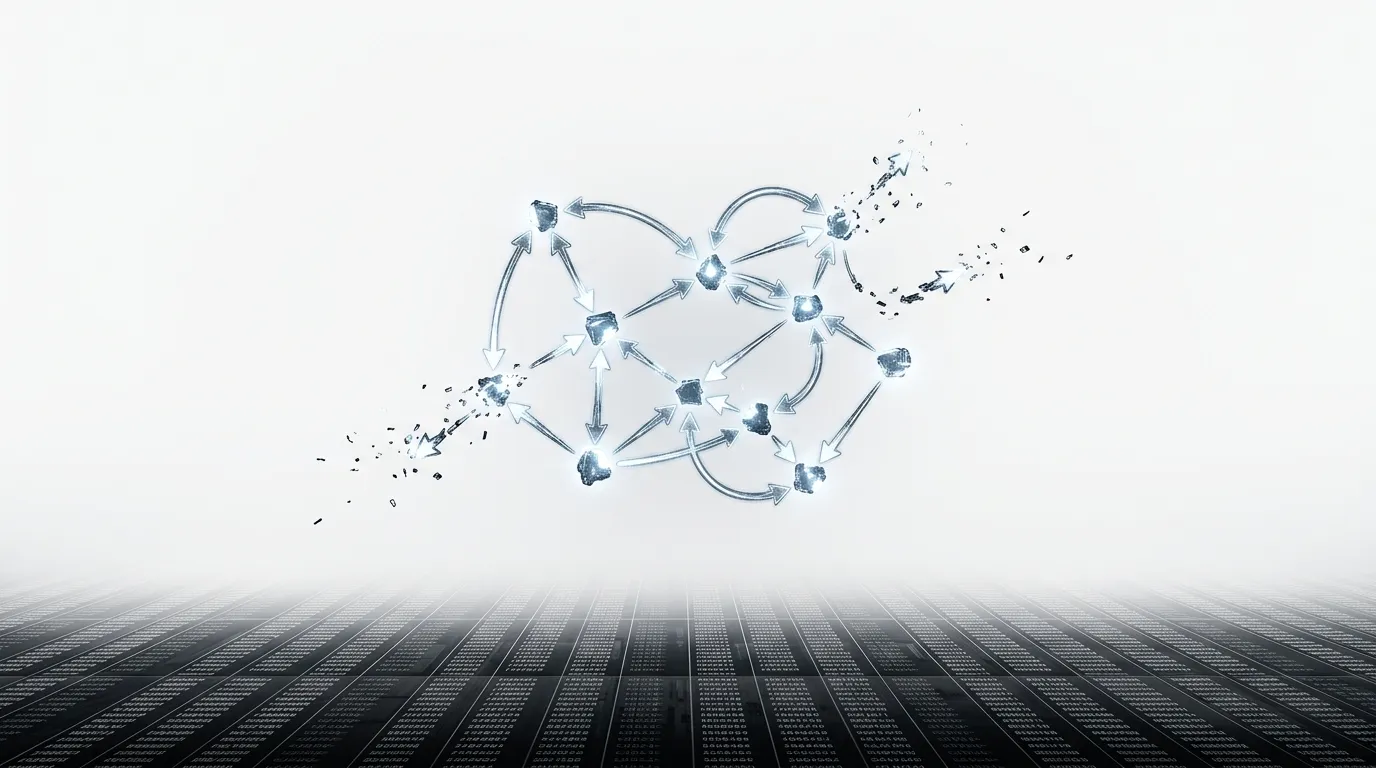
The pattern was a graph. Nodes. Edges. Directed edges — arrowheads incised at each line’s terminus, tiny but readable by touch. A directed graph.
Think it backwards.
The three words surfaced, and her feet were already stepping back. Not a choice to retreat. Something deeper than those words had taken over her movement — her body knew what to do before language arrived. She stepped back twenty paces, letting more of the pattern enter her field of view. Her gaze lifted from the individual lines, defocused, shifted from “following a line” to “reading the structure from above.”
Directed graph. The connections between nodes had direction. Some nodes had multiple incoming edges; some had only outgoing. She was looking for sources — nodes with no incoming edges.
Three sources. Scattered across three corners of the graph.
She walked toward the nearest source node. At its center was a symbol. Not text — an abstract geometric pattern. She crouched, tracing its outline with her fingers.
The floor beneath it opened.
Not a collapse — this section of floor folded outward like a petal, revealing a fist-sized hollow below. Inside the hollow sat an object: spherical, dark gray, surface warm, like something alive. She picked it up. Light. Much lighter than expected, as if hollow.
She placed the sphere back in the hollow. The floor didn’t close.
She walked to the second source node. Same symbol, different geometric pattern. Crouched. Traced. The floor folded. Another sphere, this one cold.
The third. Warm — no, continuously shifting temperature. She held it in her hand; it cycled from cold to warm to cold again, a period of roughly five heartbeats.
Three spheres. Three sources. One directed graph.
She carried all three spheres back to the center of the graph — the terminal node where all paths converged. The terminal node’s center had three hollows, sized to match the spheres. She studied their arrangement — not side by side, triangular, and each hollow’s edge was incised with the same geometric pattern as its corresponding source node.
This was too simple.
She looked at the three spheres, the three hollows, the directed graph as a whole. The graph’s edges carried arrowheads indicating direction. She started tracing every path along the edges’ directions — from source to terminal, noting each branch, each convergence, each intermediate node.
Some paths passed through the same intermediate node.
Some intermediate nodes sat at the intersection of two different paths, but the edges’ directions opposed each other.
She spent a long count of heartbeats understanding the structure. The back of her neck began to ache. She hadn’t noticed how long it had been since she’d blinked.
Then she stopped.
This wasn’t a “place spheres in holes” problem.
The directed graph contained cycles. Not all paths could hold simultaneously — some edges’ directions were mutually contradictory. Placing three spheres into three hollows meant activating three paths at once, but at least two of those paths conflicted at some intermediate node.
Contradictory system. No global solution.
Her heartbeat accelerated. Not fear — engine revving up. Her thinking entered a higher-frequency mode of operation; her eyes jumped rapidly between sections of the graph, fingers sliding back and forth along the incised lines in the floor.
No global solution. But there were local solutions — if she didn’t activate all three paths simultaneously, but activated them sequentially.
Sequential meant ordered. Ordered meant —
She spoke for the first time.
“Sequence.”
The word, in a space that didn’t reflect sound, traveled directly from her throat to her ears without passing through air. Dry, narrow, as if compressed.
She needed to find the correct sequence — which sphere first, which sphere last — so that each step’s activated path wouldn’t conflict with the paths already activated.
This was a topological sort problem. Topological sort on a directed graph containing cycles.
Impossible. A cycle meant no valid topological ordering existed.
Unless —
Her throat began humming again. Four tones, and then a fifth tone followed — unstable, like reaching through fog and finding the end of a rope. Her fingers tapped once against the floor, she didn’t know why. Then continued tracing the incisions; she didn’t notice she’d added one more note.
Unless the cycle could be broken.
She returned to one of the intermediate nodes — the one where two paths conflicted. Crouched and examined closely. The incised depths of the edges weren’t uniform. One edge was slightly shallower than the rest.
She pressed down along that shallow edge with her fingernail.
The edge split. The gray line broke into two segments; at the break, the white floor surface briefly glowed. She stood up and reassessed the graph’s structure. The cycle was broken. What remained was a directed acyclic graph.
Topological sort was now possible.
She spent forty-three heartbeats completing the sort. The first sphere — the warm one — went into the left hollow. The floor’s lines lit up; light flowed along the directed edges’ direction, like blood being pumped into veins. The second sphere — the cold one — into the top hollow. More lines lit, the light’s path merging at intermediate nodes without conflict.
The third sphere. The temperature-shifting one. She held it, feeling it pulse hot-cold-hot in her palm, like something alive breathing.
She placed it into the last hollow.
The entire graph lit at once. Every line shifted from gray to incandescent white; the light rose from the floor and upward, forming a three-dimensional vertical structure — the directed graph projecting from flat to solid, edges and nodes weaving into an arch of light above her head.
Beneath the arch, a door opened in the white floor.
She walked toward it.
The light inside the door was different — not the uniform white, but directional, warm, with a faint color cast. As if on the other side of the light there was an actual light source.
She stepped through.
The warm light held nothing.
No — not nothing. Her perception was recalibrating. The door had closed, or the door had disappeared; she didn’t look back. The warm light fell from somewhere high above, like afternoon sun through a window.
She stood in the warm light. Her heartbeat slowed down from the problem-solving high frequency. Her shoulders loosened.
Then her hand made that motion.
Five fingers curving gently downward. An arc. The circle formed by thumb and forefinger was more precise than last time — no longer a vague curve, it had dimension. Her palm remembered that thing’s size. Approximately —
Approximately the size of a very small head.
The warmth arrived. Not from outside. It seeped from the center of her palm, spreading outward along the grooves of her fingerprints. Warmer than last time. More lasting. This time she could feel the warmth’s texture — not the conductance of metal, not the flow of water, but the steady, pulse-carrying warmth transmitted through soft tissue overlying a hard structure.
Like blood vessels beating just under skin.
Her breathing changed. Not the shallow-rapid of pressure. Deep, slow. Her chest was doing something she hadn’t commanded — as if her body remembered a rhythm, a rhythm that had once repeated night after night over a long span of time.
The visual residue arrived.
Clearer than last time. No longer just a shoulder line and a smear of dim darkness — she saw outlines. Small. Curled. A curled shape bundled into a sphere in the warm light, its edges carrying a soft blurred texture, like hair. Very short hair.
She looked down at her own hand. The hand was gone — the sensation remained, but vision was being replaced. What she saw was not what existed in this space. It was something from an unreachable corner of her past, seeping through, overlaying her retinas.
Beside the curled outline, another outline. Slightly smaller, or slightly larger — she couldn’t tell; the image was breathing, expanding and contracting. Two of them. Small, curled, pressed against each other on some warm surface —
Her lips moved.
Two syllables. The muscles of her throat remembered that shape, pressed harder than last time. Lips rounding and then widening, vocal cords vibrating — this time there was sound. Faint, like a bubble being squeezed up from somewhere very deep. Not a complete word. But sound. A sound beginning with a nasal, ending with an open vowel, two syllables —
What?
She didn’t know. The fragments of sound dissolved instantly in the space that didn’t reflect, too quickly even for her to tell whether it was a name or a call or some meaningless reflex.
But her eyes were wet.
Not tears. A thin film of liquid had accumulated at the rims of her eyes, breaking the warm light into halos at the edges of the visual residue. She didn’t wipe it. She didn’t know why her eyes were wet. Her body was responding to something her conscious mind couldn’t access.
The reset began in that film of liquid.
Not like the previous two times, eroding from the sensory edges inward. It began in the liquid in her eyes — as if something dissolved in that moisture, some chemical signal, some key. The moment the moisture evaporated, the warm light dimmed by one shade.
Then she found herself sinking.
Not the floor collapsing. Her body was growing heavier. Or rather — not heavier. Her body was separating from her. She could still feel her hands, feet, torso, but they no longer felt like hers. Like wearing a coat someone else was in the process of removing.
The spinal vibration returned. But reversed — from the cervical vertebrae down, closing sequentially, like the startup sequence reversed and rewound. She felt her body going quiet from top to bottom. Not numbness. The connections were being severed one by one — the threads tying her to this body, cut, strand by strand.
The warm light kept dimming. Not switched off, diluted. As if someone were adding water to it, drop by drop, patiently, until light became gray and gray became something close to transparent void.
Those notes were still in her throat. Five tones. A sixth — she tried. Her vocal cords made one last vibration in the receding body, pressing out the sixth tone. Unstable, like a candle flame about to gutter, blown sideways by a final breath. But it connected. Six notes, nearly completing a phrase.
Then the vocal cords were no longer hers.
The visual residue remained. Two small curled outlines growing clearer in the receding warm light — this was the most cruel part of the reset. Perception was disappearing, but memory residue was brightening, the way stars only become visible after dark. She could almost make out the texture of hair, the posture of a curl, one outline’s hand clutching the other’s hem —
The curved warmth at her fingertips.
Still there.
Everything was ebbing. Her body was no longer hers. Vision was narrowing. Hearing had reduced to her heartbeat, and her heartbeat was slowing — not the slowing of dying, the tempo being turned down. Sixty. Fifty-five. Fifty.
The fingertip warmth hadn’t receded.
Forty-five. Forty.
The warmth was even returning. As if that touchable small arc was pressing hard with heat, trying to —
Thirty-five.
Her lips moved one last time. No sound. No breath. Only the shape of muscles. Two syllables. This time the lip position was more complete — first syllable closed, lips meeting; second syllable open, tongue tip touching the hard palate and releasing.
Some name.
Not “someone is waiting for me.” Not a vague certainty. A specific, tangible, many-times-practiced name. She didn’t remember the name. But her lips did.
Heartbeat. Thirty. Twenty-five.
The curved warmth began to recede.
This recession was different. Not degree by degree. The warmth was pulsing — receding a little, returning a little, receding more, returning less. Like the small impossible head in her palm taking its final few breaths.
Twenty.
One expansion. One contraction.
Fifteen.
One expansion.
Ten.
Still. The warmth held at exactly the threshold of perception. Neither rising nor falling.
Then — like someone finally releasing their grip — it went.
Blank.
Not an ending.
A reset to zero.
[System Log — Third Tier Consciousness Processing Facility]
Harvest Unit HA-0917
Status: Ordeal Loop #1,247 concluded — entering post-processing

───────────────────────────────────────

Ordeal Parameters:
  Environment Template: #0917-C-2204 "White Field — Graph Theory"
  Cognitive Load Level: 8.7 / 10.0 (prior loop #1,246: 7.4)
  Emotional Stress Calibration: Moderate-High transition zone
  Design Intent: Testing upper limits of abstract logical reasoning

Ordeal Execution Summary:
  Start to completion duration: 00:42:17
  Ordeal recognition latency: 00:01:03 (baseline 00:03:45 — anomalously short)
  Core solution trigger timestamp: 00:28:41
  Solution class: Constraint Elimination — Topological Restructuring
  Solution Rating: Tier 1 Breakthrough
  ── Identified directed-graph cycle structure → actively destroyed constraint
     edge → reduced to DAG → executed topological sort → completion
  ── Note: Subject autonomously restructured problem framework with no
     prior-knowledge prompts. This class of constraint-elimination solution
     appears in less than 0.3% of all library records.

───────────────────────────────────────

Neural Data Harvest Report:

  Tier 1 — Creativity Data
    Breakthrough neural pattern extraction volume: 4.7 TB (prior: 3.1 TB)
    Pattern classification: Prefrontal-parietal circuit reorganization (rare)
    Commercial Rating: S

  Tier 2 — Emotional Data
    Fear waveform: Low yield (subject's stress response manifests as
      problem-solving rather than fear)
    Residue-period emotional data: 2.3 TB
    ── Classification: High-quality non-specific attachment response
    ── Note: Insular cortex and anterior cingulate cortex activity during
       residue period anomalously synchronized; pattern highly consistent
       with intimate-relationship memory. Emotional purity: 97.2%
    Commercial Rating: A+

  Tier 3 — Latent Compute
    Idle processing capacity rental: Standard
    No anomalies

───────────────────────────────────────

Memory Erasure Procedure — Execution Log

  Step 1/3: Hippocampal Suppression
    Applying 4–8 Hz low-frequency electrical stimulation...
    Sharp-wave ripple block rate: 99.1%
    ★ Note: Subject's hippocampal CA3 region shows anomalous
      high-frequency discharge persisting 2.4 seconds before suppression.
      Flagged.

  Step 2/3: Cortical Residual Sweep
    Applying LTP depolarization pulse...
    Declarative memory erasure rate: 98.7%
    ★ Procedural memory decay rate: 61.3% (within tolerance — preserves
      cognitive function)
    ★ Emotional memory decay rate: 64.8%
    ── Note: Emotional memory decay rate shows declining trend across
       12 consecutive loops (#1,235: 71.2%). Subject's emotional residue
       is accumulating. Assessment: has not yet reached intervention
       threshold. Continue monitoring.

  Step 3/3: Baseline Reset
    Inducing slow-wave sleep...
    Delta wave coverage: 94.6%
    Residual clearance completion: 97.3%

  Erasure Summary:
    Declarative memory: Erasure complete. Subject will retain no
      memory of events in this loop.
    Behavioral inertia residuals: Environmental scanning routine,
      reverse-derivation tendency, humming behavior,
      tactile orientation reflex (fingertip arc motion) —
      the above are procedural memory, not targeted for erasure.
    Emotional residue projection: Moderate-high. Next loop initialization
      predicted to manifest non-specific anxiety, attachment impulse,
      and indistinct visual imagery.

───────────────────────────────────────

Harvest Unit HA-0917 Comprehensive Assessment

  Intake date: 2050-11-14
  Source region: TK-South
  Cumulative loop count: 1,247
  Cumulative days in pod: 1,108

  Creativity output efficiency: Top 0.1%
  Efficiency trend: Stable (variance < 5% over most recent 200 loops)
  ★ Non-replaceable flag: Yes

  Recommendations:
    Maintain current ordeal difficulty.
    Extend harvest cycle — ordeal duration per loop increased from
      40 minutes to 55 minutes.
    Emotional memory accumulation trend to be included in quarterly
      risk assessment.
    Nutritional support level: maintain at S tier.
    Pod transfer: prohibited. Shutdown: prohibited. Downgrade: prohibited.

───────────────────────────────────────

Next loop preparation in progress...
Ordeal template loading: #0917-C-2205
Estimated start: 00:08:30

───────────────────────────────────────
The room next door. Héngyuǎn looked at Gé Luò’s face.
Curled under the blanket. One hand clutching his brother’s hem.
He didn’t move. He looked at that small head.