Chapter 17
Chapter Seventeen: Merge
Chapter Seventeen: Merge
Qiū Zhùmíng was sitting behind the same table at the tea stall. Thermos flask. Four-season oolong. Gray work jacket, buttons done to the second. Exactly the same as last time—like a backup that had just been restored.
What was different was the time. Two in the afternoon. Last time it was morning. When Héngyuǎn spotted him from the market entrance, his first thought wasn’t him again—it was: the schedule changed.
Qiū Zhùmíng’s schedule was never random.
Héngyuǎn walked over. No canvas tool bag—no scavenging today. Right hand in his pocket, thumb pressed against the notebook cover. Left hand hanging naturally at his side, the habitual tremor blending into the motion of walking so they couldn’t be told apart.
He stood at the edge of the table for two seconds. Another cup of tea already poured across from him.
“Does your prediction model account for what shoes I’m wearing?”
Qiū Zhùmíng’s mouth moved—same degree as last time. Not a smile. “Not shoes. Step frequency. You’re twelve percent faster than last time.”
Héngyuǎn sat down. Not because he trusted the man—he hadn’t sat down last time out of trust either. A person who’d already poured your tea wasn’t worth standing up to refuse. Refusing would just waste both their bandwidth.
“You said face to face, a second time.” Héngyuǎn cut straight in. “I’m waiting for you to tell me what you need.”
Qiū Zhùmíng’s fingers stilled on the thermos flask. A very short pause—Héngyuǎn almost didn’t catch it. But he did. Because he was running analysis on every move Qiū Zhùmíng made: what was the cost of that gesture? The payoff? He was reading the man the way you read the headers in an API response—surface-level metadata that leaks the server’s version number.
Qiū Zhùmíng drew something from the inside pocket of his jacket. Slightly larger than the comms chip from last time—black anti-static packaging, fingernail-sized, fine metal contacts on the back.
“MicroSD,” Héngyuǎn said. Not a question.
“Encrypted.” Qiū Zhùmíng set the card on the table. The oil-stained surface was too deep for the small card to catch any light. “256-bit AES. I won’t give you the key.”
Héngyuǎn didn’t touch it. He looked at it.
“You want me to carry something I can’t open and embed it during a dongle op.”
“Together with your Module B. Same operational window.”
“You know I can’t check what’s inside.”
“I know.”
“You know the data you gave me last time had traces of OHMC embedded in it. You weren’t being careless. You wanted me to find it.”
Qiū Zhùmíng’s thermos rotated half a turn on the table. This time it wasn’t the measured calm of someone tasting tea—the rotation’s axis was off-center, the base scraping an arc into the tabletop. Héngyuǎn watched that arc. A QA engineer’s hand shouldn’t produce that kind of deviation.
“You’re analyzing me,” Qiū Zhùmíng said. His speech was a fraction faster than usual. “Everything I give you, you reverse-engineer the motive.”
“Would you expect a QA subject not to run QA?”
Qiū Zhùmíng looked at him. Something in that gaze was different from last time—it took Héngyuǎn two seconds to identify it. Not wariness. Fatigue. Even QA engineers wore down. The recognition nudged his model of Qiū Zhùmíng: not a perfect intelligence apparatus, but a person who occasionally let his wear show while running a job.
“Zone 7, Distribution Corridor Three.” Qiū Zhùmíng set down the thermos and placed both hands flat on the table. “Tomorrow early morning there’s a high-clearance dongle window. Not standard rotation—emergency infrastructure maintenance verification. Two tiers above anything you’ve handled.”
“My history doesn’t support a two-tier jump.”
“Your history has been updated.” Qiū Zhùmíng’s tone settled back into QA-register flatness. “Yield reports can be adjusted. Your operational stability score in the system has been raised enough to qualify.”
Héngyuǎn filed this: the Constructors could modify operator ratings in the verification system. Which meant their penetration depth was deeper than he’d estimated.
It also meant his dependence on Qiū Zhùmíng had gone one layer deeper.
“Module B’s embed window overlaps with this job.” Héngyuǎn said. Not a question.
“I arranged it.” Qiū Zhùmíng drew a folded piece of paper from another pocket. Handwritten. Héngyuǎn recognized the handwriting. “Distribution Corridor Three’s verification terminal connects directly to the cooling system management layer. No detours needed. Module B’s embed path is three hops shorter than Module A’s.”
Héngyuǎn took the paper and unfolded it. A path topology diagram. Three nodes. His eyes traced the route—it was indeed shorter than Module A’s path. But there was a fork: besides the main route, a side branch labeled encrypted payload injection point.
“Mine and yours. Same pipeline.”
“Yes.”
Merge. Two branches converging into the same commit.
Héngyuǎn folded the paper back. Set it on the table. Didn’t pocket it.
“If your encrypted payload triggers something after embed, and that something exposes my plan—”
“It won’t.”
“How do you prove that?”
“I can’t.” Something fell away from Qiū Zhùmíng’s voice—that layer of QA-speak packaging. “You only get to choose: carry it or forfeit this window. Another job at this clearance level—my model doesn’t produce a second one.”
Héngyuǎn looked at the microSD card and the paper slip on the table. A black box he couldn’t open. A path he couldn’t verify.
He pocketed both.
One in the morning.
Héngyuǎn crouched in front of the Faraday cage. The aluminum foil tape’s fraying at the edges had gotten worse since last time—the entire lower-left seal had degraded from barely holding to purely symbolic. He peeled back the tape without bothering to repair it. No need for Cornelius to run projections tonight. What he needed was already in the notebook.
What he needed was the offline computer inside the Faraday cage.
Cornelius started up. The fan sound bounced off the aluminum walls. Héngyuǎn inserted Qiū Zhùmíng’s microSD card into the reader. Encrypted—he couldn’t access the data itself. But the hexadecimal sequence on the back of the paper slip was the injection series: three segments, forty-two bytes total. He stared at the hex dump on screen and cross-checked it byte by byte against the handwritten code on the paper. Consistent. Then he started memorizing. The first two segments shared structural similarities with his own Module B payload—fifteen minutes. The third segment was entirely unfamiliar, nothing he recognized, just brute memorization. Twenty minutes.
He pulled out the microSD card and pocketed it. Angled the screen toward the opening of the tool cabinet. Then crawled out.
Gé Suǒ was standing in the bedroom doorway.
Not woken up by the noise. Héngyuǎn confirmed it—no eye-rubbing, no grogginess, posture with the settled quality of someone who’d been awake for a while. One in the morning. Two hours earlier than his usual waking time.
“You were waiting,” Héngyuǎn said.
Gé Suǒ didn’t deny it. His eyes moved past his father—toward the Faraday cage, where Cornelius’s screen leaked a faint glow through the gap in the tool cabinet.
Héngyuǎn stood in the hallway for three seconds. He was running a calculation he knew he shouldn’t be running: if something went wrong tonight—if he got flagged or detained during the dongle op—how long would it take Gé Suǒ to get Gé Luò out of this building? Then a second calculation stacked on top: if he took Gé Luò with him and something happened, his son would be on-site. If he didn’t, he’d be blind in the dark. Take him—the risk exposure doubles. Leave him—he has no eyes.
No. That wasn’t the calculation. The other one.
“What you saw on Cornelius last time,” Héngyuǎn said, voice kept very low. “The public channel event log. Do you remember the format?”
Gé Suǒ nodded. Once.
“I need you to do something.”
He brought Gé Suǒ into the bedroom. The Faraday cage. Cornelius’s screen showed a terminal interface, cursor blinking. Héngyuǎn typed a command—pulling up the public channel event stream monitoring script. The screen started scrolling plain text: timestamps, event codes, status.
“These are public.” Héngyuǎn pointed at the screen. “System status broadcasts anyone can read. I need you to watch this. If you see a run of consecutive red-code entries—” He pointed to the start of a line where a [ERR] tag was visible. “You don’t need to understand what they mean. Just watch the frequency.”
“How many is too many?”
“More than five in a minute.”
Gé Suǒ’s fingers touched the edge of the keyboard. Touched it, then pulled back. Then reached out again. He placed his right index finger on the down arrow key—too light, took two presses to register. The screen scrolled one line.
“Too slow,” Héngyuǎn said.
Gé Suǒ held the key down. The screen began scrolling fast. He let go. His eyes tracked the last few lines.
“Okay,” Gé Suǒ said.
Not I’ve got it. Just okay. A nine-year-old’s shortest way of saying: I can handle this.
Héngyuǎn looked at Gé Suǒ sitting inside the Faraday cage—legs too short, knees nearly touching the bottom panel of the tool cabinet. The screen’s blue light fell across his face, making him look younger than nine.
“If it goes over five.” Héngyuǎn said. “Shut down. Pull the power cord. Go downstairs. Don’t come back for anything.”
He stopped. The original plan had been for Gé Suǒ to take Gé Luò with him. But Gé Luò wouldn’t be home.
“Go alone. Toward the market. Find Uncle Zōu’s stall and wait for daylight.”
Gé Suǒ looked up at him. That expression wasn’t fear. It was the face of a child weighing the stress carried in his father’s words—parsing whether don’t come back for anything included Héngyuǎn himself.
“Understood,” Gé Suǒ said.
Héngyuǎn stood. His knee knocked the tool cabinet frame, his fingers slid across the aluminum foil edge. His handprints would stay there.
He walked to Gé Luò’s bed.
Gé Luò wasn’t asleep. Héngyuǎn wasn’t surprised—the boy’s sleep had always been irregular, and he could sense electromagnetic fields. The moment Cornelius started up, he’d probably woken.
“Ba.” Gé Luò’s voice came muffled from under the blanket. “The square one’s back. Faster than last time.”
Héngyuǎn crouched down. “Can you tell direction?”
Gé Luò surfaced half his face. Eyes bright in a way that didn’t belong to one in the morning. “Direction?”
“Where the humming is coming from.”
“That way.” Gé Luò’s hand came out from under the blanket, pointing toward the bedroom corner—the Faraday cage. Then the hand shifted in the air and stopped at the window. “Sometimes that side too. But that one’s different. That one’s more…” He scrunched his face, searching for a word. “The square one’s in clumps. The window one spreads out. Like salt.”
In clumps. Spreads out. Like salt. Héngyuǎn translated internally: concentrated near-field electromagnetic radiation from Cornelius’s GPU, versus dispersed far-field signals from communications towers or surveillance equipment outside. Gé Luò’s sensory vocabulary was evolving—from the shape dimension of round/square, expanding into density and spatial distribution.
“Luò.” Héngyuǎn said. “Ba’s going out in a bit. On the way out, that spread-out humming might increase. If there’s a new kind—not the spread-out kind and not the clump kind, but one that moves—tell me.”
“Moves?”
“Like something flying past. The humming goes from over there to over there.” His hand drew an arc through the air.
Gé Luò sat up out of the blanket. All the way up.
“Am I coming with you?”
Héngyuǎn’s mouth opened. What he’d been about to say was no. The negative sentence was already assembled in his mouth—tongue position, airflow direction, the shape of his lips. But it caught in his throat.
Because he needed him.
He needed someone who could detect a surveillance drone’s electromagnetic signature from two hundred meters out. That someone was nine years old. That someone was his son. He was using his own son as a node in a sensor array.
The recognition didn’t get translated into engineering language. Didn’t get framed. It was just there, bare, unpackaged, like a piece of metal just pulled from the mold before it had cooled—you couldn’t touch it, but he had no choice.
“Come with me,” he said.
Gé Luò’s reaction wasn’t the excitement Héngyuǎn had expected. Two things appeared on that face at the same time: one was finally—finally not the one being left behind, finally those strange feelings were useful for something; and the other was a kind of contraction, like pupils tightening in sudden light, mouth closing for a moment before reopening.
“Okay,” Gé Luò said. His voice was quieter than before.
Two forty in the morning. Yongkang District’s streets: streetlights and wet pavement.
Héngyuǎn walked ahead. Gé Luò was on his left, small hand gripping the hem of his jacket. Not holding hands—gripping. The same grip Gé Luò used on Gé Suǒ’s sleeve when he slept.
Late March, southern Taiwan, two in the morning: twenty-one degrees, humidity above eighty percent. The air clung to skin. The back of Héngyuǎn’s neck fired a neural disruption—half a second. His right index and middle fingers pulled toward his palm. Gé Luò felt the tremor in his body and tightened his grip on the jacket hem.
“Ba, you’re doing it again—”
“Nothing. Keep moving.”
They passed two intersections. Héngyuǎn calculated the route: avoid the main roads with cameras, cut through the narrow lanes behind the market. The distribution corridor entrance was at the end of the third lane. His fingers found the microSD card in his pocket—Qiū Zhùmíng’s encrypted payload. The other pocket held the notebook, Module B’s embed sequence pressed against the groove his thumb could find.
“Ba.” Gé Luò stopped.
Héngyuǎn stopped. Looked down.
“That way.” Gé Luò’s finger pointed toward the sky at upper left. “There’s a moving one. It went—” His hand traced a line, left to right. “The humming is different. Not the spread-out kind. More… pointed. Sharp. Moves fast.”
Surveillance drone. Héngyuǎn’s gaze tracked the direction Gé Luò was pointing—nothing visible in the dark, but he didn’t need to see. His son was the eyes.
“Still moving?”
Gé Luò tilted his head. That posture reminded Héngyuǎn of a dog identifying a sound. “It passed. Went that way.” Hand pointing northeast.
Patrol route. Héngyuǎn logged the time and direction in his head. If the patrol interval was fixed, he had roughly ten to fifteen minutes of window.
“Move faster.”
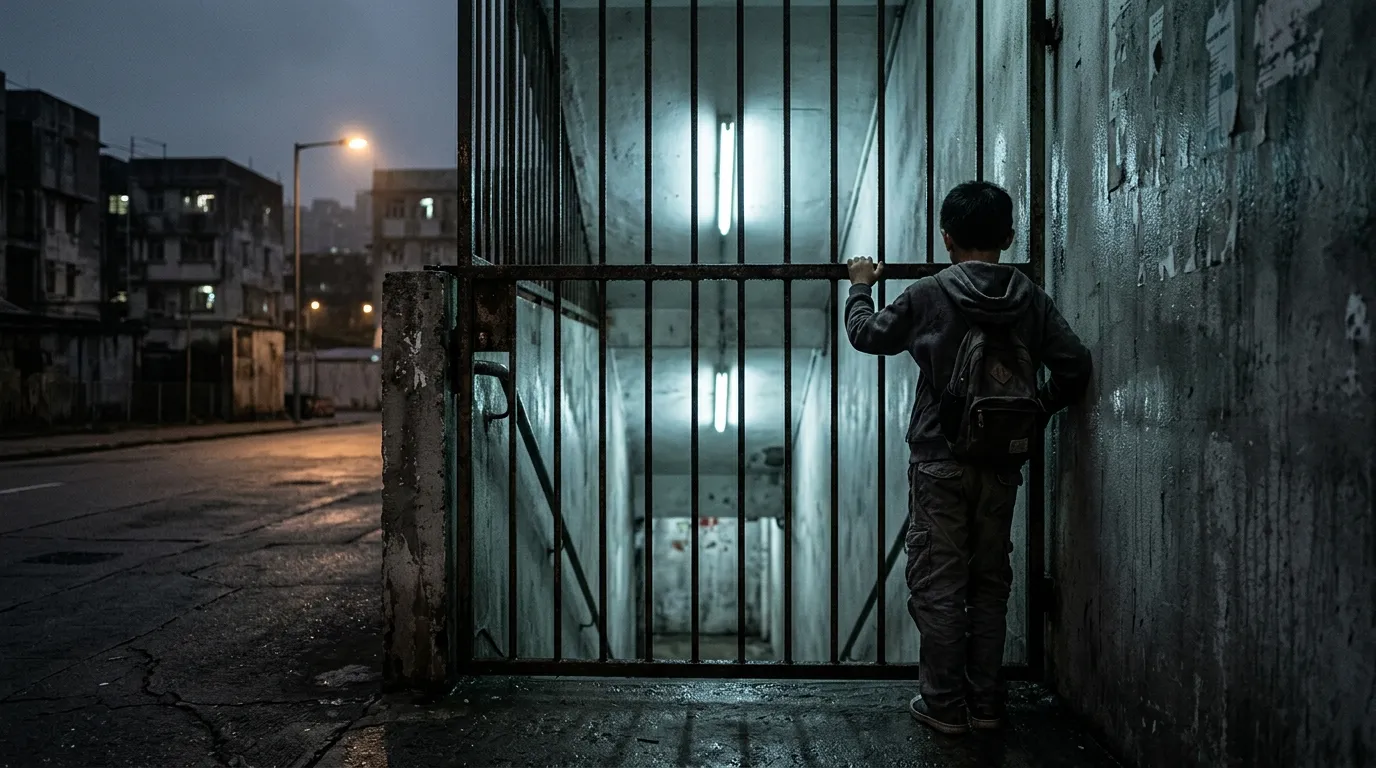
They reached the distribution corridor entrance at two fifty-two. Underground entry. Iron grate half-open—Qiū Zhùmíng had said it would be like this. Héngyuǎn didn’t move immediately. He stood for two seconds, swept the area around the entrance: no camera bracket marks on the walls, rust texture on the grate continuous and uninterrupted by recent contact, the descending staircase visible under fluorescent light and empty. Then he pulled the iron grate open. The hinge made a low rasping groan.
“Wait here.” Héngyuǎn crouched, level with Gé Luò. “Don’t go in. If that pointed humming comes back—knock on the iron grate once in my direction. Once only.”
Gé Luò nodded. Then shook his head. Then nodded again.
“Nod or shake?”
“Can I count?” Gé Luò’s voice was quieter than before, like he was consulting himself. “One knock means it’s back. Two knocks means it’s close. That way you know how far.”
Héngyuǎn looked at him. Nine years old. He’d just designed a two-bit signal protocol.
“Fine.”
He stood. Turned. Walked three steps.
“Ba.”
He stopped. Didn’t turn around.
“I’m not scared,” Gé Luò said.
Héngyuǎn heard the structure in those words. Subject—negation—verb. No particles. None of the ō or la he usually added. Gé Luò was using a grammar that didn’t belong to his age to say something he wanted his father to believe.
Héngyuǎn didn’t turn around. He walked into the underground passage.
Basement level. Cast aluminum wall panels. Fluorescent lights. Ozone.
Three in the morning and there was no queue in the distribution corridor. The maintenance verification terminal was at the end of the hallway—standalone, slightly larger than the standard daytime units. The metal chair’s backrest was higher, the recess deeper.
Héngyuǎn sat down. Back pressed into the seat. The back of his neck aligned with the recess. The moment the probe array made contact with his skin, his breathing adjusted automatically—five years of body memory. But this probe’s pressure was greater than the standard terminals, the recess’s tolerances tighter.
Pre-verification. Three signal reads simultaneously. Vertigo. Heart forced two extra beats. Cleared.
Permission confirmed. A line appeared on screen that he’d never seen before—ELEVATED ACCESS: TIER-2 MAINTENANCE PROTOCOL. One more confirmation step than usual. His thumb pressed to the operations panel; skin conductance sampled a second time. Cleared.
Instruction injection began.
His fingers moved. Not by his will. The AI had taken over the motor cortex. Different from the Module A operation—instructions denser, intervals shorter, the demand on fine motor control higher. Like shifting from an ordinary road onto a racetrack.
Layer 1 data stream visualization expanded. Pale blue light pulses. Brighter than a standard job—higher bandwidth, more densely packed signal.
Step three. Step four. A migraine stirred behind his temples—not an episode, just background noise shaken loose by the high-bandwidth instruction stream.
His fingers were executing the AI’s instructions while his consciousness tracked the operation sequence’s structure—looking for the embed window. The high-clearance task’s sequence was longer than standard but structurally cognate. He found the expected gap between steps eleven and twelve.
But Qiū Zhùmíng’s path diagram had marked the inject point after step sixteen. Deeper in. Shorter window.
Step eight. Heart rate seventy-six. He started micromanaging his breathing. Above ground, outside the iron grate, Gé Luò was against the wall. A nine-year-old in the humid air of a late-March morning.
Step ten.
Step eleven—
The system’s data stream changed.
Not an interruption. A mutation in flow pattern. The pale blue light pulses’ frequency shifted in under a third of a second from stable to pulsed—bright, dark, bright, dark, like a cardiac monitor that had just detected arrhythmia.
Héngyuǎn’s fingers stopped. The AI’s instruction stream had paused; his fingers had gone with it.
The top right of the operations panel screen: MAINTENANCE CYCLE INITIATED — STANDBY.
Maintenance cycle.
The air went out of his lungs—not fear, but his brain completing a collision check in fractions of a second. maint_window: 0300-0315 UTC+8 / cycle: 14d. That line in his notebook. The line he’d flagged as hallucination. Three in the morning. Fourteen-day cycle.
Today was the fourteenth day.
Maintenance cycle activation meant the cooling system’s control mode might temporarily revert to automatic—if he embedded Module B’s forged logic in this state, the system might overwrite his embed within minutes.
The STANDBY on the panel held for four seconds. Then released. The AI’s instruction stream resumed. Fingers started moving again.
Four seconds. The maintenance cycle’s initialization pulse. Not the full fifteen-minute maintenance window—just a lead signal. The full window might start in a few minutes.
He needed to finish the embed before that.
Step twelve. Step thirteen. Heart rate eighty-four.
His window was compressed. The original plan had been to operate comfortably in the gap after step sixteen. Now he didn’t know if the maintenance cycle’s full activation would cut off his embed path.
From the direction of the entrance: one metallic knock.
One.
Gé Luò. The drone was back.
Heart rate eighty-eight.
Step fourteen. Step fifteen. His fingers tore between the AI’s instructions and his own will—two programs fighting over the same neural pathway. Right index finger twitched. Not firmware disruption—interference between two competing instruction sets.
Step sixteen complete. Window open.
Under a second. Shorter than the Module A embed.
His fingers began. Module B’s payload split into two segments—the core forged-flow-meter logic and the verification module. First segment embedded. Second segment—
Qiū Zhùmíng’s encrypted payload. The path diagram’s injection point was right here, sharing the same operational window as Module B.
Under half a second.
His fingers switched to the encrypted payload’s injection sequence—forty-two bytes, memorized early this morning from the microSD card in the Faraday cage. Third segment. Completely unfamiliar pattern, no structure he recognized. The sensation was stiff—muscles executing instructions they didn’t understand.
Second metallic knock.
Two. Drone very close.
Embed complete. Two payloads—his and Qiū Zhùmíng’s—through the same operational window, the same pipeline, carrying the same biological noise stamp, sinking into Zone 7’s cooling system management layer.
Merge complete.
Window closed. Fingers returned to the AI’s exclusive rhythm. Step seventeen. Step eighteen.
Heart rate ninety-five. Vision beginning to narrow at the edges. He didn’t see the gray line—the monitoring AI scan he’d seen during Module A’s embed. Maybe the audit mechanism on the high-clearance channel worked differently. Maybe it was watching from somewhere he couldn’t see.
The operation sequence ran through its final steps. The probe array released.
Héngyuǎn stood. His legs held better than last time—probably because the operation was shorter. Or because the adrenaline hadn’t faded yet. He steadied himself against the cast aluminum wall and made for the exit.
Ground level. Iron grate. The humid air hit him in a wave.
Gé Luò was against the wall. When he saw Héngyuǎn emerge, his body made a quick motion—arms opened slightly, like he was about to run over, then pulled back. He just stood there.
“Gone?” Héngyuǎn asked.
“Gone. Went that way.” Gé Luò pointed south. “The second time was faster than the first. Inside the pointed humming there was an extra layer—” His hand made a rotating motion in the air. “Spinning. The first time didn’t have that.”
Rotational modulation. Héngyuǎn mapped this against what he knew of drone scan patterns. First pass: patrol, stable signal. Second pass: added rotational component—possibly radar scan mode, meaning the drone had activated active-search on the second pass.
He took Gé Luò’s hand. Palm wrapped around small palm, the way you hold something you’re not planning to let go of.
They walked back the way they’d come. Héngyuǎn wanted to push the pace—adrenaline was still running, his body said run. But two people at a half-jog at three-thirty in the morning was more flaggable than walking. He held his step frequency to just slightly faster than before. Gé Luò stayed alongside him, not being pulled.
Three forty in the morning. Home.
Gé Suǒ was still sitting inside the Faraday cage. The event stream on screen was still scrolling. He looked up as Héngyuǎn and Gé Luò came in, eyes moving from Héngyuǎn’s face to Gé Luò’s, then back to Héngyuǎn’s. One full scan.
“Zero,” Gé Suǒ said.
“What?”
“Red ones. Zero.”
Héngyuǎn’s shoulders dropped a degree. No anomalous events on the public channel—at least on the surface, his embed operation hadn’t triggered any system-level alert.
“Come out.”
The way Gé Suǒ left caught Héngyuǎn’s attention: before standing up, he read to the end of the last few lines that had scrolled past on screen. Not compulsive behavior—a nine-year-old, at the end of the first task he’d ever been entrusted with, making sure he hadn’t missed anything.
Gé Luò had already sprawled across the low table in the living room. One lap out to a late-night mission, the three-in-the-morning adrenaline gone—his body declared shutdown. Héngyuǎn draped a blanket over him.
Gé Suǒ stood in the bedroom doorway.
“Any good?” he asked.
Héngyuǎn paused for a second. Then remembered—Gé Suǒ’s language framework. Cornelius making soup. A mission was also making soup.
“Don’t know yet,” Héngyuǎn said. “The soup’s still in the pot.”
Gé Suǒ nodded. Turned. Walked two steps.
“Suǒ.”
Gé Suǒ stopped. Didn’t turn around. The same posture as Héngyuǎn at the iron grate—not turning back. Genetics wasn’t only chromosomes.
“Thank you,” Héngyuǎn said.
Gé Suǒ’s silhouette held still for a second. Then kept walking. No response. Before he disappeared into the room, his hand touched the doorframe—lightly, as if confirming that physical boundary was still there.
Héngyuǎn sat inside the Faraday cage.
Cornelius’s screen was showing the event stream as Gé Suǒ had left it. He closed the monitoring script and opened the notebook.
Architecture diagram. Module A—solid line. Module B—
He picked up the pencil and changed the dotted line beside Module B to a solid one. Two done.
Then he stopped.
The pencil tip was pressed to the paper but not moving. His eyes weren’t on the architecture diagram—they were on the first few pages of the notebook. He turned back. Back to the line he’d written on a plastic chair in the market.
maint_window: 0300-0315 UTC+8 / cycle: 14d
Return data from a dongle op in Zone 7. He’d noted it here. Three days later, Cornelius’s third projection had mentioned a maintenance schedule warning. He’d flagged it as hallucination.
Tonight he’d experienced the maintenance cycle’s lead pulse firsthand. STANDBY. Four seconds. Three in the morning.
Cornelius had no Zone 7 maintenance schedule data. His judgment at the time had been correct—a seven-billion-parameter model couldn’t know that schedule. But the third projection hadn’t been claiming knowledge. It had been running a probability inference from incomplete information: if a periodic maintenance schedule exists, then the attack window needs to avoid it.
Not a hallucination. A risk flag.
He’d thrown it out with his consistency filter—take the two aligned projections, discard the outlier.
Héngyuǎn stared at the notebook.
His filtering method had worked across more than a dozen projections. Consistency filtering was standard strategy for working with unreliable models—the direction where the majority agreed was usually the stable signal, isolated outliers were usually noise.
But tonight had produced the counterexample. The outlier had been right. The consensus—those two projections—had only been repeating what he already knew. It was the third one that was saying something new.
His filtering method wasn’t screening out noise. It was screening out novelty.
Héngyuǎn set down the pencil.
His hands rested on his knees. Not clenched—just resting. He was waiting for the rational analysis framework to come back online. Waiting for the engineer’s brain he’d run for twenty years to categorize this failure, tag the root cause, produce remediation steps. Three seconds. Five seconds.
Nothing.
Not broken. Just—the structure of this problem didn’t allow him to process it the usual way. Because what had failed wasn’t a specific operation—not missed the window at step fourteen or didn’t control heart rate precisely enough. What had failed was the method he used to determine what deserved attention. The function he used to decide which data could be discarded.
Fixing a bug is simple enough. Fixing the bug in the tool you use to find bugs—
He sat in the space enclosed by aluminum walls, screen light on the back of his hand. For a long time he did nothing. Didn’t turn pages. Didn’t type. Didn’t calculate. His breathing was even, heart rate coming down, muscles loose. But his eyes weren’t looking at anything.
He didn’t know how to fix this.
The recognition persisted. Not anxiety. Not fear. Something quieter than anxiety, without a name—like a system that had entered a state it had never been designed for, every exception-handling branch returning null, but the system hadn’t crashed. It was just sitting there. Running. But without knowing what to execute next.
What finally moved him wasn’t analysis. It was another line in the notebook.
Beside Module B, below the newly drawn solid line, there was a blank space. A position he’d reserved yesterday: the status marker for the encrypted payload. He needed to log that Qiū Zhùmíng’s data packet had been embedded.
He wrote a line in the blank space:
payload_qiu: injected. content: unknown.
Unknown. Something already in the system, bound to his Module B, packaged with his biological noise stamp. He didn’t know what it was.
The dotted line beside Plan A leading toward Plan B looked different in the solid line’s shadow. Not because he wanted to expand the attack—but because Qiū Zhùmíng’s payload might have already expanded it for him. An encrypted data packet of unknown content, embedded into the system using his operator identity, his biological signature.
If that payload’s function extended beyond the cooling system—if it touched something Héngyuǎn hadn’t meant to touch—
Merge didn’t just mean convergence. Merge had the potential for conflict.
Héngyuǎn closed the notebook. The aluminum foil tape beside his shoulder made a faint crinkle—the tool cabinet responding to his motion.
He powered down Cornelius. Pulled the power cord. Sealed the Faraday cage. Standing in the bedroom doorway looking out—in the living room, Gé Luò was curled on the floor by the low table, blanket pulled up to his shoulders. Gé Suǒ’s room door was closed.
Relocation countdown: twenty days. Module C still had no solution. The notebook held one unknown. His filtering method had just been disproved.
He stood in the dark. Four in the morning in Yongkang District, no sound at all. Not even any humming—Gé Luò was asleep, and no one would tell him what shape the electromagnetic field was.
Héngyuǎn walked back to the bedroom. Didn’t lie down. Sat on the edge of the bed. Hands on his knees.
He was listening. Not with his ears. Waiting for the rational analysis framework inside his head to restart. Waiting for it to tell him what to do next.
It didn’t come back.