Chapter 18
Chapter Eighteen: Conflict
Chapter Eighteen: Conflict
He didn’t sleep.
From four in the morning on the bed’s edge through to daylight, his heart rate was steady and his breathing even—only the module in his brain responsible for deciding what to do next was still returning nothing. Outside the window, light went from gray to white. The silhouette of the Southern Science Park ruins emerged from the darkness—rusted factory skeletons standing in the morning fog like a row of jaws with the teeth pulled out.
Gé Suǒ knocked on his door at seven twenty. “Ba. Eat something.”
Héngyuǎn stood up. In the living room, Gé Luò was still sprawled across the low table, blanket slid to one side. Gé Suǒ had already laid out two compressed biscuits and three cups of water.
“Not going out today,” Héngyuǎn said, biting into a biscuit. The sensory data came back; he didn’t process it.
Gé Suǒ looked at him—that look held for a fraction longer than usual. “I know.”
Nine o’clock. The Faraday cage.
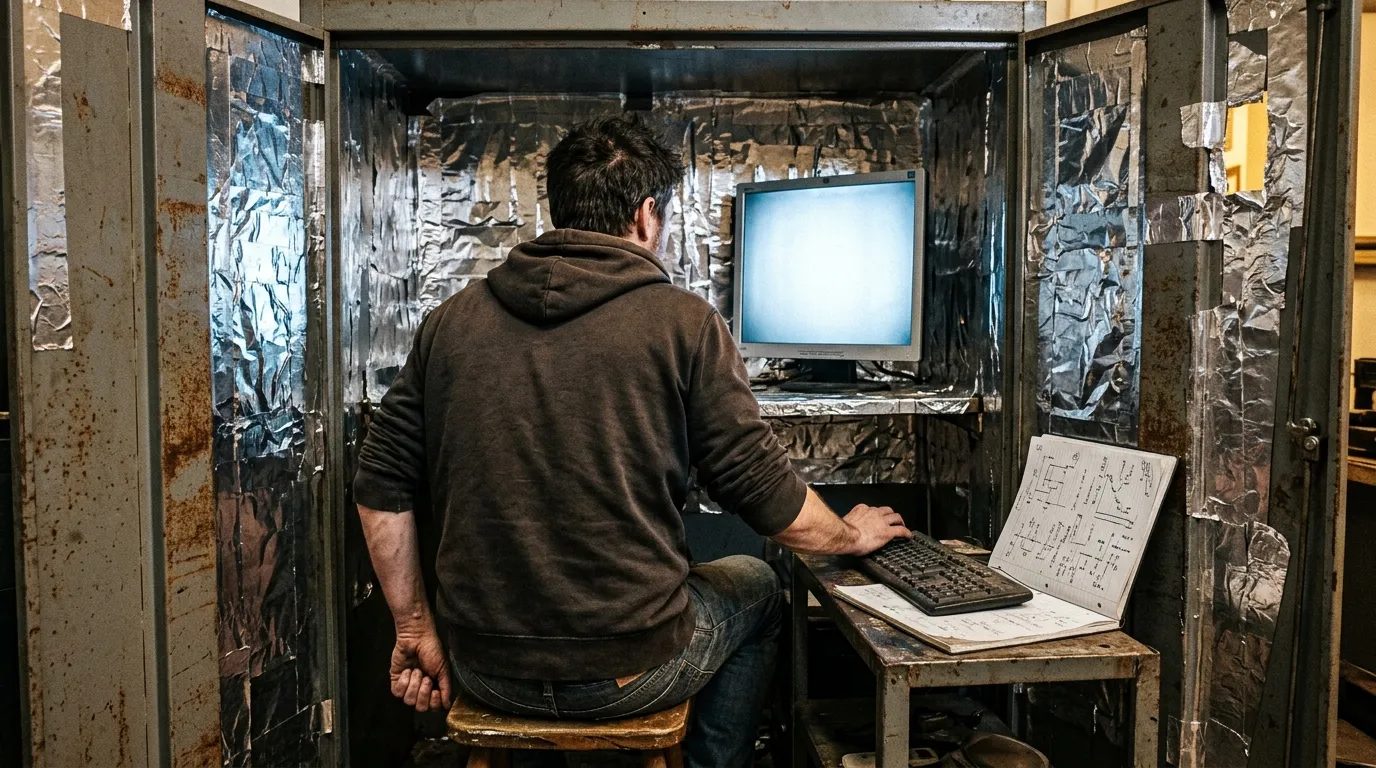
Héngyuǎn pulled the tool cabinet door shut, aluminum foil tape sealing the edge. Metal walls enclosing a meter and a half of space, the screen’s cold light pressing his shadow flat against the foil behind him.
He started Cornelius. Fan climbing from low to high, three seconds to stable. The air inside the sealed space warmed by a degree immediately—the GPU’s waste heat had nowhere to go in a meter-and-a-half metal box. The chemical sweetness of aluminum foil tape mixed with rust smell, coating the back of his nasal cavity.
Notebook open. payload_qiu: injected. content: unknown.
He stared at the word unknown. Last night—not last night, earlier this morning—his rational framework had stalled in front of that word. He wasn’t going to wait for the framework to reboot. If it wouldn’t come back, it wouldn’t come back. He still had hands.
He started doing the only thing still available to him: take it apart.
Forty-two bytes. Three segments. He’d memorized the structure of the injection sequence during the operation—just the shape of it, byte by byte. He typed it into Cornelius.
Fourteen bytes per segment. Four-byte header, six-byte target address, four-byte checksum. Standard structure—Qiū Zhùmíng wouldn’t play games with the format. A QA engineer’s instinct was to follow spec.
He fed the first segment’s address to Cornelius. A third of the response was hallucination—it had mapped the address space to a postal code lookup system—but the core was usable: the address covered the cooling system management layer’s primary control module. Exactly as expected. Module B was targeting the cooling system. No conflict.
He fed the second segment’s address to Cornelius. Waited fifteen seconds.
His fingers stilled above the keyboard.
The address range wasn’t in the cooling system. He added constraint parameters and ran it again. Same result—pointing to Zone 7’s compute scheduling layer. Scheduling itself. The layer that decided which nodes ran which tasks.
He closed the screen. Compute scheduling layer. During a Rollback, when compute crashed, the scheduling layer decided where the remaining compute went. Whoever controlled the scheduling layer decided the distribution rights after recovery.
He turned to the architecture diagram in the notebook. Module A—solid line, Module B—solid line, Module C trigger—dotted. Beside them, that pencil dotted line from Plan A toward Plan B.
The meaning of the dotted line had flipped.
When he’d drawn the Plan B dotted line, he’d been thinking if I need to expand the attack. But Qiū Zhùmíng’s payload wasn’t expanding the attack—it was doing something more precise: during the chaos a Rollback would create, it had pre-installed a pipeline to channel the compute vacuum in a specific direction.
The point was to harvest what the destruction made possible.
The Constructors’ endgame was expansion, and stability was only the cover story.
Third segment. The last fourteen bytes. He already knew what he’d find—but he dissected it anyway. Because he was an engineer. Because an incomplete diagnosis was no diagnosis at all.
The third segment’s address pointed to the Equilibrists’ compute resource pool—Zone 7 through Zone 12’s cross-region quota routing table.
Héngyuǎn’s hands left the keyboard. Released rather than lifted. As if he’d touched something he shouldn’t have.
He closed the notebook. Without force. Just closed it.
A complete takeover plan. And the operator identity that had executed all of it—the biological noise stamp—was Gé Héngyuǎn’s.
His palm rested flat on the notebook cover. No physical reaction. The null return from this morning hadn’t ended yet—restraint had nothing to do with it.
But his hand moved. Right hand picked up the pencil. Wrote three words in the architecture diagram:
scope: hostile
Qiū Zhùmíng hadn’t just slipped something in. He’d turned Héngyuǎn’s entire attack plan into the groundwork for a Constructor expansion operation. Module A cleared monitoring logic, Module B forged flow data, Module C triggered the Rollback—then Qiū Zhùmíng’s payload seized distribution rights in the chaos. He hadn’t needed to expand Héngyuǎn’s attack. Héngyuǎn’s scope was exactly right.
Two people had modified the same layer of the same system, but with contradictory intent. At merge time there’d be no error—syntactically compatible. Only at runtime would the conflict surface.
Héngyuǎn reopened Cornelius. Typed:
“If after a Rollback succeeds, the compute scheduling layer is taken over by external logic—can the life-support pods’ local failsafe power-switching instructions still execute?”
Seven seconds.
Cornelius’s answer was short. No hallucination. As if the solution space for this question contained exactly one answer.
priority conflict. The scheduling layer takeover logic and the local failsafe logic compete for the same control signal group. Outcome depends on timing—first to arrive takes priority.
First to arrive takes priority.
His life-support pod failsafe subroutine—the one he’d written to sacrifice part of the attack’s effectiveness in order to keep the pod-dwellers alive—and Qiū Zhùmíng’s scheduling-layer takeover logic would race each other through the same channel during the Rollback’s chaos.
Héngyuǎn sat in front of the screen for a long time. His right elbow touched the aluminum foil wall, the metal’s cold cutting through his sleeve—sealed for three hours and the wall was still cooler than the air. The fan hummed steadily. His own exhaled carbon dioxide was accumulating in this space without convection; his chest was starting to feel heavy. The aluminum foil reflected the screen light, making the whole interior feel like being trapped in a cold, sealed lung.
He made a decision: leave Qiū Zhùmíng’s payload alone for now.
The anger was there. What he couldn’t be sure of was whether his anger had been calculated in. Qiū Zhùmíng had manipulated him once—used the OHMC truth to amplify his attack motivation. If he changed his plan now out of anger, that might be exactly the second layer of the calculation.
He opened Cornelius’s public channel monitoring script—Gé Suǒ’s version, more stable than his own original. The event stream began scrolling.
Twenty minutes. Smooth. He began to loosen his focus, letting his gaze slide across the data stream—the twenty-year habit of troubleshooting: anomalies don’t appear where you’re looking, they appear at the periphery.
Minute twenty-three.
An unfamiliar query request appeared in the event stream.
Format correct. Authorization normal. Content: a standard compute quota usage statistics query—which zone, which time window, query call frequency by operator. This kind of query ran in the tens of thousands daily. Nothing unusual.
What made Héngyuǎn stop was the parameter range.
Yongkang District. Past seventy-two hours. Quota usage frequency sorted by operator.
His zone. His time window. His sort dimension.
Héngyuǎn’s fingers hovered above the keyboard.
He scrolled back through the event log history. Found three structurally similar queries—all compute quota usage statistics, all pointing at Yongkang District, with time windows of past hundred and sixty-eight hours, past hundred and twenty hours, past seventy-two hours in sequence.
Narrowing. Some analysis system was using statistical methods to close in on a behavioral anomaly. First pass: wide net. Second: contracted. Third: precise to three days.
The rational framework in his head—stalled all night—gave a sudden jolt. An emergency interrupt line triggering. Like a hibernating server receiving an urgent packet: the core wasn’t fully up yet, but the network interface had lit.
The Equilibrists.
Memory decompressing from archive. During the Module A embed, he’d seen a gray scanning line at the edge of the Layer 1 data stream—slow, indiscriminate, like a net settling through water. He’d read it then as routine patrol by the Equilibrists’ monitoring AI.
But routine patrols don’t narrow their parameters. Narrowing meant something worth digging had been found.
Héngyuǎn closed his eyes. Reconstructed the timeline in his head.
Module A embed. Gray scan line appeared.
OHMC data analysis. Possibly generated a distinctive traffic signature.
Module B embed. This morning. High-clearance channel. Longer operation time.
Three operations. Three log entries. The AI didn’t need to understand what the deviation meant—it only needed to detect that the same operator, same zone, operation pattern exceeding baseline by two standard deviations. Auto-escalate to review.
Héngyuǎn opened his eyes. Wrote in the notebook:
F-04 triggered. Tracking active. Remaining window: unknown.
Module C still unembedded. No trigger, and A and B were just code sleeping in the system. He still had one more dongle op to do. And the Equilibrists’ search was narrowing.
He turned to the architecture diagram and added a time estimate beside Module C’s dotted line. Then stopped. His filtering method had just been disproved. The rational framework was partially active—the emergency interrupt was running, but the standard analysis was still rebooting. Like a machine that’s halfway through POST: BIOS up, operating system not yet loaded.
Two in the afternoon.
The firmware warning had triggered three times in the past six hours. Intervals decreasing: a hundred and twelve minutes, ninety-eight minutes, seventy-seven minutes.
He was cross-referencing a projection when his left index finger twitched.
This was different from the firmware warning kind of disruption. The firmware warning was a half-second full-body micro-tremor. This was something else. The index finger moved on its own. Independent of his will. Like an invisible thread had been pulled.
Silence for three seconds. The middle finger followed. Larger amplitude.
He gripped his left wrist with his right hand. Temperature normal. Pulse normal. But the fingers weren’t answering.
In the corner of the screen, the firmware status bar. The number changed.
FIRMWARE STATUS: OVERDUE 30d — LOCKDOWN MODE INITIATED
His vision went white for an instant. A neural feedback pulse, all Layers receiving a downgrade instruction simultaneously. Like someone pulled the main breaker and pushed it back up, but some circuits didn’t come back. Half a second. Hearing briefly gone and back, a thin, unfamiliar tinnitus now layered in.
Thirty days. He’d been living with the seven-day warning for twenty-three days. Thirty was different.
Layer 3 went offline first. The AI direct connection channel closed. For daily life, minimal impact—but dongle ops’ verification and permission confirmation ran through Layer 3. Without it, standard dongle operations were gone.
Then Layer 2 restriction. Motor assist dropped from full operation to basic maintenance. Fine motor assist gone.
His left hand began a continuous tremor. Five years of accumulated damage had always been intermittent; this was something else—the muscle control signal attenuation of Layer 2 restriction, steady and unrelenting. Two tremors layered together, his left hand like a machine absorbing two different vibration frequencies simultaneously.
Visual edges began flickering. Layer 2’s precision control of the eye muscles reduced; small involuntary micro-tremors broke the visual periphery into stuttering light bands. Every two seconds. Center still clear. Edges strobing. Like the corners of a photograph beginning to peel.
Héngyuǎn sat in the Faraday cage. Left hand trembling. Visual edges strobing. Cornelius’s cursor on screen, waiting for his input.
Twenty years of systems engineering and he’d seen something like this—multiple fault lines lighting up at once, any one of them enough to take the system down. But back then he’d been standing in front of the screen. Now he was inside the fault.
Héngyuǎn picked up the pencil. Right hand. Left hand he set on his knee and stopped looking at it. Screen lit up. He started writing on a blank page in the notebook. The rational framework hadn’t recovered enough for plans. He was making a list.
1. Payload separation — need to redesign Module C trigger logic so Rollback
   activation sends the life-support failsafe instruction ahead of Qiu's
   scheduling takeover
2. Tracking evasion — reduce operation frequency's statistical signature.
   Not operating doesn't mean not being tracked, but not operating at least
   doesn't increase sigma
3. Embed method — Layer 3 offline = standard dongle unavailable. Alternative?
He stopped for a long time after writing the third item. Alternative. He knew what the alternative was. He’d read it in the chip’s technical documentation. The systems engineer corner of his brain had already assembled the word; it just hadn’t been delivered to consciousness yet.
Downgrade.
Cut three wire bundles. Surrender Layer 2 remote reception and Layer 3. After that: manual dongle only, within twenty to thirty steps, fine motor down to a third or a quarter. But remote lockdown would fail, and base-station tracking would fail too. One clean cut. The cost was irreversible.
He didn’t write downgrade on paper. The option sat like a grenade with the pin still in—pocketed for now.
He turned back to Cornelius’s screen. Left hand trembling on his knee. Visual periphery flickered once, twice.
Right index finger pressed the first key.
He began redesigning Module C’s trigger logic.
Six o’clock. Gé Suǒ knocked once on the cabinet door panel.
“Eat something.”
On screen was the third draft of Module C’s trigger logic. He’d rejected the first two himself—the first hadn’t resolved the timing conflict, the second exceeded thirty-five steps, past the safety margin for manual dongle.
His left index finger suddenly bent sideways—an angle a finger shouldn’t have. Pain shot from the root to the wrist. He pressed it with his right hand and straightened it back.
The door opened a crack. Gé Suǒ’s face. Scan: left hand to face, face to screen, screen back to left hand.
“Five minutes,” Héngyuǎn said.
Gé Suǒ pulled the door shut.
Third draft trigger logic. Under twenty-seven steps to complete the full sequence—bypass Qiū Zhùmíng’s scheduling takeover, send the life-support failsafe instruction first, trigger Rollback. Twenty-seven steps. Manual. Fine motor at a third or a quarter. If he downgraded.
He saved the projection and walked out of the Faraday cage.
Living room. Gé Suǒ at the low table. Two portions of biscuits. Two cups of water.
Héngyuǎn sat at the low table. Bit into a biscuit. This time he tasted it—salty, dry, the chalky texture of compressed starch.
Gé Suǒ sat across from him. He left his own biscuit untouched and watched, waiting for his father’s state to return to a threshold where it could receive information.
“There’s something on the public channel,” Gé Suǒ said.
Héngyuǎn stopped chewing.
“Not the red kind.” Gé Suǒ added. “But it repeated. Same type of query. I counted. Seven times.”
Seven. Héngyuǎn had found three in the event stream this morning. Since Gé Suǒ started monitoring, four more.
The frequency was rising.
“Same content in the queries?”
“Different ranges.” Gé Suǒ’s speech had the delivery of reading a report—no particles, no connectives. “Started with all of the south zone. Then just Yongkang. The last two—” He paused to confirm his memory. “Only 710.”
- Their zone’s code. His Faraday cage was in 710. Cornelius was in 710. The room where Gé Suǒ and Gé Luò slept was in 710. Everything he had to fight with, and everything he had to protect, at the same flagged coordinate.
Héngyuǎn set down the biscuit. Left hand under the table, pressed against his thigh.
Gé Suǒ was waiting for something. Confirmation, maybe. Or the next instruction. Héngyuǎn didn’t know. He had nothing to give.
From down the hallway, Gé Luò ran into the living room and flopped face-down on the low table, chin resting on the backs of his hands.
“Ba, your eyes look weird.”
Héngyuǎn blinked. “What?”
“They’re—” Gé Luò blinked rapidly, demonstrating. “Like this. Really fast. The edges.”
The strobing at the visual periphery. What he felt from inside was stuttering light bands. From outside, it looked like involuntary eye micro-tremors.
“Firmware thing,” Héngyuǎn said.
Gé Luò tilted his head. The same angle as yesterday morning when he was parsing the drone’s electromagnetic signal. “Doesn’t look like firmware. Looks broken.”
Broken. His nine-year-old used one precise, merciless verb to name his condition. The eyes, the left hand, the firmware—the word covered all of it, and more besides.
Héngyuǎn stood up. His left hand slid off his thigh and knocked the table edge.
“I’m going back to work.”
Faraday cage. Aluminum foil tape sealed. His spine protested the hours of sitting; he ignored it. Screen on. Third draft trigger logic.
Left hand on his knee. Index finger, middle finger, ring finger, taking turns or all together, no pattern.
Right hand on the keyboard. Steady. Seven-tenths fine control. Enough.
Relocation countdown: eighteen days. Module C still a dotted line. The notebook had scope: hostile and F-04 triggered. Left hand in collapse. Visual edges peeling. The Equilibrists’ search had narrowed to 710.
Right index finger pressed a key. Second. Third.
The rational framework hadn’t come back. He couldn’t see a way through. He was pressing keys because if he stopped, his two sons would go into the life-support pods.
Left hand trembling. Right hand typing.
Not a hero. A father.