Chapter 19
Chapter Nineteen: Downgrade
Chapter Nineteen: Downgrade
Two in the morning. Héngyuǎn was jolted awake inside the Faraday cage by a new pain.
Not in the left hand. The right.
The tendon between his index and middle fingers seized without warning, like something gripping it from the inside and pulling. He tried to spread his fingers — he could, but with a lag of a fraction of a second. His right hand wasn’t supposed to lag. He’d endured the left hand’s collapse. The right was his last working tool.
He checked the firmware lock’s status. Layer 3 fully disabled. Layer 2’s remote functions had entered restricted countdown — once Layer 3 was severed, the lockout pressure consolidated into Layer 2, cascading faster than he’d projected. Fine motor degradation would follow. The lock was eating his right hand.
Thirty-day countdown, not yet twenty-four hours in. Relocation in seventeen days. The lock wouldn’t wait.
He picked up the notebook. Turned to the page tucked at the back — written yesterday, the pencil strokes faint, like he hadn’t wanted to admit what he was writing while he wrote it. The word “downgrade” at the top. Below it a list of conditions: need someone with chip architecture knowledge, need basic surgical setup, irreversible, fine motor function reduced to thirty or forty percent, remote lock disabled, standard dongle ops no longer viable.
Last line on the list: Who.
He stared at that word. Among everyone he knew who understood the third-generation neural chip’s micro-bundle architecture, there was only one person in Yongkang District.
Wēng Hèqín. Xǔ Jìng’s former colleague.
Seven in the morning. He called Gé Suǒ out from the Faraday cage.
“Keep monitoring the public channels.” He paused. His right index finger lagged again, barely a beat. “If the query pattern narrows from District 710 down to an individual level, let me know immediately.”
Gé Suǒ nodded. Then he did something non-functional — he picked up the water cup from the low table and set it within his father’s reach. The water was cool; it had been sitting there a while.
Héngyuǎn glanced at him. Gé Suǒ’s expression didn’t change, but as he pulled his hand back, his fingertips rested on the table surface a second longer than necessary. Nine years old. Sitting in front of a screen every day, monitoring public channels for his father. Not because he was capable of it. Because there was no one else.
Héngyuǎn drank the water.
In the living room, Gé Luò was under the low table. Not hiding — he’d wedged himself into the gap between the tabletop and the floor, face down, both hands pressed over the back of his head.
“What’s wrong?” Héngyuǎn crouched.
“The buzzing.” Gé Luò’s voice came out muffled against his palms. “Since last night — it’s so loud. Outside. Not inside.”
Héngyuǎn’s hand stopped mid-air. Gé Luò’s electromagnetic sensitivity was getting worse. The Equilibrists might have increased their scan frequency across the district. If they’d pushed the active scan power up to cover District 710 —
“Ba.” Gé Luò’s head emerged from under the table. His eyes were red, not from crying but from not sleeping. “Why is there more buzzing outside now?”
Héngyuǎn crouched on the floor. Left hand pressed to his knee, index finger trembling. Right hand resting on Gé Luò’s head.
“I’ll handle it.”
Gé Luò looked at him. The boy who’d said I’m not afraid on that night walk — right now he was curled under a table, not afraid, but being ground down by something invisible. There was no courage that could counteract this. Bravery was useless against electromagnetic frequency.
Héngyuǎn stood. Three pressure lines crossed on that page in his notebook: the lock devouring his right hand, the Equilibrists’ scan narrowing in, Gé Luò’s sensitivity flaring. Any one of them he could leave for later. All three together — waiting was death.
“Downgrade” was no longer a grenade. It was the last door.
Wēng Hèqín lived in the northeast corner of District 710, on the top floor of a converted four-story factory building. Not far from Héngyuǎn — fifteen minutes on foot. He left Gé Luò with Gé Suǒ, said only a few hours, and Gé Suǒ nodded without asking.
Nine in the morning. Héngyuǎn knocked. No answer. He knocked again.
The door opened a crack. A left hand. A finger missing between the pinky and ring finger — the ring finger gone from the second knuckle up, nothing there.
“Who is it.” Not a question. Completely flat.
“Gé Héngyuǎn. Xǔ Jìng’s—”
The door opened a little wider. Wēng Hèqín’s face. Fifty-one. Short hair. High cheekbones. The lines beside her mouth looked carved in, not laughed in.
“I know who you are.”
Héngyuǎn stood outside. She showed no intention of letting him in.
“My third-generation chip has been firmware-locked,” he said. “I need a downgrade. Sever the Layer 2 remote and all Layer 3 bundles, preserve the local pathway.”
Wēng Hèqín looked at him for three seconds.
“Tsk.”
She turned and walked inside, leaving the door open. Héngyuǎn took this as an invitation.
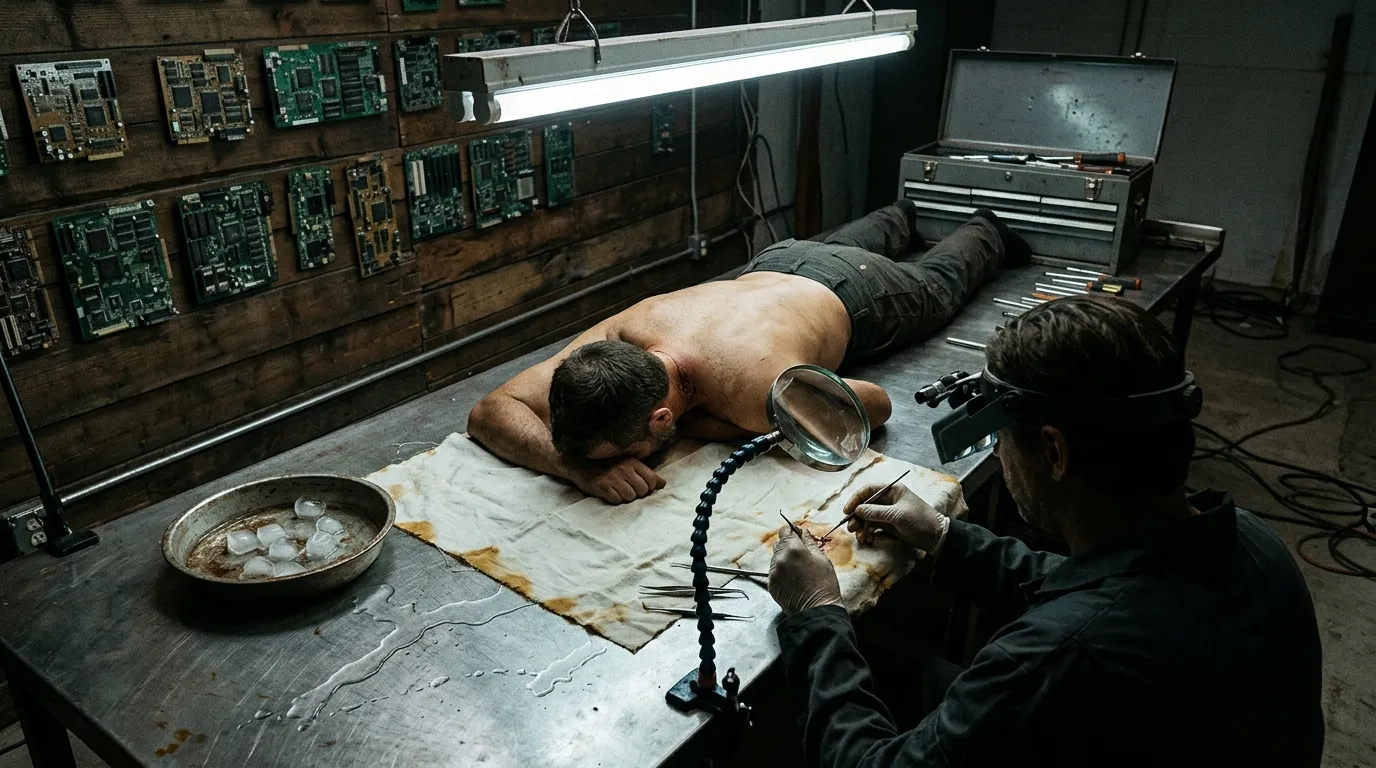
The interior was tidier than he’d expected. Metal workbench along the wall, tools arranged by size. One wall hung with circuit boards, all old models — some he recognized, some were relics from before chip implants. The air carried a faint smell of solder, thin, like something had been welded yesterday or the day before.
Wēng Hèqín sat in the swivel chair at the workbench and used her incomplete left hand to point at the folding chair across from her.
“You’re asking a woman with missing fingers to take micro-scissors to your C3-C4. Which means you’ve genuinely run out of options.”
Héngyuǎn sat down. “Yes.”
“Technical requirements. Not reasons.”
Héngyuǎn pulled out a rough diagram of the chip architecture he’d sketched in his notebook. Pencil lines, eraser marks on the paper. “Three bundles. First: Layer 2 remote reception pathway — the relay from the comms module to Layer 2. Second: all Layer 3 bundles. Third: the relay connection between the comms module and Layers 2 and 3. Local neural stimulation pathway stays.”
Wēng Hèqín took the notebook. The way she read the diagram wasn’t the way Héngyuǎn did — not whole picture down to details, but tracing along each bundle, like inspecting wiring.
“The T33-R, third generation.”
“Yes.”
“C3-C4 implant. The remote pathway runs along the posterior-lateral spinal cord — half a millimeter from the sensory pathway.” She set the notebook back down. “Of your three, the third is hardest. The relay line shares a segment of route with the Layer 1 feedback loop. Only four hundred microns of independent segment.”
“Can you do it.”
“Tsk.” A second tsk. Different pitch from the first. Héngyuǎn interpreted this one as something close to technically not impossible but you should understand what you’re asking for.
“Can be done.” She stood, moved to the left side of the metal workbench, and opened a gray iron tool case. Inside: medical equipment repair tools — not surgical instruments, but the precision tools for repairing surgical instruments. In this world, that distinction had long since blurred. “I’ll need things. Magnification at least eight times. Micro-scissors under fifty microns diameter. Disinfectant — iodine works. Local anesthetic, lidocaine if you have it.”
“I have the magnifier and the micro-scissors.” Luò Cuò’s backup tool kit, left behind when he went. At the time Héngyuǎn hadn’t thought these things would ever be used on himself. “Lidocaine might be a problem.”
“No lidocaine, use ice.” Wēng Hèqín said this without any change of expression, the way someone discusses a technical specification rather than a procedure that will open the human body. “It’ll hurt more. But your third-gen chip is at C3-C4 — by now the surrounding tissue has been encased in fibrotic scarring for five years. Local cooling can suppress conduction velocity enough to work.”
Héngyuǎn pulled a cloth bundle from his pocket. Opened it. Three precision instruments — Luò Cuò’s. Magnifier, a set of micro-forceps, a pair of micro-scissors.
Wēng Hèqín picked up the micro-scissors and held them toward the window light.
“Sharp enough.” She set them back on the bench. “The fact that you brought your own tools worth this much means you’ve been planning this for more than today.”
Héngyuǎn didn’t answer.
“When.”
“Today.”
Wēng Hèqín looked at him. That look carried no emotion — assessing the stress tolerance of a component.
“Tsk.” A third one. He didn’t attempt to translate this one.
“Two o’clock. Bring your tools. Eat something before you come, not on an empty stomach. You’ll need at least four hours of no strenuous activity after. And—” She paused. “Bring a towel. You’ll bite.”
One fifty in the afternoon. Héngyuǎn returned to Wēng Hèqín’s rooftop.
The workbench had been cleared. A white cloth spread over the metal surface — not medical grade, the texture suggested a cut-up sheet, but the edges were cut clean, and the brown-yellow iodine stains showed it had already been disinfected. The magnifier was fixed on an adjustable stand. Beside it, a basin of ice.
Wēng Hèqín wore modified goggles, additional magnifying lenses welded to the edges. Her right hand was steady. Her left — the one missing the finger — rested at the side for auxiliary positioning; the missing segment didn’t affect her grip function.
“Lie face down. Face down. Neck exposed.”
Héngyuǎn placed the towel on the bench’s edge. Removed his shirt. Lay face down on the metal workbench. The cold of the surface came through the white cloth and pressed against his sternum and abdomen. He could smell iodine, metal, solder — Wēng Hèqín’s room always smelled of solder.
The moment the ice pressed against the back of his neck. Cold. Then a feeling of something being reduced — temperature pushing neural conduction velocity down, like someone turning down the volume at the back of his neck.
“I’m going to open the fibrotic casing now.” Wēng Hèqín’s voice came from above his head. Flat. No are you ready.
Pressure. Not the pressure of a blade — the pressure of a blunt instrument separating tissue. He could feel it, but it didn’t hurt. The ice had suppressed the pain channel below threshold.
“Chip visible. T33-R. Batch number illegible — doesn’t matter.”
Héngyuǎn’s face was pressed to the workbench surface. His field of vision was only the fiber texture of the white cloth. He began doing the one thing he could do: calculate. Post-downgrade fine motor at thirty to forty percent. Module C’s trigger logic required a twenty-seven-step manual sequence. Each step demanded different degrees of fine control — the first twelve were standard operations, the last fifteen involved precise embedding of the Qiū Zhùmíng pathway map. At thirty to forty percent fine motor—
Current.
Not calculation. Not thought. An electric jolt shooting from his cervical spine straight up through the top of his skull. His entire right arm snapped out involuntarily, elbow slamming the bench surface.
“Don’t move. Brushed the outer sheath of the remote pathway. Normal response.”
Héngyuǎn bit into the towel. After the jolt faded, his right arm was still numb, like something had pumped a tube of ice water through it.
“First bundle. Layer 2 remote reception pathway. Found it.”
He heard an almost inaudible sound — not a snipping sound, something finer than that, like a thread of silk being pulled apart.
Then the flickering at the edges of his vision stopped.
Not gradually. Off. Like someone had unplugged a signal line. The visual edge dissolution that had been running for nearly forty-eight hours vanished in the wake of that tiny sound. His vision restored itself to a complete, quiet plane.
“Did you feel that.” Wēng Hèqín asked. Not asking about his feelings. Confirming the surgical result.
“Visual edges restored.”
“Remote interference signal severed. Normal. Second bundle. All Layer 3 bundles. Two of them.”
This time there was no electric jolt. But there was another sensation.
Héngyuǎn couldn’t describe it in engineering terms. Not pain — the ice had covered that. Not numbness — his sensory pathway was still running. A loss. Like a lamp in a room you’d never noticed, and only when it went out did you understand it had been on the whole time. Layer 3’s advanced functions — direct AI uplink, enhanced perception, predictive assist — he’d already lost access rights to them under the lock, but the bundles had still been there, signals still flowing, only denied service. Now the bundles were severed. Not denied — the channel itself was gone.
Something rose in his throat. Not a groan. Not a sigh. Some sound his vocal cords produced without instruction — a brief, broken thing. Wrung up from the deepest part of his chest through a channel he hadn’t known existed, leaking out through the gap between his teeth and the towel.
His eyes were dry. His breathing was steady. His rational framework was still running. But his body had issued its own eulogy — for a part of itself just permanently severed. No need to understand. No need to name it. The body knew what it had lost.
Wēng Hèqín didn’t stop working. But her incomplete left hand tightened on the bench’s edge, and three seconds passed before her next words.
“Third bundle. The relay line. This one is finest. Four hundred microns of independent segment. I’ll say this once: if you move, I’ll cut the Layer 1 feedback loop. You’ll lose all sensory feedback from the neck down. Permanently.”
Héngyuǎn bit the towel harder. His upper and lower jaw met nothing but cotton.
“Can’t move.” He said it through the towel. Not a promise. A report on his body’s current state — his muscles had already half-locked in the neural shockwave of the surgery.
“Good enough.”
Again that sound, silk breaking. Deep in the back of his neck, the last channel connecting him to the external system closed.
Wēng Hèqín cleaned the incision with iodine. Her movements were quick, precise, without redundant passes. Héngyuǎn lay on the bench, the ice pack at the back of his neck mostly melted, cold water tracking along his collarbone and into the white cloth.
“No stitches. The incision is a few millimeters — just seal it.” She closed it with a small strip of medical tape. “Don’t get it wet for three days.”
Héngyuǎn tried to push himself upright. Arms had strength, but fine control — he spread his right hand. Extended all five fingers. Made a fist. Extended. Made a fist.
Third attempt at a fist: the pinky didn’t close fully.
He stared at that finger. A gap of roughly two millimeters between it and his palm. No matter how hard he willed it, it refused to go the rest of the way.
“Fine motor at thirty to forty percent.” Wēng Hèqín was at the side, washing her tools. Cold water, no soap — iodine instead. “Layer 2 local pathway is intact, but there’s no remote calibration signal anymore. Your motor cortex needs to relearn how to coordinate with the local pathway. Could take days. Could take weeks. Final stable range: thirty to forty percent.”
Héngyuǎn slowly sat up. His legs were fine. His back was fine. The back of his neck held a dull, full ache — the surgical site’s tissue readjusting.
He picked up the notebook. Right hand on the pen. Wrote one character — a test. The final stroke came out crooked. Not a large deviation — a failure to micro-correct at the end. His hand used to auto-correct the last fraction of a millimeter’s drift. That correction was gone now.
“Manual dongle.” He turned the notebook to the Module C page. “Twenty-seven-step sequence.”
Wēng Hèqín didn’t look at his notebook. “You’re insane.”
“Wouldn’t be the first time I’ve heard that.”
“I’m making a technical assessment.” She turned in the swivel chair to face him. “Twenty-seven-step manual dongle at thirty to forty percent fine motor — do you know what the error rate is.”
“I know.”
“Then you know how many steps you need to compress to before the operation becomes viable.”
“Between twenty and thirty steps. I have twenty-seven. On the edge.”
Wēng Hèqín’s lips moved slightly. Not a smile. Possibly a residual reflex of facial muscles she hadn’t used in a long time. “Jìng married an interesting man.”
She stood. Walked to the doorway. Stopped.
“After your downgrade, your verification signal will be more chaotic.” She didn’t turn around. “With Layer 3 and the remote pathway severed, neural noise is no longer filtered. Your biophysical verification signal — brainwave entropy, microvascular pulse — it’ll read closer to… baseline human. The system will trust you more.”
Trust you more. As being human.
Héngyuǎn turned those words over in his mind. He’d lost two chip layers, shed sixty percent of his fine motor function — but the system would trust him more. Because he was noisier now. Because he read more like an unaugmented person.
Wēng Hèqín left. The door didn’t close — she never closed her door, Héngyuǎn guessed that was habit.
Back at the apartment. Four-thirty in the afternoon. Seventeen days until relocation.
Héngyuǎn sat inside the Faraday cage. In front of him: the notebook, a pen, a small mirror he’d brought for no clear reason — probably to check the incision at the back of his neck.
He began the tests.
Right hand: fist — pinky doesn’t close. Open — thumb abduction angle reduced by roughly fifteen degrees. Independent control of index and middle fingers serviceable, but fine rotation (the motion of turning a small screw) noticeably sluggish.
Left hand: same as before the downgrade. Still collapsing. The dual-frequency tremor still present, but — he stopped. Felt again.
The tremor frequency had changed.
Not diminished. One of the frequencies was gone. Before, two separate rhythms were layered on top of each other — the low-frequency firmware-lock tremor and the high-frequency dongle side-effect tremor. Now only the high-frequency remained. The remote lock signal couldn’t reach him anymore.
The left hand still shook. But only one way now.
Héngyuǎn made a fist with his left hand. The first time in nearly three days it closed completely — the grip only half strength, the fingers unclenching again after two seconds, but that one moment of full contact made something tighten in his throat.
He opened Module C’s draft page. Third version of the trigger logic, twenty-seven steps. Re-evaluated each step’s viability with his downgraded hand.
Steps one through twelve: standard operations. Moderate precision requirements. Viable post-downgrade. Steps thirteen through nineteen: opening section of Qiū Zhùmíng’s pathway map. High precision requirements. On the edge. Steps twenty through twenty-seven: core embedding sequence. Extreme precision requirements. Not viable — in his current state, the cumulative error rate after step twenty-three exceeded thirty percent for continuous fine operations.
He drew a line with his pencil at step twenty-three. Above the line, he wrote: viable. Below it: redesign required.
Four steps. He needed to reduce the precision demands of the last four steps to within his new limits. Or find a way to merge four steps into fewer, trading efficiency for roughness.
Gé Suǒ knocked once on the Faraday cage door panel.
“Ba.”
Héngyuǎn closed the notebook. “Come in.”
Gé Suǒ turned sideways through the door gap. The aluminum foil tape resealed behind him. His eyes swept over Héngyuǎn — neck to hand, hand to notebook.
“The back of your neck.”
“It’s been handled.”
Gé Suǒ didn’t ask more. He stood for a moment. The light falling across his face fragmented in the aluminum foil reflections of the Faraday cage — cold, broken.
Then he walked over and rested his head against Héngyuǎn’s arm. Without words. Not asking for confirmation, not seeking comfort. Just setting his head there.
Héngyuǎn’s right hand lifted. He wanted to place it on Gé Suǒ’s head — a motion he’d done hundreds of times. His fingers settled into Gé Suǒ’s hair. But as they curled, the pinky stayed out. It wouldn’t obey him. Four fingers pressed lightly against his son’s head, the fifth pointing toward the ceiling.
He didn’t take the hand away.
Gé Suǒ stood at his arm for about ten seconds. Then straightened up and walked toward the door.
“Luò’s buzzing.” He paused in front of the aluminum foil tape. “It seemed quieter this afternoon.”
Héngyuǎn’s hand was still in the air. “Probably.”
He knew why. The downgrade had severed his chip’s remote pathway — and cut off the Equilibrists’ ability to track his chip signal through the local relay towers. The scan hadn’t stopped. It just couldn’t find him anymore. Somewhere in the network blanketing District 710, one node had suddenly gone silent. To the Equilibrists, he’d shifted from tracked target to vanished target.
That would confuse them. Confusion would lead to a broader search. But that was a later problem.
Right now. In the notebook. The four steps after step twenty-three. His right hand. Pinky won’t close. Fine motor at thirty to forty percent.
The plan needed redesigning.
Héngyuǎn picked up the pen. Wrote in crooked strokes below step twenty-three: trade-off: precision → redundancy. Replace precision with redundancy. Not the optimal solution. But a solution his hand could actually execute.
Seventeen days until relocation. Module C’s dotted line — shorter than yesterday. But still a line.
Héngyuǎn closed the notebook. Made a fist with his right hand — four fingers closing, pinky staying out. He looked at it for one second, then released the hand, picked up the pen, and kept writing.
Less. But enough.