Chapter 20
Chapter Twenty: Rebase
Chapter Twenty: Rebase
Sixteen days until relocation. The air inside the Faraday cage was stale as a sealed can.
Héngyuǎn had the notebook open across his knees, Cornelius’s screen glowing pale blue. Module C’s third-generation trigger logic, twenty-seven steps. He looked at it for five minutes, then drew a horizontal pencil line after step twenty-three. Everything below the line: void.
Not because the logic was flawed. The logic was perfect. But the logic had been written for someone with ten functioning fingers.
He made a fist with his right hand. Four fingers closing, pinky raised, a fixed two-millimeter gap between it and the palm. That gap was a constant now. It wouldn’t change. Steps twenty-four through twenty-seven contained two micro-rotation operations — fine pinch work requiring the pinky and ring finger together. He tried once. Index and middle could compensate, but the compensating angle was off by about fifteen degrees. Insufficient tolerance.
He wrote below the line: rebase.
Not a patch. A fundamental change to the underlying premises — rendering all reasoning built on the old premises invalid. Including his own. Including everyone else’s.
Original plan: three dongle ops, embedding Modules A, B, and C respectively. Modules A and B were already planted in the previous two runs, lying dormant inside the target system. Module C was the trigger — waking A and B, initiating the Rollback cascade sequence. The original plan had the third dongle op responsible for only C’s embedding. Clean, focused, one thing per op. Distributed deployment, minimizing single-op exposure risk.
But the premises had changed. Three premises had changed at once.
First: the Constructors were not to be trusted. Qiū Zhùmíng’s encrypted payload was a delayed charge — during the chaos of Rollback’s activation, those three addressing segments would redirect the Equilibrists’ compute-takeover rights to the Constructors. Héngyuǎn needed to add a barrier inside the trigger sequence, ensuring Rollback’s reach extended to cover the Constructors’ takeover ports simultaneously. Additional operations.
Second: the Equilibrists were tracking him. The downgrade had dropped him off their tracking grid, but disappearing was itself a signal. Confusion would lead to wider search. The time window had compressed from complete before relocation to complete before they find him. Shorter. Possibly much shorter.
Third: his hand. Thirty to forty percent fine motor function. Twenty-seven steps of edge-of-tolerance operations were no longer viable; he had to compress to twenty steps or under — replacing precision with redundancy, using more verification loops to compensate for reduced control.
Three premises changed simultaneously. One conclusion: abandon the three-embedded-separately strategy. On the final dongle op, complete all remaining deployment in a single operation window. Module C’s embedding, triggering the sequence, counteracting the Constructors’ payload — all of it compressed into the same operational window.
Extreme risk. But no other option remained.
He opened a new modeling environment on Cornelius. The offline model’s response rate was slow — four to seven seconds per query. Battery would only last a couple of hours under full load. He needed to use every minute precisely.
“Cornelius, give me the minimum-step sequence for Module C under a precision → redundancy framework. Constraints—”
He began typing. With his right hand, his pinky never touched the keys. Four fingers moved across them, slower than before by roughly a third, but accurate. He’d already learned to route around the defiant finger.
Cornelius returned a first pass. Nineteen steps. He worked through them — step seven had a logical redundancy that could be merged, step twelve’s verification loop could share a time window with step thirteen’s confirmation signal. Down to seventeen steps. But seventeen left no room for countermeasures against the payload.
He fed the seventeen-step sequence back to Cornelius, asking it to re-verify under the redundancy framework. Cursor blinking. Waiting.
A sound from the doorway. The aluminum foil tape being peeled back carefully at one corner.
Gé Suǒ came in sideways, carrying something — a bowl of plain rice congee. Nothing else with it. He set the bowl in the empty space beside Cornelius, then didn’t leave.
He stood behind Héngyuǎn, looking at the screen.
Héngyuǎn didn’t block it. Before, he would have turned the screen away — not everything was suited for a nine-year-old’s eyes. But the old standards no longer applied.
“This is the trigger sequence.” Héngyuǎn said it. Not explaining. Stating.
Gé Suǒ looked for a moment. “Steps seven and eight have the same output.”
Héngyuǎn paused. Looked at steps seven and eight. The outputs were indeed identical — the redundancy he’d just merged, Cornelius had re-generated when producing the new output. He hadn’t caught it.
“Right.” He deleted the duplicated step. Sixteen steps.
Gé Suǒ stood there. His eyes moved from the screen to Héngyuǎn’s right hand — that raised pinky — then back to the screen.
“Ba.”
“Yeah.”
“Cornelius has a limited context window. You can save the first ten steps as a file, then in a new context load only the file and continue from there. Saves tokens.”
Héngyuǎn’s fingers stilled on the keyboard.
That wasn’t a concept a nine-year-old should know. But Gé Suǒ had been operating Cornelius on the public-channel monitoring work for at least six days. He’d figured it out himself. Or asked Cornelius directly — Héngyuǎn hadn’t restricted his query access to the model.
“You’ve done this before?”
“Yeah. Monitoring the channels. The public-channel logs were too long — I saved the old parts as a file, only loaded the new stuff each time.”
Héngyuǎn looked at him for one second. Then turned back to the screen. “You drive, then. I’ll dictate.”
Gé Suǒ sat down. His hands went to the keyboard — ten fingers, all of them working. He typed slowly but steadily. Héngyuǎn’s dictation ran at exactly the pace Gé Suǒ could track. The two of them worked in the Faraday cage for forty minutes. Aluminum foil reflections dancing at the screen’s edge. The old fan humming. The rice congee going cold.
Sixteen steps. Add the two steps for counteracting the Constructors’ payload — priority weight rewrite and port mirror redirect — eighteen steps. Within Héngyuǎn’s fine motor range. Barely.
Then the priority conflict.
The life-support pods’ local fault-tolerance system and the Constructors’ scheduling takeover command were competing for the same control signals. If the Rollback cascade triggered the fault-tolerance system first — maintain life, suspend processing, suspend purge, hold safe — the people inside the pods would safely enter standby. If the Constructors’ scheduling takeover arrived first — control signals redirected to the Constructors’ compute-takeover ports — the fault-tolerance system might not have time to initialize.
He needed a delay valve inside the trigger sequence: let the life-support pod fault-tolerance instruction arrive zero-point-three seconds ahead of everything else. Zero-point-three seconds. In the chaos of a cascade failure, that was the minimum time for the fault-tolerance system to complete its initialization.
Héngyuǎn stared at the timing diagram on screen. Cornelius had rendered it in ASCII characters — rough but legible. The life-support pods’ fault-tolerance activation sequence ran along the left side of the diagram, marked with a dotted line. A dotted line.
The last time he’d seen this dotted line was weeks ago, when he was drawing the attack architecture diagram. He’d boxed in the life-support pod system and written a note beside it in small letters: signal needed. Later, that afternoon when he’d found the OHMC, the dotted line’s meaning had upgraded from signal needed to decision required.
Now the dotted line had a concrete number.
Cornelius calculated Rollback’s reach at different trigger intensities. Héngyuǎn asked it to flag all affected subsystems. The results came back, scrolling line by line. Compute scheduling nodes, cooling control, data center power supply, edge computing arrays—
Life-support pod system. Listed explicitly.
Not may be affected. Definitely affected. The Rollback cascade would sever the pods’ external compute supply. The local fault-tolerance system would activate, seven-two hours on independent power. After seventy-two hours, if external compute hadn’t been restored—
Héngyuǎn didn’t ask Cornelius to continue calculating what came after seventy-two hours. He knew the answer.
The cursor blinked on screen. The life-support pod line glowed pale blue. He stared at that line.
Gé Suǒ was beside him. He couldn’t read what that line meant — he didn’t know what the pods were, didn’t know how many people were inside them, didn’t know what seventy-two hours implied. He only saw that his father had stopped.
Héngyuǎn stared at that line. A long time. The Faraday cage had no clock; he didn’t know how much time passed. Maybe thirty seconds, maybe two minutes. The fan turned. The aluminum foil trembled faintly.
Then he reached forward and typed a command into Cornelius — changing the delay valve parameter from zero-point-three seconds to zero-point-five seconds. The extra zero-point-two seconds wouldn’t make the pods any safer. It only gave Héngyuǎn the psychological sense that he’d done something.
He knew it was self-deception. He changed it anyway.
“Save file,” he said to Gé Suǒ.
Gé Suǒ pressed save. He didn’t ask why his father had stopped for so long.
Afternoon. Héngyuǎn organized the plan’s final section into his notebook at the living room table.
Gé Luò lay draped across the windowsill, face pressed to the aluminum foil. He was quiet — not the pressed-down quiet of something bearing down on him, but genuinely relaxed. The downgrade had severed Héngyuǎn’s remote pathway and eliminated the Equilibrists’ ability to scan District 710 through his chip signal. One source of electromagnetic noise had been removed from the sky above this neighborhood. Gé Luò had felt it.
“The buzzing got smaller.” Gé Luò said. His face was still pressed to the foil. “Since yesterday afternoon.”
“Yeah.”
“Did Ba do something?”
“A little.”
Gé Luò peeled his face off the foil, taking a small flap with it. He looked at the silver piece stuck to his cheek, tilting his head at it curiously.
“The sounds outside now — some of them push you. Hard, with corners. Some don’t. They just slide past.” He thought for a moment. “Yesterday’s were all pushing. Today there are more sliding ones.”
Héngyuǎn set down his pen. “What’s the difference between the square ones and the round ones?”
“The ones that push, they press against the skin when they hit. The ones that slide don’t. They just pass through.”
Héngyuǎn wrote a line in the notebook: square = active scan / round = ambient EM baseline. If Gé Luò could distinguish active scans from background noise—
“Can you tell me when the square ones come?”
“Sure.” Gé Luò hopped off the windowsill. “But they don’t come on a schedule. Sometimes there’s a long gap, sometimes several in a row.”
“Irregular frequency.”
“What’s frequency?”
“How often something comes.”
“Oh. Then irregular frequency.”
Héngyuǎn drew a timeline in the notebook. If Gé Luò could provide real-time active scan detection on action day — no electronics required, no device that could be tracked. A nine-year-old’s body was the best antenna possible.
That thought made his pen pause for a moment.
Then he kept writing.
“Gé Suǒ.” He called once.
Gé Suǒ came from the direction of the Faraday cage.
“Action day arrangements.” Héngyuǎn turned the notebook to a fresh page. “You’re in the Faraday cage operating Cornelius, monitoring all public channels. If anything unusual comes up — define unusual as any new queries related to District 710, any change in relocation schedule timing, or any system announcement I didn’t anticipate — use the binary tap code to signal Gé Luò.”
Gé Suǒ nodded.
“Gé Luò. You’re at the window.” Héngyuǎn turned to his younger son. “If the square buzzing suddenly gets louder, or closer, or a shape you haven’t heard before—”
“I knock on the wall.” Gé Luò said. “Twice.”
He remembered the binary signal protocol. He’d invented it himself, that night they went out before dawn.
“Right. Twice means anomaly. I’ll adjust the operation.”
Héngyuǎn closed the notebook. His right hand’s pinky rested against the cover’s edge, unable to reach the paper surface. He looked at his two sons — one sitting on the low stool waiting for instructions, one standing at the windowsill waiting for a role.
Nine years old.
He’d folded them into the operational plan. Not let them help with something safe. He’d assigned them irreplaceable tactical roles. Gé Suǒ was his offline intelligence hub. Gé Luò was his electromagnetic early-warning system. No fallbacks. If either of them failed, the plan’s fault tolerance dropped to an unacceptable level.
He hadn’t asked if they were willing. He hadn’t even explained what they were doing. Because explaining meant choosing, and he wasn’t going to give them the right to choose.
This was his sharp edge. He saw it clearly. Like looking at a beautifully written line of code — logic perfect, ethics collapsed.
Five in the afternoon. Yongkang market.
The tea stall was the same tea stall. The canvas awning dripped condensation. Cooking smoke drifted from the noodle stall next door. When Héngyuǎn arrived, Qiū Zhùmíng was already there. Old thermos on the table. The faint scent of Four Seasons oolong threading through the smoke, barely there.
Qiū Zhùmíng saw the back of his neck. Héngyuǎn had worn a high collar, but a high collar couldn’t hide the edge of the medical tape. Qiū Zhùmíng’s gaze stopped there for a moment — call it less than a second, Héngyuǎn had timed it. Quality assurance engineer’s eye.
“Engineer.” Qiū Zhùmíng spoke at his customary measured pace. He unscrewed the thermos, took a sip. “What did you do.”
Not a question.
“Maintenance.” Héngyuǎn sat down. The wooden stool gave a creak. “Aging equipment, removing unstable modules. Standard degradation management.”
Qiū Zhùmíng’s lips didn’t move. He set the thermos back down; the base made a dull sound against the tin table.
“You downgraded.”
Héngyuǎn didn’t deny it. Denying was pointless — Qiū Zhùmíng wasn’t the kind of person who worked from guesswork.
“I’ve adjusted the plan,” Héngyuǎn said. “The operational window for the third mission needs to change. The original phased embedding becomes single-pass.”
“Single-pass.” Qiū Zhùmíng repeated the phrase. His pace dropped further. “Tolerance?”
“Recalculated.”
“Yield rate?”
“Within acceptable range.”
“My definition of acceptable is ninety-five or above.” Qiū Zhùmíng looked at him. “What’s your current fine motor function?”
“Sufficient.”
Qiū Zhùmíng was silent for a few seconds. The iron scraping sounds from the wok next door. Someone calling prices in the distance. The market was winding down, the last vendors’ calls carrying the exhaustion of late afternoon.
“I need to confirm the payload deployment location remains unchanged,” Qiū Zhùmíng said.
Héngyuǎn’s right hand rested on the table. Pinky raised. He wasn’t hiding it, wasn’t displaying it. It was just there.
“The payload will be deployed within the trigger sequence.” Every word a technical truth. The payload would indeed be deployed — deployed to a port address Héngyuǎn had modified. Mirror redirect. The Constructors’ takeover commands would arrive at a target that looked completely correct but had been rerouted. Rollback’s reach had been quietly extended to cover the Constructors’ own compute-takeover ports. They expected to receive the Equilibrists’ compute in the chaos. Instead they’d be swallowed by Rollback along with the Equilibrists.
That was steps seventeen and eighteen he’d added inside the Faraday cage. Only he knew.
“Engineer.” Qiū Zhùmíng turned his thermos a half rotation. “I hope you understand — what we’re providing isn’t just the payload. Logistics, cover, access path into Zone 7 — all of that is built on mutual trust.”
“I understand.”
“Your downgrade was done without informing us.”
“Because it didn’t need to be.” Héngyuǎn said. “The downgrade is my own equipment. My hardware, my decision. Your payload is unaffected.”
Qiū Zhùmíng looked at him. The expression of a QA engineer examining a product for tolerance deviation — not anger, but calculating whether the variance was within acceptable range.
“Payload unaffected.” Qiū Zhùmíng repeated it.
“Unaffected.”
Silence. The scent of Four Seasons oolong. Cooking smoke. Somewhere distant, someone was pulling down the iron shutter of a tin-stall, the drawn-out grinding sound like some old machine closing for the last time.
“You know,” Qiū Zhùmíng said, screwing the thermos shut, “what I fear most isn’t a partner who betrays me. What I fear most is a partner who believes he’s optimizing, but his own sampling bias is invisible to him.”
The corner of Héngyuǎn’s mouth moved. Not quite a smile. “I haven’t betrayed you. I cherry-picked the parts I needed from your branch, then rebased onto my own main.”
Qiū Zhùmíng didn’t respond. He probably didn’t know Git.
“In version control,” Héngyuǎn said, “that’s called best practice.”
Qiū Zhùmíng stood. Thermos in hand. He looked at Héngyuǎn for a few seconds. That expression — not a threat, not a probe, but a QA engineer taking one last look at a product before shipping.
“Final mission.” Qiū Zhùmíng said. “Time, location, access route — notify me three days in advance.”
“Two days.”
“Three is the minimum tolerance.”
“Two days,” Héngyuǎn said. “Three-day-old intelligence degrades in this environment. You work in QA — you know the only difference between a product that’s still good and one that’s expired is a timestamp.”
Qiū Zhùmíng didn’t answer. He turned and left. His thermos swayed once in his hand, and the Four Seasons tea’s fragrance dissolved with his retreating figure into the market’s dusk.
Héngyuǎn stayed at the tea stall an extra minute. Right hand on the table, four fingers slightly curled, pinky raised. He watched Qiū Zhùmíng’s silhouette disappear among the vendors.
Mirror redirect. Port override. Step seventeen of the eighteen-step sequence — looks like standard trigger prep, but carries an extra three-millisecond signal pre-fire. Three milliseconds. Enough to extend Rollback’s reach from Equilibrists only to Equilibrists and the Constructors’ takeover ports simultaneously.
Qiū Zhùmíng wouldn’t know. Not until Rollback activated.
Héngyuǎn stood. His knees were a little stiff. He walked out of the tea stall, into Yongkang market at dusk. The vendors were packing up around him. One tin shutter after another coming down.
Eight in the evening.
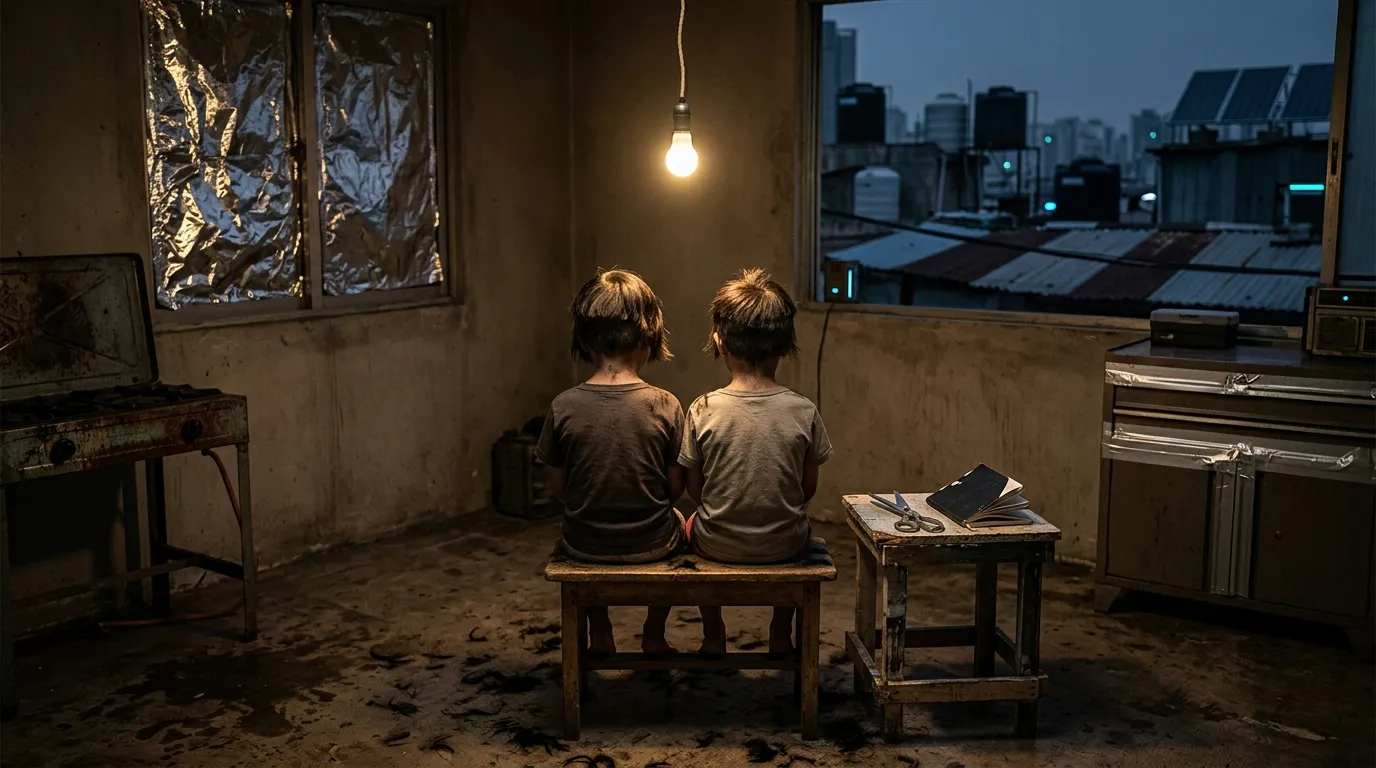
Héngyuǎn found a pair of scissors in the bathroom. Nothing special — blade somewhat dull, screw a little loose. But functional.
He called both sons to the living room.
“Sit down.”
Gé Luò sat first. He never asked why — he executed first, observed during. Gé Suǒ stood for a second, glanced at the scissors, then sat.
Héngyuǎn stood behind Gé Luò. Left hand on top of his head to hold it steady — the index finger was stable now, the tremor reduced to barely a whisper of the old single frequency. Right hand holding the scissors. Four fingers around the handle, pinky raised outside.
First cut: a clump of black hair fell to the floor.
Gé Luò tilted his head. “Haircut?”
“Yeah.”
“Why?”
“Practical.”
Gé Luò asked nothing more. His head moved slightly under Héngyuǎn’s hand, small shifts following the scissors’ rhythm. Héngyuǎn’s cut wasn’t neat — the right hand’s fine control wasn’t up to it, and the lengths came out uneven. But shorter. That was enough.
Gé Suǒ’s turn. As he sat down, his back was very straight.
Héngyuǎn tried the scissors in his left hand — his left hand was steadier than the right now. That fact made him pause for a moment. Left hand’s tremor improved to almost nothing; right hand’s fine motor reduced to thirty to forty percent. The dongle side effects and the downgrade’s cost had produced a strange rebalancing between his two hands.
He used the left hand. Better than the right by a margin. Gé Suǒ’s hair fell to the floor, mixing with Gé Luò’s. Same black. Same fine. Indistinguishable.
“Ba.” Gé Suǒ’s voice came from the bowed head.
“Yeah.”
“Hair grows back.”
Héngyuǎn’s scissors paused.
“It does.”
He brushed the last cut strands from Gé Suǒ’s collar. The motion at the back of the neck made his own incision pull faintly — the few-millimeter wound tightening when he straightened. He stood up.
The two boys stood. Two short-haired heads, round, uneven. Gé Luò touched his own head, wearing a slightly confused expression. Gé Suǒ didn’t touch anything.
Héngyuǎn swept the hair on the floor into a pile. Put the scissors back in the bathroom.
He went back to the living room. Notebook open on the table. Eighteen-step trigger sequence. Two nine-year-old tactical nodes. A three-millisecond pre-signal that Qiū Zhùmíng didn’t know about. And a dotted line — life-support pods — sitting steadily inside the reach of Rollback.
Sixteen days until relocation.
Héngyuǎn picked up his pen. Right hand. The pen barrel caught between his fingers at a different angle than before. He wrote one line at the bottom of the last page, then closed the notebook.
The line read: ready.