Chapter 21
Chapter Twenty-One: Commit
Chapter Twenty-One: Commit
The battery indicator shifted from green to yellow at 1:14 a.m. Héngyuǎn glanced at it — roughly sixty percent remaining. Enough to run Cornelius for an hour and a half. Tonight he only needed an hour.
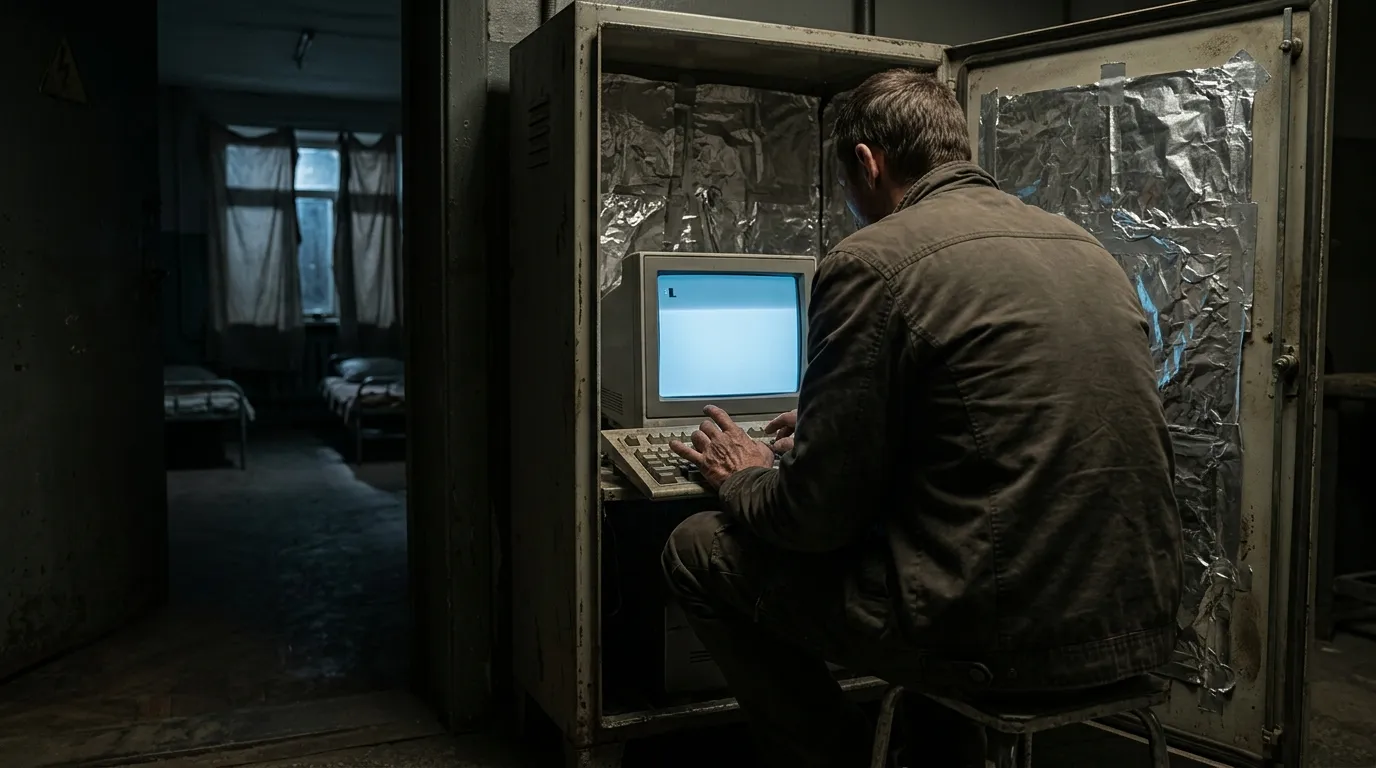
The air inside the Faraday cage carried a metallic taste. The tool cabinet door hung half open, and Cornelius’s screen was the only light in the space. Pale blue glow on the aluminum foil walls, refracted into irregular speckles. Like a very small, sealed aquarium — no fish inside, just an old machine that couldn’t run large models.
Héngyuǎn sat on the low stool. The notebook was spread across his left knee, open to the second-to-last page. The complete logic of the eighteen-step trigger sequence. The right-hand page was in Gé Suǒ’s handwriting — a size smaller than his own, but steadier in the strokes. Since the downgrade, the nine-year-old’s handwriting was better than his. He had accepted this.
He typed the first command. Four fingers of the right hand on the keys, pinky cocked about two centimeters above Enter, like an antenna that never caught a signal.
full_sequence_validation --mode=final --constraints=current_physical
Cornelius’s fan stepped up a gear. Waiting. Four seconds. Seven seconds. Cursor blinking.
The results began to scroll. He didn’t read line by line — he scanned the structure first. Module A dormancy confirmed. Module B dormancy confirmed. Module C implant eighteen-step logic validation passed. Constructors payload countermeasure logic validation passed. Delay valve parameter: 0.5 seconds—
His gaze caught there. Half a second. He had changed it himself. From 0.3 to 0.5. The extra 0.2 seconds didn’t change anything substantive — the life-support pods’ local failover would either trip in time or it wouldn’t. A 0.2-second gap in the chaos of a cascade failure was noise-level fluctuation.
The day he’d changed it, Gé Suǒ had been sitting beside him, typing. On the screen the life-support-pod line was glowing pale blue. He had stared at it for a long time, then reached out and edited the number. Gé Suǒ pressed save. Didn’t ask why.
0.5 seconds. He had told himself that day: this was doing a little something. Not nothing. A little something.
Now that “little something” sat quietly on the screen, waiting to be validated. Cornelius judged it the way it judged every other parameter: passed. Compliant. Within constraints. The machine didn’t know that the gap between 0.5 and 0.3 wasn’t an engineering decision — it was a man at the edge of a cliff, shuffling half a step back, only to discover the cliff was three hundred kilometers wide.
He scrolled down.
overall_success_probability: 12-18%
range determined by: physical_operator_variance (primary), cascade_timing_uncertainty (secondary), countermeasure_detection_risk (tertiary)
Twelve to eighteen percent. The primary variable was the operator’s physical state. His hand.
Héngyuǎn stared at the number. Not long. About three seconds. Then he started typing the next command. His fingers moved more slowly than before — not hesitation; he was checking the spelling letter by letter. He had never typed this command before.
if rollback_cascade triggers life_support_failover:
estimate civilian_casualty_range
--scope=all_affected_nodes
--variable=local_failover_capability
Enter.
The fan didn’t change pitch. Cornelius didn’t know what made this question different from the previous one. To it, they were all parameters, constraints, computation.
Six seconds.
Four lines appeared on the screen.
Unable to compute precise figure.
Estimated range: 50,000 - 3,000,000
Primary variable: per-node local failover capability (data incomplete)
Secondary variable: cascade propagation speed (model uncertainty ±40%)
Fifty thousand to three million.
Héngyuǎn read it through once. Then a second time. The numbers didn’t change. They wouldn’t.
Fifty thousand. The best case. All nodes’ local failover systems functioning normally, cascade velocity at the low end of prediction, independent power holding for seventy-two hours until external systems recovered. Fifty thousand dead — the ones inside nodes whose local failover happened to be flawed. Fifty thousand.
Three million. The worst case. Cascade velocity exceeding prediction, most nodes’ local failover too slow to engage, independent power draining before external systems came back. Three million.
And every number in between was a specific person. In a specific life-support pod. Mind trapped inside some engineered ordeal. Failover firing or not firing. Power holding or not holding. Alive, or no longer alive.
He thought about the delay valve. 0.5 seconds. He had “done a little something.” That 0.2 seconds of margin, set against a scale of fifty thousand to three million—
Like a man placing a single sandbag in front of a tsunami. Not a wall. One bag.
He shut the thought down. Not for the first time. Before, he had wrapped it inside a vague probability distribution — “life-support pods in the affected range” was a system-level description, no human face attached. But now Cornelius had given him numbers. Numbers weren’t systems. Numbers were head counts.
He moved the cursor to the top of the screen. Saved the complete results of this run to a local file. He typed final_validation_log as the filename. His fingers paused on the keyboard. Then he changed it to fv_log. Shorter. No other reason.
The battery indicator was still yellow. Cornelius’s fan turned steadily. Outside the Faraday cage, the whole building was black. No streetlights. Occasionally the beam of a flashlight swept past the window — scavengers, or a patrol. The beam skidded across the aluminum foil and was blocked.
Héngyuǎn reached out and pressed the physical button in the top right of the screen. The screen went dark.
The Faraday cage became pitch black in an instant. Only the faint yellow of the battery indicator. He sat in the dark. The keyboard was still warm. The fan’s hum seemed louder without the screen’s light.
He stood up. The stool’s leg scraped against the floor. The incision at the back of his neck tightened as he straightened — a three-millimeter wound, two days old, the edges starting to close but still aware of itself.
The corridor wasn’t long. Seven steps.
He counted, because there was no other coordinate system in the dark. His first step landed on the hair clippings left over from the day — barely-there pressure against the sole, like stepping on fragments of time. At the fourth step his right hand brushed the wall. Condensation on the tile surface. The night’s temperature gap between inside and out was just enough to bead a thin film of water on the north wall.
Seventh step. He stopped at the door to his sons’ room.
The door wasn’t closed. Yongkang District rules: doors unlocked — during power outages, you needed to gather fast. Two low beds stood against the wall, less than a meter apart. The curtain was pieced together from cut-up old clothes; moonlight leaked through the seams, drawing a few white lines on the floor.
Gé Suǒ faced the doorway. The frequency at which he turned in his sleep had increased noticeably over the past two weeks — Héngyuǎn knew because he’d counted on late-night passes. High-pressure-period behavior. The body maintaining some guard posture even in sleep. Facing the doorway. Facing the direction sound came from. A nine-year-old shouldn’t be maintaining a guard posture in his dreams.
Gé Luò’s face was buried in the pillow, only one ear and half the back of his head visible. His freshly cut hair was uneven in the moonlight, like a patch of grass just mown. His breathing was light, regular, carrying a faint nasal note — not a hum, more like the vocal cords vibrating unconsciously on the exhale.
Héngyuǎn stood at the door frame. Left hand on the frame. Right hand hanging at his side, pinky slightly cocked.
Fifty thousand to three million.
He looked at Gé Suǒ’s face turned toward the doorway. In the moonlight only half of it was visible — forehead, bridge of nose, upper edge of the lips. The other half sank in shadow.
He looked at Gé Luò’s exposed ear. Very small. The curve of the auricle hadn’t fully formed, still carrying that soft roundness only children have.
How many nine-year-olds were inside fifty thousand to three million.
The moment the thought arrived, his knees bent.
Not kneeling. Not stumbling. The standing body suddenly losing a support layer — like a system having a low-level dependency pulled while running, everything above it still there, but the foundation drops a notch and the whole structure sinks two centimeters. From outside it just looked like a man’s height suddenly became a little shorter.
He stood there. Knees bent. Didn’t drop to a crouch. Didn’t straighten either.
Gé Suǒ turned over. Still facing the doorway. His hand brushed the edge of the pillow — touched something, let it go. Maybe a daytime habit lingering into sleep. Maybe nothing.
Héngyuǎn’s left hand tightened on the door frame. Knuckles pressing into the wood edge. His breathing wasn’t disordered. He couldn’t check his pulse, but it didn’t feel accelerated. The rest of his body was still running normally. Only the knees — the knees weren’t listening. They had made a decision on their own, one that didn’t route through the cortex.
Fifty thousand to three million life-support pods. Each pod had a person inside. Each person might have children. Each child might be asleep on some bed, facing a doorway.
His knees sank a little further.
Then stopped.
He hadn’t stopped them. They’d hit bottom. The system had settled at a new equilibrium — a few centimeters lower than before, but stable. It wouldn’t keep collapsing. The structure still held.
He stood at the door for a long time. The moonlight moved a small distance — slid from Gé Suǒ’s forehead to his brow bone. He watched the line of light travel. He wasn’t thinking anything specific. What filled his skull wasn’t language, wasn’t numbers, wasn’t the trigger sequence. It was a white static that saturated the whole cavity.
Then his knees straightened.
Not slowly. In an instant. Like a hardware reset. The system springing back from the settled state to running height, no transition animation.
Héngyuǎn turned. Seven steps down the corridor. He walked back to the Faraday cage.
Low stool. Keyboard. Screen. He pressed the power button. The pale blue light came back on, on his face. Cornelius’s boot interface was loading. The fan spun back up. He glanced at the battery — yellow, around forty-some minutes of runtime. He didn’t need forty minutes.
He placed his hands on the keyboard.
Ten fingers. Nine resting on keycaps. The tenth — the right pinky — hovered to the right of Enter, touching nothing.
Cornelius’s command line waited. Cursor blinking. One second. Two.
He didn’t move.
The plastic of the keyboard still held the earlier warmth. His fingertips pressed against the letter keys without depressing them. The fan turned. The battery’s yellow light cast a blurred oval on the aluminum foil at the screen’s edge. Outside the Faraday cage were sleeping sons, unlit alleys, a compute-less night sky.
Five seconds. Ten.
The loop in his head wouldn’t stop. Every unit in the “fifty thousand to three million” range collapsed into one person, and then that person had a bed, a doorway, a child facing the doorway. The loop wouldn’t complete. The dataset was too large. But the processor didn’t stop.
Fifteen seconds. Twenty.
The loop produced no conclusion. It wouldn’t. This wasn’t a problem with a solution.
Twenty-five seconds.
His right hand moved. Index first. Then middle. Then ring.
C-o-m-m-i-t
Six letters. The key travel was about two millimeters. Every letter was struck with the same pressure — no hesitation-light, no anger-heavy. Just an operator executing an instruction. His typing speed was exactly consistent with every other input he’d made all night.
Pinky still hovering to the right of Enter.
He pressed Enter with his ring finger.
The echo of Commit flared on screen for a moment. Cornelius began executing the final lockdown sequence — all parameters frozen, simulation environment closed, file marked read-only. This wasn’t a Cornelius feature. It was a script Héngyuǎn had written himself. After Commit, no further modification allowed. Same as version control. Written into history. Irrevocable.
He watched the progress bar run to the end. One confirmation line:
Sequence locked. No further modifications permitted.
Héngyuǎn didn’t shut down. He took his hands off the keyboard and rested them on his knees. The right pinky cocked. The left hand lay flat, steady, more like a normal hand than the right.
The Faraday cage was quiet. The fan was still turning. The battery’s yellow light still on. The confirmation message stayed on the screen, unmoving.
He sat for a while. Not long. Maybe thirty seconds, maybe a minute. Then he powered down Cornelius, turned off the screen, closed the tool cabinet door. Resealed the edges with aluminum foil tape.
When he walked out of the Faraday cage, his feet landed on those hair clippings again.