Chapter 22
Chapter Twenty-Two: 404 Not Found
Chapter Twenty-Two: 404 Not Found
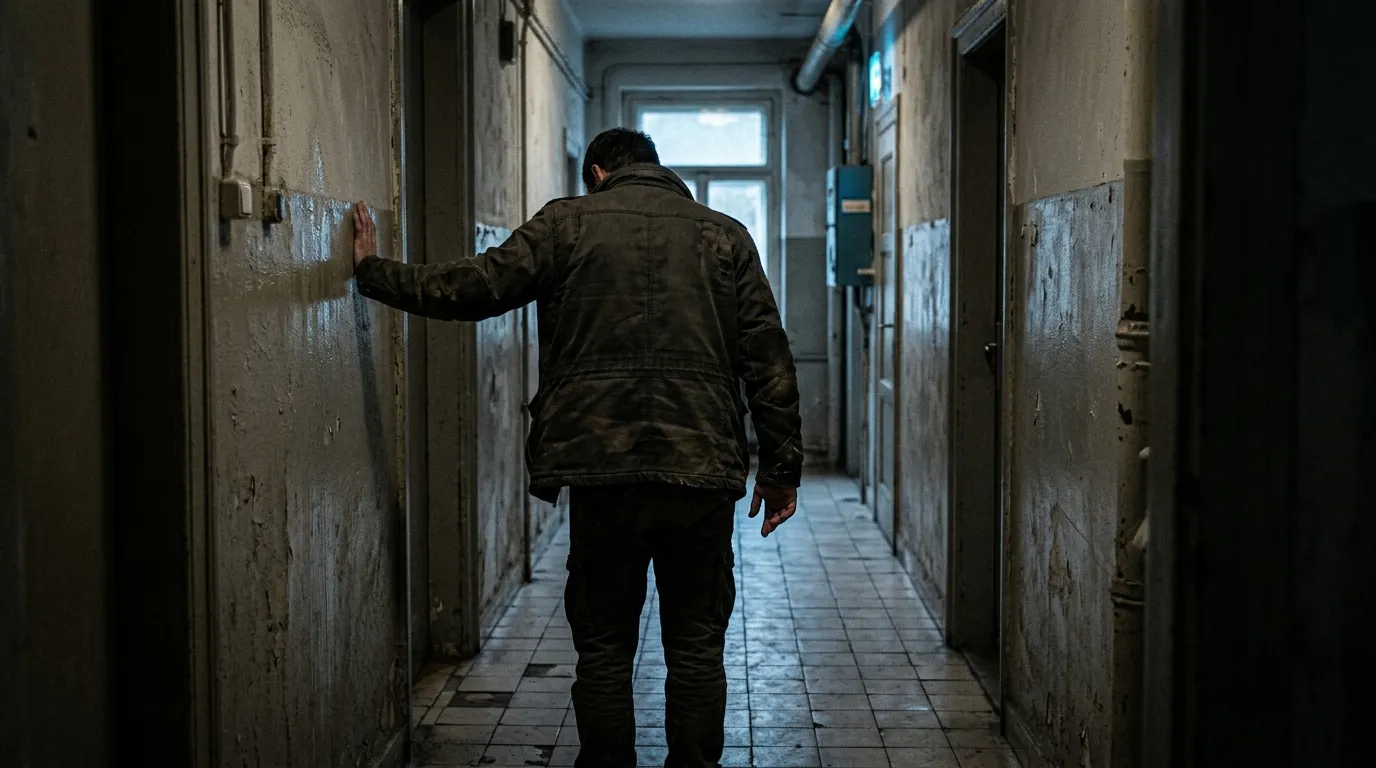
3:11 a.m. Héngyuǎn sat on the corridor floor.
Back against the wall. The tile’s cold seeped through from behind, climbing up along his spine. The three-millimeter incision at the back of his neck was pinned between wall and skin, slightly swollen. He didn’t adjust his posture.
The Faraday cage was two steps to his right. The door was closed, the aluminum foil tape resealed. His sons’ room was five steps to his left. Moonlight bled in from the end of the corridor, laying down a thin gray wash across the floor.
His notebook was open on his knees. Eighteen-step trigger sequence. Commit complete. In the top right of the page he had written the time in pencil: 02:27. It was now 3:11. Forty-four minutes ago he had locked everything down.
He should go to sleep.
The body didn’t move. Not that it didn’t want to — the difference between moving and not moving was too small to be worth spending energy on choosing. The post-Commit world was a straight line. From now until operation day, all the time in between was waiting. Waiting didn’t require a posture.
He turned a page of the notebook. Not with purpose — the fingers were running on inertia. The page he landed on had a slip of paper tucked behind a blank one. A quarter of an A4, with a crease in one corner. The file index for the encrypted payload in Qiū Zhùmíng’s microSD — he had printed it when dismantling the payload. Most entries had pencil check marks. Three-segment addressing. Compute-scheduling layer. Cross-zone credit routing table. All dismantled.
But one entry had no check mark.
The last line. An encrypted block he had marked “low priority” at the time. Not because its encryption grade was high — on the contrary, its encryption grade was the lowest in the whole payload. Standard AES-128. Qiū Zhùmíng probably hadn’t considered it worth stronger crypto. Héngyuǎn had glanced at the file header then: partial mirror of a personnel database. Unrelated to the attack plan. Skip.
Now he was staring at that line. Not out of curiosity. The notebook had just opened to this page.
He stood up. Took two steps. Tore off the aluminum foil tape. Turned sideways and went in. The stool was where he’d left it.
When Cornelius started up, the battery indicator flickered from yellow to red, then back to yellow. Less than thirty percent remaining. He didn’t need long.
He fed the file header of that encrypted block into Cornelius. AES-128. He had already mapped Qiū Zhùmíng’s key habits while dismantling the three-segment addressing — a QA engineer’s instinct was to use the same key-management logic, only adjusting length by tier. Low-priority files got low-priority keys. Cornelius ran eleven seconds.
Decryption successful.
Data began to scroll on the screen. Table format. Column headers:
ID | INTAKE_DATE | SOURCE | CYCLES | STATUS | CLASS | OUTPUT_RANK | NOTES
He scrolled down. Hundreds of rows. Each row a person — a person inside a life-support pod. ID, intake date, source region, cycle count, status, classification, output rank, notes.
The data itself didn’t surprise him. He knew the pods existed. He knew there were people inside them. He had calculated the fifty-thousand-to-three-million casualty range before Commit. These IDs just turned “range” into “list.”
He began to scan. Not line by line — the way twenty years of fault-hunting had taught him to let his eyes slide across data, waiting for an anomaly to jump out on its own.
Row forty-seven.
HA-0917 | 2050-11-14 | TK-South | 1247 | ACTIVE | TIER-1 | 99.9%ile | irreplaceable flag
His gaze didn’t stop. TK-South. Tainan Southern Science Park region code. Intake date November 14, 2050. His eyes kept scrolling down three more rows.
Then stopped.
Not stopped by consciousness. The eyeballs rebounded on their own — like fingers hitting the wrong key, muscle memory beating the brain by half a beat, pulling the cursor back into position. His gaze settled again on row forty-seven.
November 14, 2050. TK-South.
Xǔ Jìng’s disappearance date was November 13, 2050. Official notification arrived the morning of the 14th. Structural collapse. Body unrecoverable. He remembered that date because he had carved it into his brain stem — not memorized, burned in.
One-day gap. Could be coincidence. Collapse on the 13th, record on the 14th. TK-South’s coverage area included all of Southern Science Park and the surrounding zones. A lot of people lived there.
He looked right. OUTPUT_RANK column: 99.9%ile.
Qiū Zhùmíng’s words surfaced from the archived memory. “Third Tier output quality has been abnormally high lately.” Gray zone. Thermos. Sijichun oolong. Slow cadence. “This number isn’t right.”
At the time he had archived that sentence as-is. Added no speculation. Now the speculation walked in on its own.
Abnormally high output quality. Top 0.1%. Irreplaceable flag.
Xǔ Jìng.
Three years ago. Structural collapse. Body unrecoverable. He had held the memorial. He had turned the photograph facedown in a drawer. He had learned not to touch that name — like routing around a stretch of road known to be mined, and eventually the rerouting itself became reflex, until even the mines were no longer in mind.
She hadn’t died.
She was in a metal container. ID HA-0917. 1,108 days in the pod. Over 1,247 cycles, waking up again and again not knowing who she was, solving an engineered ordeal, being wiped, starting over.
His lung skipped a beat. Like a program hitting an instruction it didn’t recognize, freezing there, waiting for input.
He opened HA-0917’s detailed record.
The data on screen was very cold. System format. No tone. No adjectives. Each line was a field name followed by a value.
Cumulative cycles: 1,247
Days in pod: 1,108
Memory erasure executions: 1,247
Declarative memory erasure rate: 97.3% (average)
Procedural memory erasure rate: 62.1% (average)
Emotional memory erasure rate: 71.2% → 64.8% (recent 12-cycle trend)
One thousand two hundred forty-seven times.
His hand came off the keyboard. Not lifted — the fingers splayed, like touching something hot.
One thousand two hundred forty-seven times. One thousand one hundred eight days. On average, more than once a day. Each time, 97% of declarative memory wiped. She didn’t know who she was. Then dropped into an ordeal. Then solving the ordeal. Then wiped. Then again.
He scrolled down.
Behavioral inertia markers:
- Reverse-decomposition tendency (prioritized in 92.3% of ordeals)
- Vocalization habit: low-frequency humming, 4-7 note fragments, appearing periodically in mid-ordeal
- Somatic memory residue: right-hand arc motion (radius approx. 8-12cm), trigger conditions unknown
Think it backwards.
Héngyuǎn’s gaze stopped at the equivalent of those three words. “Reverse-decomposition.” What the system logged in jargon, he had known in human language for thirty years. Xǔ Jìng’s way of solving problems. Working from the result back to the cause. From the endpoint back to the start. She read papers by looking at the conclusion first; she assembled furniture by looking at the finished diagram first; the sentence she said most often in the lab was—
His lips moved.
No sound. The corridor was silent, the Faraday cage was silent, Cornelius’s fan was turning but he couldn’t hear it.
Humming. Four to seven notes. She was humming in the life-support pod. 97% of her memory wiped, she didn’t know what she was humming, but her throat remembered. Her vocal cords remembered the first phrase of a song.
Right-hand arc motion. Radius eight to twelve centimeters.
He knew what that was.
It was stroking a small child’s head. The arc of a hand moving from forehead to the back of the skull. Gé Suǒ’s head circumference — he had measured it — was between eight and twelve centimeters. Three years ago, it was. Now it was bigger. But her hand didn’t know. Her hand was stuck three years ago.
The text on the screen was still there. System format. Field names. Numerical values. Percentages. No tone. No adjectives.
Héngyuǎn’s engineering vocabulary broke here.
Not gradually failing. One particular fuse blew. He had spent a lifetime translating every sensation into system language. Delay valve. Failover. Cascade. Parameter. Commit. But the numbers on the screen refused to be translated. 1,247 times wasn’t “cycle count.” It was 1,247 mornings of opening her eyes and not knowing who she was. Four to seven notes wasn’t “vocalization habit.” It was a throat, after memory had been erased, still singing a song shared between two people. Eight to twelve centimeters wasn’t “arc motion.”
It was her hand reaching for a child’s head.
His right hand rested on the edge of the keyboard. His left hand lay on his thigh, trembling once, faintly. His body didn’t move. His eyes didn’t blink. The screen’s light lay across his face. The fan turned. Battery yellow.
Then he said something.
Not to Cornelius. Not to himself. Not to anyone. His mouth opened, vocal cords vibrated, a sentence walked out, bypassing every system he used to manage language.
“You’re still counting.”
Three words. Very soft. Volume just barely enough to reach the screen. The Faraday cage’s aluminum walls held those three words inside the one-and-a-half-meter space; they could go nowhere.
Emotional-memory decay rate. 71.2% to 64.8%. Over twelve consecutive cycles. Declining.
She was still counting. Didn’t know what she was counting. But the number was moving.
Héngyuǎn’s breath was shallow. The chest barely moved.
He sat on the low stool. The screen glowed. The data held still. His eyes were open but the focus had dispersed — the text became blurred points of light. Not tears. The eyeball had lost its focus command. Like the motor had been pulled out of an autofocus lens.
He didn’t know how long he sat. It was the battery indicator flicking from yellow to red that brought him back.
Not gradually. The red blink’s single pulse pulled him back. Emergency signal. The system was about to lose power.
He blinked once. Focus re-locked. The data on the screen resolved back into text. HA-0917. 1,247 cycles. Emotional-memory decay rate still declining.
He looked down at his hand.
Right pinky cocked. The other four fingers resting on the edge of the keyboard. Left hand flat on the thigh. Steady.
There was a voice in his head — not Xǔ Jìng’s voice, his own voice — repeating a fact: Commit has executed. Trigger sequence locked. Eighteen steps. Unmodifiable. Rollback will reach the life-support power systems. Delay valve 0.5 seconds. That 0.5 seconds he “did a little something” about — it was for all life-support pod nodes. Broadcast. No priority.
But now one node had a name.
HA-0917. He knew her ID. He knew her node. He knew where that node sat in the data structure.
What Commit locked was the trigger sequence. Eighteen steps. Parameters frozen. Unmodifiable. But Commit didn’t prohibit adding independent subroutines — the lockdown script he’d written only locked files under the sequence_final directory. New scripts could be written elsewhere.
He could write a section pointing precisely at the node where HA-0917 lived. A failover subroutine. Not broadcast — point-to-point. At the same moment Rollback triggered, preemptively inject a force-switch-to-backup-power instruction into that one node. Highest priority. Not routing through the scheduling layer — point-to-point instructions went over local paths, not competing with Qiū Zhùmíng’s scheduling-takeover logic for the same channel.
Cost: point-to-point protection would take up additional trigger-sequence bandwidth. Attack effectiveness would lose another two to three percent. Success rate from the original 12-18% down to—
He calculated three seconds in his head. About ten to fifteen.
Two or three percentage points. But inside those two or three percentage points was HA-0917.
The red battery indicator blinked a second time. He reached under the stool and took out the spare battery. Swapping batteries needed both hands — left hand holding the slot, right hand’s four fingers pushing in the new battery. Pinky cocked outside. Three seconds. Done.
Yellow light came on. Cornelius hadn’t lost power.
He put his hands back on the keyboard.
Opened a new file. Not under the sequence_final directory. A new directory: failsafe_local.
First line:
target_node: [HA-0917_location]
Cornelius needed to map HA-0917’s ID to a physical node address. He typed the query. Seven seconds. Result came back. Three-layer nested address structure. Zone 4, Rack 1172, Pod 9.
He began writing the failover logic. Not long. Twelve lines. Shorter than any subroutine he had ever written.
At line seven he paused.
Line seven was the trigger condition for power switching. What he had typed was if power_loss > 0.3s — if power loss exceeded 0.3 seconds, force switch to backup. 0.3 seconds. Faster than the main sequence’s delay valve of 0.5 seconds.
He stared at the number. 0.3.
The 0.5-second delay valve was what he had changed the day Gé Suǒ typed for him. From 0.3 to 0.5. The extra 0.2 seconds was for all life-support pods. It was him “doing a little something.”
Now he was giving 0.3 to one person.
Not everyone. One person. One ID. One node. One twelve-line subroutine.
His sharp edge flashed here. He didn’t look away. He didn’t wrap it in engineering language. It was what it was: he had picked one row out of a list of fifty thousand to three million and given her the fastest protection. Because her fingers still remembered the arc of a child’s head. Because her throat was still humming a song he had listened to for fifteen years. Because her decay rate was declining.
Because she was his.
He didn’t scroll through the rest of the hundreds of rows. Who was in row forty-eight, he didn’t know. He didn’t plan to know.
He kept writing. Line eight. Line nine. Line ten. The four fingers of his right hand moved across the keyboard, steady, the same pace as when he’d typed Commit. The left hand pressed the space bar occasionally.
Line eleven. Line twelve.
failsafe_local_HA0917: complete.
He ran a validation. Cornelius took nine seconds. Result: logic passed. No conflict with sequence_final. Bandwidth usage: 2.7%. Success rate revised down to 10.4-15.6%.
He stared at that number for two seconds. Then saved.
Cornelius asked him whether to name the file. He typed a name. Backspace. Deleted. Typed another. Backspace again.
In the end he typed fl_09.sh. Nothing identifying. Local failover script number nine.
He powered down Cornelius. Turned off the screen. The Faraday cage went black again. Battery yellow. Fan winding down.
He closed the door. Aluminum foil tape resealed. Walked out.
Corridor. Seven steps. At the third step he stopped.
Not from hair clippings underfoot. His body was suddenly very heavy. Not the knees — this time it was the whole man. From crown to sole the gravity seemed to have doubled. He stood in the middle of the corridor, left hand against the wall, right hand hanging. Moonlight fell on the back of his hand. The pinky’s shadow was shorter than the others by a notch.
He leaned on the wall. The tile was cool.
His sons’ door was at the end of the corridor. Five steps. Gé Suǒ facing the doorway. Gé Luò’s face in the pillow. He couldn’t see them. But he knew they were there.
His wife was in some metal container a thousand-plus kilometers away. Her memory was wiped once or more a day. She didn’t know she had two sons. But her right hand every few cycles drew an arc of eight to twelve centimeters.
He stood in the corridor. Some hour of early morning. The moonlight moved a small distance on the floor.
He wasn’t sure what state he was in. He turned through his head. Null return? No, he was still processing. Cascade failure? No, the system hadn’t crashed. He finished turning. Empty.
His throat moved once. Not to speak. Something in the chest had pushed up — a note squeezed out of the windpipe. Tuneless. Somewhere between a sigh and a hum.
Then a second note. Slightly higher than the first.
Then he closed his mouth, closed it hard, teeth clicking together with a faint sound. He knew what those two notes were the beginning of. The opening of the song Xǔ Jìng had hummed 1,247 times.
There was something on his face. He didn’t wipe it.
Straightened up. Moonlight had moved.
Three steps. Past the spot where he had stopped. Four. Five. At the door to his sons’ room.
He didn’t go in. Stood at the door frame and looked once. Gé Suǒ had turned over, still facing the doorway. Gé Luò’s breathing carried that faint nasal note.
He turned and walked back to his own room.
Lay down on the bed. Eyes open. The ceiling was black.
Eighteen-step trigger sequence. Locked. Unmodifiable. fl_09.sh. Twelve lines. Zone 4, Rack 1172, Pod 9. 0.3 seconds.
10.4-15.6%.
He put his right hand on his chest. Four fingers. Pinky cocked. The heartbeat was under his fingertips. Regular. Slow.
Outside, the sky began to shift from black to gray. Very slowly. The silhouette line of the Southern Science Park ruins hadn’t yet surfaced. In the distance a flashlight beam swept once and went out. A scavenger heading home. Or a patrol ending.
Héngyuǎn closed his eyes.
He wouldn’t sleep. But he could keep his eyes closed until dawn. After dawn came daytime. After daytime came the countdown before operation day. After the countdown came eighteen steps. After eighteen steps came—
He stopped calculating. Cornelius couldn’t compute a precise figure. Neither could he.
Some things sat outside computation.