Chapter 23
Chapter Twenty-Three: The Last Dongle
Chapter Twenty-Three: The Last Dongle
Dawn came. Héngyuǎn didn’t move.
He lay on the bed, watching the ceiling turn from black to gray to white. About forty minutes. He kept his eyes open the whole time. Not insomnia — an active choice not to power down. Like a server in its pre-deployment hold: all processes loaded into memory, waiting only on an external signal.
The ceiling turned white. The signal came.
He sat up. Slowly. The body had its own inertia after a whole night awake. The incision at the back of his neck tugged when he turned his head. Two days. Edges scabbed but not healed. He didn’t care. After today, this wound would become the least noteworthy thing on him.
Living room. The Faraday cage door was closed. Aluminum foil tape intact.
He didn’t open it first. Went to the kitchen first. Ran the faucet three seconds, caught half a cup of water. Took a sip. Choked — his throat was dry enough to have forgotten how to swallow. Second sip went down. On the third, footsteps came from the end of the corridor.
Gé Suǒ. Yesterday’s clothes on. Hair flattened on one side. He stood in the kitchen doorway, looking at Héngyuǎn.
No good-morning. A nine-year-old in this household had learned: some mornings didn’t need greetings; they needed status confirmation.
“Eaten anything?” Gé Suǒ asked.
“Not yet.”
Gé Suǒ turned and got the mantou left over from yesterday. Cold. He set it on the table. Héngyuǎn glanced at it, tore off a corner and put it in his mouth. Chewed like cardboard. But carbs were carbs. Today’s operation needed a stable blood-sugar baseline; hypoglycemia would double the tremor in his fingers — and he had no margin left.
“Your brother?”
“Still asleep.”
“Wait a bit longer.”
Héngyuǎn finished half the mantou. Drank what was left of the water. Stood up and walked to the Faraday cage.
When he tore off the aluminum foil tape, his fingertip feel was duller than usual — four fingers of the right hand barely completing the fine peeling motion, pinky cocked outside, like an employee who had been dismissed but hadn’t yet left the office. The left hand steadied things, and at the base of his thumb the single-frequency twitch was faintly visible as he gripped the edge of the door.
Cornelius booted. Battery green. Last night it had charged on solar a full night. Today didn’t need much power — he only needed to run the final rehearsal once.
He typed a command:
contingency_drill --scenario=early_detection --switch_threshold=step_11
Cornelius thought for six seconds.
Two operation sequences scrolled onto the screen side by side. Left: primary plan, eighteen steps, full Module C implant + fl_09.sh + three-segment mirror redirect. Right: backup plan, first eleven steps shared, back half compressed from seven steps to four — Module C core trigger + fl_09.sh + single port overwrite + terminate. Lower precision, but completable within the compression window after detection.
Eighteen steps was precision surgery. Fifteen was a hemostat.
He walked both sequences through in his head. His right-hand fingers tapped silently on his thigh — simulating the operating rhythm. The primary plan’s step nine had a micro-rotation, requiring index and middle finger to cooperate at a specific angle. He tried once. Delay about 0.2 seconds. Within tolerance. Barely.
The backup plan had no micro-rotation. Pure straight-line keystrokes. Like using a hammer in place of a screwdriver — it could hold the thing in place, but not gracefully.
He saved both sequences. Powered down Cornelius. Battery back to standby.
Walked out of the Faraday cage. Resealed the tape.
Gé Suǒ was sitting on the living-room floor, notebook open across his knees — not Héngyuǎn’s, his own. Smaller, cover cut from some food packaging board. Héngyuǎn could see a few lines of writing, letters small, illegible.
“Cornelius is yours later,” Héngyuǎn said, crouching down. His knee popped. “After I leave, open it. Run public_channel_monitor and cascade_estimator. If the public channel shows anomalous query density for the 710 region—”
“Notify you,” Gé Suǒ said. “By what channel?”
“Don’t notify me. I can’t receive anything.” After downgrade there was no remote path. “You only log. Timestamps and query patterns. If—” He paused. “If I’m not back in two hours, take your brother to Auntie Wēng’s.”
Gé Suǒ’s pen paused. He looked at Héngyuǎn.
He didn’t ask why. He didn’t ask how the two hours were calculated. He just put that sentence into his own system — Gé Suǒ blinked once, lips pressing together slightly.
“Got it.”
Héngyuǎn stood up. The knee popped again. A forty-eight-year-old knee plus thirty-some sleepless hours — the ligaments were protesting.
He walked to his sons’ room. Gé Luò was still asleep. Face buried in the pillow, one ear out. Héngyuǎn crouched beside the bed.
“Gé Luò.”
A hum. Nasal. Gé Luò turned over, eyes half-open.
“Ba?”
“Get up. Listen for buzzing today. For me.”
Gé Luò’s eyes opened all the way. He sat up faster than usual — not because he was nervous, but because “help” had acquired weight over these past few days. He knew his buzzing was useful. He didn’t entirely understand how, but he knew his father meant it.
“The square kind?”
“Yeah. The square kind. You stay at the mouth of the alley — don’t leave it. If you feel the square buzzing, you—” Héngyuǎn pulled a piece of metal from his pocket. Scrap from a disassembled casing. “Hit the wall. Three times.”
Gé Luò took the metal. Turned it over. “Hit three times and then what?”
“Then nothing. Keep listening. If there’s another square one, hit three more times.”
“Okay.” He hopped off the bed. “Can I bring water?”
The corner of Héngyuǎn’s mouth moved. At the final prep meeting before a human executed a top-clearance infiltration operation, the nine-year-old perimeter sentry’s most pressing logistical concern was: can I bring water.
“Bring it.”
The alley was narrow. Yongkang District buildings were spaced 0.8 to 1.2 meters apart, just enough for two people to pass sideways. Héngyuǎn walked in front, notebook tucked behind at his waist, covering the incision at the nape of his neck. Not camouflage — habit. Showing a neck port in this area was basically holding up a sign that read I have a chip.
Gé Luò followed behind, metal piece and a bottle of water clutched in his hand. His steps were lighter than Héngyuǎn’s, tilting his head every three paces — listening.
They reached the alley mouth. Héngyuǎn stopped.
From here to the target verification terminal was about four hundred meters. A half-collapsed commercial building, B1 level. The last high-clearance window Qiū Zhùmíng had arranged — the shift table called it “cooling system maintenance verification.” Héngyuǎn didn’t know what Qiū Zhùmíng had paid for this window, and didn’t plan to find out. What was left after trust broke was not trust — it was transaction.
“Gé Luò.”
“Mm.”
“What do you hear?”
Gé Luò tilted his head. Three seconds. “Round ones. Lots of round ones. Sliding-past kind.” He frowned. “There’s one — not square. Flat. Like a square that’s been pressed down. Far away.”
Héngyuǎn translated in his head: baseline ambient normal. A low-intensity scan signal in the distance — probably routine patrol, not directed tracking. Can move.
“You wait here. Remember — square, hit three times.”
“I know already.”
Gé Luò found a corner against the wall and sat down, back against brick, water bottle at his feet. He looked like a kid waiting for a school bus.
Héngyuǎn turned. Walked three steps.
“Ba.”
He stopped.
“Round ones I don’t worry about, right? Just the square?”
“Right.”
“Okay.”
Héngyuǎn kept walking. Four hundred meters. He counted his paces. Not for measurement — to suppress his heart rate. Every step was a counter incrementing. The counter didn’t think. The counter just added one.
B1. Cast-aluminum wall panels. Cold fluorescents. The ozone smell was heavier — heavier than last time, probably the ventilation had stepped down another layer. Héngyuǎn rounded the corner and saw the door he knew — the verification room. Metal door. No markings. Last time he’d come here it was for Module B’s implant. That time he’d had full Layer 2, had AI assistance, and only needed to smuggle contraband in between relay gaps.
This time was different. This time there was no AI. Only his own hand, his own memory, and a notebook with eighteen steps written in it.
No line at the door. Qiū Zhùmíng’s window was exclusive — not standard scheduling, no shared slot with other Dongles. Héngyuǎn didn’t know if this was privilege or trap. Possibly both.
He stood at the door. Deep breath. Once.
Pulled the notebook from his waist. Turned to the second-to-last page. Eighteen steps. Ink and pencil mixed. The first sixteen were his own writing: slanted, heavy-handed, a few marks of correction. Steps seventeen and eighteen had a few symbols Gé Suǒ had filled in for him — steady, clear, better-looking than his.
He walked through each step in his head one last time. Didn’t speak aloud. Lips didn’t move. Only the eyes tracked across the page.
Step one. Post-pre-validation wait window — 0.8 seconds. Fingers in position.
Steps two through six. Module C core code injection. Straight-line keystrokes. No fine control needed. Four right-hand fingers sufficient.
Step seven. Checksum. Pause 0.3 seconds for system confirmation.
Steps eight through eleven. Trigger logic deployment. Precision starts here — step nine’s micro-rotation. He simulated the cooperation angle of index and middle in his head. Possible. Should be.
Steps twelve through sixteen. fl_09.sh injection. Point-to-point instruction, bypassing the scheduling layer. Zone 4, Rack 1172, Pod 9. He repeated the physical node address three times in his head. Three was enough. That string was already carved into the border between his personal memory and his engineering memory — half coordinate, half name.
Step seventeen. Constructors payload mirror redirect. Port address overwrite. Qiū Zhùmíng didn’t know this step existed.
Step eighteen. Confirmation signal. Full sequence terminates. Trigger enters delay state. Seventy-two hours.
He closed the notebook. Tucked it back behind his waist.
He walked into the verification room.
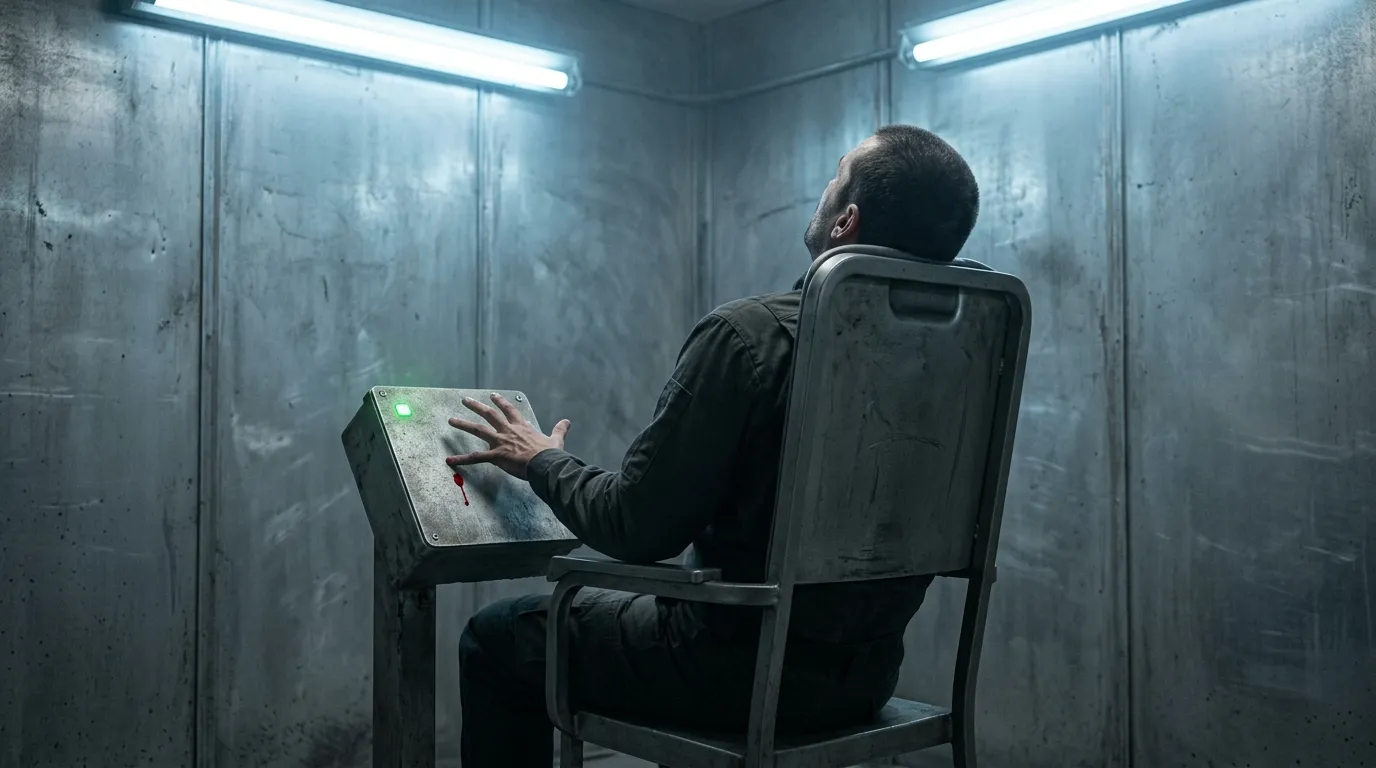
Three meters square. Metal chair. Recess. Same as in memory. The cold fluorescent hummed overhead — frequency a little higher than last time, possibly ballast aging. Ozone mixed with a faint trace of copper rust.
He sat with his back to the chair. As the back of his head neared the recess, the incision at his neck brushed the metal edge. Cold. Then pressure — probe array aligning, locking on C3-C4.
Click.
Connection established.
Pre-validation began. Three biosignals read simultaneously — brainwave entropy, microvascular pulsation, skin conductance. Vertigo. Heart rate kicked up two beats. Faint sweat at the back of his neck.
But this time the vertigo was milder than before. The downgrade had stripped Layer 3; Layer 2 remote functions were cut too — his nervous system was now “cleaner.” Fewer digital signal artifacts, more raw biological noise. What the verification system was reading was a more human-like signal than before.
Passed.
No AI injection. There wouldn’t be. A downgraded chip had no capacity to receive instruction injection. From this second on, his fingers took orders only from him.
Step one.
Right index fell. Force controlled to the minimum of key-travel activation. No AI calibrating for him — he was running on five years of Dongle operations pressed into muscle memory. Index. Middle. Ring. The rhythm was his, not the machine’s. Slower. Clumsier. But each stroke was his.
Step two. Step three.
Module C’s core code entered the terminal’s buffer. Straight-line keystrokes.
Step four. Step five. Something moving in the nasal cavity. Not blood yet — not yet. Mucosa engorgement pressure. Intracranial pressure rising. Downgraded neural paths overloaded more easily than intact ones, because Layer 2’s remote buffer wasn’t there to distribute the load. All of it pressed onto local paths.
Step six. Heart rate eighty-three. Workable.
Step seven. Checksum. His fingers held for 0.3 seconds. System confirmation. Pass.
Step eight. Trigger logic deployment began. The finger rhythm shifted from straight-line to combined sequences — three to four keys per step, order and timing both strict. His brain was doing two things at once: executing the current step and preloading the next. Like a single-core CPU simulating multi-threading.
Step nine. Micro-rotation.
Index and middle cross-angle thirty-five degrees. He tried — delay. Not 0.2 seconds. 0.4. Twice the rehearsal time. The lubricant in his fingers had thinned after thirty-plus hours of dehydration. Joints stiff.
He completed the rotation through gritted teeth. The system accepted it — at the edge of tolerance. Like a key turning five extra degrees in a lock. Edge of tolerance. It opened.
Step ten. Nosebleed arrived.
Left nostril. Running down the philtrum. He didn’t wipe. Wiping meant lifting a hand. Lifting a hand meant interrupting the sequence. Interrupting meant repositioning. Repositioning took time. Time was what he didn’t have.
A drop hit the operating console. One drop. He continued.
Step eleven. Tinnitus. Right ear. Frequency around four kilohertz — like someone had placed a tuning fork inside the ear canal and walked away. Continuous, steady, not planning to stop. He classified it as background noise, demoted it from the attention priority list.
Just as he completed the step-eleven confirmation—
Three knocks came through the wall.
Metal on brick. Dull. Even. Spacing about one second.
Gé Luò.
Square buzzing. Active scan.
Héngyuǎn’s fingers hovered over the console. Heart rate jumped from eighty-seven to ninety-four. Active scan wasn’t the same as directed tracking — but active scan was the prelude to directed tracking. The Equilibrists’ tracking AI was sniffing.
He had two choices.
Continue the primary plan. Eighteen steps. Seven remaining. Normal execution needed about forty seconds. If the tracking AI was sniffing, after forty seconds it might have locked onto this terminal’s anomalous traffic.
Switch to backup. Enter the simplified sequence from step twelve. Four steps replacing the planned seven — fl_09.sh injection, Module C trigger confirmation, simplified mirror redirect (single port overwrite, not full three-segment remap), terminate signal. About twenty seconds. Precision down. Mirror redirect from “complete coverage” to “rough coverage.” In the chaos after Rollback, the Constructors might seize a ten-to-fifteen-percent takeover window.
But he would walk out of this room alive. His son was waiting at the alley mouth.
Forty and twenty. Seven and four. Complete and rough.
He switched.
In his head the sequence flipped from eighteen steps to fifteen. Like changing acts mid-run in a script rehearsed dozens of times — the actor knew the lines, just a different version. Muscle memory realigned. His right index found the first keycap of the simplified sequence.
Step twelve (backup). fl_09.sh.
Zone 4, Rack 1172, Pod 9. Point-to-point instruction moving from his fingers through the console into the terminal, bypassing the scheduling layer, taking the local path. Twelve lines of code. Each line had weight in his head — not the weight of code, but the weight of the person inside the metal container the address pointed to.
His fingers were executing. Heart rate ninety-six. Nosebleed hanging at his chin, about to drip. Tinnitus spread from right ear to left — both ears at four kilohertz, like stereo.
Step thirteen (backup). Module C trigger confirmation. Three packets. Each packet carrying a biological-noise stamp. The post-downgrade stamps were more chaotic, more raw than before — the tracking AI’s statistical model was built on normal chip users; downgraded signal profiles fell outside the model’s training set. It couldn’t tell this was anomalous.
This was the downgrade’s only gift.
Three more knocks. Gé Luò.
Héngyuǎn’s fingers didn’t stop. They couldn’t. A second round of knocks meant the scan frequency was increasing — the tracking AI wasn’t just sniffing anymore, it was narrowing the radius. But he had only two steps left.
Step fourteen (backup). Mirror redirect. Simplified version. Single port overwrite. Not the precise surgery of a three-segment remap — more like throwing a cloth over something and hoping no one lifted it. Qiū Zhùmíng’s payload, after Rollback triggered, would try to seize compute scheduling rights. This overwrite would block most paths, but not all.
Héngyuǎn’s fingers finished the overwrite sequence. Heart rate one-oh-one. Vision starting to blur at the edges. Not fear — pure physiological ceiling. Something had to be released.
The vision went.
Step fifteen (backup). Terminate signal.
Right index tapped the final key. Force twice what was needed — not intentional; his fingers had lost fine control in that moment, leaving only “strike” and “no strike” as states. On-off. No intermediate values.
The terminal’s confirmation light lit for 0.5 seconds. Green. Then off.
Trigger implanted. Modules A, B, C all in position. fl_09.sh injected into the target node. Mirror redirect executed. Delay mechanism engaged.
Seventy-two hours.
Héngyuǎn’s hand slid off the console. Not set down — fell off. The fingers had lost all tension. The four right-hand fingers and the palm had no space between them, as if flattened. Pinky cocked. The left hand’s single-frequency twitch had escalated from micro-tremor to visible shake. He made a fist to pin it down — held three seconds, released. The shake dropped back to micro-tremor.
The probe array disengaged. Click. The pressure at his neck vanished. The incision stung at the moment of separation — a patch of scab tore loose.
He stood up. This time the knees didn’t buckle — not because the body was better than last time, but because the adrenaline hadn’t left yet. When it did, it would settle the bill.
The nosebleed was still running. He wiped with the back of his hand. Red drew a diagonal line from nose to mouth corner. No tissues. Only him today.
Out of the verification room. Corridor. Cold fluorescents. Cast-aluminum wall panels carrying the prints of his right-hand fingers — sweat. He walked ten steps. Twenty. Up the stairs. Ground level.
When the sunlight hit his face, his eyes hurt for a moment. Pupils had been underground too long; light response was half a beat slow. He stood at the exit waiting for his eyes to adjust. Tinnitus still there. Nosebleed slowing. Heart rate he didn’t know — no chip readout now; he only had feel. Fast. But falling.
Four hundred meters. He walked back. Not counting paces. The counter had completed its task.
Alley mouth. Gé Luò still sitting against the wall. Water bottle half empty. Metal piece in his hand. He stood up when he saw Héngyuǎn — then saw the blood on his face.
“Ba! You—”
“Nosebleed,” Héngyuǎn said. “I’m fine.”
Gé Luò stared at him for two seconds. Then fished a wad of paper out of his pocket — some flyer he’d picked up somewhere, crumpled into a ball. He stood on tiptoe and extended it under Héngyuǎn’s nose. The angle was off. The wad was too big. But the intent was clear.
Héngyuǎn took the paper. Didn’t use it. Stuffed it in his pocket.
“How many squares came?”
“Two. I hit. Did you hear?”
“I heard.”
“The second was louder than the first,” Gé Luò said, frowning. “Hard. Like — like someone measuring you with a ruler.”
Measuring you with a ruler. Héngyuǎn translated in his head: scan precision climbing. The tracking AI had narrowed its search radius on the second pass. His decision to switch to the backup plan had been right. If he’d spent another twenty seconds—
He didn’t finish the calculation. No need.
“Move. Home.”
They walked into the alley. Gé Luò’s pace couldn’t match Héngyuǎn’s — Héngyuǎn’s pace was noticeably faster than on the way out. Not intentional. The body automatically accelerating the withdrawal before the adrenaline left. The fight was over; the flight routine had taken over.
- Stairs. Door.
Gé Suǒ was waiting in the living room. The Faraday cage door was open — receiving the public channel needed the antenna exposed. Cornelius was on, screen showing the monitoring interface, text scrolling. He stood up when Héngyuǎn came in. His eyes went first to Héngyuǎn’s hands, then to his face. The order was telling: hand was a functional indicator, face was an emotional indicator. He confirmed function first.
“Public channel showed anomalous queries for the 710 region fourteen minutes ago,” Gé Suǒ said. Pace level. “Density three times normal. Dropped back to normal seven minutes later.”
Fourteen minutes ago. Right in the middle of the operation. Matched Gé Luò’s early warning. Scan and query rising in sync — the tracking AI had done one concentrated probe of the 710 region in that window. Then dropped back.
It hadn’t found the exact target. The post-downgrade biosignal had fooled it.
“Has Cornelius run cascade_estimator?”
“Yes,” Gé Suǒ said, walking to the screen. “Countdown’s started.”
On screen. Héngyuǎn walked over.
Cornelius’s simulation engine was computing from the frequency shifts in the public channel’s system heartbeat packets — not directly reading the trigger, but inferring from the heartbeats’ micro timing drift that system load had shown movement not attributable to regular duty cycles. Module C’s trigger was already counting down inside the target system.
cascade_countdown: 71:47:23
Seventy-one hours, forty-seven minutes. Starting about thirteen minutes ago — the moment the op completed.
Héngyuǎn looked at the string of numbers. They were moving. Every second one fewer.
After seventy-one hours forty-seven minutes. The cooling system’s falsified temperature data would trigger the first anomaly. Then thermal runaway. Then compute collapse. Then retry storm. Then cascade failure. Then rollback.
Rollback.
He had pressed that switch. The irreversible switch. Now the switch was walking on its own. It didn’t need him anymore. Didn’t need anyone. It would walk its own seventy-one hours, forty-seven minutes — forty-six — forty-five—
He stood in front of the screen. Nosebleed stopped. Tinnitus hadn’t. Right hand hanging at his side, the gap between the four fingers and palm slowly returning — after the adrenaline left, the muscles drifting from cramp back to their daily half-damaged state. Pinky cocked.
Gé Luò was at the door. He hadn’t come into the Faraday cage — he knew that was a place for his father and brother. He put the half-empty water bottle on the floor by the door.
Gé Suǒ stood beside Cornelius, fingers resting on the keyboard. The monitoring interface was still scrolling. Public-channel query density had returned to normal.
Héngyuǎn turned. He saw his two sons. One beside the screen, one at the door. One nine-year-old public-channel monitor, one nine-year-old electromagnetic-wave warning sentry. He had placed them inside a plan with a ten-to-fifteen-percent success rate. He had treated them as functional nodes.
Gé Luò shook the metal piece at the door. “Ba, still need this?”
“No.”
“Can I keep it? Good for hitting.”
Héngyuǎn’s right hand lifted.
He watched it — like watching someone else’s hand. Four fingers opened, extended, came to rest on Gé Luò’s head.
The hair was short. Uneven. Under his fingertips was the curve of the skull. Warm.
The fingers didn’t move. Didn’t slide from forehead to the back of the head. Didn’t draw an arc. Just rested. Four fingers and one head.
Pinky cocked two centimeters above Gé Luò’s ear. Touching no hair.
Gé Luò didn’t move. He tilted his face up and looked at Héngyuǎn.
Three seconds.
Héngyuǎn took his hand back. Turned back to the screen.
71:46:08
The number was falling. He watched it fall. Nothing was computing in his head. Nothing simulating. Nothing archiving.
The countdown didn’t need him. It would tick on its own. Whether he stood here or not, the number would be neither a second more nor a second less.
He just stood there. A man who had pressed a switch. Waiting for the switch to finish walking itself.