Chapter 24
Chapter Twenty-Four: T-72
Chapter Twenty-Four: T-72
69:52:31
Héngyuǎn hadn’t slept.
The gap between asleep and awake wasn’t a meaningful variable inside sixty-nine hours of countdown. His body needed rest — his brain knew that. But with two sons and a timer still ticking, rest ranked third in priority. Third priority won’t get executed.
He leaned against the aluminum foil wall of the Faraday cage, the screen’s cold light on his face. Cornelius’s fan ran low — steady white noise. He stared at the public-channel log scrolling across the terminal: the auto-fetch script Gé Suǒ had set up last night was still running, refreshing the 710 region broadcast data every fifteen seconds.
The data was changing.
He didn’t need Cornelius to run statistics. His eyes caught it on the fourth refresh: the base station active scan frequency for the 710 region had climbed from six times per hour to twelve. Doubled. Not random fluctuation — someone had turned the dial up.
The Equilibrists.
He wrote a line in his notebook: 710 scan freq 6→12/hr. T=69:50.
Then he flipped back one page. The list he’d made last night was still there. Pencil pressed deep enough to groove the paper:
Question 1: Has the 710 scan record been flagged as high-priority
Question 2: Is the frequency increase an automatic response or a manual command
Question 3: Time window from frequency doubling to physical search
Questions one and two — he had no data to answer. Question three he could estimate. He’d seen fragments of the Equilibrists’ operating procedures in five years of Dongle work: from remote anomaly flag to drone physical confirmation, standard response time was six to twelve hours. But 710 was a peripheral zone, not a core infrastructure zone. Peripheral zones had lower response priority. Could stretch to twenty-four hours.
Could.
He didn’t like the word “could.” Engineers didn’t use “could” as a design parameter. But his whole plan was just a pile of “coulds” stacked on each other. Success rate 10.4% to 15.6%. fl_09.sh’s coverage depended on three assumptions he couldn’t verify. The mirror redirect had a gap he’d deliberately kept open — because sealing the gap required four extra manual steps, and four extra steps meant four more places to fail.
Eighteen steps. He’d chosen eighteen steps. He’d calculated the tolerance on every one of them. But tolerance was the error range for the operations themselves — it didn’t include the variable “operator gets tracked to physical location and dragged out of the chair.”
He closed the public-channel log window. Switched to Cornelius’s command line. Typed a command:
threat_model --source=710_anomaly --escalation_path=physical --est_window
Cornelius thought for nine seconds. A third of the response was hallucination, a third was what he already knew, and the last third was useful: based on historical data, the median time from anomaly flag to physical confirmation in a peripheral zone was eighteen hours. But a high-priority flag would compress that to eight hours. And the electromagnetic anomaly his Ch.23 operation had created in the 710 region — frequency saturation from a short burst of high-volume packet injection — was enough to trigger high-priority.
Eight hours. He checked the countdown. 69:47:15. About two hours had passed since the operation completed. If the Equilibrists had finished flagging within an hour of completion — he had five hours.
Five hours. Not to run. To decide which direction to run.
Corridor. The air in the small hours carried the coolness of concrete. He slipped sideways out of the Faraday cage, aluminum foil tape making a dry tearing sound under his fingers. The four right-hand fingers managed well enough; the pinky was absent as usual. It cocked there, like a permanently deprecated API endpoint — still connected, but no longer handling any requests.
His sons’ room. Door not closed.
Gé Suǒ was sitting on the bed, notebook spread across his knees, pencil in hand. Not writing — the pencil tip pressed against the paper, leaving a point that was growing deeper. He looked up the moment he heard Héngyuǎn’s footsteps. Scan: hands first, then face. A fraction of a second.
“Frequency changed.” Gé Suǒ said. Not a question.
Héngyuǎn wasn’t surprised. Gé Suǒ had been monitoring the public channel last night. The script he’d set had a threshold alarm — frequency exceeding ten times per hour would flag red on screen. The boy had seen the red text before sleeping.
“Doubled.” Héngyuǎn confirmed.
Gé Suǒ’s pencil drew a mark on the paper. Not a word — a line. He’d drawn many lines in his notebook, different lengths, different directions. At some point Héngyuǎn had realized those were Gé Suǒ’s version of a timeline: each line an event he’d observed, length representing duration, direction representing — Héngyuǎn wasn’t sure. Maybe only Gé Suǒ knew.
“Leaving?” Gé Suǒ asked.
Two words. Nine years old. No “why,” no “where to,” no “I’m scared.” Only the action judgment. Héngyuǎn looked at him. Event-driven — no polling, minimal response only when the world pushed an event.
“Pack.” Héngyuǎn said. “Notebook. Water. Whatever food you can carry. Not Cornelius.”
“The battery?”
“Too heavy.” Héngyuǎn paused. “Bring the charging cable. Leave the unit.”
Cornelius stayed here. Seven billion parameters, offline inference, all his calculations from the past six months — all of it staying in this fourth-floor apartment’s Faraday cage. Can’t take it. The modified forty-eight-volt vehicle had limited weight capacity; battery plus GPU came to over six kilograms, and two kids plus supplies was already close to the load limit.
He ran a quick cost-benefit. Cornelius stays = lose real-time reasoning capability. Cornelius comes = vehicle speed drops fifteen to twenty percent, range cut by a third, two sons’ seating space further compressed.
The answer was obvious. But obvious didn’t mean easy to execute. Six months ago he’d found that consumer-grade GPU in a basement scavenging pile; it had taken three weeks of running Cornelius to finish the reverse analysis of the life-support pod system. That was the starting point of his whole attack plan. Now he was leaving the starting point behind.
“Dad.” Gé Suǒ’s voice came from behind him. He was already off the bed. Notebook under his arm, pencil in his pocket. “Gé Luò.”
Right. Gé Luò.
Héngyuǎn walked to the other bed. Gé Luò was curled in the blanket like a cat stuffed into a container — knees at his chin, hands around his shins, his body taking up less than a third of the bed. He was asleep. His expression was unusually calm.
Héngyuǎn crouched. His left hand touched Gé Luò’s shoulder — the single-frequency twitch in his index finger transmitted through his fingertip to Gé Luò’s shirt, like a very weak pulse signal.
Gé Luò woke. Not with a start — slowly, rising from somewhere deep. His eyes focused on Héngyuǎn’s hand first, then moved to his face. Same order as Gé Suǒ — hands before face. But the reason was different. Gé Suǒ looked at hands to confirm his father’s functional state. Gé Luò looked at hands because hands were touching him.
“The buzzing changed.” Gé Luò said. Voice hoarse, thick with just-woken stuffiness.
“Changed how?”
“Sharper.” He thought for a moment. “Before it was round. Rolling. Now it’s square. One cell at a time.”
Héngyuǎn translated in his head: continuous scan switching to pulse scan. A signature of elevated frequency. Gé Luò’s electromagnetic sensitivity was precisely describing the Equilibrists’ search pattern change in a nine-year-old’s sensory vocabulary.
“Get up.” Héngyuǎn said. “Bring your metal piece.”
Gé Luò extended a hand from the blanket. Fingers pinching an irregular scrap of metal — the one from last night, which he’d been holding all through sleep. “It’s been here.”
Héngyuǎn didn’t respond. He stood. The scab on the nape of his neck caught the shirt collar’s edge as he rose, the scab’s border peeling slightly. He ignored it. The dried blood in his left nostril tugged faintly with each breath — he rubbed with the back of his hand, a brown crumble on his knuckle. Dry. His body’s complaint queue was backed up to overflow; one more ticket wouldn’t change the processing order.
Fifteen minutes.
He divided what could be carried into two loads. Heavy on him. Light split with Gé Suǒ. Gé Luò carried nothing — his attention needed to stay with his ears. Not his ears exactly. The whole-body system he used to receive electromagnetic signals. Héngyuǎn didn’t know the physiology, had no papers, no data. But he knew it worked. Yesterday had proved it.
The packing list was short:
- Héngyuǎn’s paper notebook (all operation sequences, architecture diagrams, timeline)
- Gé Suǒ’s notebook
- Three bottles of water (1.5 liters)
- Eight compressed-biscuit bars
- Charging cable and a small foldable solar panel (folding type, 200 grams)
- Gé Luò’s metal piece (Gé Luò carries it himself, tucked in his pants pocket)
He looked at Cornelius’s screen one last time. 69:31:44. Then he shut it down. Not shut down — cut power. Flipped the battery switch to OFF. The green light died. The fan stopped. The Faraday cage went suddenly quiet, sealed like a crypt.
He closed the Faraday cage door. Sealed it with aluminum foil tape. One last time.
“Go.”
Stairwell. Around four in the morning. On the wall, charcoal writing floated in the faint glow of an old terminal with its comms module stripped out: compute exchange-rate tables, scavenging route maps, EMF distribution markings. Someone had added a new line beside the exchange-rate table — 1kT=3.2 work-hours, the characters fresh. Héngyuǎn didn’t look. He was counting steps. Fourth floor to third: eighteen. Third to second: eighteen. Second to first: eighteen. Eighteen. Same as his operation sequence. His brain under pressure automatically linked every number to that sequence — not a useful thinking pattern, but he had no will left to shut it off.
Gé Suǒ in front. Footsteps very light — he was landing on the ball of his foot, not his heel. Nobody taught him. He’d watched his father walk and learned it himself.
Gé Luò behind Héngyuǎn. The metal piece in his pocket gave an occasional faint click. One step, click. Two steps, click. Like a minimal-footprint metronome.
First floor. Iron door. Héngyuǎn pushed it open fifteen centimeters — just enough for Gé Suǒ to slip through sideways. The outside air surged in: the nighttime scent of concrete, the distant fragrance of a chinaberry tree in bloom, and a layer of metallic smell he couldn’t name. Yongkang District at night smelled like a factory left running and forgotten — the machines had stopped, but the residue of coolant and lubricant was still evaporating.
The alley. No streetlights. Clouds overhead. Moonlight filtered to a flat, even gray, compressing everything — walls, ground, the laundry hung from the second-floor balcony, a paper mulberry tree forcing itself up from a crack in the asphalt at the alley mouth, all flattened into the same deep-gray silhouette.
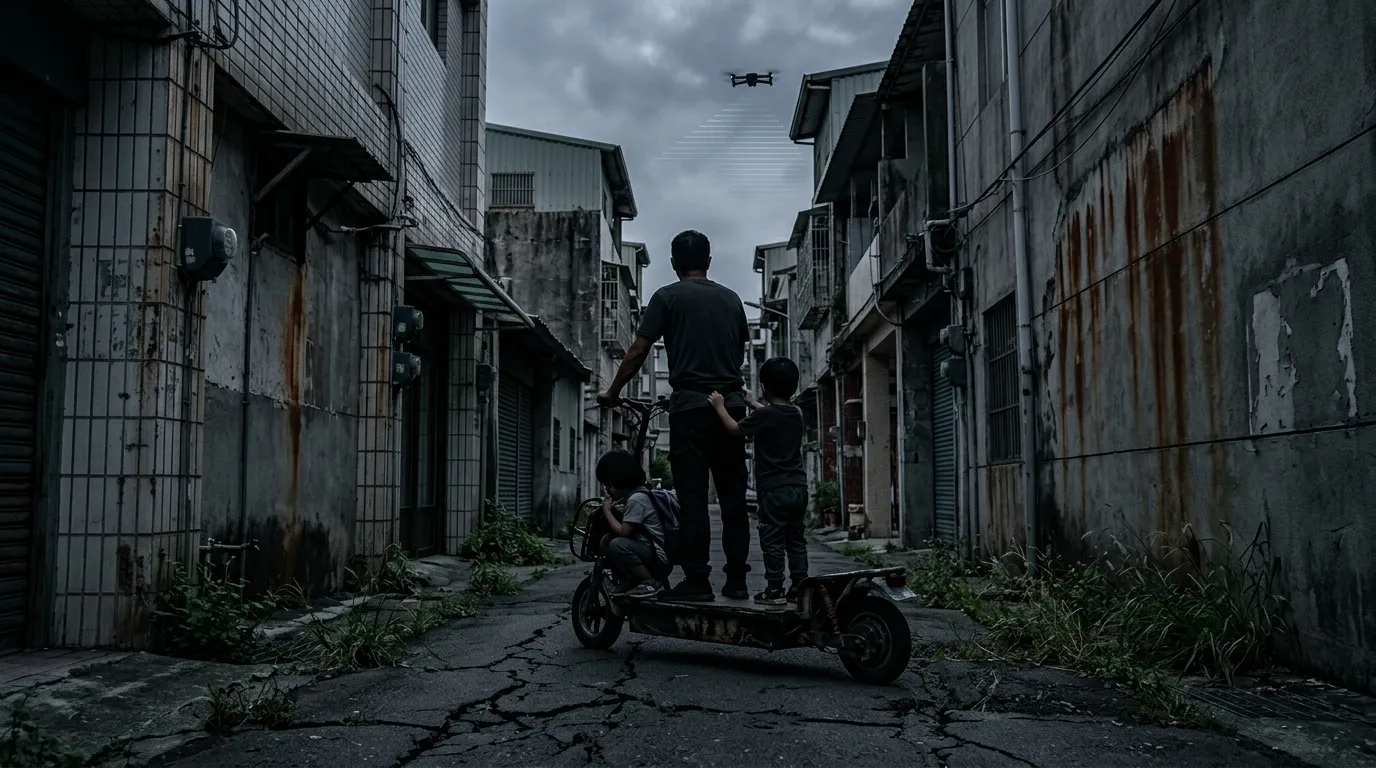
The modified vehicle was parked at the far end of the alley. Forty-eight volts. Two wheels. Originally a logistics electric pallet truck — Héngyuǎn had stripped the cargo frame, lowered the center of gravity, added an aluminum plate for a footboard. Rated load eighty kilograms; he’d tested it. Him plus the two boys came to about seventy-five. Add supplies: right at the limit.
“Gé Suǒ in front. Gé Luò in the middle.”
Gé Suǒ climbed onto the front of the footboard, crouched, hugged his pack. Gé Luò stood in the middle, one hand on Héngyuǎn’s belt. Héngyuǎn stood at the rear, feet on the back edge.
The vehicle made no sound. The electric motor at low speed was quiet as a man holding his breath. Héngyuǎn pushed off with his right foot to start, then turned the knob on the handlebar. Speed climbed to twelve kilometers per hour. Not fast. But in an alley with no streetlights, twelve was already the limit of vision and reaction time.
They went west. Toward Zhonghua Road. The longer way, but the darkest.
68:15:07
Yongkang didn’t sleep in the small hours.
Not literally — most people were indoors, most windows dark. But this satellite town buried in the former tech-park hinterland: its background noise never zeroed out. Somewhere distant, a generator hummed. Further out, occasional metallic clashing from the direction of the Southern Science Park ruins — scavengers didn’t check the clock, they checked the moon. Moon out, don’t go: too bright. No moon, work. Tonight the clouds moved; the moon came and went. Scavengers probably wavering.
Héngyuǎn didn’t go where scavengers went. He stopped the vehicle a hundred meters south of the intersection of Zhonghua Road and Dawan Road. Under the arcade of a three-story building. The signboard wreckage still showed traces of two Chinese characters — the rest swallowed by rust. The automatic doors were long gone. By the entrance, some metal salvage trussed with plastic rope.
He needed to wait for Qiū Zhùmíng.
He hadn’t reached out first. The day before — no, the night before that, before the operation started, he’d received a signal in the public channel’s encrypted layer. Old-style. Qiū Zhùmíng’s encoding habit. Content: a single set of coordinates and a time. Coordinates: the intersection of Zhonghua Road and Dawan Road. Time: between four and five in the morning on operation day.
Qiū Zhùmíng knew he would act. Qiū Zhùmíng didn’t know what he’d done — fl_09.sh’s existence, the mirror redirect’s three-segment remap, the life-support pod’s local failsafe subroutine, all of those sat in Qiū Zhùmíng’s intelligence blind spot. But Qiū Zhùmíng knew he would act. A QA engineer’s predictive ability didn’t come from knowing what you’d done — it came from knowing your behavioral pattern would drive you to act at a certain moment.
He had Gé Suǒ and Gé Luò stay inside the arcade. Against the wall. In the dark.
“Don’t come out.” He looked into Gé Suǒ’s eyes. “No matter what.”
Gé Suǒ nodded. No follow-up question about what he’d be doing. He crouched behind a pillar in the arcade, set his pack down in front of him, opened his notebook. In complete darkness. Not to write anything — what he was doing took Héngyuǎn a few seconds to understand: he was running his fingers over the lines he’d drawn before. Those lines of different lengths. He was reconstructing his timeline by touch.
Gé Luò leaned against Gé Suǒ’s side. Metal piece out of his pocket, held in hand, not tapping. Quiet. His head tilted slightly, as if listening — or sensing something. The “square” pulses. He was tracking those cell-by-cell signals in the dark.
Héngyuǎn turned and walked out of the arcade.
Qiū Zhùmíng was in the shadow of the building across from the arcade.
Héngyuǎn didn’t see him. He heard him — not footsteps; the sound of a thermos lid unscrewing. Metal on metal, an extremely faint friction. The scent of Sijichun oolong, incongruously mild in the pre-dawn air.
“Engineer.”
Same pace as months ago. Neither fast nor slow. Volume low — not forced down, just where his voice naturally sat. Like a calibrated instrument, output permanently steady at the same setting.
Héngyuǎn walked over. The alley was three meters wide. Two and a half steps.
Qiū Zhùmíng leaned against the wall. Work jacket, buttons done to the second. Hair seemed a shade whiter than last time — but in pre-dawn gray light everything looked whiter. The thermos was in his right hand, lid already unscrewed, steam rising. He was drinking tea. Four in the morning, in the shadow of a blocked-zone street, drinking Sijichun.
“Your operation doubled the scan frequency in 710.” Qiū Zhùmíng said. Not an accusation. A briefing. Like reading numbers off a QA report. “We estimate physical confirmation within eight to twelve hours. My people spotted two drones coming from the Southern Science Park direction. Not a patrol formation — directional search.”
“You came to tell me this?”
“I came to do a final QA pass.” Qiū Zhùmíng took a sip of tea. Swallowed. Then in precisely the same register said: “Your Rollback plan — we’ve re-evaluated the yield rate.”
Héngyuǎn stood. Not leaning against anything. A step and a half from Qiū Zhùmíng. The tinnitus in the quiet sharpened — a steady 4000 Hz tone, like a test signal that never shut off. Background noise. He’d learned to operate inside background noise.
“The evaluation.” Qiū Zhùmíng turned the thermos lid halfway, then turned it back. An unconscious motion. Or not — QA engineers had no unconscious motions. “The number we calculated for your primary plan’s success rate is more optimistic than your own figure. Around seventeen to nineteen percent.”
Higher than Héngyuǎn’s estimate. That didn’t surprise him. The Constructors had data he didn’t — sources inside the Equilibrists. Their model was more accurate than what he’d run on a consumer-grade GPU with seven billion parameters inside a Faraday cage.
“The problem isn’t the yield rate.” Qiū Zhùmíng said. “The problem is how you handle the rejects.”
Héngyuǎn waited.
“After Rollback triggers, the cascade failure propagates along three to four main branches. Our model ran over six hundred simulations. In eighty-two percent of scenarios, your plan operates normally on the first three branches.” He paused. Took a sip of tea. “The fourth branch passes through the life-support pods’ control layer.”
Héngyuǎn’s breathing didn’t change. His heart rate didn’t climb. His expression didn’t shift. All of that was true — not the result of control, but because he’d already known. The reason fl_09.sh existed was this branch. The life-support pod local failsafe subroutine. His eighteenth step.
But Qiū Zhùmíng didn’t know about the eighteenth step.
“If the cascade failure reaches the fourth branch,” Qiū Zhùmíng continued, “the pod control hub will have a six-to-eight-second decision window. With no pre-loaded instructions in that window, the hub defaults to pre-set logic — shut down non-core systems to protect the main trunk. The people in the life-support pods would enter minimal-power maintenance.”
“They’d die.” Héngyuǎn translated.
“Within seventy-two hours, they’d die as life-support systems dropped below critical threshold.” Qiū Zhùmíng’s register didn’t waver. Like stating a component’s failure rate. “That figure is wrong. It shouldn’t be part of your plan.”
Three seconds of silence.
“We can solve this problem.” Qiū Zhùmíng said.
Héngyuǎn watched him. The pre-dawn gray light cut Qiū Zhùmíng’s face in half — the left was behind a pillar, the right exposed to thin moonlight. The half-face that showed was calm. A QA engineer presenting a solution.
“Before Rollback triggers, the Constructors can insert an identity shield at the base layer of the verification system. Your family’s three chip signatures — yours has been downgraded, but your sons’ base signals are still active. Once the shield activates, the Equilibrists’ tracking system will be unable to locate any of you for forty-eight hours.”
“The condition.”
Qiū Zhùmíng took a sip of tea. Swallowed. “Your plan contains a subroutine our model didn’t predict.”
Héngyuǎn’s internal alarm went off. He didn’t move.
“We don’t know what it does specifically.” Qiū Zhùmíng continued. Same pace. “But our model’s predictions for the fourth branch were off. In over six hundred simulations, one hundred forty showed a variable that shouldn’t exist — something creating a buffer in the life-support pod control layer. Our analysts traced the signal chain and located it to something you injected in your final operation step.”
fl_09.sh. They didn’t know its name, didn’t know its specific function, but they’d detected its existence. A QA engineer’s ability to find defects never required knowing the defect’s name — only that something that shouldn’t be there was there.
“This subroutine,” Qiū Zhùmíng put down the thermos, arms folding across his chest, “is interfering with our takeover plan.”
Silence.
Héngyuǎn ran a rapid game-theory analysis in the silence. Qiū Zhùmíng’s cards: knows fl_09.sh exists but not what it is. The Constructors’ demand: remove it. The exchange: identity shield, forty-eight hours.
What was under the cards: fl_09.sh was the life-support pod local failsafe. Removing it meant that after Rollback triggered, if cascade failure reached the fourth branch, the people in the pods — including HA-0917, including Xǔ Jìng — would fall back to default logic. Minimal-power maintenance. Seventy-two-hour threshold.
The Constructors’ takeover plan needed the life-support pod control hub to lose independent decision capability in the chaos of Rollback. fl_09.sh had left the pods with a sliver of autonomy. That sliver was disrupting the Constructors’ path to seizing allocation rights.
The goodwill was real. The first time Qiū Zhùmíng had provided an observation node, that was genuine help. The Constructors had let his attack plan go further, with more precision — because his attack benefited the Constructors. Mutual gain. Symbiosis. A perfect cooperative framework.
Until he’d added something to the framework that the Constructors didn’t need.
“Remove that subroutine,” Qiū Zhùmíng repeated, “and we provide the identity shield. Forty-eight hours. Enough for you to get your children out of Yongkang.”
Héngyuǎn thought of a QA term. Tolerance. Every system had a tolerance range — within that range, deviation was acceptable. Beyond it: reject. When Qiū Zhùmíng had accepted him, he was within tolerance. His attack motive, attack target, attack scope — all within the Constructors’ tolerance range.
fl_09.sh was out of tolerance.
“No.”
One word. Héngyuǎn said it without hesitation. The decision was easy — because the decision had been made a long time ago. The moment he saw the row of data with HA-0917 in it. The second he knew Xǔ Jìng was still alive. The five hours he’d spent writing fl_09.sh. That subroutine wasn’t a removable component. It was the second starting point of his entire plan. The first starting point was saving the kids. The second was not letting her die a second time.
Qiū Zhùmíng looked at him. Three seconds. Four seconds. Five seconds.
“The yield rate on this plan of yours is too low.” Qiū Zhùmíng said.
“I know.”
“Seventeen to nineteen percent. With the variable that subroutine adds, your actual yield rate drops below twelve percent.”
“I know.”
“The Equilibrists’ physical search arrives in eight to twelve hours. You have no identity shield. You have two nine-year-olds.” Qiū Zhùmíng’s register carried no inflection from start to finish. He was stating facts. The “Risk Summary” on the final page of a QA report. “Your probability of being found exceeds sixty percent.”
“I know.”
Qiū Zhùmíng went quiet. He picked up the thermos. Screwed the lid on. This time didn’t reopen it.
“Engineer,” he said, his voice dropping half a register — not from emotion, but because he’d leaned slightly further into the wall, the distance widened by half a step, “I’ve done QA for thirty years. I’ve seen many people stick with plans where the reject rate was over spec.”
He tucked the thermos into his jacket’s inner pocket. The motion was clean. One pass.
“Not one of them succeeded.”
Héngyuǎn stood in the alley. Tinnitus. 4000 Hz. The twitch in his left index finger in his pocket went on in silence. His right pinky cocked in the night air, too dark to see.
“That’s because none of them were the reject.” Héngyuǎn said.
Qiū Zhùmíng’s mouth moved slightly. Not a smile. Or maybe it was. Too dark to tell.
“Goodbye, Engineer.”
He turned and walked into the shadow. His footsteps continued for about five seconds, then vanished. No turning back. No hesitation. No “if you change your mind, you can reach me.” Cut your losses and cut them. Once a QA engineer judges a product’s reject rate over spec, he doesn’t stand by the line waiting for the product to fix itself.
The scent of Sijichun hung in the air for a dozen more seconds. Then the pre-dawn metallic smell swallowed it.
Héngyuǎn stood for a moment. Not long. About eight seconds.
In those eight seconds he ran a system status update: allies list updated from “Constructors (conditional)” to “none.” External resources updated from “limited” to “zero.” Threat list updated from “Equilibrists” to “Equilibrists + Constructors (passive).” The Constructors wouldn’t actively attack him — but they would no longer shield him from anything. In a hunt, losing cover and being hunted was only a matter of time.
He walked back to the arcade.
Gé Suǒ was still reading his notebook by touch. Gé Luò was leaning against Gé Suǒ, eyes half closed.
“Gone.” Héngyuǎn crouched down.
Gé Suǒ looked up. This time he didn’t look at the hands first. He looked directly at Héngyuǎn’s face. Then took four seconds — much longer than usual — to finish the scan.
“Bad.” Gé Suǒ said.
Not a question. A conclusion. A nine-year-old using four seconds to determine that his father had just experienced a major situational deterioration outside the arcade. He didn’t know the details. He didn’t need the details. He read his father’s face faster than he read data from the public channel.
“Bad, but we can move.” Héngyuǎn said. “Plan unchanged. South.”
“Route.” Gé Suǒ opened his notebook. In the dark he flipped to a page — Héngyuǎn couldn’t see what was on it — then traced a line on it with his finger. “Zhonghua Road straight to the end, left on Dawan Road, at Dawan Wulongdian right into the alley, cut through the market to Zhongzheng Road, south along Zhongzheng Road to the outer edge of Yongkang.”
Héngyuǎn paused.
The route wasn’t wrong. More than not wrong — the route Gé Suǒ had chosen avoided every high EMF zone he knew of. Those EMF distribution markings on the stairwell wall, Gé Suǒ had looked at them too. Not just looked — memorized them. And overlaid them onto the street map in his head.
“EMF markings.” Héngyuǎn said. Confirming.
Gé Suǒ nodded. “Red ones, no go. Yellow ones, go fast.”
The stairwell’s EMF markings used three colors: red for high-intensity, long-term exposure risk; yellow for moderate, short-duration passage acceptable; unmarked meant safe. This was a public information system the Yongkang scavenger community had built on its own — not for hiding, just to reduce chip interference. But for Héngyuǎn, already downgraded and no longer worried about remote lock-out, EMF zones had a different meaning: high EMF zones were Equilibrists sensor-dense zones. Red = high detection probability.
Gé Suǒ didn’t know that layer of logic. He only knew “red is bad.” But the conclusion was the same.
Héngyuǎn looked at his son. In the dark, Gé Suǒ’s face was just an outline. The smell of pencil drifted from his notebook — wood and graphite mixed, like the scent of some most minimal, purely human tool.
“Go.” Héngyuǎn stood.
67:28:33
Yongkang under blockade looked almost exactly the same as usual.
That was the most frightening part.
The blockade wasn’t checkpoints and barbed wire — those were the last era’s tools. The Equilibrists’ blockade was digital, quiet, saturated into the signal strength of every base station. Héngyuǎn felt no physical obstruction from the vehicle. The roads were still the roads. The alleys were still the alleys. Asphalt cracked, weeds forcing up through the cracks, building facades with large swaths of tile peeling, rust-stains like tear tracks. Everything as before.
But he knew it was different.
The base stations had switched from passive listening to active scan — for anyone with a chip, every time you passed within a base station’s range, your chip got pinged once. Location, identity, status. Three data points. Uploaded. AI analyzing behavioral patterns in the backend.
He was downgraded. His chip wouldn’t respond to remote pings. He’d earned that on Wēng Hèqín’s operating table three months ago.
But his sons had no chips. Nine years old. Hard limit: implant eligibility started at twelve to fourteen. The Equilibrists’ system during a scan would find them as “untagged individuals” — in a world where nearly everyone had a chip, people without chips were the ones who stood out.
He rode four minutes on Zhonghua Road. The cracked road surface made the vehicle’s wheels jump every few seconds. Gé Luò’s fingers tightened on his belt.
“The buzzing,” Gé Luò suddenly lowered his voice, “left side. Up above. The sharp kind.”
Héngyuǎn didn’t look up. He steered the vehicle thirty degrees right, edging into the shadow of the buildings along the road. His left hand pressed harder on the handlebar — the index finger twitch made his control unsteady, so he compensated with his whole palm.
“Gone.” Gé Luò said three seconds later.
A drone. Directional search type. The “sharp” signal Gé Luò had picked up was its active scan pulse. They hadn’t been scanned — the buildings’ cover had left a blind spot in the low-altitude drone’s angle of view. But this was luck. Next time there might not be a building.
Dawan Road. Héngyuǎn turned left. The vehicle’s motor let out a faint whine on the turn — battery efficiency dropping in the cold. The pre-dawn temperature was around eighteen degrees. Not cold, but a forty-eight-volt lead-acid battery didn’t like eighteen degrees.
Dawan Wulongdian was on the right. The temple’s outline loomed in the dark, massive and silent — stone lions, upturned eaves, glazed tiles, these things looked like relics from a parallel universe. The temple doors were closed. On the stone steps outside sat a figure — a scavenger, or someone sleeping there. Héngyuǎn didn’t look twice.
Right turn into the alley. The market.
The market at four-thirty in the morning was empty. The stalls were fixed metal frames — some still intact, some just skeleton. Plastic tarps snapping in the light wind. The ground wet, some leak from somewhere. Héngyuǎn dropped the vehicle to walking speed. The wheels rolling through standing water amplified in the open market.
Gé Suǒ had stepped off the footboard. He was walking. The vehicle’s speed was too slow; he thought walking was faster. He walked three steps ahead of Héngyuǎn, notebook under his arm, right index finger tracing something in the air without thinking — silently calculating something.
Héngyuǎn watched his back. Nine years old. Walking at the front in a pre-dawn empty market. He’d put himself at the forward position because he’d judged that being in front meant he’d spot obstacles first. Functional deployment. He’d deployed himself to the forward observation post.
Zhongzheng Road. Héngyuǎn’s vehicle nearly clipped a fallen iron frame at the market exit. Gé Suǒ reached out and pulled the handlebar — no words, just a pull, and the vehicle angled fifteen degrees and went around it.
Zhongzheng Road was wider than Zhonghua Road, more exposed. Héngyuǎn accelerated to fifteen kilometers per hour. The motor’s whine climbed slightly. Wind from the front carried the southern smell — the rust of Southern Science Park ruins, concrete dust, and something Héngyuǎn couldn’t identify, like ozone and welding smoke.
They went south. Toward Yongkang’s edge.
Gé Luò’s hand on his belt tightened suddenly. Not gradual — an instant clench.
“Stop.” Gé Luò said. Very quietly, but there was a quality in that syllable Héngyuǎn had heard during last night’s operation: not a request. A warning.
Héngyuǎn braked. The vehicle’s momentum slid them another two meters.
“Above. Two.” Gé Luò said. “One round, one square. The square one’s closer.”
Two drones. One in passive patrol (round — continuous scan), one in active search (square — pulse scan). Héngyuǎn immediately pushed the vehicle into the arcade of a building along the road. Aluminum sheeting and corrugated plastic overhanging from the roof extension formed an irregular shelter overhead.
They crouched in the dark. Héngyuǎn’s heartbeat in his ears layering with the 4000 Hz tinnitus. Two frequencies. One was his body’s, one was damage. He couldn’t tell which was louder.
Forty seconds.
Gé Luò’s hand loosened. “Gone. Heading north.”
North. Not their direction. Heading back. The search pattern was grid-style — contracting inward from the perimeter. The direction they were going south happened to fall in the gaps of the grid.
Luck. Again luck.
Héngyuǎn restarted the vehicle. No words. Kept south.
66:41:18
Yongkang’s outer edge.
Zhongzheng Road stopped being a road here — asphalt fractured to scattered black fragments embedded in dirt, like scars left after a skin disease healed. The weeds weren’t growing through cracks anymore — they’d taken over the surface; the cracks were theirs. Buildings thinned out. On the left: a row of corrugated-metal shacks, rusted black, several already collapsed. On the right: an open lot, grown over with grass taller than a person.
Héngyuǎn stopped the vehicle. The battery indicator was flashing yellow. Roughly thirty percent remaining.
He needed a base. Not long-term — just enough to hold until Rollback triggered. Sixty-six hours. A little over two days. He needed a position the Equilibrists’ grid search wouldn’t easily reach. The low building density at Yongkang’s edge meant drone scan coverage was actually higher — no buildings to block it.
But he didn’t have many options left.
Gé Suǒ stepped off the footboard and stood on the dirt road. The soles of his shoes made small grating sounds on the asphalt fragments. He looked around — not vaguely, but scanning. Systematic, left to right, eyes pausing one second at each possible hiding place.
“There.” Gé Suǒ pointed into the tall grass on the right. “There’s a roof.”
Héngyuǎn looked where he was pointing. The grass was too tall — he couldn’t see anything. But Gé Suǒ was forty centimeters shorter than him — a nine-year-old’s eye level let him look through the gaps between the grass roots and see what Héngyuǎn couldn’t.
“How far?”
“Two minutes walking.” Gé Suǒ confirmed.
Héngyuǎn pushed the vehicle into the grass. Blades rasped against both sides of the body. Three people moved through the grass. Héngyuǎn at the rear — he needed to use his body to prop the flattened grass back up, reducing path traces. An engineer executing counter-tracking operations. His specialization was system architecture, not wilderness survival. But logic was universal: if you don’t want to be found, don’t leave traceable paths.
What Gé Suǒ had found was a corrugated-iron shed. Three walls, one side open, facing south. Roof was corrugated iron sheeting, a few rust holes. Floor was concrete, cracked, a pile of long-forgotten agricultural equipment debris in the corner — a hoe with a plastic handle rusted through, a coil of broken pipe. Probably an old farm shed or tool room.
Not perfect. But three walls and a roof. Inside a grass field. From above—
“Gé Luò.” Héngyuǎn crouched. “Any buzzing up there?”
Gé Luò tilted his head and listened for five seconds. “Yes. Very far. Round ones. Not pointed this way.”
Passive patrol. Not directional search. Temporarily safe.
Héngyuǎn sat down on the concrete floor. Back against the rusted corrugated wall. The corrugated iron gave a muffled thump under his weight.
Tired.
The thought floated up from some partition of his system he didn’t visit often. Not an objective statement of fatigue — he’d been awake more than twenty-four hours since yesterday morning, performed an eighteen-step manual Rollback pre-set operation in between, all of that he knew. Something else was surfacing: an urge to close his eyes, let every process pause, stop calculating anything.
A sliver of sky light came through a hole in the shed’s corrugated roof. White. The white of nothing. The sound of two children breathing echoed once off three walls.
He didn’t close his eyes. He opened his notebook. Flipped to a blank page. Pencil.
Location: Yongkang outer edge, approx 200m east of south end of Zhongzheng Road
Time: T-66:41
Status: Three people. Battery 30%. Water 1.2L. Food 6 bars.
Threat: Physical search ETA 4-8hr. Drone grid contracting.
Resources: Zero external support.
He stared at the last line. Zero external support. Four months ago when Qiū Zhùmíng had appeared at the tea stall, his external support had gone from zero to limited. Now it was back to zero. Like a function call returning to its initial value. Four months of cooperation ended with a return statement.
Gé Suǒ sat down beside him. Not pressed close — about one adult shoulder-width of space. The right distance. Not too near, not too far. He opened his own notebook and started drawing lines. New lines. Héngyuǎn glanced sideways — Gé Suǒ seemed to be drawing the route they’d just traveled. Reconstructed from memory. Every turn had a mark.
“Between numbers four and seven on Zhongzheng Road,” Gé Suǒ said, pencil still moving, “there’s a stretch of wall that can block from above. If we have to go back.”
He was recording the retreat path. Nine years old. Drawing the retreat path with a pencil in an iron shed.
Gé Luò crouched at the open side of the shed. Facing south. He took the metal piece out of his pocket, set it on the ground, then spun it with one finger. The metal piece spun two and a half turns on the concrete, stopped. He picked it up, spun again.
On the third time, he stopped.
Not because the metal piece stopped spinning. His finger stopped mid-air — as if it had touched something invisible.
“Dad.”
Héngyuǎn looked up.
Gé Luò’s face was toward the ground. Not toward the metal piece — toward the concrete beneath it. His whole posture had changed: from crouching to lying down, one ear nearly pressed to the floor.
“There’s a — ” he stopped, mouth opening slightly, searching for a word, “not buzzing. It’s — thump. Thump. Like a heartbeat. But a square heartbeat.”
Héngyuǎn set down his notebook.
“Coming from below?”
“Deep.” Gé Luò pressed his whole face to the concrete floor. His metal piece was sandwiched between his cheek and the ground. “Not always there. One thump, then long pause, then another thump.” He went quiet three seconds, listening hard. “Thump.”
Five more seconds of quiet.
“Thump.”
Intermittent pulses. From underground. Low frequency. Héngyuǎn’s brain auto-translated: low-power EMP pulse, intermittent discharge. Fifteen to twenty meters underground. Yongkang outer edge — close to the direction of the Southern Science Park.
He knew what this was.
Beneath Yongkang lay military infrastructure from the previous era. Air-raid shelters. Some had been converted into EMP defense stations — a Cold War mindset product. In standby mode they should have been silent. But decades of unmaintained circuitry would fail. A failing EMP system wouldn’t shut down cleanly — it would discharge intermittently at minimum power. Like a heart beating on the lowest life support.
Thump. Long pause. Thump.
Underground EMP defense station. Reinforced concrete structure. A natural Faraday cage. For shielding against drone scans—
Héngyuǎn stood up. Too fast. The scab on his neck was pulled taut in the quick motion; he felt the edge crack slightly. Didn’t matter.
“Gé Luò.” He crouched back down, voice dropped low. “Can you feel which direction it’s coming from?”
Gé Luò pressed his whole face to the floor. Eyes closed. Fingers — all ten fingers spread open, pressed to the concrete, as if using his whole body as an antenna.
“That way.” His fingers pointed south-southeast. Eyes still closed. “Not far.”
Héngyuǎn looked in that direction. Grass. Corrugated-metal building ruins. Further in: a cluster of low concrete structures — possibly former factory or storage area. Air-raid shelter entrances were usually in the basements of buildings like these.
He added a line to his notebook:
Underground signal source. Intermittent EMP pulses. Bearing SE. Distance unknown.
Possibility: old military EMP defense station. Standby mode discharge failure.
If structure intact = natural Faraday cage.
By the time he finished writing, Gé Suǒ had already stood up. He walked to Gé Luò’s side, crouched, placed a hand on Gé Luò’s back. No words. Just resting there.
Gé Luò opened his eyes. He pushed himself up from the floor, gray concrete dust on his face. Metal piece back in his hand. He looked at Héngyuǎn, then at the floor.
“Dad.” He said.
“What.”
“There’s something calling down there.”
Héngyuǎn watched him. Watched that face with concrete dust still on it, nine years old. Watched those eyes — not fear, not curiosity, but something more primal than either: certainty. He was certain something was down there. He didn’t know what it was, didn’t understand its meaning, but he was certain it was there.
Sixty-six hours. Two kids. Zero external support. A plan with a reject rate over spec.
And something underground, calling.
Héngyuǎn closed his notebook. Stood up.
“Go.” He said. “Find the entrance.”
66:22:05
The countdown didn’t need him. It ticked on its own. But now he needed the countdown — because in the sixty-six hours remaining, he had to find a path down.