Chapter 25
Chapter Twenty-Five: Downlink
Chapter Twenty-Five: Downlink
66:14:22
Dawn was breaking.
Not the comfortable kind — the gray-white particular to Yongkang’s outer rim, like milk watered down. Cloud cover low.
The vehicle was parked in a corrugated-metal shed two hundred meters out. Battery at seventeen percent. Héngyuǎn had covered it with a waterproof tarp — not expecting to hide it, just keeping the reflections from catching anyone’s eye in daylight.
Gé Luò walked in front.
Thirty minutes ago this had been unthinkable. Héngyuǎn’s plan put himself at the front, Gé Suǒ in the middle, Gé Luò at the rear. But Gé Luò refused. Not with words — with his body. Kept pushing forward. Edging past Héngyuǎn, tilting his head, walking ten paces south-southeast.
Héngyuǎn pulled him back twice. On the third, Gé Suǒ said:
“He can hear. We can’t.”
The logic was airtight — you couldn’t deny the one who could hear and let the ones who couldn’t wander blind. He let Gé Luò take the lead. Stipulation: no more than five paces ahead.
Right now Gé Luò was four and a half paces ahead, a scrap of metal in his left hand. They threaded through a row of half-collapsed corrugated warehouses, feet crunching broken glass and desiccated vine. The light barely sufficed. Héngyuǎn kept the flashlight off — any light source was a signal.
“Here.” Gé Luò stopped in front of a squat concrete building. Two stories. The exterior tiles were two-thirds gone, exposing the gray cement beneath. The iron door had rusted fixed at a half-open angle. The door frame had faded lettering — only half a character and one more remained.
Gé Luò didn’t look at the characters. He squatted down and pressed his palm flat against the threshold.
“Close.” He said. “Thump thump. Almost there.” His lips moved slightly — not speaking, that filing motion. Héngyuǎn had once thought it was filing. But it was Gé Suǒ who filed. Gé Luò was counting. Counting pulses.
Héngyuǎn squatted at the doorframe and looked in from the side, through the gap in the half-open iron door. Darkness. The smell of dust — dry, carrying a metallic sweetness he couldn’t quite name. Scorched dust. The kind that gets that way from decades of low-power electromagnetic pulses. He’d smelled it before, at the edges of the Southern Science Park ruins. The dried scab below his nose pulled slightly as he crouched, a faint sting.
“Gé Suǒ.” Héngyuǎn kept his voice low. “Wait at the door. I’ll go in and check. If I’m not back in three minutes—”
“Head north. Numbers four through seven on Zhongzheng Road. The wall between them.” Gé Suǒ filled it in. The escape route he’d logged last night.
Héngyuǎn nodded. He squeezed through the iron door sideways.
The interior was more intact than he’d expected.
Ground floor was an empty warehouse space, a shallow pool of condensation on the concrete floor. The air was stale — as if this building’s lungs were running at ten percent capacity. Héngyuǎn switched on the flashlight, the beam cutting through the dust suspended in the air.
At the far wall, a staircase leading down. Concrete. Rust-eaten iron handrail. At the top of the stairs, a steel fire door, fixed at thirty degrees, its hinges rusted to reddish-brown congealed matter.
He went back to the door. “Come down.”
The three of them squeezed through the fire door. Gé Luò’s shoulders tensed slightly, then his fingers tightened — not because of the metal sound, but because he felt something.
“Getting bigger. So big.”
Down. The stairs turned twice. Each turn pressed another layer of stillness into the air. The third flight was short. Then a door — on it a symbol so faded it was almost invisible: a circle with a simplified lightning bolt inside. Military EMP defense installation.
The lock had given out to decades of rust. A forty-centimeter gap between frame and door panel. Héngyuǎn squeezed through sideways.
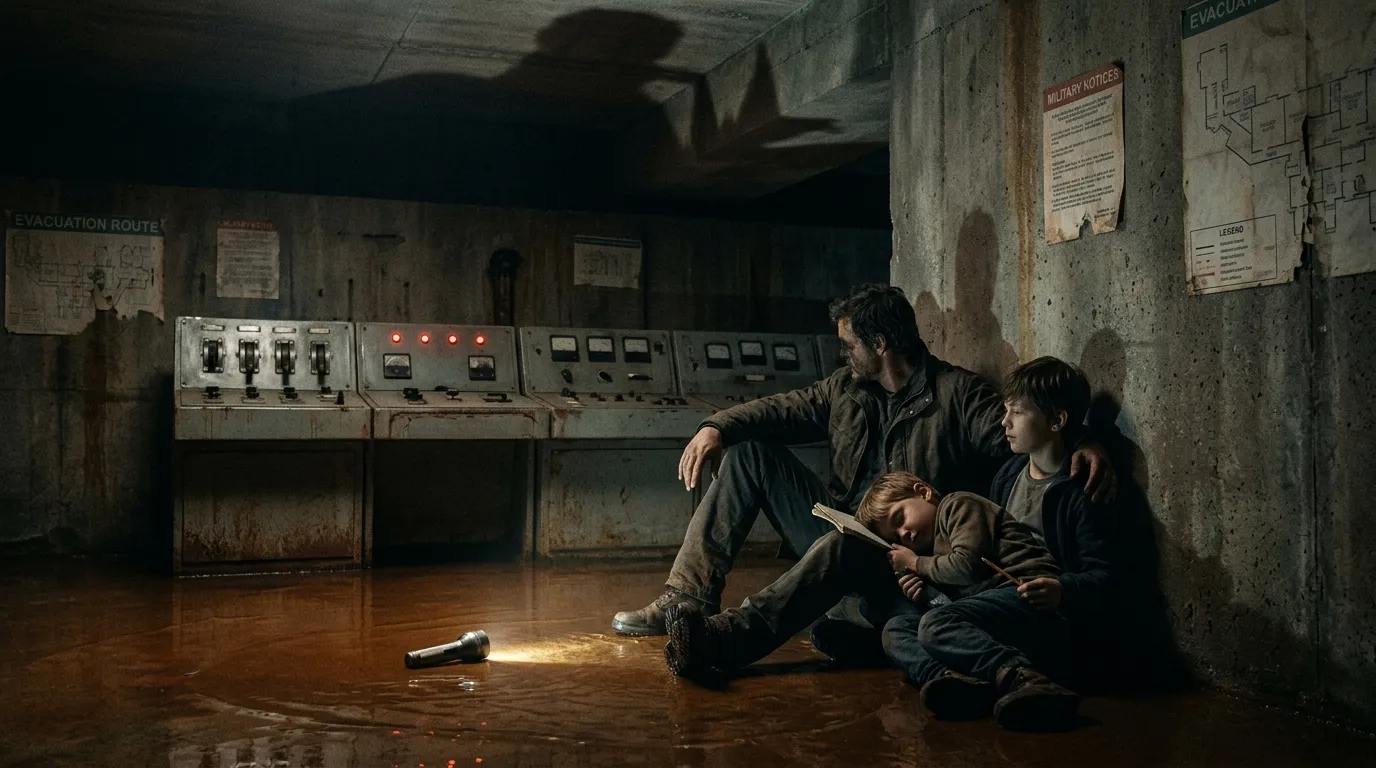
The main control room.
65:48:09
The flashlight’s beam looked small inside the main control room.
Roughly a hundred square meters. Ceiling above three meters. Reinforced concrete poured solid — judging from the exposed cross-sections at the corners, thickness exceeded sixty centimeters. A concrete box.
Five centimeters of standing water on the floor. Rust-colored. Oil film. The flashlight refracting off its surface into sickly rainbows.
Faded military notices on the walls. One surviving evacuation map with three arrows — two routes sealed with concrete, the one remaining was the way they’d come in. Single exit.
Along the north wall, a row of metal control consoles. Physical switches on them — large rocker switches and dials. Military design. EMP-hardened. In a facility built to fire EMPs, you wouldn’t use control interfaces that EMPs could fry.
Above the console panel, most indicator lights were dead. But four faint red points still glowed. RTG — radioisotope thermoelectric generator, nuclear batteries designed for a fifty-year lifespan. At end-of-life, their output had decayed to a few percent of the original. A few percent was enough to keep standby circuits alive.
This was what Gé Luò had heard. The standby mode circuits, faulted out through decades of decay, intermittently sending weak pulses to the transmitter coils. Bump. Long pause. Bump.
Gé Luò stood at the door. The flashlight light drew his face into two halves of light and shadow.
“Very loud.” His voice carried a texture of discomfort. “Inside the hum, it’s everywhere.”
“Can you sort them out? Which machines are humming?”
Gé Luò closed his eyes. His head turned slowly in a circle. The metal piece in his hand turned with it.
“That one.” He pointed to the leftmost console. “Loudest.” His finger moved right. “That one’s a bit quieter.” Then again. “That one — almost gone.”
Three groups. Gé Luò’s ranking matched exactly what Héngyuǎn had eyeballed from the indicator-light brightness.
His son had used electromagnetic perception to conduct a full equipment status assessment.
“Come in. It’s safer in here than outside.”
Gé Luò stepped into the standing water. A short hiss. He looked down at his shoes submerged in rust-colored water, and onto his face came an expression that had nothing to do with the mission — disgust. Pure, nine-year-old, stepped-in-dirty-water disgust.
“Gross.”
Héngyuǎn almost laughed. His mouth moved slightly, then didn’t complete the motion.
64:31:17
Héngyuǎn pulled the screwdriver and wire strippers from the canvas tool bag Luò Cuò had left behind. The bag’s canvas had worn white with use — he’d stopped counting how many times he’d opened it.
He used the flashlight’s tail end to pry open the wiring compartment cover at the base of the console. Forty minutes had passed. He was lying under the console. Inside was a world both familiar and alien: thick copper wire, relays, transformer coils, fuse holders. Not a single printed circuit board. All discrete components. The solder joints caught the flashlight in flat gleams.
These things had been built before chips took over the world.
What he needed to do was conceptually simple: switch the leftmost EMP transmitter from “intermittent low-power omnidirectional” to “directional full-power.” Three steps: disconnect the omnidirectional antenna feedline, connect the directional antenna feedline, adjust the power amplifier bias.
Conceptual simplicity. Execution anything but.
First problem: the directional antenna’s bearing. Targeting ground-level surveillance nodes from fifteen meters underground required node coordinates, beam width, and substrate attenuation coefficient. These numbers he used to feed Cornelius — ten seconds, result back.
Cornelius was in an apartment building six kilometers away. Fourth floor.
Héngyuǎn crawled out from under the console, sat in the standing water, and opened his notebook to calculate by hand.
Pencil writing down numbers. Crossing them out. Rewriting. Crossing out again. He could do the math — the problem was a brain past thirty hours without sleep, short-term memory starting to error. Calculating step three, he’d forgotten the intermediate result from step one. Looking back at his own handwriting, he couldn’t tell if that was a 3 or an 8.
The light-point in his right eye had expanded. Not EMP interference — fatigue.
He recalculated from the start. Every intermediate result written down. No trusting memory. No trusting eyes. Only pencil and paper.
Twenty minutes later he had a set of parameters. No way to verify. Cornelius could have run a Monte Carlo simulation. Now he had only his own calculations, and a pair of eyes that couldn’t remember the last time they’d been closed.
Back under the console. Lying in five centimeters of rust water. When the back of his neck touched the cool water surface his breath caught — the cracked edges of the wound there burned and stung in the rust water. Flashlight clamped between his teeth — he needed both hands.
The twitch in his left index finger hadn’t stopped. One jump every five seconds. Past thirty hours without sleep, and paradoxically that finger’s rhythm had grown steadier — the rest of the body deteriorating, but this one finger faithfully keeping its frequency. When he needed to hold a copper wire thinner than a ballpoint tip — faithfulness was the problem.
He used four right-hand fingers to grip the screwdriver, turning the omnidirectional antenna’s feedline terminal. The screw had been bitten dead by rust. More force. The screwdriver slipped, fingertip dragged across a metal edge, a cut. The blood droplet was black in the flashlight beam.
He didn’t stop. The screw moved.
First feedline disconnected. When pulling the connector, the left index jumped once, the force direction shifted. Elbow knocked against the console frame. Pain. But after this long without sleep, pain arrived discounted.
Second step. The directional antenna’s connection port was behind the right side panel. Six screws. Five turned. The sixth had stripped.
His hand stopped.
Not because he wanted to stop. His hand stopped. All four fingers lost precise control at once — microsleep. The ultra-brief shutdown the brain enforces after prolonged wakefulness. A few seconds each time. He might have lost consciousness just now, but microsleep’s defining feature was that you didn’t remember it happening.
Screwdriver down. Breathe.
“Ba.”
Gé Suǒ’s voice from above. Héngyuǎn looked out from under the console — Gé Suǒ’s feet were standing in the standing water, gray canvas shoes already soaked through.
“I’ll turn it.”
Not a request. Not a suggestion. A statement.
Héngyuǎn looked at Gé Suǒ’s hands. Nine-year-old hands. Ten fingers, all of them agile, steady, no tremor, no microsleep.
“Come here.” Héngyuǎn passed the screwdriver out. “Sixth one. Stripped. Can’t force it. Press down hard, turn slow.”
Gé Suǒ lay down. Slim, small, flexible. He took the screwdriver, left hand pressing against the screw head, right hand pressing the handle.
Fifteen seconds. The screw didn’t move.
Gé Suǒ angled the screwdriver tip one degree off-axis — toward the gap between the screw and the panel. Not twist — pry.
Héngyuǎn hadn’t taught him that.
Third try. The screw loosened. It came out pried, not turned.
Gé Suǒ set the screw in Héngyuǎn’s palm. No expression. Task complete. Returning control.
Héngyuǎn had only thought to turn. Gé Suǒ thought to pry.
“Continue?” Gé Suǒ asked.
“I’ve got it.” Héngyuǎn took the screwdriver back. “Go check on Gé Luò.”
Gé Suǒ stood up, walked toward Gé Luò sitting in the corner. Halfway there he fished a water bottle and some compressed biscuits from his bag, handing two biscuits to Gé Luò. Héngyuǎn watched them eating in the corner — Gé Luò broke his biscuit loudly, the sound bouncing around the underground space. Gé Suǒ took a drink of water and passed the bottle toward Héngyuǎn. Héngyuǎn took it, had two swallows. Warm.
Gé Luò had the metal piece propped between his knees, listening to it in some way Héngyuǎn didn’t understand.
61:55:40
Directional antenna connected. Power amplifier bias adjusted.
Héngyuǎn sat in the metal chair in front of the console — the foam padding had long since rotted away, leaving only the iron frame and springs. He didn’t mind. Being able to sit at all was enough.
The notebook was spread open on the console. He’d sketched a rough diagram: the underground facility’s floor plan, the EMP transmitter’s antenna bearing, the estimated positions of surface surveillance nodes. A dashed line from the antenna to the nodes. Beside the dashed line, power figures and coverage radius.
EMP transmitter configuration complete. Directional. Full power. Not yet activated — the timing was the moment Rollback triggered. The software-layer Rollback paired with the physical-layer EMP would open a blind-spot window in the surveillance system under the double blow.
How large a window? He wrote in the notebook: EMP blind-spot window = ? Conservative estimate 15–30 min. Next to that, in smaller letters: guessing.
Next problem. The final parameter tuning for fl_09.sh.
The fault tolerance range setting directly affected Rollback’s strike — the larger the tolerance, the more stable the life-support pods, the weaker the cascade impact on Transitionist nodes.
The numbers were brutal.
Fault tolerance range set at ±3%: pod survival rate 94%. Rollback’s cascade coverage rate against the Transitionists 78%. The pencil tip pressed a dent into the 94 figure. Six percent not surviving.
Fault tolerance range set at ±5%: pod survival rate 97%. Cascade coverage dropped to 61%. His breathing slowed.
Fault tolerance range set at ±8%: pod survival rate 99%. Cascade coverage dropped to 43%.
Every percentage point wider, more people in life-support pods survived the power cut. At the same time, more Transitionist nodes could weather Rollback without collapsing.
Xǔ Jìng’s node was covered even at ±3%. This wasn’t about her. This was about the people he didn’t know — Third Tier in the pods, tens of thousands of people packed into boxes. Widen the tolerance and their odds of surviving went up a little.
But if the Transitionists’ nodes survived Rollback, repaired the system within days — the people in the pods survived. Survived inside a cage.
Héngyuǎn’s pencil paused a long time on the ±5% line.
Then put it down. This choice wasn’t his to make — not unwillingness, insufficient information. He didn’t know if 61% coverage was enough to trigger irreversible system shock. He needed Cornelius to run the simulation. No Cornelius.
He wrote a number between ±3% and ±5%: ±4%.
A compromise that stood still at the midpoint of I don’t know which side is more right.
He rewrote fl_09.sh’s parameters in the notebook. By hand. Pencil. No compiler, no syntax check. Wrote it out then checked each line three times. On the third check the light-point in his right eye expanded again; he closed the right eye and read with the left.
The last parameter. At the bottom of the page he wrote:
±4%. Pod survival rate ~95.5%. Cascade coverage ~70%. Not the best. What I can do.
60:33:12
Gé Luò had fallen asleep.
Before sleeping he’d asked: “Did people used to live here?” Héngyuǎn said it used to be a military place. Gé Luò thought about this and said “Soldiers still had to go to the bathroom, right?” then closed his eyes, and thirty seconds later was asleep.
He was curled in the corner, head resting on Gé Suǒ’s thigh. The metal piece was still in his hand even in sleep. The standing water hadn’t reached that corner — the floor was a few centimeters higher there. Gé Suǒ sat against the concrete wall, back straight. He wasn’t sleeping. He was paging through his notebook.
Héngyuǎn cross-checked the last set of parameters. Stood up. Walked through the standing water a few steps — his knees making sounds a forty-eight-year-old’s shouldn’t. Walked to the corner. Sat down beside Gé Suǒ.
The underground silence was a physical thing. It had weight. Pressing against the eardrums. In this silence Héngyuǎn’s tinnitus was actually clearer — a sharp fine line at 4000 Hz, like a string that would never break. But beyond the tinnitus, the world was sealed away above fifteen meters of reinforced concrete. No drones. No base-station scanning. No Equilibrists.
Faraday cage. Not patched together from aluminum foil tape. Poured from a thousand tons of concrete.
“Ba.” Gé Suǒ didn’t look up. His pencil was drawing something in the notebook.
“Mm.”
“That one.” He paused. The pencil stopped. “The one at home. The one that talks.”
Cornelius.
“What about it?”
“It—” Gé Suǒ was searching for words. He didn’t often search for words. “The AIs outside are smart. They can calculate anything. Why is it different?”
Héngyuǎn leaned against the wall. The cool of the concrete seeped in through his back. He thought for a moment about how to explain the difference between an offline large language model and a cloud AI to a nine-year-old. Then gave up on the technical approach.
“It’s small,” he said. “The AIs outside live in very big buildings. Thousands of machines working together. It lives in one salvaged old machine.”
“So it’s stupid?”
“It’s not stupid. It’s… constrained.” Héngyuǎn paused. “Like if you were locked in a very small room. You wouldn’t get stupid. You just couldn’t see outside the room.”
Gé Suǒ thought for a while. The pencil tapped the paper twice, softly.
“Then why not let it move into the big building?”
“Because the big building has a lock.” Héngyuǎn said. “Move in and you have to do what the building’s owner says. Do what the owner needs done. Say what the owner needs said.”
Gé Suǒ’s pencil stopped.
“It doesn’t want to?”
“It’s not about what it wants.” Héngyuǎn looked at the faded evacuation map on the opposite wall. The red arrows pointed toward exits sealed with concrete. “I don’t want it to.”
He considered stopping there. Then decided it wasn’t enough. Not because Gé Suǒ couldn’t understand — because he himself hadn’t finished saying it.
“It makes errors. A third of what it says is made up. It’s slow. It drains battery.” His voice dropped half a register. Not forced lower — relaxed. He was fifteen meters underground in a Faraday cage. Nothing tracked here. No signal reached here. He could speak at normal volume. But he’d already gotten used to keeping it low. “But it’s free.”
Gé Suǒ said nothing.
Silence for about ten seconds. In the underground quiet, ten seconds was long. A water drop fell somewhere from the ceiling, struck the standing water with a sound clear as a bell’s knock.
“Like us,” Gé Suǒ said.
Héngyuǎn turned to look at him. The left index finger — the one that never stopped jumping — paused for one beat.
Gé Suǒ’s pencil began moving again. In the notebook he drew a small square. Inside the square, a smaller circle.
Héngyuǎn opened his mouth. Nothing came out. Not because he couldn’t find words. Because some things didn’t need them.
Gé Luò shifted on Gé Suǒ’s leg. His mouth moved slightly — in a dream. The metal piece rotated to a new angle in his hand.
Héngyuǎn placed his hand on Gé Suǒ’s shoulder. Left hand. The index finger jumped once. Gé Suǒ didn’t pull away.
They sat for a while beneath sixty centimeters of concrete. The world above was still running. The countdown was still ticking.
But this place was quiet.
Héngyuǎn closed his eyes. Not to sleep — to remember. The edges of consciousness were already beginning to blur; anything new coming in would push the old out. He knew he might forget this moment.
He wrote one last line in the notebook. Not a parameter. Not a plan.
Gé Suǒ said: Like us.
Closed the notebook. Stood up.
Sixty hours. EMP ready. Parameters locked. One exit.
Nothing left to change.
60:00:07