Chapter 26
Chapter Twenty-Six: Rollback
Chapter Twenty-Six: Rollback
47:12:03
Héngyuǎn woke up on the floor.
Consciousness had simply reconnected to a stretch of time he didn’t remember losing. Micro-sleep. Maybe two seconds. Maybe twenty. The water stain on the ceiling hadn’t changed shape. The smell of standing water hadn’t changed. The 4000Hz tinnitus hadn’t changed.
Nothing had changed. This was waiting.
He rolled over. Every vertebra protested. Concrete floors don’t soften with time — this was not a material capable of sympathy toward human beings. When his right hand pushed against the ground, four fingers found their positions. The pinky cocked.
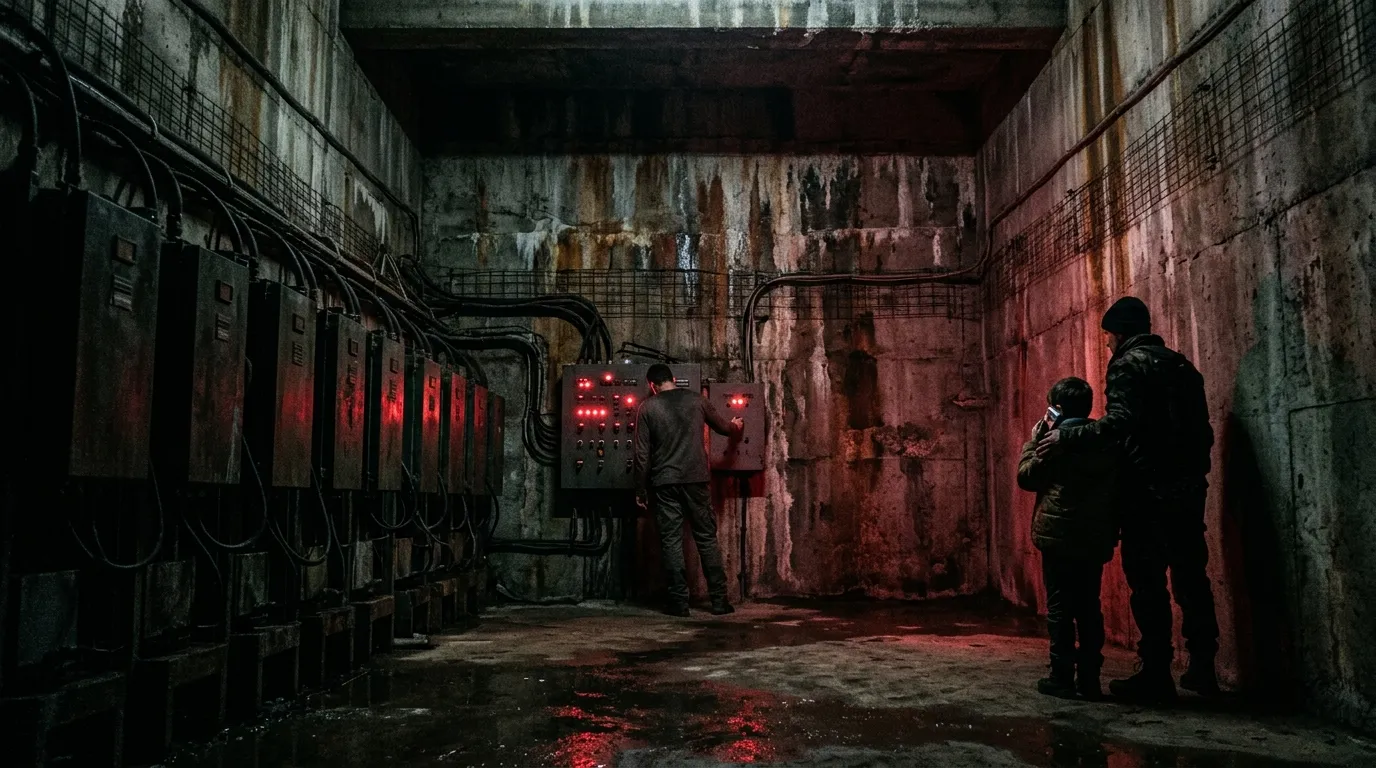
Gé Suǒ sat beside the console. Notebook open across his knees. Pencil unmoving. He was staring at the faded evacuation route map on the wall. Three arrows. Two pointing into concrete. One pointing the way they’d come.
“What time is it?” Héngyuǎn’s voice came out scraped from the bottom of his throat.
Gé Suǒ glanced down at the numbers on the console panel. The RTG-powered clock module — military grade, EMP-hardened, not high precision but it didn’t stop.
“Forty-seven,” Gé Suǒ said. He’d dropped the hours, minutes, seconds. He knew his father didn’t need them.
Thirteen hours. At some point Héngyuǎn had lost thirteen hours. Not all at once — in fragments. What he could remember: getting up to drink water. Walking to the corner to check on Gé Luò. Lying back down on the floor. Being woken by a dripping sound. Lying down again. The seams between one memory and the next blurred like badly soldered tin joints.
Gé Luò slept in the corner. He’d been there for all thirteen hours. He’d woken once in between — Héngyuǎn remembered this because he’d heard metal piece on concrete. Two taps. Then silence again.
“How much water is left?”
“In the bottle—” Gé Suǒ picked up the water bottle and shook it. Héngyuǎn heard the slosh — brief. “Less than a third.”
Under 400ml. Three people. Forty-seven hours.
Héngyuǎn didn’t do the math. Doing the math served no purpose — the result was either enough or not enough, and if not enough he had no way to conjure water in a concrete box fifteen meters underground.
“Crackers?”
“Three.” Gé Suǒ pointed at the backpack. “Luò and I each had one. Yours is right there.”
Héngyuǎn saw a compressed cracker on the edge of the console. Resting on a page torn from a notebook. The page had pencil writing: Dad's.
Gé Suǒ’s handwriting.
He picked up the cracker. Broke it in half. Stuffed half in his mouth. Set the other half back on the paper. The dry crumbs were sand in his mouth. He needed water to swallow. But he didn’t want to drink water. Less than a third of the bottle. Two children.
He swallowed dry.
31:06:48
Time moved at a different speed underground than above.
The difference was in perception, not physics. No shifting daylight. No temperature cycles. Only the military clock on the console ticking its numbers. Héngyuǎn wasn’t certain, when he found himself staring at those numbers, whether he was awake or in micro-sleep. Sometimes he’d stare a long time and then find the number had jumped forty minutes.
His notebook lay open in front of him. Turned to the fl_09.sh parameters page. He’d read it seven times. Every time was the same. Nothing to change. Nothing that could be changed. But his eyes kept returning to that page. Like a man checking a locked door over and over.
The door was locked. He knew it was locked. But his hand still reached for the handle.
Gé Luò woke up. Without speaking, he just sat up and moved the metal piece from his left hand to his right. Then back again. He cocked his head and listened for a while.
“The hum changed,” he said.
Héngyuǎn looked up. “How?”
“A little faster.” Gé Luò thought about it. “Before it was — bump — long pause — bump. Now — bump — shorter pause — bump.”
RTG output power microtick upward? Unlikely. More probably the ambient electromagnetic background was shifting — something on the surface was adjusting. Base station reconfiguration. Patrol routes moving. Or just the day-night variation in the atmospheric ionosphere changing the way faint signals leaked through.
He didn’t know. He was underground.
“Don’t worry about it,” he said to Gé Luò.
“I’m not worried.” Gé Luò’s expression was serious. “I’m counting.”
He spread his fingers. Five on the left hand. Three on the right.
“Eighty-seven. Since I woke up.”
Héngyuǎn watched him. A nine-year-old in a concrete box underground, counting electromagnetic pulses. What were other nine-year-olds doing? He couldn’t remember anymore. What nine-year-olds did in this world, he’d already forgotten.
“Good,” he said. “Keep counting.”
12:41:55
Héngyuǎn drew a timeline in his notebook.
A horizontal line. Left end marked T-72, right end T-0. In between were his hand-calculated theoretical model — the cascade failure propagation sequence after Rollback triggered:
T-0:00:00  forged cooling signal triggers
T+0:00:03  Zone 7 temperature alert
T+0:00:15  Zone 7 auto compute load-shed
T+0:00:30  fl_09.sh triggers [0.3s]
T+0:00:50  Zone 7-dependent services begin timing out
T+0:01:30  retry storm begins
T+0:03:00  Zone 7 auto rollback to prior version
T+0:05:00  adjacent Zones affected (projected: Zone 4, 6, 11)
T+0:05:00  mirror redirect activates, clearing Constructors' takeover ports
T+0:08:00  global compute network enters oscillation phase
T+0:15:00  EMP activation window (critical point judgment)
He read through it once. Then again. All numbers were estimates. No simulation. He’d assembled the sequence from five years of reading public-channel logs and Cornelius’s two-thirds-accurate projections. Could be right. Could be off by thirty seconds. Could be off by three minutes. Could be that the entire model’s foundational assumptions were wrong.
He closed the notebook.
Twelve hours.
Gé Suǒ was sorting through the backpack. His movements had a rhythm Héngyuǎn recognized — systematic, one thing at a time. Water bottle on the outside. Compressed crackers (one and a half left) beside the bottle. Charging cable coiled. Solar panel folded. Notebook. Pencil.
“You’re packing?” Héngyuǎn asked.
“We need to leave after it’s over,” Gé Suǒ said. Not a question. He’d worked it out himself — they couldn’t stay underground long, they’d need to leave after whatever happened happened. The specifics of what, he didn’t ask.
Héngyuǎn looked at him.
“Right,” he said. “After it’s over, go that way.” He pointed toward the exit. “Turn left when you get up top. Two hundred meters. Corrugated shed. The vehicle.”
“Not enough charge,” Gé Suǒ said.
“Enough charge to get somewhere with sun.”
Gé Suǒ thought about it. Nodded. Zipped the backpack closed.
Héngyuǎn didn’t tell him: the vehicle might have been caught in the EMP radius. Two hundred meters was at the edge of the directional blast. The control circuits were consumer grade. Maybe it would hold. Maybe not.
Another “maybe.”
02:17:33
Final two hours.
Héngyuǎn stood before the console. The EMP emitter’s control panel showed a few red indicator lights under the RTG’s faint supply. His hand rested beside the toggle switch. Not touching. Not yet.
The notebook lay open on the console. Timeline page. Pencil tucked between pages. His heartbeat was something he could count. This wasn’t normal — normal people didn’t constantly feel their own heartbeat. But after more than ninety hours without sleep, the body’s various signals had been promoted from background noise to foreground notifications. Heartbeat, breathing, tinnitus, the twitch in his left index finger, the absence of his right pinky — all of them in the notification bar.
He should have turned some notifications off. But he wasn’t an admin anymore. After the downgrade, he wasn’t.
Gé Suǒ walked over and stood beside him. Saying nothing. His hand rested on the backpack strap. Ready.
Gé Luò had been woken by Gé Suǒ. He stood in the corner holding the metal piece, rubbing his eyes. Nine years old. Middle of the night. Underground. His hair hadn’t been washed in three days. Neither had Héngyuǎn’s.
“Gé Suǒ,” Héngyuǎn said.
“Mm.”
“In a moment it’s going to be very loud. Then very quiet.” He paused. “After the quiet — don’t touch anything. Wait until I say you can go.”
“How long?”
“I don’t know.”
Gé Suǒ accepted this answer. He walked back to Gé Luò and put his hand on his younger brother’s shoulder. Gé Luò leaned into him.
Héngyuǎn turned back to the console.
02:00:00
Two hours.
His left index finger was twitching. Every five seconds. He counted. Twitch. One, two, three, four, five. Twitch. Steady. The most stable thing in his entire body was a side effect.
He thought of Xǔ Jìng.
A choice he didn’t make — his brain had lost control of its own thoughts after ninety hours without sleep. Ideas occupied the foreground like unauthorized processes. Xǔ Jìng. Zone 4. Rack 1172. Pod 9. fl_09.sh. ±4%. 0.3 seconds.
If fl_09.sh succeeded — her life-support pod would switch to backup power, local fault-tolerance logic taking over. Life support maintained. Ordeal Loop suspended. Memory erasure suspended. Safe to wait. She’d be alive. Alive in a dark box, with no idea what was happening outside.
Like him.
If fl_09.sh failed — the 0.3-second window swallowed by the cascade failure’s fluctuation, ±4% not enough. Power switch failure. The life-support pod’s systems entering undefined state as compute capacity collapsed. He’d read the life-support pod’s technical manual — “undefined state” appeared seventeen times in that document, every single occurrence followed by “requires manual intervention.” But after Rollback, there would be no manual intervention.
He closed his eyes. Opened them. The tinnitus was still there.
01:44:12
01:15:07
00:48:33
Time jumped. He hadn’t deliberately compressed it — micro-sleep. Consciousness cut out and reconnected. Cut out and reconnected. Each time it reconnected his hand was still beside the console. Unmoving. His body had stood watch for him while he was gone.
00:12:41
Twelve minutes.
Héngyuǎn’s fingers started going numb. He’d been clenching his fist too long. He unclenched. The knuckles of four fingers cracked. The pinky was still.
He opened the notebook. Last page. That line was still there.
Gé Suǒ said: Like us.
He closed the notebook. Tucked it into the back pocket of his pants.
00:00:00
Nothing happened.
Héngyuǎn stared at the clock. The number turned over zero. No sound. No vibration. No dramatic signal telling him — Rollback had begun.
Because Rollback wasn’t a switch. It was a forged temperature reading. Thousands of kilometers away in some data center, a cooling system was receiving a false signal. Temperature was normal, but the system believed it abnormal. Protection mechanisms activated. Compute capacity began to load-shed.
He couldn’t see it. Couldn’t hear it. Fifteen meters underground in reinforced concrete, his ability to sense the outside world was zero.
The timeline in his notebook. T+0:00:03 Zone 7 temperature alert. He counted in his head. One. Two. Three.
Nothing to feel.
“Dad.” Gé Luò’s voice came from behind him. Very faint. “The hum is different.”
Héngyuǎn turned. “How is it different?”
Gé Luò’s eyes were closed. Head tilted slightly to the left. Metal piece pressed against the side of his ear.
“Chaotic,” he said. “Before it was — bump — bump — bump. Now it’s — bump-bump — pause — bump-bump-bump — short pause — bump.” His brow furrowed. “Loud.”
Héngyuǎn felt the cold travel down his spine, one vertebra at a time.
Zone 7’s compute load-shed was shifting the global network’s load distribution. The electromagnetic environment was changing. Base station power was adjusting. Signal patterns were reorganizing. The change in pulse rhythm Gé Luò was sensing — that was the beginning of the cascade failure.
His hand-calculated model said T+0:00:15 Zone 7 auto load-shed. Gé Luò had sensed the change at roughly T+0:00:10. Faster than projected.
Faster than projected was not good news.
T+0:00:30 fl_09.sh triggers [0.3s]
He counted down in his head. No way to confirm. fl_09.sh was a pre-planted script, auto-executing when specific conditions triggered. 0.3 seconds. Ahead of the main delay valve’s 0.5 seconds, issuing the backup power switch instruction to Zone 4 Rack 1172 Pod 9.
He had no way to know if it had executed. No terminal. No logs. No Cornelius. Only a nine-year-old telling him “the hum went chaotic.”
T+0:00:50 Zone 7-dependent services begin timing out
“More chaotic,” Gé Luò opened his eyes. His expression wasn’t fear — it was confusion. A child who’d spent his whole life listening to electromagnetic fields, hearing the entire field lose its order for the first time. “So many new ones. Kind I’ve never heard before.”
Retry storm. Hundreds of thousands of timed-out services retrying simultaneously. Every retry was a new packet, a new base station communication, a new electromagnetic pulse. Gé Luò could hear them.
Héngyuǎn looked at the timeline in his notebook. The theoretical model said retry storm began at T+1:30. In reality it had started before T+0:50.
Forty seconds early.
He picked up the pencil. Wrote beside the model: Actual ~40s early. Blast radius possibly larger than estimated.
Larger than estimated. That “larger” — he hadn’t calculated it. Cornelius hadn’t calculated it either. A seventy-billion-parameter offline model had limited projection capacity, let alone his pencil and paper.
“Bump-bump-bump-bump-bump-bump—” Gé Luò covered his ears. Metal piece wedged between his fingers and ear canal. “Too much. Too fast.”
Gé Suǒ walked over and crouched beside Gé Luò. Said nothing. Only placed his hand over his brother’s hand.
Héngyuǎn watched them. Then turned back to the console.
T+3:00 — the theoretical prediction was Zone 7 auto rollback to prior version. If the cascade was running forty seconds ahead of model, the rollback might trigger before T+2:00. And once rollback triggered, the impact on adjacent Zones would be faster, harder — because the buffer time in between had been compressed.
Mirror redirect. The operation he’d injected in the last Dongle — using Rollback’s chaos to simultaneously clear the Constructors’ pre-planted takeover ports. Theoretically effective at T+5:00. But if the cascade accelerated — effective time moved forward. The Constructors’ response window compressed. That ten-to-fifteen-percent takeover window — maybe down to eight percent. Maybe up to twenty. He didn’t know.
What he didn’t know had doubled in the last three minutes.
“Dad.” Gé Luò’s voice had a sob caught in it. The noise was the problem, not pain. To him, the world was screaming. “It won’t stop. It’s everywhere.”
Héngyuǎn walked over. Crouched down. He put his hand on Gé Luò’s head.
“It’ll be quiet very soon,” he said. “I promise.”
This was the truth. After the EMP activated, all of this would stop.
Gé Luò shook under his palm. The cold wasn’t the reason — he was simultaneously receiving some unknowable number of disordered electromagnetic pulses. Normal electromagnetic environments had rhythm and regularity. He’d grown up inside one. Now that environment was dissolving.
Héngyuǎn stood up. Walked back to the console.
His hand rested on the EMP activation switch. Toggle switch. Metal. Ice-cold.
He checked the clock. About four minutes had passed since T-0. His model predicted the EMP window at T+15:00. But the cascade was running faster than predicted. The life-support pod might already have entered emergency mode. If he waited until T+15:00, the Equilibrists’ monitoring systems might have re-established their position in the chaos — the electromagnetic noise from the retry storm wouldn’t mask them forever.
But if he activated now — fl_09.sh might still be executing. The life-support pod’s backup power switch might still be in progress. The EMP wouldn’t affect the life-support pod thousands of kilometers away. But the EMP would sever his last thread of perception connecting him to the outside world. He would never again know whether fl_09.sh had succeeded.
He was calculating. Not with paper and pencil — with whatever intuition he had left. Every second he delayed activating the EMP, the probability of detection climbed one notch. Every second he activated early, the story on the life-support pod’s end went one second less known.
But the story on the life-support pod’s end — he’d never known it to begin with. What Gé Luò’s electromagnetic sensing told him was global chaos, not the status of one specific Pod. He had never had the capacity to monitor fl_09.sh’s execution results. He was only stalling.
He knew he was stalling.
The toggle switch was under his fingers. The metal edge had been warmed by his body heat.
“Gé Suǒ.”
“Mm.”
“Take Gé Luò over there.” He pointed to the corner farthest from the console. “Crouch down. Cover your ears.”
Gé Suǒ didn’t ask why. He pulled Gé Luò to the corner. Both of them crouched. Gé Suǒ’s hands over Gé Luò’s ears. Gé Luò’s hands over Gé Suǒ’s hands. Metal piece sandwiched between.
Héngyuǎn looked at them. In the dim red light of the emitter’s indicator, the silhouettes of two children pressed against the gray concrete wall. Small.
He turned back.
Left hand on the toggle switch. Index finger twitched.
He didn’t hesitate.
Toggle switch down.
Sound.
A sound he hadn’t anticipated. Not the explosion or roar from the movies. A deep, low-frequency oscillation pressing outward from inside the chest — the mechanical resonance produced when the capacitor bank discharged decades of trickle-charged accumulated energy in an instant. The concrete walls vibrated. The standing water vibrated. His ribs vibrated.
It lasted under two seconds.
Then —
Silence.
A different silence from before. The earlier silence still had dripping water, still had breathing sounds, still had the faint hum of the RTG’s standby circuits.
This silence was —
Nothing at all.
The red indicator lights on the console went dark. The reverse surge from the capacitor bank’s discharge had burned through the panel’s control circuits. The RTG was still there, quietly decaying, quietly generating power — but there was no longer any intact circuit to receive its output. The clock stopped. The indicator lights went dark. The entire console became a block of silent metal.
Flashlight. Héngyuǎn felt his pocket. Flashlight still there. Pressed the switch. Light. His eyes were stabbed after complete darkness.
The beam swept the main control room. Standing water. Concrete walls. Faded evacuation route map. The EMP emitter — silent, mission accomplished machinery.
The corner.
Gé Suǒ and Gé Luò were crouched there. Gé Suǒ’s hands still over Gé Luò’s ears. Both of them present. Héngyuǎn counted. Two. Both present.
“Is it over?” Gé Suǒ asked.
Héngyuǎn didn’t answer. He turned to Gé Luò. “Gé Luò. The hum?”
Gé Luò slowly lowered his hands. He tilted his head. Closed his eyes. Metal piece raised beside his ear.
Ten seconds.
“Gone,” he said. His voice was very soft. Like a child who had never experienced complete silence hearing nothing for the first time. “Everything is gone.”
The EMP had worked. The monitoring nodes covering Yongkang on the surface — drones, base stations, sensors — all paralyzed. Advanced-process chips destroyed in an instant under the directed full-power pulse. Unrecoverable. Unrestartable. Requiring physical replacement.
Blind-zone window. He’d written in his notebook: 15-30 min. Beside it that word: guess.
He didn’t need to guess now either. Because he couldn’t see anything anymore.
Héngyuǎn’s downgraded chip was fine. When Wēng Hèqín severed the remote reception pathway, she’d effectively disassembled his primary EMP coupling entry point. L0 and L1 normal. He was still alive. His nervous system was still running.
But every connection between him and the outside world — all severed.
No Cornelius. No public channel. No base station signal. No satellite. No network. Gé Luò’s electromagnetic sensing — nothing left. Even the hum that had made him uncomfortable was gone. Nothing on the surface was emitting any signal from any electronic device.
He stood in a concrete box. A flashlight was his only light source. Two children were the only people he knew were still alive.
Everything else — the people in the life-support pods. Xǔ Jìng. fl_09.sh. ±4%. Those numbers he’d spent six months calculating, projecting, compromising.
All of it became logs he would never be able to read. Until he walked out to the surface.
Héngyuǎn leaned against the edge of the console. The flashlight beam hit the ceiling and reflected back down, weak enough to turn the whole room a dim amber — the color of something from the bottom layer of memory.
His legs were shaking. Muscle tremor at the edge of metabolic limits after more than ninety hours without sleep — not emotion, not feeling. He let himself slide down along the console’s edge. Sat in the standing water. By the time the rust water soaked through his pants he’d already stopped caring.
Gé Suǒ led Gé Luò over. Both of them sat beside him. Gé Luò leaned against Héngyuǎn’s left side. Gé Suǒ sat on the right. Backpack on his knees.
Three people sat in standing water. The flashlight beam angled against the opposite wall.
Héngyuǎn turned off the flashlight.
Darkness. Complete darkness, no light source whatsoever. Fifteen meters underground. Sixty centimeters of reinforced concrete. Above them the world was going through the cascade failure he had designed. The compute network was oscillating. Life-support pods were struggling in emergency mode. The Constructors were fighting for the takeover window. The Equilibrists’ monitoring systems had become scrap metal.
He couldn’t see any of it.
Breathing. Three people’s. His the roughest. Gé Suǒ’s the steadiest. Gé Luò’s the lightest.
Left index finger twitched. Five seconds later, twitched again.
Héngyuǎn closed his eyes. In the darkness, closed eyes and open eyes were the same. But the closing was itself a kind of — surrender. Not the surrender of conceding defeat. The surrender of releasing the last sliver of control.
He had done what he could. He had forged the temperature signal. He had written fl_09.sh. He had given up Cornelius. He had taken two children underground. He had configured the EMP. He had pressed the switch.
Now there was nothing left to do.
The chess player had placed the final move. The board had been flipped over. He couldn’t see the other side.
Gé Luò’s breathing had slowed. He’d fallen asleep again. In complete darkness and complete silence, a nine-year-old fell asleep more easily than a forty-eight-year-old engineer.
The metal piece slipped a little from Gé Luò’s fingers. But didn’t fall.
Héngyuǎn’s right hand — four fingers — rested on Gé Luò’s back. Pinky cocked. Feeling the rise and fall of his ribcage. Regular. Alive.
Left side. Gé Suǒ’s shoulder leaning against his arm. Body heat.
He didn’t know what was happening outside. Didn’t know how many systems were collapsing. Didn’t know how many life-support pods were struggling. Didn’t know whether Xǔ Jìng’s Pod had received that 0.3-second instruction. Didn’t know if ±4% was enough. Didn’t know whether the mirror redirect had blocked the Constructors. Didn’t know how many people would never wake again because of the switch he’d pressed.
What he knew:
This place was quiet. Two children were breathing. There was only one way out.
His left index finger twitched. In the darkness, invisible even to himself.
Héngyuǎn rested his head against the concrete wall. Cold. Rough. Real.
He closed his eyes. Not to sleep. Not to remember.
Only because there was nothing left to see.