Chapter 27
Chapter Twenty-Seven: Offline
Chapter Twenty-Seven: Offline
Light.
Not flashlight light. Light seeping in from the end of the tunnel — dust-filtered, uneven. Dawn. Or long past dawn. Héngyuǎn didn’t know. The last time he’d checked a clock was before it stopped working. Time since then had been measured in Gé Luò’s breathing cycles — imprecise, but alive.
When he stood, his knees cracked twice. Like dry branches snapping. The fabric of his trousers pulled free from the standing water with a smell of rust and iron. His muscles had moved past protest — protest required something to protest against. This was pure physics now: muscle fibers entering low-efficiency tremor mode after more than a hundred hours without adequate rest. Left hand. Right leg. Latissimus dorsi. Left index finger. The index finger’s rhythm hadn’t changed. Five seconds. Five seconds. His whole body shook at different frequencies, only that one finger steady.
“We’re going.” His voice was sandpaper on wood.
Gé Suǒ was already up. Backpack on, straps shortened to their minimum — running length. When had he done that? Héngyuǎn didn’t remember. Probably in one of the blank gaps of micro-sleep.
Gé Luò was rubbing his eyes. The metal piece in his left hand. He shifted it to his right, then back. Then slid it into his trouser pocket. First time Héngyuǎn had seen him put the metal piece away.
Flashlight on. The beam lit the tunnel. Exit direction. Only exit.
He walked first. Gé Suǒ in the middle. Gé Luò last. The standing water in the tunnel came up to their ankles. Cold. His work boots hitting the water inside the concrete pipe amplified into muffled thuds. One step. One step. One step. He was counting. Not deliberately — the brain, lacking external input, had started counting on its own. At step one hundred and three, the light grew stronger.
The tunnel sloped upward. The water shallowed. Underfoot changed from concrete to gravel. Gravel to dirt. Dirt to —
Outside.
Héngyuǎn stopped. Not because he wanted to. His eyes. Pupils that had been underground too long — light came in like needles, his vision whiting out instantly into a blank brightness with no detail. He raised the back of his hand to block it. The tracery of veins on the back of his hand, rendered sharp by the strong light, looked like circuit traces on a board.
Wind.
Wind. Carrying the smell of grass, and of sun-warmed earth. Nothing else. No ozone. No warm draft from electronics venting heat. Only grass and soil.
He slowly lowered his hand. Eyes adjusted to about thirty percent. Outlines emerged — silver grass. A corrugated-metal shack. Sky.
The sky was grey-blue. Thin clouds. The sun was east of center — morning. No idea what time. His sense of time had shattered underground and hadn’t recalibrated.
Quiet.
Not the sealed quiet of underground. A quiet with something missing. It took him a few seconds to identify what was missing — the hum. The drone-hum. For as long as he could remember what this world looked like, the sky had always carried that layer of background noise. Like a refrigerator running — you never notice it’s there until it stops.
It had stopped.
The sky was empty. No moving points of light from patrol drones. No low-angle cuts of logistics drones. Nothing flying. Only a bird. Possibly a sparrow. He wasn’t sure. It flew fast, skimming the tops of the silver grass, and vanished behind the corrugated-metal shack.
“Gé Luò.”
Gé Luò’s head emerged from the tunnel entrance. Blinking — adjusting to the light.
“Where’s the humming?”
Gé Luò tilted his head. Closed his eyes. That gesture. He’d done it countless times. But this time his expression was different — not searching, but confirming a known answer.
“Still nothing.” He opened his eyes. Then looked at the sky, mouth opening slightly. “So bright.”
Héngyuǎn turned toward the corrugated-metal shack. Two hundred meters. The vehicle was inside. He started walking.
His gait was unsteady. Not the terrain — he’d walked gravel roads a thousand times. His body. Every three steps, the quadriceps of his right leg would twitch, like a relay with a faulty contact. He didn’t address it. The leg could still walk. That was enough.
Gé Suǒ caught up. Walking on his right, a half-step behind. Not side by side — close enough to catch him if needed. Héngyuǎn noticed. Said nothing.
The shack’s door was ajar. He pushed it open. The vehicle was inside, leaning at an angle against the wall, looking the same as when they’d left it.
He pressed the ignition.
Nothing happened.
Again.
The charge indicator blinked. Dark red. Blinked once and went out. On the control circuit board, a hairline burn mark — EMP edge effect. Two hundred meters hadn’t been far enough. Consumer-grade circuits’ tolerance threshold was lower than he’d estimated.
Héngyuǎn crouched and looked at it for three seconds. Stood up.
“We walk,” he said.
Gé Suǒ nodded. He’d already pulled the solar panel from his backpack, unfolded it, draped it over the vehicle’s rear rack. Panel face angled toward the sun.
“Leave it charging here,” Gé Suǒ said. “Might be enough when we come back.”
Héngyuǎn looked at him. Nine years old. Don’t abandon assets, don’t waste time waiting, leave things charging when you go, recover them when you return. No one had taught him this. Maybe not learned — maybe calculated.
“Let’s go.”
Yongkang’s streets had broken glass.
Not much. Not the scale of a riot. Sporadic — a few stores’ automatic doors had shattered, because after the control chips burned out the electromagnetic locks on the door frames had lost their holding force, and the glass had slid from its tracks under its own weight and smashed. A few vehicles stopped in the middle of the road, askew, drivers probably having lost power steering in the instant of the EMP. No one visible inside the cars.
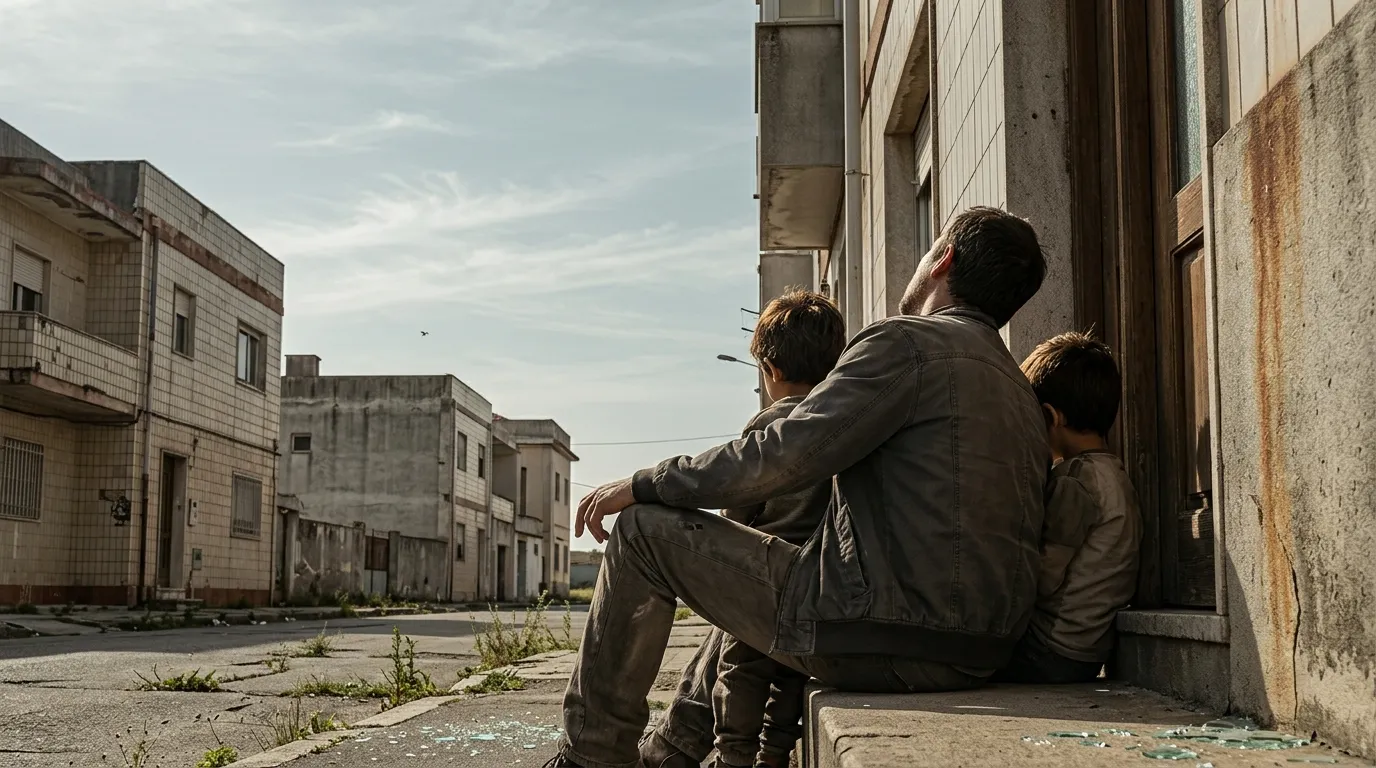
People were walking.
Not many. Twos and threes. Some walking fast, heads down, rushing somewhere. Some standing at the curbs motionless, looking at their own hands — chip communication cut. The implanted chip at the back of the neck was receiving no signal. No notifications appeared in the visual cortex. Close your eyes and it was dark.
Héngyuǎn knew this feeling. After his chip downgraded, it was like this. But he’d had months to adjust. These people had had a few hours.
A woman stood at the entrance of a convenience store, making gestures at empty air — trying to trigger a virtual interface that no longer existed. Her fingers traced through the air three times, then slowly lowered.
Gé Luò tugged at Héngyuǎn’s sleeve. “Dad, what’s she doing?”
“Looking for something she used to see that she can’t see anymore.”
Gé Luò thought about it. “Like the humming?”
“Yes.”
They didn’t stop. Headed south along Zhonghua Road. The cracks in the pavement and the weeds were just as he remembered. The asphalt still crumbling. The silver grass still tall. The southern Taiwan sun still hot.
His body found a low-order rhythm in the walking — not comfort, but automation. Left foot, right foot. Brain not required. Occasional micro-sleeps would arrive — two seconds, three seconds — his footsteps wouldn’t stop, just drift sideways. Each time he drifted, Gé Suǒ would lightly touch his elbow.
No words. Just a touch.
The Yongkang apartment. Fourth floor. No elevator — there’d never been an elevator. He climbed the concrete stairs one step at a time. Fourteen steps per floor. He counted. Not by choice. The brain, counting. Forty-two steps to the third floor. Fifty-six to the fourth. The right leg’s twitching became a full spasm at step thirty-nine — he grabbed the railing and waited five seconds. The metal railing was hot in his palm — sun-warmed.
The door was unlocked. He’d never locked it — in a world where surveillance drones covered every alley, a door lock was meaningless. But there were no more surveillance drones now.
He pushed the door open.
The air inside was stale. Several days without opening the windows. Dust floating in the light through gaps in the curtains. On the table, two capacitors — Gé Suǒ’s half-finished sorting from last time. A corner of the foil window paper had lifted and curled.
The bedroom corner. The metal equipment cabinet. Double doors. Sixty centimeters wide. Closed.
Héngyuǎn walked over. Opened the cabinet doors.
Cornelius was inside. Motherboard, graphics card, SSD, heat sink — all of it sitting quietly in the Faraday cage. Fan not spinning. No power. Screen dark.
Intact. Seven billion parameters sleeping quietly in the NAND flash, unaware of what had happened outside. The dumbest AI. A third of the time hallucinating. A thousand times slower than online models. But it was still here.
He reached out and touched the casing. The metal was cool. He closed the cabinet doors.
He tried three methods to determine the life-support pods’ status.
First: low-band broadcast. The handheld radio in the drawer was still there — salvage team backup gear, never imagined he’d use it for this. He swept the full frequency range from the balcony. Most frequencies dead — base stations and relay nodes all offline. But on a VHF frequency there were fragmented voices. Several people shouting. Incomplete. He listened for five minutes and pieced together a few words: “south zone,” “second batch,” “life-support pods,” “counting.”
Second: paper. From the balcony he could see in the direction of the Southern Science Park. That skyline hadn’t changed — the ruins’ silhouette was the same as three days ago. But closer in, at an intersection about two hundred meters away, someone was posting paper on a wall. He couldn’t make out the characters. Too far.
Third: walk to the intersection and look.
He set the handheld radio on the table. After walking nearly five kilometers, his legs were approaching their limit. But two hundred meters was still possible.
“I’m going out for a bit.”
Gé Suǒ looked at him. Said neither yes nor no. Only: “I’ll watch the door.”
Héngyuǎn walked down the stairs. His body had entered a purely mechanical mode of operation — not endurance, but no cortical resources left over to process pain signals. All sensation was compressed to minimum resolution: is the ground level. Are there people ahead. Are his feet still moving.
Two sheets of paper on the wall at the intersection. Handwritten. The ink had bled slightly into the damp wall surface.
The first was a relief distribution point — location and time. Tomorrow morning. The plaza in front of the district office.
The second:
Life-support pod system affected by Rollback
Some nodes now operating on local failsafe
Some nodes offline — confirming
Death toll: counting

The following nodes' data unavailable——

Zone 4: Rack 0903-1205
Zone 7: entire zone
Zone 11: Rack 0001-0344
Héngyuǎn’s eyes found Zone 4. Rack 0903 to 1205.
Xǔ Jìng was in Rack 1172.
Data unavailable.
He stood in front of the wall. The characters on the paper lost focus in his field of vision for a second — micro-sleep. He forced himself to refocus. Read it again. Data unavailable. Not dead. Not alive. Unavailable. Query rejected. Records incomplete. Connection broken. Any of these — all pointed to the same result: he didn’t know.
Zone 7’s data entirely unavailable. That was the Rollback’s detonation point. The 0.3-second window in fl_09.sh, the ±4% fault tolerance, the mirror redirect — all the precise calculations’ final result was a returned empty value.
NULL.
He didn’t know how many people had died. The paper said “counting.” Maybe fifty thousand. Maybe three million. The day the number came out he might look. He might not.
Héngyuǎn stood there for about twenty seconds. Then turned and walked back.
Up the stairs. Forty-two steps. Fifty-six steps. Right leg seized into another spasm at step forty-eight. He braced against the wall and waited eight seconds. Then kept going.
The doorway. Gé Suǒ sitting on the threshold. A notebook on his knees. Writing. Héngyuǎn didn’t look at what.
“How was it?” Gé Suǒ asked.
Héngyuǎn sat down beside him. The concrete edge of the threshold dug into his femur. He adjusted his position. Still dug. He left it.
“Don’t know,” he said.
Gé Suǒ didn’t ask further. He closed the notebook. Slipped the pencil between the pages. Then leaned his body over, shoulder pressed against Héngyuǎn’s arm. Same position as in the underground chamber.
Gé Luò’s footsteps sounded from inside. He ran out and sat on Héngyuǎn’s left. The metal piece in his trouser pocket clinked lightly against the threshold.
“What happened outside?” Gé Luò asked.
“The system downgraded.”
“What does that mean?”
“It means… a lot of things aren’t available for now.”
Gé Luò thought about it. “Like a power outage?”
“A little more complicated than that.”
“But there’s still power.” Gé Luò pointed at the building across the way — one of the apartments had a lit window. “That one’s on.”
“The power’s still there. What’s running on top of it stopped.”
Gé Luò’s expression said he understood about twenty percent. But he accepted it. He turned his head to look at the sky. Héngyuǎn looked too.
The sky had nothing in it. Grey-blue. A few thin clouds. No drones. No condensation trails from satellite communications. Nothing man-made flying. Very empty.
The back of Héngyuǎn’s neck had no sensation at all. After the downgrade, the firmware notifications had stopped. But before, there had sometimes been a faint background signal — the base stations’ mere existence was a kind of electromagnetic noise; the downgraded chip didn’t process it but could sense it. Now even that was gone. The skin on the back of his neck was just skin.
He leaned against the doorframe. The concrete surface was rough. Like some moment long past. He remembered it. Or he didn’t remember — only his body remembered. The dull sting of the back of his skull pressed against a rough surface.
The wind came through. From the south. Carrying a faint sweetness of plants. Maybe silver grass pollen. Maybe something else. He didn’t know. His olfactory discrimination had degraded past a hundred hours without sleep to only two levels: something, nothing.
Gé Suǒ’s hair moved in the wind. Short. Cut some time before — not three days before. Many days before. That afternoon many days ago. Scissors on the balcony. Cut hair falling on the concrete floor, blown by the wind to the edge of the drain.
It would grow back.
Gé Suǒ had said that.
It had grown back. Not much. But you could see it. The new growth was slightly lighter in color, and in daylight there was a thin line of difference between the new growth and the old ends.
Things that grow back will grow back. The things that won’t —
Héngyuǎn’s right hand rested on his knee. Four fingers curled, the little finger cocked out, unable to close. A two-millimeter gap. Constant.
He didn’t move. Sat there. Two children on either side. The sun slowly shifted west. He didn’t know what time it was. Didn’t need to. No firmware update notifications. No bill payment deadlines. No countdowns. No T-minus anything.
His left index finger jumped. He watched it. Five seconds later it jumped again. This would keep going. Bad debt doesn’t clear. But he’d stopped counting.
Behind him in the apartment, the metal cabinet stood quietly in the bedroom corner. Seven billion parameters in the silicon lattices of the SSD — not decaying, not running, not reasoning, not hallucinating. Only existing. An offline, dumbest-of-all, unconnected model. Waiting for the day someone powered it on. Or not waiting. It had no capacity for waiting. It only existed.
He suddenly thought of something. He didn’t know what day of the week it was. Didn’t know the date. Didn’t know what version of the rules the whole world was running on now — the old ones, he’d broken a part of them; the new ones hadn’t formed yet. What was this blank in between?
He had no answer. A hundred-some hours. The brain had stopped producing answers — only producing blankness. Between blanks a thought would occasionally surface, break at the top like a bubble, leave nothing behind.
Xǔ Jìng. Broken. Don’t know.
He closed his eyes. The concrete wall at the back of his neck was rough. Sunlight on his eyelids was orange-red. The 4000Hz tinnitus was still there — it needed no electricity. It was his own.
“Dad.”
Gé Luò’s voice.
Héngyuǎn opened his eyes.
“What version is the world running now?”
Héngyuǎn looked at the sky. Grey-blue. Empty. No hum. No machines flying. A bird passing from very far away, small as a period.
“I don’t know,” he said. “But at least it’s offline now.”