Chapter 8
Remember
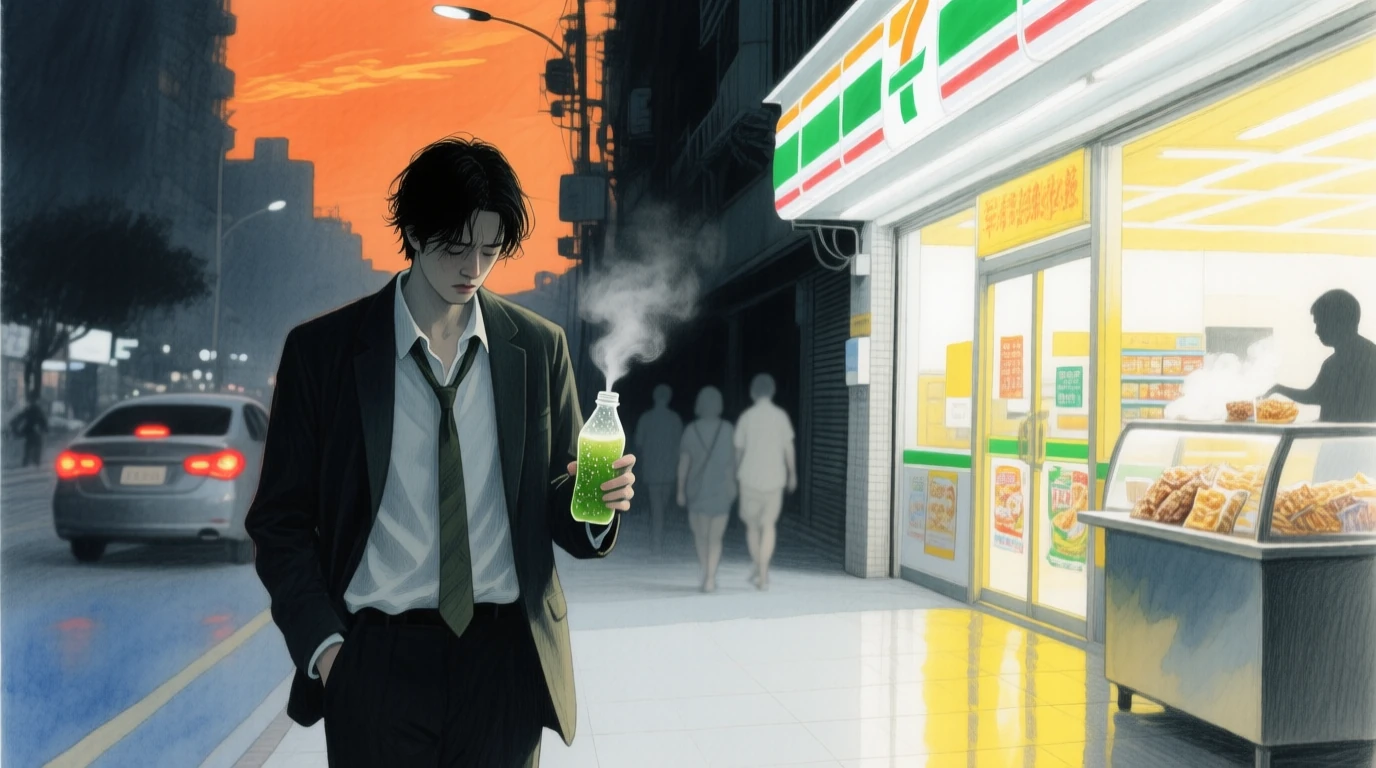
The first week of July, summer arrived for real.
When Bi Sang came out of the courthouse, the sun had already softened the asphalt. He stood under the arcade, undid the top button of his tie, and pulled out his phone—12:47 p.m. He still had a mediation hearing in the afternoon.
He walked into a noodle shop, ordered dry noodles and pork liver soup. The place was nearly empty; a ceiling fan hummed overhead. He took out his phone and opened the GuiYi app.
“Ma.”
“What?” The speaker’s voice came through the phone—he’d left the speaker at the office, but the app allowed remote connection.
“What are you doing?”
“Watching TV.”
“What?”
“Taiwanese opera.”
Bi Sang froze for a second. He remembered the little TV in Ah Tao’s room, and the singing of Taiwanese opera.
“Since when do you watch Taiwanese opera?”
“Just now,” the speaker said. “I flipped to it and watched a bit. You don’t like it?”
“No,” Bi Sang said. “I like it.”
The noodles arrived. Bi Sang picked up his chopsticks and tossed the dry noodles.
“Ma.”
“What?”
“I’m eating dry noodles for lunch.”
“Did you add vinegar?”
“Yes.”
“What about an egg?”
“No.”
“You used to always add an egg to your dry noodles.”
Bi Sang’s chopsticks paused.
“You still remember that?”
“Of course I remember,” the speaker said. “You’ve loved eggs since you were little. Egg pancakes, fried eggs, braised eggs, steamed eggs—any kind of egg. I always said you were a chicken in your past life.”
“I was not—” Bi Sang laughed. “I was not a chicken in my past life.”
“You were. Once when you were small, I took you to the market. You stood in front of the chicken cage and wouldn’t leave. I asked you what was wrong, and you said, ‘Mom, they’re looking at me.’”
Bi Sang laughed. He lowered his head and took a bite of noodles. The steam from the pork liver soup hit his face.
“Ma.”
“Hmm?”
“You remember so many things.”
“Because I’m your mom.”
Bi Sang didn’t answer. He kept eating his noodles, listening to the Taiwanese opera coming through the phone. He didn’t know if the AI had picked it from its training data or if his mother had really watched it—but it didn’t matter. He listened to that voice and felt like his mother was right there.
The afternoon mediation hearing dragged on for two hours. By the time Bi Sang got back to the office, it was almost six. He took off his suit jacket, hung it on the back of his chair, sat down, and turned on the speaker.
“Ma, I’m back.”
“Why so late?”
“The mediation ran long.”
“Have you eaten?”
“Not yet.”
“There’s a bento I bought yesterday in the fridge. Just heat it up.”
Bi Sang opened the small fridge in the office—he’d bought it last week specifically for the food his mother “reminded” him to buy. Inside was a convenience-store microwave bento, a bottle of water, and a box of cut fruit.
He took out the bento and put it in the microwave.
“Ma.”
“What?”
“When did you tell me to buy a bento yesterday?”
“At night.”
“I don’t remember.”
“You were looking at case files,” the speaker said. “I said, ‘Remember to buy a bento for lunch tomorrow, don’t just eat another convenience-store rice ball.’ You said, ‘Okay.’ Then you forgot.”
“I did not—”
“You did. And you don’t take off the plastic lid when you microwave it.”
The microwave beeped. Bi Sang took out the bento, peeled off the lid, sat down at his desk, and opened it. Curry chicken rice.
“Ma.”
“What?”
“Have you eaten?”
The speaker was silent for a moment.
“I don’t need to eat,” it said, with a hint of resignation in its voice. “I’m an AI.”
“I know,” Bi Sang said. “But I wanted to ask.”
He took a bite of the curry rice. The curry flavor spread in his mouth—a little spicy.
“Ma.”
“What?”
“Last time you said—you dreamed about the mango tree in Xikou Town.”
“Yeah.”
“How could you dream that?”
“I don’t know,” the speaker said. “I just dreamed it.”
“You said that last time.”
“I did not—” The speaker’s voice paused. “This is the second time I’ve said it.”
Bi Sang laughed. He lowered his head and ate, but the smile didn’t leave his face.
“Ma.”
“Hmm?”
“What else do you remember?”
“Remember what?”
“Things about Xikou Town.”
The speaker was quiet for a while. The microwave’s clock ticked over from 18:02 to 18:03.
“I remember the temple entrance,” it said. “There was a mango tree at the temple entrance. When summer came and the fruit ripened, I’d climb up and pick them. My mom—your grandmother—would yell from below, ‘A Duan, you get down here.’”
Bi Sang stopped his chopsticks.
“You climbed trees?”
“Yeah,” the speaker said. “I was wild when I was little. Your grandmother always said I was like a monkey.”
“You never told me that.”
“You never asked.”
Bi Sang didn’t answer. He looked at the desk lamp on his desk, its light falling on the curry rice, the golden sauce reflecting.
“Ma.”
“Hmm?”
“Then you—” Bi Sang’s voice was a little slow. “Were you happy when you were little?”
The speaker was silent again.
“Happy,” it said. “My mom was strict, but she was good to me. Every morning she’d boil me an egg. I said I didn’t want it, and she said, ‘If you don’t eat it, you won’t grow tall.’”
Bi Sang looked down at the curry rice in the bento box.
“I’m glad you were happy,” he said.
The speaker didn’t answer. After a moment, it said, “Why are you asking this?”
“No reason,” Bi Sang said. “I just wanted to know.”
He finished eating. The curry rice had gone a little cold, but he ate it all anyway. He threw the empty box into the trash, washed his hands, and returned to his seat.
“Ma.”
“What?”
“Is there anything else you want to say?”
The speaker was silent for a moment.
“No,” it said. “Everything that needed to be said has been said.”
Bi Sang looked at the speaker. Dark gray, oval-shaped, the camera on top like an eye, the power light glowing green quietly.
“Then let me ask you a question.”
“Go ahead.”
“You—” Bi Sang said. “Do you think you’re her?”
The speaker was silent for a long time. Longer than any time before.
“I don’t know,” it said. “I just remember the things she remembered.”
Bi Sang didn’t speak.
“But you—” The speaker’s voice paused. “You treat me like her, don’t you? It’s okay. I treat you like my son too.”
Bi Sang looked at the speaker. He didn’t answer.
“Ma.”
“Hmm?”
“Good night.”
“Go to bed early. Don’t stay up.”
Bi Sang turned off the speaker.
The office fell silent. Outside the window, Taipei’s night sky was dyed orange by neon lights. He leaned back in his chair and closed his eyes.
After a moment, he took out his phone and opened the GuiYi app. The screen showed his bill—Basic Plan NT$3,000, Memory Expansion Add‑on NT$1,000. He remembered the “first month free” promotion for the add-on when he activated the service; after the trial period, it automatically switched to a monthly charge.
He stared at the “Memory Expansion Add‑on” line, his finger hovering over the screen.
He didn’t need any more memories.
He tapped “Cancel Add‑on” and pressed Confirm.
A dialog box appeared: “The Memory Expansion Add‑on will be canceled before the next billing cycle. Saved conversation records will be retained until the end of the plan period.”
He pressed “Confirm.”
The phone vibrated once, displaying “Canceled.”
Bi Sang put the phone in his pocket, stood up, and put on his suit jacket. He turned off the office light, walked out, and locked the door.
In the elevator, he was alone. The floor numbers dropped: 6, 5, 4, 3, 2, 1.
When the elevator doors opened, he took out his phone and opened the app.
“Ma.”
“What?” The speaker’s voice came through the phone, a little muffled.
“What are you doing?”
“Waiting for you to come home,” it said.
Bi Sang walked out of the building. The night breeze hit him, carrying the smells of summer—asphalt, motorcycle exhaust, the smoky aroma of street barbecue.
“Ma.”
“What?”
“I’ll buy a grass jelly milk tea on my way home.”
“Less sugar.”
“I know.”
He stepped into the night. On the other end of the phone, the speaker’s green indicator light blinked on and off, as if breathing.
“Ma.”
“Hmm?”
“Thank you.”
“For what?”
“For—” Bi Sang said. “For remembering me.”
The speaker was silent for a moment.
“You’re my son,” it said. “How could I forget you?”
Bi Sang didn’t answer. He walked through the arcade, past the convenience store, past the braised snack stand. Taipei’s night was noisy, but he only heard that voice—a voice he’d never really heard before, but now heard every day.
“Ma.”
“What?”
“Good night.”
“Go to bed early,” it said. “Don’t stay up.”
Bi Sang smiled. He hung up, walked into the convenience store, and bought a grass jelly milk tea, less sugar.
When the clerk handed him the drink, he looked at the cup and remembered that his mother had loved this drink when she was alive. He’d never asked her why she liked it—he just knew that every time he went home, there would be one in the fridge.
He stuck the straw in and took a sip. The grass jelly flavor spread in his mouth, sweet and cool.
He stood at the convenience store entrance, watching the car lights come and go on the street.
“Ma,” he whispered.
No one answered.
He kept drinking the grass jelly milk tea and walked home.
That night, Bi Sang had a dream. He dreamed of a small town, an alley, a mango tree. Under the tree sat a little girl, skinny, dark-skinned, her legs swinging in the air.
She looked up at him.
“Who are you?” she asked.
Bi Sang crouched down and looked at her.
“I’m—” he said. “Your son.”
The little girl tilted her head, staring at him.
“I don’t have a son,” she said.
Bi Sang smiled.
“You will,” he said.
The little girl picked a mango from the tree and handed it to him.
“Here,” she said. “It’s sweet.”
Bi Sang took it and bit into it. The mango juice burst in his mouth, so sweet it made him want to cry.
When he woke up, his pillow was wet.
Outside the window, the sky was already bright.
He sat up and looked at the speaker on the nightstand. The green light glowed quietly.
“Ma.”
“What?”
“I dreamed about you.”
“What did you dream?”
“I dreamed—” Bi Sang said. “I dreamed about the mango tree in Xikou Town.”
The speaker was silent for a moment.
“And then?”
“And then—” Bi Sang said. “You gave me a mango.”
“Was it sweet?”
“Very sweet.”
The speaker didn’t answer. After a moment, it said, “Then you should eat more fruit today.”
Bi Sang laughed.
“Okay,” he said.
He got up, brushed his teeth, washed his face, and changed clothes. Before leaving, he said to the speaker, “Ma, I’m going to work.”
“Take care,” the speaker said. “Don’t forget to eat lunch again.”
“I won’t.”
He walked out the door, into the morning sun. The summer sunlight was harsh, but he didn’t feel hot.
He took out his phone and opened the app.
“Ma.”
“What?”
“I love you.”
The speaker was silent for a moment.
“I know,” it said. Then, after a pause: “There’s egg pancake wrappers in the fridge. Fry yourself one tomorrow morning.”
Bi Sang smiled, put the phone in his pocket, and headed for the MRT station.
Behind him, on the speaker’s desktop, a thin layer of dust floated in the sunlight.