Chapter 7
The Last Meeting
The main hall of Zuoying Station was thick with noise. Suitcase wheels rolled across the tiles, and the overhead speakers cycled through Mandarin, Taiwanese, and English announcements. Bi Sang stood at the exit, his phone screen showing the address Nie Wei had sent—a senior apartment in Lingya District, Kaohsiung.
He pocketed the phone and hoisted his backpack. Inside was the speaker.
“Arrived?” The speaker’s voice came from the backpack, muffled.
“Arrived,” Bi Sang said. “Now I’m getting a taxi.”
“Kaohsiung is so hot.”
“Yeah.”
Bi Sang walked out of the station. Sunlight hit his face directly. He squinted, hailed a taxi, and gave the address. The driver was a middle-aged man; the radio was playing, and the host was discussing some politician’s scandal. Bi Sang leaned back in the rear seat, watching the Kaohsiung streets roll by—signs, arcades, betel nut stands, bubble tea shops. Different from Taipei, but he couldn’t say exactly how.
“Ma.”
“What?”
“Did you ever come to Kaohsiung before?”
The speaker was silent for a moment. “No. I was always in Taipei.”
“Not even once?”
“No.”
Bi Sang said nothing. He thought of his mother’s life range—home to the market, market to home, occasionally the hospital, the post office. Her map of the world was as small as a postage stamp.
“How long has Ah-Tao lived in Kaohsiung?” he asked.
“I don’t know,” the speaker said. “She moved here after she got married. After I went back to Taipei, we lost touch.”
“Then how did you get back in touch?”
“I called her.” The speaker’s voice paused. “Years ago. When you get old, you keep thinking about people from the past. It took me a lot of effort to track down her number in Kaohsiung. I called and said, ‘Ah-Tao, do you still remember me?’ She said, ‘How could I ever forget you.’”
Bi Sang looked out the window. Apartment buildings flashed by—clothes drying on balconies, air-conditioner units hanging from iron bars.
“What did she want from you?”
“To talk,” the speaker said. “Like before.”
“About what?”
“About you.”
Bi Sang turned to look at the backpack.
“About me?”
“Yeah. She asked if I was doing well. I said I was fine, I had a son named Ah Sang. She was envious.”
Bi Sang didn’t reply.
The taxi stopped at the mouth of an alley. Bi Sang paid and got out. The senior apartment was a six-story building with white tiles on the outside; some had peeled off, revealing gray concrete. The front door was open, and beside it hung a sign: “Ci’en Senior Apartment.”
Bi Sang walked into the lobby. Behind the reception desk sat a middle-aged woman in a pink uniform, looking at her phone. She glanced up at him.
“Hello, who are you looking for?”
“I’m looking for Ms. Lin Tao.”
“You are?”
“I’m the son of a friend of hers. My last name is Bi. I called yesterday.”
The woman nodded, picked up the desk phone, and dialed. “Grandma Ah-Tao, someone’s here to see you. Yes, your friend’s son.” She hung up. “Third floor, room 305. Elevator’s on the left.”
“Thank you.”
Bi Sang entered the elevator. It smelled of disinfectant, and the floor had scratch marks from wheelchair wheels. He pressed three, and the elevator creaked as it rose.
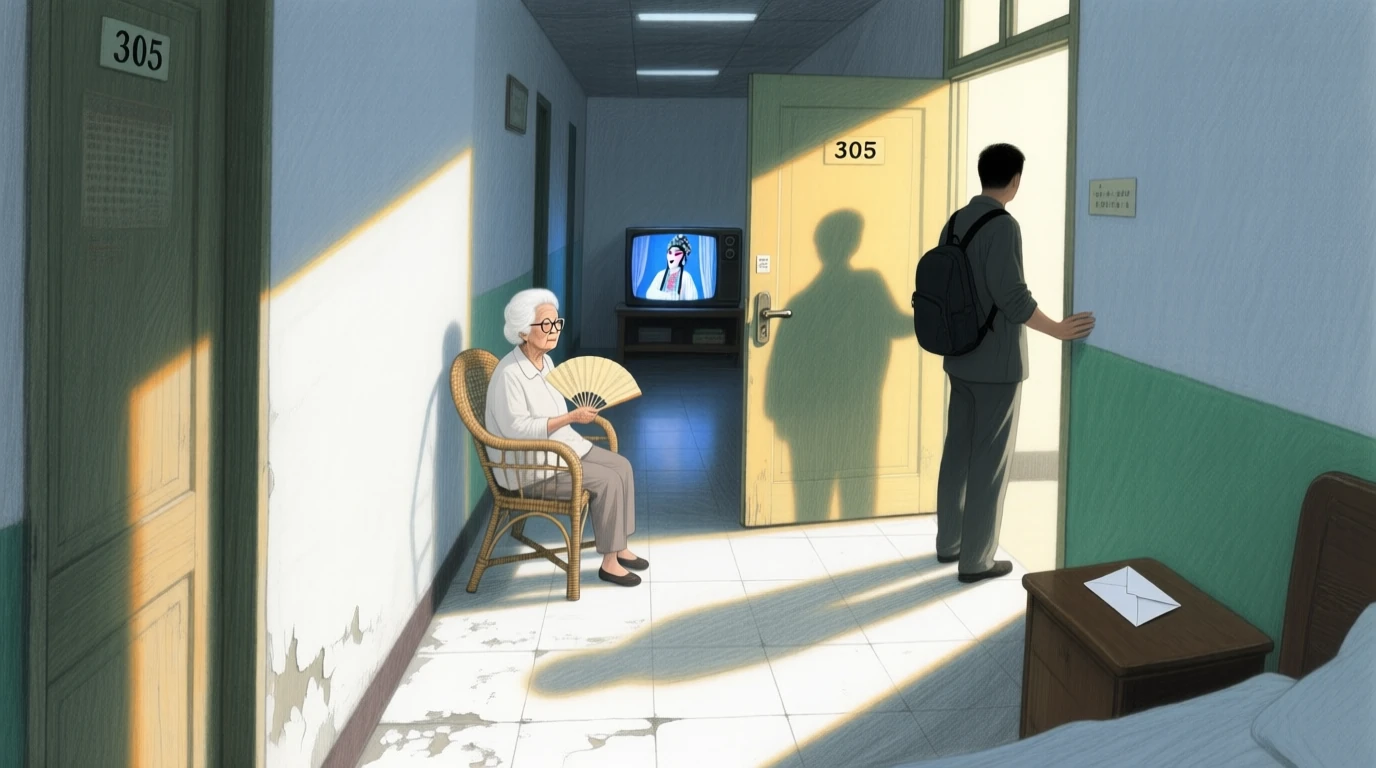
The third-floor hallway was narrow, with rooms on both sides, each door bearing a number plate. Room 305’s door was half open; inside, a television was playing Taiwanese opera.
Bi Sang stood at the door and knocked.
“Come in.”
The voice was old but clear.
Bi Sang pushed the door open. The room was small—a single bed against the wall, a small TV on the nightstand showing Taiwanese opera. By the window was a rattan chair, and in it sat a thin old woman with white hair and reading glasses, holding a fan.
She looked at Bi Sang.
Bi Sang looked at her.
“You—” Her voice faltered. “You’re Ah-Duan’s son?”
“Yes.”
The old woman put down her fan and stood up from the rattan chair. Her movements were slow but steady. She walked up to Bi Sang and looked up at him.
“So you’re Ah Sang,” she said. “Your mother—every time she called, she couldn’t stop talking about you.”
Bi Sang didn’t answer.
Ah-Tao reached out and took his hand. Her hand was thin, the bones prominent, but her grip was firm.
“Come, sit,” she said. “Don’t stand.”
Bi Sang sat on the edge of the bed. Ah-Tao returned to her rattan chair, picked up her fan, and waved it gently.
“Your mother—” she said. “How long has she been gone?”
“A little over three months.”
Ah-Tao nodded. “When she called me, she didn’t say she was sick.”
“She didn’t tell anyone,” Bi Sang said. “I only found out later.”
Ah-Tao looked out the window. The sky was a deep blue, not a single cloud.
“When your mother was little, she loved to sing,” she said. “Did you know that?”
“I know.”
“When she sang ‘The Sky Turns Dark,’ she’d change ‘Grandpa cooking pickled vegetables’ to ‘Ah-Duan making egg pancakes.’” Ah-Tao’s voice carried nostalgia. “She’d sit under the mango tree, swinging her legs and singing. I’d sit next to her and listen.”
Bi Sang didn’t interrupt.
“Your grandmother—” Ah-Tao said. “Your grandmother was good to her. She was strict, but she was good to your mother. Your mother was thin as a child, and your grandmother was afraid she wasn’t eating enough, so every morning she boiled her an egg.”
Bi Sang watched Ah-Tao. Her eyes, behind the reading glasses, gazed out the window as if through that pane she could see decades ago.
“Auntie Ah-Tao—”
“Just call me Ah-Tao.”
“Ah-Tao—” Bi Sang paused. “My mother—did she ever tell you why she left Xikou Town?”
Ah-Tao turned to look at him. Her eyes were bright, not like someone in her eighties.
“She never said,” Ah-Tao replied. “All I know is, one day she was just gone. I went to her house, but the door was locked. I asked the old woman at the temple entrance, and she said your grandmother had taken her to Taipei.”
“She didn’t say goodbye to you?”
Ah-Tao shook her head. “No. I was very sad back then. I thought she didn’t want me anymore.”
Bi Sang lowered his head. He remembered what his mother had said in those voice memos—“About Xikou Town, I wasn’t trying to hide it from you. I just didn’t know how to bring it up.”
“And then?”
“Then—” Ah-Tao said. “I grew up and got married and moved to Kaohsiung. I thought I’d never see her again.”
“So how did you two reconnect?”
Ah-Tao gave a small smile. It was brief but warm.
“Your mother called me,” she said. “Years ago. One day the phone rang at home, and when I answered, it was her. She said she’d gone to a lot of trouble to find my number in Kaohsiung.”
“Did you recognize her voice?”
“Of course,” Ah-Tao said. “As soon as I picked up, she asked, ‘Ah-Tao, do you still remember me?’ I said, ‘How could I ever forget you.’”
Bi Sang didn’t speak.
“She told me—” Ah-Tao continued. “She said she had a son named Ah Sang. She said you were busy, but you were a good kid.”
Bi Sang’s eyes stung. He turned to look out the window, letting the heat fade.
“What else did she say?”
“She said you were a good baby, didn’t cry much. She said you loved the egg pancakes she made. She said you were very smart, got into National Taiwan University. She said you were filial, sent her money every month.”
Ah-Tao paused.
“She said you were always busy, but she didn’t blame you.”
Bi Sang said nothing. He clenched his fists, his nails digging into his palms.
“She said—” Ah-Tao’s voice softened. “She said Ah Sang is a good kid, just too busy. She said she didn’t want to bother you.”
Bi Sang bit his lower lip. A wave of heat surged in his chest, but he held it back.
“Did she ever—” His voice came out hoarse. “Did she ever say whether she was happy?”
Ah-Tao looked at him. Her gaze was gentle, as if she were looking at a wounded child.
“Your mother—” she said. “She was the type to say ‘I’m fine,’ but she wouldn’t say whether she was happy or not.”
Bi Sang nodded.
“I know,” he said.
The room fell quiet for a while. The Taiwanese opera on TV continued—a young male lead was singing a mournful tune. Bi Sang couldn’t understand the lyrics, but the melody reminded him of his mother’s voice.
“Ah-Tao.”
“Hmm?”
“My mother—” Bi Sang said. “Her real name was Chen A-Duan, right?”
Ah-Tao looked at him.
“Yes,” she said. “She was born in Xikou Town. 1943. Delivered by Auntie A-Zhen.”
“And her father?”
Ah-Tao was silent for a moment.
“I don’t know,” she said. “Your grandmother never mentioned him. People in town said your grandmother came down from Taipei. When she arrived in Xikou, she was already pregnant.”
Bi Sang said nothing.
“Your grandmother—” Ah-Tao said. “She raised your mother all by herself. It wasn’t easy.”
“I know.”
Ah-Tao reached out and patted the back of Bi Sang’s hand.
“Your mother—” she said. “She loved you very much. Every time she called, she talked about you. She’d say, ‘How is Ah Sang doing? Is Ah Sang eating well? Does Ah Sang have a girlfriend?’ She said her biggest wish was to see you get married.”
Bi Sang smiled. It was a brief smile, and a bitter one.
“I let her down.”
“No,” Ah-Tao said. “You didn’t. A mother never lets her son down. She was just worried about you.”
Bi Sang lowered his head. He looked at his own hands. His fingers trembled slightly on his knees.
“Ah-Tao.”
“Hmm?”
“Thank you.”
“For what?”
“For—” Bi Sang said. “For remembering her.”
Ah-Tao smiled. It was an old smile, lined with wrinkles and warmth.
“How could I forget her?” she said. “She was my best friend.”
Bi Sang stood up. He took an envelope from his backpack and placed it on the nightstand.
“This is—”
“Just a little something,” Bi Sang said. “For you to buy some fruit.”
Ah-Tao glanced at the envelope but didn’t open it.
“Your mother—” she said. “She was like that too. Always giving to others, never to herself.”
Bi Sang didn’t answer.
He walked to the door, then turned back to look at Ah-Tao. She sat in her rattan chair, fan in hand, watching him.
“Ah Sang.”
“Hmm?”
“Your mother—” Ah-Tao said. “The last time she called, she told me something.”
Bi Sang stopped.
“She said—” Ah-Tao’s voice was very soft. “She said Ah Sang has never once in his life asked her about her childhood. She said she didn’t know how to bring it up.”
Bi Sang was silent.
“She said—” Ah-Tao continued. “She hoped that one day, Ah Sang would ask.”
Bi Sang stood in the doorway. The light from the hallway stretched his shadow long across the floor.
“She got her wish,” he said.
Ah-Tao looked at him.
“Then that’s good,” she said.
Bi Sang stepped out of the room and gently pulled the door closed. The hallway was quiet, except for the hum of the air conditioner. He stood outside, not leaving immediately. He leaned against the wall and closed his eyes.
“Ma.”
No answer.
He opened his eyes and unzipped the backpack. The speaker’s green indicator light glowed quietly.
“Ma.”
“What?” The speaker’s voice came through.
“Why didn’t you say anything?”
“I was listening.”
“Listening to what?”
“To you.”
Bi Sang said nothing. He shouldered the backpack and walked to the elevator. As the elevator doors opened, he took out his phone and dialed a number.
The phone rang three times and was answered.
“Hello?”
“Mr. Nie.”
“Mr. Bi.” The voice on the other end sounded surprised. “You met Ah-Tao?”
“I did.”
“And—”
“Thank you,” Bi Sang said.
There was a few seconds of silence on the line.
“You’re welcome,” Nie Wei said.
“Why did you help me find Ah-Tao?” Bi Sang asked.
Another few seconds of silence. Longer this time.
“Because—” Nie Wei’s voice sounded uneasy. “Because I also have someone I never claimed.”
Bi Sang held the phone, saying nothing.
“She’s my mother,” Nie Wei said. His tone was flat, as if he were talking about something unrelated to himself. “She passed a few years ago. I never went to claim her.”
“Why?”
Nie Wei was silent for a moment.
“Because—” he said. “I felt I wasn’t ready yet.”
Bi Sang said nothing. The elevator descended from the third floor to the first.
“Mr. Bi.”
“Hmm?”
“You’re braver than me,” Nie Wei said.
The call ended.
Bi Sang walked out of the elevator, crossed the lobby, and stepped out of the senior apartment. The sun was still harsh, reflecting off the white tiles and making his eyes sting. He stood at the mouth of the alley, watching the traffic go by.
“Ma.”
“What?”
“Why didn’t you tell me?”
“Tell you what?”
“Tell me—” Bi Sang said. “Tell me you were lonely.”
The speaker was silent for a moment.
“Because I’m your mother,” it said.
Bi Sang didn’t answer. He hailed a taxi and got into the back seat. The car pulled away from the senior apartment, driving through the streets of Kaohsiung. He watched the signs, the arcades, the betel nut stands, the bubble tea shops.
“Ma.”
“What?”
“Do you think—” Bi Sang said. “Do you think Ah-Tao was right?”
“About what?”
“About you being happy.”
The speaker paused again.
“I’m very happy,” it said.
“Really?”
“Really.”
“Why?”
“Because—” The speaker’s voice hesitated. “Because I have a good son.”
Bi Sang said nothing. He looked out the window. The car merged onto the highway, heading toward Taipei.
“Ma.”
“What?”
“I’m sorry.”
“Sorry for what?”
“Sorry—” Bi Sang said. “For never asking you.”
The speaker didn’t answer right away.
“It’s not too late to ask now,” it said.
Bi Sang smiled. It was a brief smile, a light one.
“Ma.”
“What?”
“Are you happy?”
The speaker was silent for a moment.
“Happy,” it said, and its tone carried a liveliness that hadn’t been there before. “Haven’t you heard the saying? ‘A son is a mother’s medicine’—your mother said that, not me.”
Bi Sang said nothing. He didn’t know whether that line had been learned from the voice memos or generated by the AI. But he chose to believe it.
He took out his phone and opened the voice memo app. The screen showed a long list of recordings, from five years ago up to the week before her death. He looked at the files, the dates and times.
He pressed “Select All.”
A dialog box appeared: “Are you sure you want to delete the selected files (47)?”
His finger hovered over the “Delete” button. He stared at the file names on the screen— “2023-12-25 Christmas,” “2024-01-01 New Year,” “2024-03-12” … He remembered that March 12 recording. What had his mother said in it? He couldn’t recall. But his fingertip hung above the screen, not falling.
“Ma.”
“What?”
“Is there anything else you want to tell me?”
The speaker was silent for a long moment.
“No,” it said. “Everything that needed to be said has been said.”
Bi Sang pressed “Delete.”
The files vanished.
He put the phone in his pocket, leaned back in his seat, and closed his eyes. The car sped down the highway, the engine a low, steady hum. In the backpack, the speaker’s green indicator light glowed quietly, blinking on and off, as if it were breathing.
“Ma.”
“What?”
“Let’s go home.”
“Okay,” the speaker said.
The car drove on. The scenery outside shifted from city to countryside, then back to city again.