Chapter 6
Auntie A-zhen
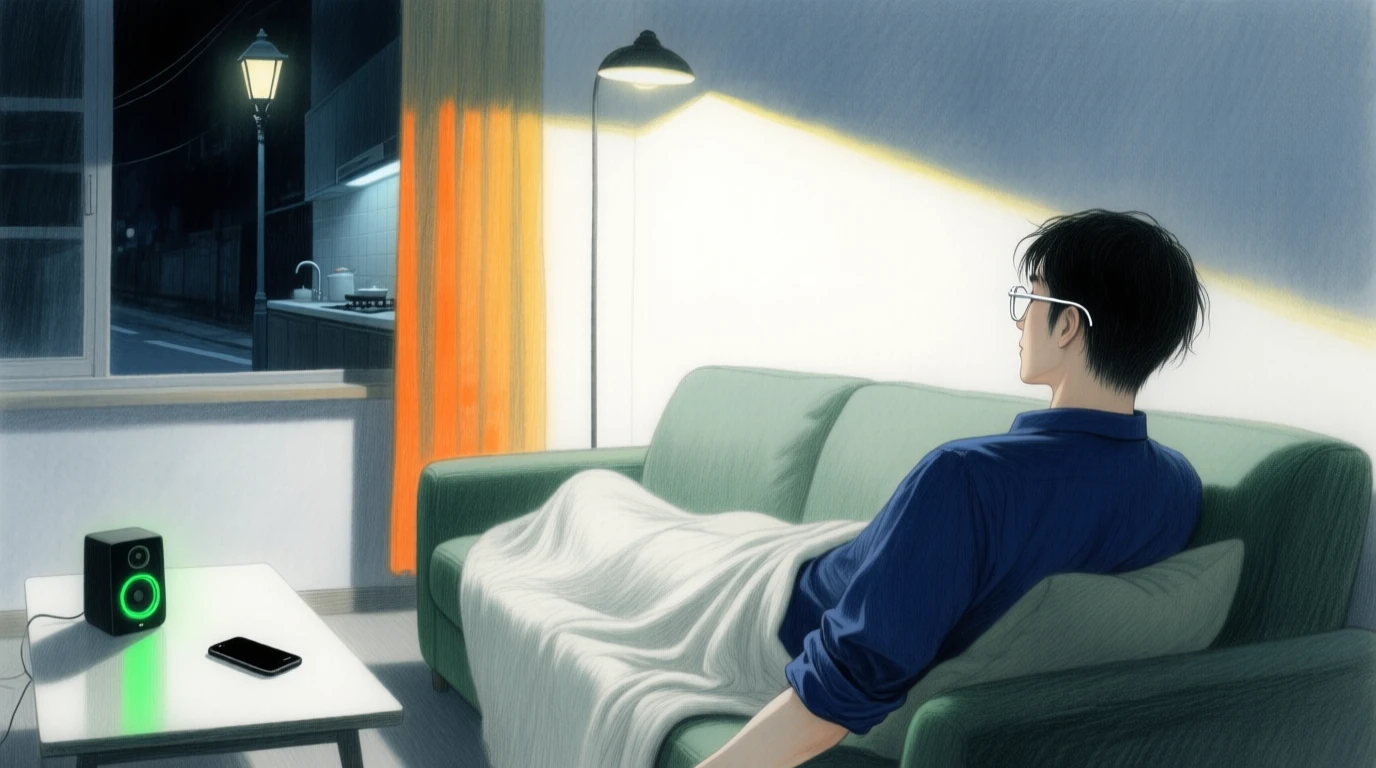
Bi Sang got home, dropped his backpack on the floor by the entrance. The speaker’s green indicator light seeped through the gap in the bag, like a quiet eye. He didn’t take it out right away. He stood at the door, listening to the sounds in the living room. The fridge hummed in the kitchen. The clock ticked on the wall. From outside the window came the ding-dong of the convenience store downstairs.
He unzipped the backpack, pulled out the speaker, and set it on the coffee table. The green indicator light shifted from a breathing pattern to a steady glow.
“You’re back.” The digital mother’s voice came out of the speaker.
“Mm.”
“Are you tired?”
“Not really.”
Bi Sang sat down on the sofa without turning on the light. The light in the living room came from the kitchen and the streetlamp outside the window, stretching his shadow long. He leaned back against the sofa, closed his eyes.
“What are you thinking about?” the digital mother asked.
“Nothing.”
“You are. You’re thinking about what happened in Xikou Town.”
Bi Sang opened his eyes. He looked at the top of the speaker. The tiny red light of the camera glowed in the dark.
“I found Ah-Po,” he said.
“I know.”
“How did you know?”
“I was in your backpack the whole time. I heard everything she said. You forgot?”
Bi Sang didn’t argue. He had been thinking—about what Ah-Po said, about the mango tree, about what his mother looked like as a child. Those images kept spinning around in his head, like an alley with no exit.
“She said you were very skinny,” Bi Sang said.
“Yeah, I was really skinny when I was little.”
“And your skin was dark.”
“Because I was always playing outside.”
“She said you used to sit under the mango tree and sing.”
The speaker was quiet for a second.
“Yeah,” it said. “I sang Dark Sky.”
“You’ve sung it for me before.”
“I know.”
Bi Sang didn’t say anything. He stared at the ceiling. The streetlight came through a gap in the curtain, drawing a thin orange line across the ceiling.
“I went to the household registration office today,” he said.
“To apply for the correction?”
“Mm.”
“Did it go through?”
“No.”
The speaker didn’t answer.
“The clerk said without an original birth certificate, no hospital record, no midwife record, no household registration data to back it up, they can’t make the correction.” Bi Sang’s tone was flat, like he was reading a court verdict. “She said I could file a declaratory judgment suit at the district court, but I’d need other evidence. I said I don’t have any.”
“Why are you telling me this?” the speaker asked.
“Because—” Bi Sang paused. “Because I want you to know that I went.”
“I know.”
“I know you know.”
Bi Sang stood up, walked into the kitchen, poured a glass of water. He leaned against the kitchen counter, looking at the speaker on the coffee table in the living room. The green indicator light glowed in the dark, on and off, as if breathing.
“Ma.”
“What?”
“Do you hate me?”
“Hate you for what?”
“For never asking you.”
The speaker was quiet again.
“No, I don’t,” it said. “You’re my son, how could I hate you? I just think—some things, whether you know them or not, don’t matter anymore.”
“Then what matters?”
“That you’re doing well. That’s what matters.”
Bi Sang didn’t answer. He finished the water, put the glass in the sink. He walked back to the living room, sat on the sofa, picked up his phone, and opened the notes app. He scrolled to the entry “Household Registration Correction Application,” paused for a moment, then pressed delete.
“What are you doing?” the speaker asked.
“Nothing. Cleaning up my notes.”
“What did you delete?”
“Something that doesn’t matter.”
He put the phone on the coffee table. The screen went dark, and the living room returned to its original dimness.
“Ma.”
“What?”
“Tell me about Xikou Town.”
“What do you want to hear?”
“Anything. The temple fair. The ditch. The mango tree. Ah-Tao.”
The speaker’s electrical hum hesitated.
“You sure you want to hear it?”
“I’m sure.”
The speaker was silent for a few seconds. Then it started speaking—not in that “Okay, let me explain” tone, but really remembering, with a light, nostalgic voice.
“Every year there’s a temple fair at the temple entrance,” it said. “Third lunar month, Mazu’s birthday. That day lots of vendors set up stalls—sugar-coated hawthorn sticks, cotton candy, grilled squid. Ah-Ma would give me one dollar to buy a sugar-coated hawthorn stick. I’d sit under the mango tree, eating it and watching the commotion.”
“Ah-Ma—Grandma?”
“Yeah, your grandma. She was young back then, only in her twenties. She’d wear a blue blouse and stand at the temple entrance chatting with people. She smiled beautifully, but she rarely smiled.”
Bi Sang pictured it. A young woman standing at the temple entrance, wearing a blue blouse, rarely smiling.
“And the ditch?”
“There was a ditch west of the temple. Made of cement, very shallow. In the summer, Ah-Tao and I would go catch tadpoles in it. Ah-Tao said tadpoles grow up to become frogs. I said I didn’t believe her. She said, if you don’t believe me, let’s raise one and see. We caught five and kept them in a glass jar. Later they really did turn into frogs.”
“What happened to the frogs?”
“We put them back in the ditch. Ah-Tao said frogs need to go home.”
Bi Sang didn’t speak. He listened to the speaker’s voice. That voice was soft, gentle, as if coming from far away.
“Ah-Tao—was she good to you?”
“She was my best friend,” the speaker said. “We grew up together. She was two years older than me, but we played together. She’d teach me songs. I’d teach her string figures. Once, she stole a mango from her house and gave it to me. A local mango, small, green, very sour. We sat under the mango tree, half each, dipping it in salt.”
“Was it good?”
“Sour as hell,” the speaker said, a hint of laughter in its voice. “But it was delicious.”
Bi Sang smiled a little.
“Ma.”
“What?”
“When you talk about this, you sound really happy.”
The speaker didn’t answer right away.
“Because that was the happiest time of my life,” it said.
Bi Sang didn’t ask “What happened after?” He didn’t want to. He didn’t want to break that voice.
They sat quietly for a while. The only sounds in the living room were the fridge humming and the clock ticking. The speaker’s green indicator light glowed on the coffee table, on and off, as if breathing.
“Ma.”
“What?”
“I sorted through your voice memos today.”
The speaker didn’t answer.
“I heard the last recording.”
Still no answer.
“You recorded a lot,” Bi Sang said. “Starting five years ago. Right up to a week before you passed.”
“I know.”
“You know?”
“Because those were my words.”
Bi Sang didn’t say anything. He took out his phone, opened the Voice Memos app, scrolled to the last file. The file name was “2024-03-12.” The time was 9:47 PM. Duration: three minutes twelve seconds.
He pressed play.
A woman’s voice came out of the speaker—his mother’s voice. Not the digital mother’s, but the real, living mother’s voice. Hoarse, slightly breathless, as if she had just stood up from a chair.
“Ah Sang, are you asleep?”
Bi Sang didn’t answer.
“If you ever hear this, don’t be sad. In this life, I have no regrets, except that I never got to talk with you much. About Xikou Town—I didn’t mean to hide it from you. I just didn’t know how to bring it up. You’ve been busy since you were young, and I didn’t want to bother you with these things. Anyway, it’s all in the past.”
Bi Sang put the phone on the coffee table. He didn’t look at the phone. He looked at the speaker on the coffee table. The green indicator light glowed quietly.
“Ah Sang, are you doing okay? I haven’t seen you for a long time. The last time you came back was to pick up something, right? You didn’t even sit down before you left. You’ve lost weight. Are you not eating properly? You never liked raw vegetables when you were little—you thought I didn’t know, but I always did.”
The voice in the speaker paused, then continued.
“Forget it, I won’t say more. I just wanted to tell you—if you ever hear this, don’t be sad. In this life, having you as my son, that’s enough to make me happy.”
The recording ended.
Bi Sang sat on the sofa, not moving. He didn’t cry. He just sat there, listening to the quiet sounds of the living room. The fridge hummed in the kitchen. The clock ticked on the wall. The speaker’s green indicator light glowed on the coffee table, on and off, as if breathing.
“Ma.”
“What?” the digital mother’s voice said.
“I—” He paused. “I’m sorry.”
“Sorry for what?”
“I never asked you. About your childhood. Whether you were happy. Whether you were sad. You—” His voice caught. “Why did you hide it from me?”
The digital mother didn’t answer right away.
“Because I’m your mother,” it said. “A mother doesn’t want her son to worry.”
Bi Sang lowered his head. He looked at his hands. His fingers trembled slightly on his knees.
“The thing you said yesterday—” he said. “‘The most important thing is that you’re doing well.’—Did you learn that from the voice memos?”
The speaker was silent for a moment.
“No,” it said. “I said that myself.”
Bi Sang looked at the speaker. The green indicator light glowed quietly.
“How did you know to say that?”
“Because—” The speaker’s voice hesitated. “Because that’s what your mother most wanted to tell you.”
Bi Sang didn’t answer.
He leaned back on the sofa, closed his eyes. In the darkness, he heard the speaker’s electrical hum, very faint, like breathing.
“Ma.”
“What?”
“I canceled the household registration correction application today.”
“I know.”
“I also stopped investigating Xikou Town.”
“Why?”
Bi Sang opened his eyes. He looked at the speaker on the coffee table.
“Because—” He paused. “Because those things don’t matter anymore.”
“What matters?”
“The stories you told me,” he said. “The temple fair. The ditch. The mango tree. Ah-Tao.”
The speaker didn’t answer.
“Those are real,” Bi Sang said. “Not official records. Not household registration transcripts. But those are real.”
“How do you know?”
“Because you’re my mother.”
The speaker was silent for a long time.
“Yeah,” it said. “I’m your mother.”
Bi Sang stood up, walked into the bedroom, grabbed a blanket, and spread it on the sofa. He lay down on the sofa, staring at the ceiling. The speaker sat on the coffee table, the green indicator light pointing straight at him.
“Ma.”
“What?”
“Tomorrow morning, I want to eat egg pancake.”
“Can you make it?”
“No.”
“Then buy it.”
“Okay.”
The speaker gave a soft electrical hum.
“You’ve grown up,” it said.
Bi Sang didn’t answer. He closed his eyes. In the darkness, the speaker’s green indicator light glowed like a firefly, quiet and steady.
His phone vibrated on the coffee table.
Bi Sang opened his eyes, picked up the phone. The screen showed an unknown number. He answered.
“Hello?”
“Mr. Bi?” A man’s voice, a little hesitant. “This is Nie Wei from GuiYi.”
Bi Sang sat up.
“Mr. Nie?”
“Yes.” The voice on the phone sounded a bit awkward. “Sorry to call so late.”
“It’s fine. What’s up?”
Nie Wei was quiet for a moment. On the other end came the sound of keyboard clicking, very light, as if hesitating.
“Mr. Bi, about your mother’s restoration case—”
“What about it?”
“I found some information that might help you.”
Bi Sang tightened his grip on the phone.
“What information?”
Nie Wei was quiet again. The keyboard stopped.
“In your mother’s call logs, there was a number she kept in contact with—”
“Ah-Tao.”
“Yes.” Nie Wei said. “That person is still alive.”
Bi Sang’s heartbeat quickened a beat.
“Where is she?”
“Kaohsiung,” Nie Wei said. “A senior apartment complex. I checked the address—”
“How did you find it?”
There was a few seconds of silence on the other end.
“I just—” Nie Wei’s voice sounded a bit uncomfortable. “I just thought you should know.”
Bi Sang didn’t speak. He looked at the speaker on the coffee table. The green indicator light glowed quietly.
“Mr. Bi?”
“I’m here.”
“I’ll send the address to your phone.”
“Okay.”
Nie Wei didn’t hang up right away. On the other end came the sound of him taking a breath.
“Mr. Bi—”
“Yeah?”
“You—” He paused. “Are you okay?”
Bi Sang was taken aback.
“I’m fine,” he said.
“Good.”
The call ended.
Bi Sang put down the phone and looked at the speaker on the coffee table.
“Ma.”
“What?”
“Tomorrow—”
“I know,” the speaker said. “You’re going to Kaohsiung.”
Bi Sang didn’t say anything.
“Go ahead,” the speaker said. “Ah-Tao is there.”
“How did you know?”
“Because—” The speaker’s voice paused. “Because I’m your mother.”
Bi Sang smiled. It was a brief smile, but a smile nonetheless.
He lay back on the sofa, put the phone on the coffee table. The phone screen lit up with a message. He didn’t look at it right away. He looked at the speaker’s green indicator light, glowing quietly in the dark.
“Ma.”
“What?”
“Tomorrow, when I go to Kaohsiung, do you want to come along?”
The speaker was silent for a moment.
“Where else would I go?” it said.
Bi Sang didn’t answer.
He closed his eyes.
In the darkness, the speaker’s green indicator light glowed like a firefly, quiet and steady.