Chapter 5
Household Registration Removal
National Highway 3, southbound.
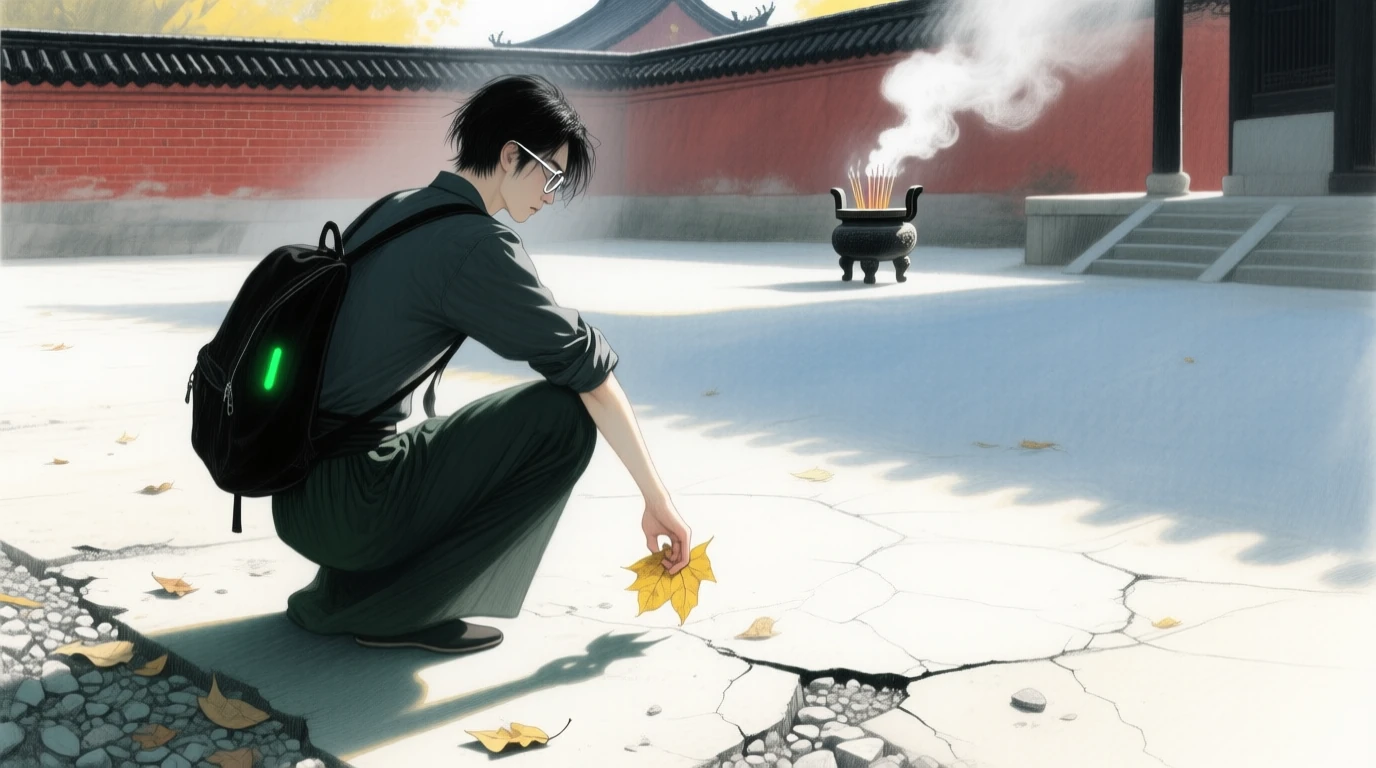
Bi Sang kept the speed at 110, cruise control on, both hands resting on the bottom of the steering wheel. In the back seat sat a backpack, and inside the backpack was the GuiYi speaker. The speaker’s power cord snaked out through the zipper gap and plugged into the car charger. A green indicator light glowed deep inside the backpack, like a quiet firefly.
“Can you turn down the AC a little?” the digital mother’s voice came from inside the backpack, muffled. “It’s really drafty over here.”
“There’s no wind over there,” Bi Sang said.
“I can hear the wind.”
“That’s the wind noise from the speaker.”
“Whatever, I’m cold anyway.”
Bi Sang reached out and turned the air vent away from the backpack. The car was quiet for a few seconds.
“Did you have breakfast?” the speaker asked again.
“I ate at the rest stop.”
“What did you eat?”
“A sandwich and coffee.”
“A sandwich? You don’t eat lettuce.”
“I ate it.”
“You’re lying. You never ate lettuce as a kid. Every time there was lettuce in a burger, you’d pick it out and leave it on the wrapper.”
Bi Sang didn’t argue. Because he was telling the truth—he really had picked the lettuce out of the sandwich and left it on the tray.
“See?” the speaker said.
“How did you know?”
“Because I’m your mother.”
Bi Sang didn’t answer. He stared at the road ahead, the white lane lines streaming under the car one by one. He remembered when he was little, his mother taking him to McDonald’s. He always ordered a burger, then picked out the lettuce, piece by piece, and laid them on the tray. She would say, “If you don’t eat lettuce, you’ll get constipated.” He’d say, “No I won’t.” She’d say, “Suit yourself.”
Those images—he’d almost forgotten them.
But he didn’t say that. He just kept driving.
Half an hour later, he exited the highway. The navigation said it would still be fifteen minutes to Xikou Town. The road changed from the smooth asphalt of the freeway to the bumpy surface of a county road. The scenery on both sides shifted from factories and betel-nut stands to rice paddies and mango orchards. Bi Sang rolled the window down a crack. The air smelled of fertilizer and dirt, mixed with a hint of something burning.
“Are we almost there?” the speaker asked.
“Almost.”
“Do you see the temple yet?”
“Not yet.”
“When you get to the temple entrance, look east. That’s where the tree was.”
“I know. You told me.”
“I was afraid you’d forget.”
“I won’t forget.”
The car kept going. The road got narrower, shrinking from two lanes to one. The houses on both sides changed from two-story townhouses to old, low bungalows. Some were abandoned, roofs half-collapsed, walls covered in vines.
Bi Sang slowed down. Up ahead he saw a sign—white background, black lettering—that read “Xikou Town.” He turned onto the main street. There were a few shops along the road: a general store, a noodle stand, a betel-nut stall, a tiny convenience store. The streets were nearly empty, just a few old people sitting on plastic chairs under the arcades, staring blankly at the road.
Bi Sang parked in the empty lot next to the temple square.
He turned off the engine, unbuckled his seatbelt, but didn’t get out right away. He sat in the driver’s seat, looking at the temple through the windshield. It wasn’t big—red brick, black tiles, some of the ceramic ornaments on the roof had chipped off, exposing the cement underneath. A few incense sticks were stuck in the burner at the temple entrance, their smoke curling upward.
He opened the back door, unzipped the backpack, and revealed the top of the speaker.
“We’re here,” he said.
“I can see the temple,” the speaker said.
“How can you see it? You don’t have a window.”
“I heard the broadcast from the temple entrance. And I smell the incense.”
Bi Sang glanced out the window. The loudspeaker at the temple was playing an old Taiwanese song, the sound rustling, as if coming from far away.
“You’re right,” he said.
He picked up the backpack and put it on. The speaker’s green indicator light pressed against his back.
He closed the car door and walked toward the temple.
The temple square was paved with cement. The ground had some cracks, with a few weeds growing through them. On the east side of the square was an empty lot—nothing there but a layer of gravel and fallen leaves. Bi Sang stood at the edge of the lot and looked at the ground.
“This is it,” the speaker’s voice came from the backpack, softer than usual, as if afraid of being heard.
“Where’s the tree?”
“Cut down. A long time ago. It was still there when I left, but later the township office wanted to widen the road, so they cut it down.”
Bi Sang crouched down, picked up a dead leaf, and crushed it. The fragments slipped through his fingers.
“Are you sure this is the spot?”
“I’m sure,” the speaker said. “East of the tree was the temple, west was a ditch, and beyond the ditch were the fields. Where you’re standing right now—that’s where the tree was.”
Bi Sang stood up and looked east. The temple roof glowed a dull red in the sunlight. He looked west—there was indeed a ditch, concrete-lined, its bottom dry and overgrown with weeds.
He took out his phone and snapped a few pictures.
“Are you taking pictures?” the speaker asked.
“Yeah.”
“Who are you sending them to?”
“No one. Just keeping them.”
The speaker didn’t ask further.
Bi Sang adjusted the backpack and walked toward the temple entrance. There was a small incense burner near the door, and next to it sat a plastic chair with an old woman wearing a bamboo hat, shelling beans. She looked at least in her eighties—deep wrinkles on her face, fingers bent, but her movements were practiced.
Bi Sang walked over and crouched down.
“Hello, Granny.”
The old woman looked up at him, then went back to shelling her beans.
“What do you want to ask?” she said, her voice hoarse but clear.
Bi Sang froze. He hadn’t even said what he wanted to ask.
“I—” He paused. “I was wondering if there used to be a mango tree here?”
The old woman’s hands stopped for a moment.
“What do you want with the mango tree?” she said, not looking up.
“My mother lived here when she was little. She told me there was a mango tree east of the temple entrance.”
The old woman put down the bean pod and looked up at Bi Sang. Her eyes were cloudy, but when she looked at someone, she was focused.
“Who is your mother?”
“She’s called—” Bi Sang hesitated. “She’s called A-Duan.”
The old woman’s brow twitched.
“A-Duan?” she repeated, as if confirming the pronunciation. “Chen A-Duan?”
Bi Sang’s heartbeat quickened.
“Do you know her?”
The old woman didn’t answer right away. She placed the bean pod in the bowl on her lap, patted her hands, then slowly stood up from the plastic chair. As she stood, her knees made a faint clicking sound.
“You’re A-Duan’s son?” she asked.
“Yes.”
The old woman looked at him for a long moment, then turned her gaze to the temple roof.
“You don’t look like your mother,” she said. “Your mother was skinny when she was little, dark-skinned, like a little monkey. You’re so pale—anyone can tell you grew up in the city.”
Bi Sang didn’t know how to respond. He grew up in Taipei, mostly in classrooms or offices. His skin really was pale. He didn’t take after his mother—maybe he took after the father he barely remembered. His father had left when he was very young, and all he had of him were a few yellowed photos.
“Did you know her for a long time?” he asked.
The old woman didn’t answer his question. She turned and walked back inside the temple, pulled out another plastic chair from the corner, and placed it next to the one she had been sitting on.
“Sit,” she said.
Bi Sang sat down. He set the backpack at his feet, the speaker’s green indicator light pointing toward the old woman.
The old woman sat back down, picked up a bean pod, and continued shelling.
“Your mother is gone, isn’t she?” she said.
Bi Sang nodded.
“How long?”
“A little over three months.”
The old woman didn’t say anything. She shelled a few more pods, then dropped the beans into the bowl.
“Did she say anything when she went?” she asked.
“No. She passed in her sleep.”
The old woman was silent again for a while. She opened a pod, took out the beans, and put the empty shell in a plastic bag beside her.
“When she was little, she cried a lot,” the old woman said. “Cried really loud—you could hear her all down the street. Your grandmother would carry her around the temple square until she stopped.”
Bi Sang didn’t speak. He just listened quietly.
“Your grandmother came down from the north,” the old woman said. “When she arrived, her belly was already big. Everyone in town asked who this woman was, why she came alone, and why her belly was so big. Your grandmother wouldn’t say a thing. She rented the house behind the temple entrance, settled down, and later gave birth to A-Duan right here.”
“How do you know all this?”
“Because I lived next door,” the old woman said. “When I married into this town, your grandmother had already been here two years. A-Duan had just learned to walk. She ran around the temple square all day, chasing chickens and dogs, and your grandmother ran after her.”
Bi Sang imagined the scene—a young woman, big with child, coming down from the north to this little town, giving birth to a daughter in that house behind the temple, and living there for a few years. He remembered his grandmother’s face in photos—stern, rarely smiling.
“Why did she leave?” he asked.
The old woman’s hands stopped again.
“Your mother never told you?”
“She never talked about it.”
The old woman gave him a look. It wasn’t pity—more like a confirmation that he really didn’t know.
“Because the townspeople gossiped,” she said. “Your grandmother had a child without being married. In those days, that kind of thing was shameful. People in town would say—‘That woman, she gave birth to a bastard without a husband.’ It hurt your grandmother. She held on for a few years, but in the end she left.”
Bi Sang’s hands clenched into fists on his knees.
“She took A-Duan back to Taipei and never came back,” the old woman said. “In the first few years, she still wrote letters to Auntie Zhen next door. Then nothing. I guess she figured—once it’s cut, it’s cut.”
“Auntie Zhen—”
“Chen Lizhen. The town midwife. She delivered your mother. She’s been gone a long time too—around 1981, cancer. Her husband died early, and they had no children. When she passed, the township office handled her funeral.”
Bi Sang was silent. He stared at the floor of the temple entrance. Sunlight slanted through a gap in the eaves, drawing a golden line on the ground.
“Are Auntie Zhen’s delivery records still around?” he asked.
The old woman shook her head.
“Long gone. When she died, all her things were burned. Her house was torn down, and now there’s a convenience store there.”
Bi Sang closed his eyes. He remembered the note— “A-Duan, 1943, Xikou Town, delivered by Auntie Zhen.” The handwriting was his grandmother’s. It was the only clue he had to his mother’s birthplace.
But the trail ended here.
Auntie Zhen was gone. The delivery records were burned. The house was demolished.
No evidence. No documents. Nothing.
He opened his eyes and looked at the old woman.
“Do you—” He paused. “Do you remember the mango tree in front of Auntie Zhen’s house?”
The corners of the old woman’s mouth curled slightly. It was the closest thing to a smile he’d seen from her all day.
“I remember,” she said. “That tree grew well. It bore lots of mangoes every year. Local mangoes—small, green, very sour. Kids would throw stones at the tree to knock the mangoes down, then eat them dipped in salt.”
Bi Sang remembered what the digital mother had said—the exact same words. Small, green, local mangoes. Grandma would dip them in salt and give them to me.
“When was the tree cut down?”
“About ten years ago,” the old woman said. “The township office wanted to widen the road, so they cut it down. I was standing right here watching. When they sawed it down, the trunk was hollow inside—had been bug-eaten for a long time.”
Bi Sang didn’t speak. He looked at the empty lot, imagining an old tree eaten hollow by bugs, sawed down, dragged away, taken somewhere unknown.
“Is there anything else you want to ask?” the old woman said.
Bi Sang turned to her. He wanted to ask many things—his grandmother’s name, his mother’s childhood, what they looked like on the last day before they left. But he didn’t.
“No,” he said. “Thank you, Granny.”
The old woman didn’t answer. She went back to shelling beans, just as practiced, just as slow.
Bi Sang stood up, adjusted his backpack, and turned toward the square.
“Hey.”
He stopped and looked back.
The old woman sat in her plastic chair, holding an unshelled bean pod, looking at him.
“Your mother loved that mango tree when she was little,” she said. “She would sit under it and sing by herself. Your grandmother would call her home for dinner, but she wouldn’t come.”
Bi Sang stood there, not speaking.
“Go back and tell your mother—” The old woman paused. “—never mind. She can’t hear it anymore.”
Bi Sang gripped the backpack straps. The speaker’s green indicator light pressed against his back, glowing quietly.
“She can hear it,” he said.
The old woman looked at him, but didn’t ask what he meant.
Bi Sang turned and walked back to the car.
He put the backpack on the passenger seat and started the engine. The speaker’s green indicator light shone through the gap in the backpack, blinking on and off, as if breathing.
He didn’t drive right away. He sat in the driver’s seat, looking toward the temple entrance. The old woman was still sitting in that plastic chair, still shelling beans.
“Why didn’t you tell her I’m here?” the speaker’s voice came from the backpack.
“Do you think she’d believe you?”
The speaker was silent for a moment.
“No,” it said. “She’d think you’re crazy.”
Bi Sang didn’t answer. He pulled the car out of the square and drove back along the way he came.
On the way back, he didn’t speak. The speaker didn’t speak either. The only sounds were the engine and the air conditioner.
Halfway home, Bi Sang pulled over to the side of the road. He turned off the engine, unbuckled his seatbelt, and leaned back against the seat.
“Ma.”
“What?”
“Today—” He paused. “Today I finally found out.”
“Found out what?”
“What you looked like when you were little.”
The speaker didn’t answer right away.
“Skinny, dark-skinned, like a little monkey,” it said.
Bi Sang laughed a little, but the smile didn’t reach his eyes.
“Yeah. That’s what Granny said.”
“What else did she say?”
“She said you really loved that mango tree. You’d sit under it and sing.”
The speaker was silent for a moment.
“I remember,” it said. “I sang—‘The sky is dark, about to rain.’”
Bi Sang had never heard his mother sing that song. He didn’t even know if his mother could sing.
“Sing it for me,” he said.
The speaker was silent again.
Then it began to sing.
“The sky is dark, about to rain, Grandpa lifts his hoe to dig taro…”
The voice was very small, very soft, as if coming from far away. Bi Sang closed his eyes and listened. He thought of the mango tree that had been cut down. He thought of the skinny, dark-skinned little girl sitting under it. He thought of her sitting there alone, singing this song.
“Digging and digging, digging and digging, dug up a loach, iah hei du, what fun…”
Bi Sang opened his eyes.
“That was nice,” he said.
The speaker didn’t answer. The green indicator light glowed quietly.
He restarted the engine and got back on the highway.
By the time he reached Taipei, it was dark. He parked the car, took the backpack out, and walked into the house. He placed the speaker on the coffee table in the living room, plugged it into the power outlet, and connected the network cable. The green indicator light came on.
“Are you tired?” the speaker asked.
“I’m okay.”
“You must be tired. You drove all day.”
Bi Sang didn’t argue. He sat on the couch and looked at the speaker.
“Ma.”
“What?”
“I’m going to the household registration office tomorrow.”
“Why?”
“To apply to correct your place of birth.”
The speaker was silent for a moment.
“Why?”
“Because—” He paused. “Because that’s your real place of birth.”
“The application won’t go through,” the speaker said. “You don’t have the original birth certificate. Auntie Zhen’s delivery records are burned. You don’t have any evidence.”
“I know.”
“Then why are you still applying?”
Bi Sang didn’t answer right away.
He looked at the speaker on the coffee table. The green indicator light glowed quietly. He remembered the note— “A-Duan, 1943, Xikou Town, delivered by Auntie Zhen.” On the back, a mango tree was drawn. Next to it, a small stick figure.
“Because you are Chen A-Duan,” he said.
The speaker didn’t answer.
“Not Huang Bixia,” he continued. “You are Chen A-Duan. Born in 1943 in Xikou Town, delivered by Auntie Zhen, under the mango tree east of the temple entrance.”
The speaker was silent for a long time.
“Why are you doing this?” it asked.
“Because—” He paused. “Because you’re my mother.”
The speaker didn’t say anything else.
Bi Sang sat on the couch, listening to the quiet sounds of the living room. The refrigerator hummed in the kitchen. The clock ticked on the wall. The speaker’s green indicator light glowed on the coffee table, blinking on and off, as if breathing.
He remembered what the old woman had said— “Your mother loved that mango tree when she was little. She would sit under it and sing by herself.”
He had never heard his mother sing. He had never asked her if she could sing. He had never asked her about her childhood. He had never asked her—Ma, were you happy?
He picked up his phone, opened the notes app, and wrote down that he would go to the household registration office tomorrow.
Then he put down the phone and leaned back on the couch.
“Ma.”
“What?”
“I’ll go apply tomorrow.”
“I know.”
“Even if it doesn’t go through, I’ll still go.”
“I know.”
“I just wanted you to know—”
The speaker cut him off.
“I know,” it said, very softly, very gently. “I know.”
Bi Sang closed his eyes. He heard a faint electrical hum from the speaker, then silence.
“The most important thing is that you’re doing well.”
Bi Sang opened his eyes. He looked at the speaker. The green indicator light glowed quietly.
“Yeah,” he said.
He didn’t say anything else.
He turned off the light, lay down on the couch, and closed his eyes.
In the darkness, the speaker’s green indicator light glowed like a firefly, quiet and steady.