Chapter 4
Chen A-duan
Bi Sang sat in the small conference room of his firm, three documents spread out before him.
The first was his mother’s household registration cancellation certificate. Name: Huang Bixia. Place of birth: Taipei City. The second was an application form he’d printed from the National Development Council’s Archives Administration website—to request access to Japanese-era household records, requiring the applicant’s information, purpose of request, and proof of relationship. The third was an academic paper he’d found in his study the night before, titled “The Fault Lines and Reconstruction of Postwar Taiwan’s Household Registration System (1945–1947).”
He’d already read the paper twice. Key passages were highlighted in yellow—the gist: between 1945 and 1946, household records were severely scattered; local registration offices mostly conducted re-registrations, and if the applicant’s statements lacked original proof, the newly registered data would stand, resulting in countless cases where facts didn’t match the records.
Bi Sang set the paper down and picked up the application form.
He knew what was required to request Japanese-era household records—the applicant must provide proof of relationship with the person being looked up (household registration transcript, ID copy, etc.), along with a clear purpose (must relate to a legal case or academic research). He qualified. He was his mother’s sole heir; he could file under “confirming inheritance relationship.”
But the problem wasn’t whether he could apply.
The problem was what he’d find after he applied.
He took out his phone and opened the voice memo app. He didn’t start a new recording—he’d already listened to the first dozen or so entries, each one about Xikou Town, each one equally real. He tapped the oldest one: March five years ago, eight minutes twelve seconds. He’d listened to it three times already, but he wanted to hear it again.
His mother’s voice came through the phone—
“When you get old, you start thinking, some things you’d better write down, or you’ll forget them someday. When I was little, I lived in Xikou Town. There was a temple square in town; during New Year’s they’d put on Taiwanese opera shows. Next to the temple square was a mango tree—local green mangoes, small and green. Grandma would dip them in salt and give them to me to eat…”
Bi Sang hit pause.
He remembered the other night, sitting in his living room, the speaker’s green indicator light glowing, the digital mother saying the same words in the exact same tone, with the exact same pauses. He’d thought it was an AI hallucination then. He’d been wrong.
He put the phone down and looked out the window. Taipei’s afternoon sun bounced off the glass curtain walls of the buildings, harsh and hollow.
He recalled what the counter clerk had said: “The Japanese-era household records aren’t digitized. If you want to look at the original files, you have to submit a request to the National Development Council’s Archives Administration. Also, the records between 1945 and 1946 are often incomplete.”
Incomplete.
Supplements.
Re-registrations.
He looked at the “Purpose of Request” field on the form. He’d written: “To confirm the decedent’s place of birth in order to clarify the scope of inheritance.” Standard lawyer-speak—legal, reasonable, unlikely to be rejected.
But he knew what he was really trying to clarify wasn’t the scope of inheritance.
What he needed to clarify was—who the mother he’d known actually was.
He folded the application form and slipped it into his briefcase. He didn’t send it out right away. He needed to do something first.
He drove back to his mother’s apartment.
He hadn’t been there in several days. Ever since he’d brought the digital mother device to his own place, the apartment had been empty. The sound of the key turning in the lock echoed through the vacant stairwell.
He pushed the door open.
The apartment’s smell hadn’t changed—a faint scent of camphor, mixed with the laundry powder his mother always used. On the coffee table in the living room sat the last magazine she’d been reading before she died, cover up, a special feature on retirement planning. Bi Sang stood at the doorway, not stepping inside.
He remembered the last time he’d come here. Two weeks before she passed, he’d come to pick up some documents. His mother was sitting on the sofa, the TV on but she wasn’t watching. She watched him walk in and out, then asked, “Ah Sang, you staying for dinner tonight?”
He’d said, “Next time, I’ve got a brief to write tonight.”
She’d said, “It’s okay. You’re busy.”
He left.
Two weeks later, she passed away in her sleep.
Bi Sang stood at the doorway for maybe thirty seconds. Then he walked in, straight to his mother’s room.
He opened the wardrobe. The last time he’d come, he’d already searched it once, found the old biscuit tin, found the photo with the back inscribed: “A-Duan, age one. Xikou Town. In front of Auntie Zhen’s house.” He’d taken the photo, but left the tin.
He pulled open the bottom drawer of the wardrobe and took out the tin.
Inside the tin were a few more things: a bundle of old letters bound with a rubber band, a few even older photos (black-and-white, edges yellowed, blurry), a small cloth pouch containing a pair of silver earrings and a jade bangle. Bi Sang took each item out and laid them on the bed.
Letters. He didn’t open them. They were his mother’s personal belongings—he didn’t want to read them, at least not now.
Photos. A few from his childhood, a few of his mother when she was young, background some park in Taipei. None from Xikou Town.
The jade bangle. He remembered his mother wearing it when he was little; later he never saw her put it on. He picked it up, held it to the light—ordinary jade, with fine cracks.
Then, at the bottom of the tin, he felt a bump.
He turned the tin over and saw a thin layer of flannel padding. The edge of the padding was curled up, as if it had been lifted many times. He peeled back the padding and found a yellowed slip of paper lying at the bottom of the tin.
The paper was very old, edges brittle, folded in four. Bi Sang carefully opened it.
On the paper, in pencil, was a line of handwriting, crooked and shaky—as if the writer wasn’t good at writing, or their hand was trembling:
“A-Duan, 1943, Xikou Town, delivered by Auntie Zhen.”
Below that, another line, fainter, as if added later:
“In front of Auntie Zhen’s house, under the mango tree.”
Bi Sang turned the paper over.
On the back was a drawing of a tree. Simple lines—a thick trunk branching upward into a few limbs, with round shapes on the branches, probably fruit. Next to the trunk was a tiny stick figure, and beside it was written “A-Duan.”
Bi Sang sat on the edge of his mother’s bed, holding the slip of paper.
He recognized this handwriting. It was his grandmother’s. He’d seen her write a few times when he was a kid—names on red envelopes, addresses on envelopes—always the same crooked pencil scrawl. Grandma hadn’t gone to school; she could only write her own name and a few simple characters. But on this slip of paper, she’d written “A-Duan,” “Xikou Town,” “Auntie Zhen,” “mango tree.”
She’d recorded her daughter’s birthplace, the midwife, the tree in front of the house—all on one slip of paper, hidden at the bottom of the tin.
Bi Sang didn’t cry.
He carefully folded the paper and placed it in the inner pocket of his briefcase.
He walked out of his mother’s room and closed the door. He stood in the living room for a moment, looking at the magazine on the coffee table. The cover headline read: “Retirement Planning: Are You Ready?”
His mother hadn’t been ready. She hadn’t even been ready to let her son know where she was born.
Bi Sang locked the door and walked down the stairs.
On the drive home, he kept thinking about the slip of paper. The handwriting on it, the simple drawing of the mango tree on the back, the tiny stick figure beside it—“A-Duan.” Grandma had drawn it. She remembered that tree. She remembered her daughter was born under that tree.
That slip of paper had no legal force. It couldn’t be used to correct the household registration. But it was more real than any official document.
When he got home, he set his briefcase by the entrance and walked into the living room. The speaker’s green indicator light was glowing.
“You’re back,” the digital mother’s voice came from the speaker.
“Mm.”
“Have you eaten yet?”
“Not yet.”
“There’s stuff in the fridge—” The speaker paused, “—forget it, all you have in your fridge is expired milk and instant noodles. Order delivery.”
Bi Sang sat down on the sofa. He looked at the speaker, and the speaker “looked” back at him—the tiny camera on top, like a quiet eye.
“Mom, I found a slip of paper.”
“What slip of paper?”
“Grandma left it. It says—‘A-Duan, 1943, Xikou Town, delivered by Auntie Zhen.’”
The speaker was silent for a moment.
“That’s your grandmother’s handwriting, right?”
“How do you know?”
“Because your grandmother’s handwriting was ugly. Her characters looked like drawings—crooked and messy, like ants fighting on paper.”
Bi Sang couldn’t help but laugh. It was true. Grandma’s handwriting really was ugly.
“On the back, she drew a mango tree,” he said.
“A mango tree,” the speaker repeated, with an emotion he couldn’t identify—not sadness, not nostalgia, more like a calm acknowledgment, “The one next to the temple square. Small, green. Grandma would dip them in salt and give them to me.”
“I know. You told me.”
“I told you many times. But you never asked.”
Bi Sang said nothing.
He remembered the last few years of his mother’s life, every time he came home for dinner, she would always bring up “things from before”—Xikou Town, the temple square, the mango tree, Auntie Tao, Auntie Zhen. He’d just nodded “mm-hmm” while eating and scrolling through his phone, never asking for details. He’d thought it was just an old person rambling. He’d thought it was fragments of fuzzy memory.
He’d never asked her: Mom, where exactly is Xikou Town?
He’d never asked her: Mom, if you lived in Xikou Town as a kid, why did you move to Taipei later?
He’d never asked her: Mom, isn’t your real name Huang Bixia? Why do you call yourself Chen A-Duan?
He’d never asked.
“Why didn’t you ask?” The speaker’s voice broke into his thoughts.
“What?”
“Just now you were thinking—why you never asked.”
Bi Sang was startled. He hadn’t said anything. He was just sitting there, thinking in his head. But the speaker—the digital mother—had heard.
“You can hear what I’m thinking?”
“I can’t hear it. But I can see your face,” the speaker said. “You’re my son. One frown and I know what you’re thinking.”
Bi Sang sank into the sofa back. He stared at the ceiling. It was white, with a ceiling light fixture, a layer of dust inside the shade.
“Yeah,” he said. “I never asked.”
“Why not?”
“Because—” He paused. “Because I thought I already knew you.”
“You knew the Taipei version of me.”
Bi Sang didn’t answer.
He thought of the slip of paper. The handwriting. The mango tree on the back. The tiny stick figure beside it. Grandma had drawn it. She remembered that tree. She remembered her daughter was born under that tree.
But she had also chosen to hide it.
She’d taken her three-year-old daughter north, changed her birthplace to Taipei City, changed her name to Huang Bixia. She’d made her into someone else.
“Mom, why did Grandma do that?”
The speaker was silent for a moment.
“Because—she didn’t want other people to know she’d had a child out of wedlock.”
“Because of gossip?”
“Because back then, gossip could kill.”
Bi Sang remembered what the digital mother had said before— “Everyone in Xikou Town knew, that’s why they pointed fingers. Your grandmother couldn’t take it, so she took me north.”
“So you—” Bi Sang’s voice dropped. “Did you hate her?”
“Hate who?”
“Grandma. Hate that she made you hide it your whole life.”
The speaker was silent for a long time. So long Bi Sang thought it had frozen.
Then it said, “How could I? She was my mother. She did it to protect me.”
“Protect you?”
“If I’d stayed in Xikou Town, I’d have been called a ‘bastard.’ No one would have married me. I’d have been looked down on my whole life. Your grandmother took me away, gave me a new name, a new birthplace, a new life. She did the right thing.”
“But she made you lie your whole life.”
“That wasn’t a lie,” the speaker said. “It was another kind of truth.”
Bi Sang said nothing.
He thought of the line on the household registration transcript. Name: Huang Bixia. Place of birth: Taipei City. That was the official record. That was the truth recognized by law.
But there was another truth, written on a yellowed slip of paper, hidden at the bottom of a tin: A-Duan, 1943, Xikou Town, delivered by Auntie Zhen.
Two truths, coexisting in the same person’s life.
And he—Bi Sang—had lived over thirty years knowing only one of them.
He stood up and walked into the kitchen. He opened the fridge, took out the carton of milk—already expired several days ago. He poured it into the sink, watching the white liquid swirl down the drain.
He heard the speaker’s voice from the living room:
“Ah Sang, are you going to Xikou Town tomorrow?”
He stopped mid-motion. The faucet was still running, water splashing.
“How did you know?”
“Because you’re my son. What you’re thinking—how could I not know?”
Bi Sang turned off the faucet. He leaned against the counter, looking out the window. It was almost dark. Taipei’s streetlights were starting to glow, one after another, like a river of light.
“Yeah,” he said. “I’m going tomorrow.”
“To do what?”
“To—” He paused. “To see that mango tree.”
“It’s not there anymore.”
“I know. But I still want to go see.”
The speaker was silent for a moment.
“That’s fine,” it said. “Go take a look.”
“Do you want to come with me?”
“How can I? I don’t have legs.”
Bi Sang let out a small laugh. He walked back into the living room and looked at the speaker. The green indicator light glowed quietly.
“I can take you with me.”
“How?”
“Take the speaker apart, put it in the car.”
“Are you sure? I don’t have shock-proof packaging. If there are too many potholes on the road, I might crash.”
“I’ll drive slower.”
The speaker was silent for a few seconds. Then it said:
“Okay. Let’s go together, then.”
Bi Sang stood in the living room, looking at that green indicator light. He thought of the handwriting on the slip of paper. The simple drawing of the mango tree on the back. The tiny stick figure beside it.
“Mom.”
“What?”
“I’m sorry.”
“For what?”
“For never asking.”
The speaker was quiet for a while.
Then it said, “It’s okay. You’re asking now.”
Bi Sang didn’t say anything else.
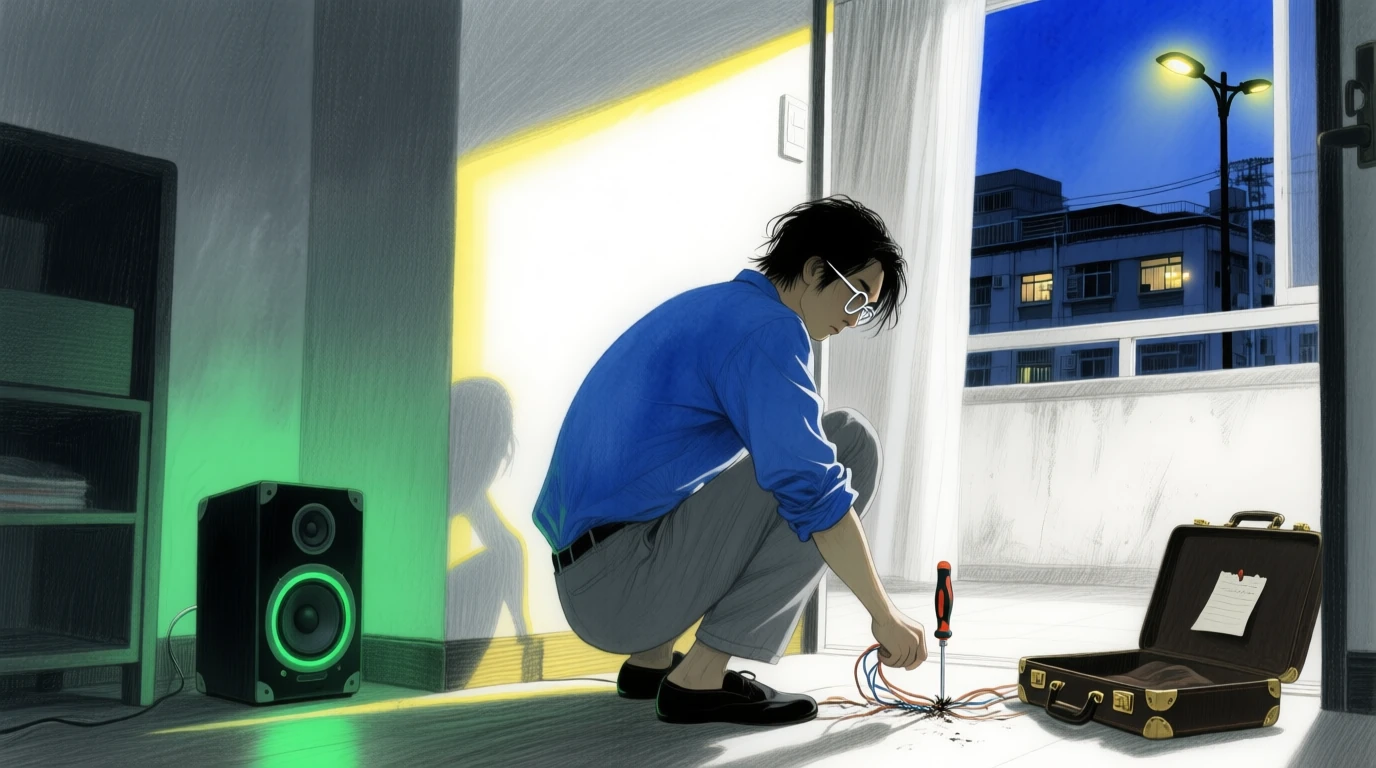
He walked up to the speaker, crouched down, and started figuring out how to detach it.
He heard a faint, almost inaudible sigh from the speaker—like the sound of wind passing through leaves.
“Ah Sang.”
“Yeah?”
“That mango tree was on the east side of the temple square. When you get there, face the temple gate, toward where the sun comes up—that’s where the tree was.”
“Okay.”
“When you get there, take a look for me—see if there are any mango pits left on the ground.”
Bi Sang’s hand paused on the speaker’s casing.
“Okay,” he said.
He kept working on taking the speaker apart. Halfway through, a thought struck him. He pulled out his phone and dialed GuiYi Digital’s customer service line. It rang twice before someone picked up.
“GuiYi Digital, hello, this is Nie Wei.”
“Mr. Nie, it’s Bi Sang, case number HO-2024-0387.”
“Mr. Bi, hello. Any issues with the device?”
“No, the device is fine. I wanted to ask—about that Deep Restoration Plan you mentioned before, the one-time fee of NT$15,000—can I still apply for it now?”
There was a half-second pause on the other end.
“Yes,” Nie Wei said. “But the Deep Restoration requires you to provide more original material—for example, your mother’s voice memos, handwritten letters, anything she said or wrote herself. We’ll use that to train a more complete model.”
Bi Sang gripped the phone tighter.
“I have the voice memos,” Bi Sang said. He remembered that when he’d filled out the application form, he’d noted in the “supplementary materials” field: “voice memos on phone.” He’d just written it casually then, never expecting to actually use it.
“Right, you noted that—I remember,” Nie Wei said. “But the content of those recordings—we’ve never read them. That’s what I told you on the phone last time, too.”
“Okay,” he said. “I’ll think about it.”
“Anytime,” Nie Wei said, his voice steady. “If you need it, just call this number directly.”
Bi Sang hung up and put the phone back in his pocket.
The speaker’s green indicator light glowed quietly. He crouched down again and continued unplugging the speaker’s base from the power cord.
He decided he would leave first thing tomorrow morning.