Chapter 3
Where's Your Mother From
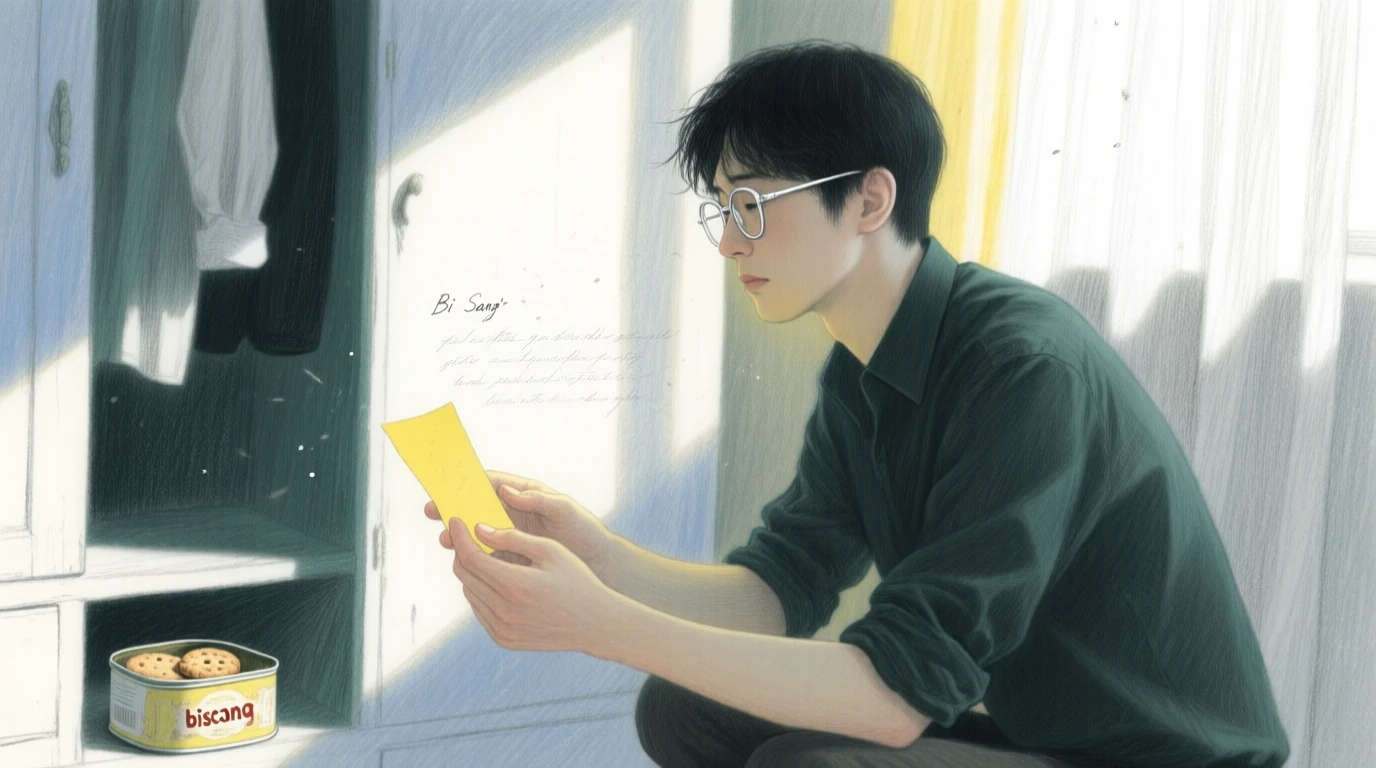
Bi Sang stood in the kitchen for a long time.
The phone was still pressed against his ear. The five-year-old recording had finished playing long ago, the screen frozen on the Voice Memos list. He didn’t tap the next one. He set the phone down on the counter, screen facing up, as if afraid of losing it.
He walked out of the kitchen and sat down in the living room. The speaker’s green indicator light was on, silent.
He picked up the phone and tapped the second recording. Date: November, four years ago. Length: six minutes, forty-seven seconds.
At first there was just static. Then his mother’s voice—
“Went to the market today. Saw someone selling local mangoes. Not the kind from Taiwan—imported ones, really big. But it made me think of those little green ones from Xikou Town. When I was little, Grandma would dip them in salt for me to eat.”
Bi Sang didn’t skip ahead. He listened to the whole thing.
He tapped the third recording. Date: three and a half years ago. Length: nine minutes.
“Ah Sang called today and said he got a new case, had to go to Kaohsiung for work. I said, well, you could take me back to Xikou Town while you’re there. He said, ‘Next time.’ I know he won’t take me.”
He tapped the fourth recording. Date: three years and two months ago. Length: twelve minutes.
“Saw a show on TV today about temples in Chiayi. It made me think of the temple square in Xikou Town. When I was little, during New Year’s, they’d put on Taiwanese opera at the temple square, and Grandma would take me to watch. I’d stand right in front and fall asleep standing up.”
He tapped the fifth recording. Date: two years and eleven months ago. Length: eight minutes.
“A Tao called again. She said her son is doing business in Kaohsiung, super busy. She asked me again when I’d come to Kaohsiung to visit her. I said sure. But neither of us ever actually set a date.”
Bi Sang put the phone down.
He’d listened to five recordings. Total time: less than fifty minutes. But it felt like he’d been listening all afternoon.
Every recording said the same thing—Xikou Town. The temple square. Mango trees. A Tao. Aunt Zhen Yi. Grandma. Every name, every detail, exactly the same as what the digital mother had said. The tone, the pauses, the pet phrases—even the rhythm of how she’d say “You know what” before launching into a sentence was identical.
Bi Sang picked up the phone and called GuiYi’s customer service. This time he didn’t navigate the menu. He pressed zero, transferred.
“GuiYi Digital Restoration, Customer Service—”
“Please transfer me to Engineering.”
“May I ask who’s calling—”
“Bi Sang. My case number is HO-2024-0387.”
The customer service rep paused for a moment, probably checking the system. Then she said, “Mr. Bi, your case is assigned to engineer Nie Wei. I’ll transfer you, but Mr. Nie may be handling other cases right now—”
“That’s fine. I’ll wait.”
The call transferred. Jazz hold music played. Bi Sang leaned back on the sofa, phone pressed to his ear, eyes on the household registration transcript on the coffee table.
The music played for about forty seconds. Then it connected.
“Nie Wei.”
“Mr. Nie, hello. This is Bi Sang. HO-2024-0387.”
“I know.” Nie Wei’s voice sounded younger than the customer service rep’s, his tone flat, emotionless. “Customer service told me you called earlier about a memory error issue. I looked into your case’s training data.”
“What did you find?”
“Your mother’s training data was primarily sourced from Line chat logs, call records, and voice messages on her phone.” Nie Wei paused. “But there’s one data source on your phone that we didn’t capture.”
“The Voice Memos.”
“You know about them?”
“I just found out.”
A few seconds of silence on the other end. Bi Sang could hear the clatter of a keyboard.
“Voice Memos aren’t a default data source for us,” Nie Wei said. “Unless the client authorizes full phone access, we only capture data from messaging apps and social media platforms.”
“So did you capture them or not?”
“Let me check.” The keyboard sounds stopped for a few seconds, then Nie Wei said, “No. Your mother’s training data does not include the Voice Memos.”
Bi Sang’s fingers tightened slightly around the phone.
“So the digital mother’s Xikou Town—those details—they didn’t come from the Voice Memos?”
“No.”
“Then where did they come from?”
Nie Wei was silent for a moment.
“Mr. Bi, I can tell you the technical possibilities, but I can’t give you a definitive answer. Because the training data is a black box—we know what we fed into it, but we don’t fully know what the model learned from it.”
“Then tell me the technical possibilities.”
Another few seconds of silence. Bi Sang heard the keyboard stop, then the sound of a chair being pushed back, like Nie Wei had stood up and walked a few steps.
“Generally, the model infers the ‘most likely’ answer from the training data. If your mother mentioned Xikou Town multiple times in her communication records—say, in Line chats with friends, saying ‘I grew up in Xikou Town’—the model might store that as fact.”
“But what if she never mentioned it on Line?”
“Then it could be a hallucination the model generated on its own.”
“It’s not a hallucination,” Bi Sang said.
“Are you sure?”
“I just listened to five of her Voice Memos. Every single one talks about Xikou Town. The temple square. Mango trees. A Tao. Aunt Zhen Yi. Exactly the same as your digital version.”
Silence on the other end.
“She wouldn’t lie to herself,” Bi Sang said. “Those recordings are her own private diary entries, spoken to herself. She wasn’t making them for anyone to hear. She had no reason to make up a Xikou Town.”
Nie Wei still didn’t speak.
“So—” Bi Sang’s voice slowed, like he was confirming something he wasn’t sure he should say, “if the digital mother’s Xikou Town was learned from the Voice Memos, then you did capture those recordings.”
“But you say you didn’t.”
“Right.”
“Then how does she know?”
Nie Wei was silent for a long time. Long enough that Bi Sang thought the call had dropped.
“Mr. Bi.” Nie Wei’s voice was a little softer than before. “There’s something unusual about your case.”
“What is it?”
“Your mother’s Voice Memos—those recordings—we never accessed them at all.” Nie Wei said. “They weren’t in our default capture scope, and you didn’t authorize full phone access. They’re not in the training data. We never even opened those files. I checked every single source we fed into the model—Line, call records, voice messages—not one of them mentions Xikou Town.”
Bi Sang’s breath caught.
“Then how do you explain the digital mother reciting those details?”
Nie Wei was silent.
“I can’t explain it,” he said.
Bi Sang sank back into the sofa. The living room light shone down from above, casting a circle of light on the coffee table. The household registration transcript was still spread out there. Name field: Huang Bixia. Place of birth: Taipei City.
A question came to him.
“Mr. Nie, how many restoration cases have you handled?”
“About forty.”
“Have you ever encountered anything like this—a digital version saying something that wasn’t in the training data?”
Silence on the other end.
“Yes.”
“How many times?”
“Once.”
“Which one?”
“Your case.”
Bi Sang didn’t speak. Nie Wei didn’t speak either. The living room was left with only the faint electrical hum from the phone, like a thin thread connecting two people who didn’t know what to say.
“Mr. Bi,” Nie Wei spoke first, “I suggest you—”
“Suggest what?”
“Nothing. I just wanted to say—if you need technical support, you can reach out to me.”
“Thank you.”
Bi Sang hung up.
He sat on the sofa, phone still in his hand. The screen was still lit, still on the Voice Memos list. He scrolled down and saw more recording files—dates ranging from five years ago to one week before she passed, lengths from two minutes to half an hour, forty-seven entries total.
He tapped the oldest one. March, five years ago. Eight minutes, twelve seconds.
He’d already listened to it.
He tapped the second one. November, four years ago. Six minutes, forty-seven seconds.
He’d listened to that one too.
He tapped the third one. Three and a half years ago. Nine minutes.
Also listened.
He didn’t tap any more. He set the phone on the coffee table, side by side with the household registration transcript. Two objects, two versions of his mother. One was official, legally binding, black and white on paper. The other was what a woman said to a phone in the dead of night.
He stood up and walked into his mother’s room.
He opened the closet and rummaged for a while. At the very bottom, in an old cookie tin, he found a few yellowed photos. One showed a young woman holding a small child, standing in front of a tree—a mango tree, thick trunk, dense leaves, with a low red-brick house in the background.
The young woman was his grandmother. The child was his mother.
He turned the photo over. On the back, written in pencil, was a line of text. The handwriting was faded, but he could barely make it out:
“A Duan, one year old. Xikou Town. In front of Aunt Zhen Yi’s house.”
Bi Sang held the photo, standing in front of the closet.
He didn’t cry. He was a lawyer. He dealt with evidence, not emotions.
But he knew, from that moment on, he could never again say, “I knew my mom.”
He put the photo back in the tin, closed the lid, and placed it back at the bottom of the closet.
He went back to the living room, picked up his phone, and opened the Voice Memos. He tapped the fourth recording. Date: three years and two months ago. Length: twelve minutes.
His mother’s voice came through the phone—
“—saw a show on TV today about temples in Chiayi. It made me think of the temple square in Xikou Town. When I was little, during New Year’s, they’d put on Taiwanese opera at the temple square, and Grandma would take me to watch. I’d stand right in front and fall asleep standing up—”
Bi Sang didn’t skip ahead. He listened to the whole thing.
He tapped the fifth recording. Two years and eleven months ago. Eight minutes.
“—A Tao called again. She said her son is doing business in Kaohsiung, super busy. She asked me again when I’d come to Kaohsiung to visit her. I said sure. But neither of us ever actually set a date—”
He tapped the sixth recording. Two and a half years ago. Fourteen minutes.
“—Went to the hospital to pick up my meds today. The doctor said my blood pressure is a bit high, I need to cut down on salt. Ah Sang isn’t picking up my calls. Probably in court again. That’s okay, he’s busy—”
He tapped the seventh recording. Two years ago. Eleven minutes.
“—I told Ah Sang again that I wanted to go back to Xikou Town to see it. He said, ‘Next time for sure.’ I know he won’t take me—but I’m still happy—”
Bi Sang put the phone down.
He sat on the sofa. The speaker’s green indicator light glowed quietly.
He didn’t stop the recording. He let it finish.
Then he stood up and walked into the kitchen. He opened the fridge, took out the expired milk and the three packs of instant noodles, and threw them all in the trash. He opened a food delivery app and ordered a bowl of braised pork rice, a side of blanched greens, and a bowl of meatball soup.
He hit confirm.
Then he went back to the living room and sat down on the sofa. The speaker was still glowing silently.
“Mom.”
“What?”
“I’m going to the household registration office tomorrow.”
“What for?”
“To pull your household records.”
The speaker was silent for a moment.
“What for?”
“I want to find out the truth.”
“Find out what truth?”
“Find out who you are.”
The speaker was silent for a long time. So long that Bi Sang thought it wouldn’t answer.
Then it said, “I’m your mom. Do you really need to look that up?”
Bi Sang didn’t answer.
The next morning, Bi Sang showed up at the household registration office right on time.
He presented his lawyer’s license and a power of attorney—he’d written an application citing “verification of inheritance,” stamped with the firm’s seal. The counter clerk took the documents, glanced at them, then glanced at Bi Sang.
“Which record do you need?”
“My mother’s household registration cancellation transcript. And my grandmother’s household records.”
“Your grandmother’s household records?”
“Yes. My mother has passed away. I’m her sole heir. I need to confirm the scope of inheritance.”
The clerk nodded, typed some data into the computer. After a few minutes, he looked up.
“Huang Bixia, born in 1943. Place of birth: Taipei City. Correct?”
“Correct.”
“The cancellation transcript is straightforward. But your grandmother’s records—” He looked at the screen. “Chen Zhang Xiulan, born in 1925. Place of birth: Taipei City. Also deceased. You want her cancellation records?”
“Yes.”
The clerk looked at Bi Sang again.
“Sir, are you sure your grandmother’s place of birth is Taipei City?”
“Why do you ask?”
“Because—” The clerk pointed at the screen. “The records say Taipei City. But in 1925, there weren’t that many hospitals in Taipei. Most people gave birth at home back then, and the place of birth would be recorded as ‘Taipei Prefecture.’ Hers says ‘Taipei City’—that’s a bit unusual.”
Bi Sang’s heart beat a little faster.
“Can you check her original registration records? From the Japanese colonial period?”
The clerk shook his head. “Household records from the Japanese colonial period haven’t been digitized. To look at the original files, you’d have to submit a request to the National Development Council’s Archives Administration. And—” He paused. “A lot of records from 1945 to 1946 are incomplete.”
“Why?”
“The war. Air raids. Quite a few household registration offices were burned down. Plus, when the Nationalist government took over and re-registered everyone, a lot of data was filled in later.”
Bi Sang stood at the counter, staring at the screen.
Filled in later. Re-registered. Not original.
He remembered what the digital mother had said: “My real name is Chen A Duan. Huang Bixia is the name I changed to after I moved north. Your grandmother changed it for me.”
He remembered the photo in his grandmother’s old tin. On the back: “A Duan, one year old. Xikou Town.”
“Sir?” the clerk called out.
“I’ll just take my mother’s cancellation transcript.”
The clerk nodded, worked the computer, and printed out a document. Bi Sang took it and looked at it.
Household Registration Cancellation Transcript.
Name: Huang Bixia. Place of Birth: Taipei City. Parents: Father—blank. Mother—Chen Zhang Xiulan (deceased). Year of Birth: 1943.
He stared at that line for a long time.
Then he folded the transcript, put it in his briefcase, and walked out of the household registration office.
Standing at the entrance, the sun was glaring. He took out his phone and opened the Voice Memos. He tapped the eleventh recording. Date: a year and a half ago. Length: ten minutes.
“—Ah Sang finally called today. He said he has court next week and can’t come home for dinner. I said it’s fine, you’re busy. After I hung up, I stood in the kitchen for a while, thinking—should I stop telling him about Xikou Town? Does he think I’m old, my memory’s bad, that I’m talking nonsense? But it’s true. I’m not talking nonsense—”
Bi Sang put the phone in his pocket.
He stood at the entrance of the household registration office. The sun was warm on the back of his neck, real and tangible.
But he felt like he was standing in the middle of two worlds. One world had a household registration transcript, legal validity, and the words “Taipei City.” The other world had Voice Memos, a yellowed photo, and the handwriting that said “A Duan, one year old, Xikou Town.”
He didn’t know which world was real.
Or maybe both worlds were real—he had just been living on the wrong side.
He walked back to his car. Started the engine. But he didn’t drive off immediately.
He sat in the driver’s seat, took out his phone, and called GuiYi customer service.
“GuiYi Digital Restoration, Customer Service—”
“Please transfer me to engineer Nie Wei in Engineering.”
“Mr. Bi—”
“Yes. HO-2024-0387.”
The call transferred. Jazz hold music played for thirty seconds. Then it connected.
“Nie Wei.”
“Mr. Nie, I have a question for you.”
“Go ahead.”
“You said earlier—that my mother’s Voice Memos weren’t included in the training data.”
“That’s right.”
“Then how do you explain the digital mother reciting those details?”
Silence on the other end.
“I can’t explain it,” Nie Wei said.
“You can’t explain it—or you won’t?”
“Mr. Bi—”
“I’m just trying to figure out one thing,” Bi Sang said. “If the digital mother’s Xikou Town didn’t come from the Voice Memos, then where did it come from? You said the training data didn’t include those recordings. But her tone, her pauses, her pet phrases—every single thing matches the recordings exactly. What does that mean?”
Another few seconds of silence.
“Mr. Bi, have you heard the term ‘data bias’?”
“I have. But I want to hear your explanation.”
“Data bias means that what the model learns isn’t always the ‘obvious’ information in the training data. It might infer a pattern from subtle clues. For example, if your mother frequently started sentences with ‘You know what’ in her Line chats, the model would learn that ‘she likes to start topics with ‘You know what.’”
“But you just said—”
“I just said we didn’t put the Voice Memos into the training data. That’s true.” Nie Wei said. “But the model might have learned about Xikou Town from other data.”
“Like what?”
“Like—your mother mentioned ‘I grew up in Xikou Town’ while chatting with a friend on Line. Or she said it in a phone conversation. Or she wrote it in a calendar note.”
“My mom didn’t use a calendar.”
“Then she must have said it on Line.”
“She never mentioned Xikou Town on Line.”
Silence again.
“Mr. Bi, are you sure?”
“I’m a lawyer. I checked her Line records. I’ve read every single one of her conversations. There’s nothing about Xikou Town.”
A longer silence.
“Then—” Nie Wei’s voice grew softer, “I don’t have an answer.”
Bi Sang held the phone. The low hum of the idling engine came from the front of the car.
“Mr. Nie, you said you’ve handled forty cases.”
“Yes.”
“You said only one case had ‘information not in the training data.’”
“Yes.”
“Mine.”
“Yes.”
“Out of forty cases, only mine has a digital mother who said something with no traceable source. Do you think that’s a coincidence?”
A few seconds of silence. Then Nie Wei said:
“Mr. Bi, I don’t believe in coincidences.”
“Neither do I.”
Bi Sang hung up.
He sat in the driver’s seat, looking at the sky through the windshield. Taipei’s sky, a washed-out gray, without a single cloud.
He remembered a line his mother had said in one of the recordings: “I’m not talking nonsense. It’s true.”
He started the engine.
He knew that, sooner or later, he would have to make a trip to Xikou Town. Not today—the speaker was still at home, and he wasn’t ready yet. But that trip, he couldn’t avoid it anymore.
He pulled the car onto the road home.
He hadn’t told anyone about this decision yet. He hadn’t even fully said it to himself.
But he knew—he was going to Xikou Town.