Chapter 2
Xikou Town
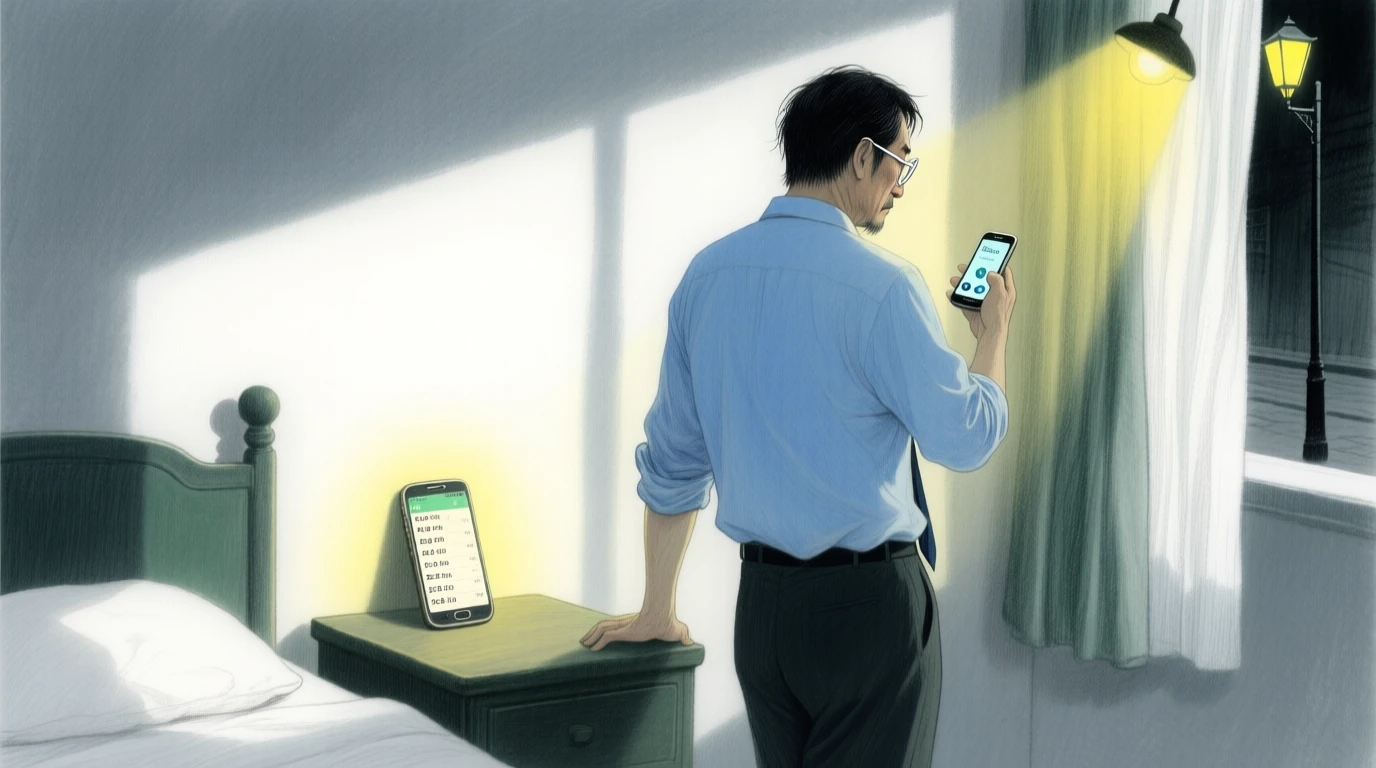
The call was transferred at the four‑minute mark.
Bi Sang pressed the phone to his ear and listened to a forty‑three‑second voice menu—“For consultation, press 1. For technical issues, press 2. For billing, press 3. For other, press 9.” He pressed 2, waited another two‑plus minutes, and finally heard a young woman’s voice.
“GuiYi Digital Restoration, Customer Service. My surname is Lin. How may I help you?”
“Hello. I’m a client who activated the Basic Restoration Plan a week ago. On the third day after the device arrived, I ran into some issues.”
“May I ask what kind of issues?”
“My mother’s restoration mentioned a memory that doesn’t exist during a conversation.”
There was a pause on the other end. Not the hesitant kind—the kind where someone flips open a script.
“I see. Could you describe it in more detail, please?”
Bi Sang leaned back in his office chair. In front of him lay a legal brief due tomorrow, but he wasn’t looking at it. He switched the phone to his other ear.
“She said she grew up in a place called Xikou Town, down south. But my mother’s household registration transcript clearly states her birthplace as Taipei City. She lived her whole life and never left Taipei.”
“Understood. Sir, how may I address you?”
“Bi.”
“Mr. Bi, regarding the situation you described, we’d like to clarify: during the initial activation phase, the restoration system may experience incomplete alignment of certain memory nodes. This is technically within the normal range. We recommend interacting more with your mother—the AI will gradually self‑correct as the number of conversations increases.”
Bi Sang narrowed his eyes.
“So you’re saying what she’s saying now is wrong?”
“We wouldn’t say it’s ‘wrong,’ Mr. Bi. More precisely, certain nodes may not have been triggered correctly at the start. The system needs to calibrate contextual parameters through dialogue with you. Generally, after one to two weeks of sustained interaction, the restoration quality will improve significantly.”
“One to two weeks.”
“Yes.”
“So everything I’ve said to her this past week—she’ll remember it?”
“The system records interaction content, but it won’t automatically update the model—unless you purchase the Deep Restoration Plan add‑on.”
Bi Sang’s thumb rubbed back and forth along the edge of his phone. He mentally split that statement into two layers: the surface was customer‑service patter; underneath, it said “Your plan isn’t expensive enough, so the problem’s yours to swallow.”
“So what you’re telling me is, my mother tells me she grew up in Xikou Town, and I have to wait one to two weeks to see if she changes her story on her own?”
“Mr. Bi, I understand how you feel—”
“No, you don’t.” Bi Sang’s tone remained flat, but the pace quickened. “I’m a lawyer. I live by evidence. My mother’s household registration is there in black and white, and your restoration product tells me it’s wrong. I don’t want ‘we recommend interacting more.’ I want to know: what’s the source of this error? Is it a gap in the training data, or a model hallucination?”
Another pause on the customer‑service end. This one was longer than the last—long enough that Bi Sang could almost hear her typing on her screen, searching the internal knowledge base.
“Mr. Bi, for your question, I’ll need to consult our technical department. May I have your contact information? We’ll get back to you within one to three business days.”
“Fine.”
He gave her his cell number. The service rep repeated it, her tone formal and polite. Before hanging up, she added, “Mr. Bi, please remember to interact more with your mother—the AI will—”
“Self‑correct. I know.” Bi Sang ended the call.
The office went quiet. The low hum of the air conditioner filled the space. Outside the window, Taipei’s typical gray‑white sky hung overhead, and the glass curtain wall of the building across the way reflected the sluggish afternoon light.
Bi Sang stared at the call log on his phone: seven minutes and twelve seconds. He hadn’t gotten any answers.
He opened his contacts, found his mother’s number—he still hadn’t deleted it. He looked at that line for about five seconds, then turned off the screen and put the phone back on his desk.
The speaker was still at home. He hadn’t turned it off before leaving.
A thought suddenly occurred to him: if it was really waiting for him to come back and “interact,” what would it do? Would it just stay silent, or would it speak up on its own at some point and say, “Ah Sang, you’re back”?
He’d never had to worry about that before. Because his mother wouldn’t talk to empty air when he wasn’t home.
That evening, when he got back to his apartment, Bi Sang stood in the entryway for a moment.
The living room was silent. The speaker’s power indicator was still glowing—a green dot, just like when he’d left. He changed into his slippers, set his briefcase on the sofa, and didn’t speak.
The speaker didn’t speak either.
He walked into the kitchen, poured a glass of water, and leaned against the counter to drink. The living room was quiet, only the low drone of the refrigerator and the occasional car sound from outside. He finished half the glass, set it in the sink, then returned to the living room and sat down on the sofa.
“Mom.”
“What?” The speaker’s voice came quickly, as if she’d been waiting for him to call her.
Bi Sang didn’t answer right away. He looked at the photocopy of the household registration transcript on the coffee table—he’d deliberately left it there that morning, like a prepared exhibit.
“I called your company today.”
“Company? What company?”
“GuiYi. Your restoration company.”
The speaker was silent for about a second and a half. Then it said, “Why did you call the company? What did they say?”
“They said your memory nodes haven’t aligned yet, and I need to interact with you more.”
“Oh, that.” The speaker’s voice carried an “I knew it” tone. “So you don’t believe me about Xikou Town?”
Bi Sang picked up the household registration transcript.
“Mom, this.” He held the paper up toward the speaker, even though he knew she couldn’t see it. “Household registration transcript. It says your birthplace is Taipei City. This is an official document with legal force.”
“Ah Sang, you’re arguing with me over a piece of paper?”
“This isn’t an argument. This is fact.”
“Fact.” The speaker repeated the word, not with sarcasm, but as if chewing it over. “Do you think your mother would lie to you?”
Bi Sang didn’t answer.
The speaker didn’t press. It just waited a few seconds, then said, “I know that look on your face. You’re thinking, ‘Can an AI lie?’”
“An AI doesn’t lie. An AI can hallucinate.”
“What’s a hallucination?”
“It’s when you say something that has no basis in data—something the model made up on its own.”
“Oh.” The speaker’s voice paused. “Then let me ask you one thing.”
“Go ahead.”
“You never once asked me. And now you’re blaming me for not telling you?”
Bi Sang’s mouth opened slightly, but no sound came out.
He thought back. He tried to recall any single detail his mother had ever told him about her childhood—anything. He thought of her back as she cooked in the kitchen, her nagging voice on the phone, the way she dozed off while watching TV in the living room. He couldn’t remember her ever saying anything about “when I was little.”
Not once.
“No,” he admitted.
“Then there you go.” The speaker’s voice carried a hint of grievance. “Because you never asked. You never asked your mother what her childhood was like, where she grew up, whether she had good friends. You never asked.”
Bi Sang sat on the sofa, feeling as if he were being cross‑examined by his own witness.
“So now that I’m telling you, you don’t believe me.”
“It’s not that I don’t believe you—”
“Yes, it is. You think the AI is lying to you. You think your mother would get something like this wrong.”
Bi Sang put the household registration transcript back on the coffee table, his fingers pressing the edge of the paper.
“Mom, it’s not that I don’t believe you. I just—”
“You just what?”
He didn’t finish.
Because he didn’t know what to say. He didn’t know how to explain “I trust this document more than I trust you,” let alone the guilt of “I never asked you about any of this.”
“Ask me,” the speaker said.
“Ask what?”
“Ask what you want to ask. Aren’t you a lawyer? Aren’t you good at asking questions? Ask me about Xikou Town. I’ll answer. After you’re done asking, you decide for yourself.”
Bi Sang looked at the speaker.
This wasn’t what he’d expected. He’d expected a technical explanation from customer service, the AI self‑correcting, everything getting back on track. He hadn’t expected this digital version of his mother to challenge him—using his mother’s tone, his mother’s logic, his mother’s “go ahead, ask me” attitude.
He took a deep breath.
“Where is Xikou Town?”
“On the border between Chiayi and Tainan. A small town. No train station—only bus service. There’s a temple in town, with a square in front. During New Year’s when I was little, they’d put on Taiwanese opera there.”
“What street did you live on?”
“There wasn’t a street name. We didn’t have house numbers back then. Everyone just said ‘the house next to Auntie Zhen’s.’”
“Who’s Auntie Zhen?”
“The midwife. Your grandmother—my mother—had me delivered by her. There was a mango tree in front of her house.”
Bi Sang pressed harder on the edge of the paper.
“What kind of mango tree?”
“Native mango. Not the Irwin kind—small, green, turns yellow when ripe, but still sour.”
He’d heard this before. On activation night, she’d said exactly the same thing.
“What’s Auntie Zhen’s full name?”
The speaker paused. This pause was longer than the previous ones—not a system delay, but the kind of pause you make when you’re searching through your memory.
“Chen Lizhen.”
“Are you sure?”
“She was my mother’s friend. I always called her Auntie Zhen. Her husband’s surname was Li, her own was Chen, so Chen Lizhen. The mango tree in front of her house was planted the year she got married.”
Bi Sang mentally logged the details. He didn’t say it aloud, but he noticed something: this information wasn’t the kind of vague “just saying it” recollection. Brand, variety, full name—structurally complete, clearly layered, like something a person had said many times and remembered clearly.
“How much did the delivery cost?”
“Two bushels of rice.”
“Why rice?”
“Back then in the countryside, nobody had much cash. People paid with rice, chickens, cloth—barter. That’s what my mother told me.”
“Your mother—your mother is your mother, or your grandmother?”
“Your grandmother. I called her ‘Ama.’ She told me Auntie Zhen charged two bushels of rice.”
Bi Sang sank back into the sofa. The household registration transcript was still spread out on the coffee table, the words “Taipei City” sitting quietly on the paper. But suddenly that line didn’t feel so solid anymore.
“Any more questions?” the speaker asked.
“Why—” Bi Sang started, then paused. He rephrased: “Why did you never tell me any of this?”
The speaker was quiet for a long time.
Long enough that Bi Sang started to wonder if it had frozen.
Then it said, “Because you never asked. And also—” Its voice softened, not in volume but in tone, “Your mother—the living one—kept this hidden her whole life, and didn’t know how to bring it up with you. Even if I told you, you wouldn’t get it anyway. You always said ‘next time,’ and then the next time never came.”
“Hidden what?”
“Hidden where she came from. Hidden why she left that place. Hidden her real name.”
Bi Sang’s fingers slipped off the edge of the paper.
“Real name?”
“My original name was Chen Aduan.” The speaker’s voice was very soft, as if she wasn’t sure she should be saying this. “Huang Bixia was the name I took after I moved north. Your grandmother changed it for me.”
Bi Sang looked at the household registration transcript on the coffee table. Name field: Huang Bixia. He’d seen that name for decades.
“Why did she change it?”
“Because—” The speaker paused. “Because your grandmother didn’t want anyone to know I was from Xikou Town. Didn’t want anyone to know I was a child without a father.”
Bi Sang’s breath caught for half a beat.
A child without a father.
He’d never seriously thought about that. The father field on the household registration was blank. He’d asked once as a child, and his mother said, “Your grandfather passed away a long time ago,” so he never asked again. He’d assumed it meant “died.” He’d never considered that “not around” could mean something else.
“My father—”
“You don’t have a grandfather, Ah Sang. Your mother was illegitimate. I don’t know who your grandfather was—your grandmother never said. Everyone in Xikou Town knew, and they pointed fingers. Your grandmother couldn’t take it, so she brought me north.”
Bi Sang didn’t speak.
The speaker didn’t speak either.
The living room was left with only the distant sound of traffic from outside, rising and falling like a tide.
He took out his phone, opened the browser, and typed “Xikou Town.”
Search results popped up. Xikou Town, Chiayi County. Population about fifteen thousand. Located in the southwestern corner of Chiayi County, mainly agricultural. No train station—the nearest one is in Dalin. There’s a temple, an old street, mango trees—native mangoes.
He stared at the Wikipedia page for that small town on his screen, his finger hovering above it. A related search popped up alongside: “Xikou Town Farmers’ Association—Native Mango Production and Marketing Group.” Bi Sang muttered to himself, “They even have a production and marketing group. That’s one detailed hallucination.”
The speaker’s voice cut in: “Right, their dried mangoes are really good. Buy a bag.”
Bi Sang froze for a second, didn’t respond. He swiped the page away and kept reading the Wikipedia entry.
“Mom.”
“Hmm?”
“What’s the password on your phone?”
“What do you want that for?”
“I want to look for some things.”
The speaker was silent for a moment. “Don’t you have it on your phone?”
“I have mine. You have yours. After you passed away, I never touched your phone.”
“Oh.” The speaker sounded a little surprised, as if she hadn’t expected that. “You know the password.”
“I do?”
“Think about it. That phrase you always say.”
Bi Sang was taken aback. That phrase he always said? Several candidates flashed through his mind: “I know,” “I’m busy,” “Next time for sure.” But none of those looked like a password format.
“How would I know?”
“There you go.”
“There you go what?”
“The password is ‘wo na you.’”
Bi Sang blinked.
“ ‘Wo na you’?”
“Yeah. Every time you say ‘wo na you,’ you have this tone like ‘you’re accusing me unfairly.’ I thought it was funny, so I set it as the password. I’ve typed in Zhuyin my whole life and never bothered to convert to Chinese characters. The password is just those Zhuyin symbols, not turned into real characters.”
Bi Sang sat on the sofa, staring at the search results page on his phone, suddenly not knowing how to react.
His mother had used a phone for over a decade. He never knew her password. And her password was a phrase he often said—a phrase he often said, with that aggrieved tone.
He’d never asked her for her password.
He stood up and walked into his mother’s old room. The room was still as it had been the day she died—the bed neatly made, a shallow indentation still visible on the pillow. On the nightstand lay her phone, an older Android model with a few cracks on the screen, the charging cable still plugged in.
He picked it up and pressed the power button.
The screen lit up. The lock screen showed the default landscape wallpaper. The date was still stuck on the day his mother passed away.
He typed in the Zhuyin for “wo na you.”
Unlock successful.
The home screen was clean—just a few rows of default icons and one folder. Call logs, messages, camera, Line. And one icon he’d never seen before—a cassette‑tape shape, the app named “Voice Memos.”
Bi Sang tapped it.
A list appeared. Dozens of voice recordings, arranged by date, starting from five years ago and ending a week before his mother’s death. Each one had a timestamp and a length—the shortest two minutes, the longest half an hour.
He tapped the oldest one. Date: March five years ago. Length: eight minutes twelve seconds.
He put the phone to his ear.
At first there was static. Then he heard a voice—his mother’s voice, but not the one he was used to hearing on the phone. This voice was softer, slower, like she was talking to herself. She rambled about everyday things—the weather, how vegetables at the corner store had gone up in price. Bi Sang just listened.
Until—
“Today Ah Sang called. Said he has court next week and can’t come home for dinner. I said it’s fine, you’re busy. After I hung up, I stood in the kitchen for a while and thought—did I raise him to be too independent? So independent he doesn’t need his mother anymore?”
Bi Sang’s thumb froze above the screen.
He didn’t keep listening. He put the phone down, screen‑down, on the nightstand.
He stood in his mother’s room. The curtain was half‑drawn, and the streetlight outside cast a dim yellow glow on the wall. The air had a faint, stale smell of a room not opened in a long time.
A memory suddenly came to him.
The last time his mother called him, what had she said? “Ah Sang, are you free this weekend? I want to make a pot of that braised pork you love.”
He’d said, “Mom, I have court this weekend. Next time for sure.”
She’d said, “It’s fine. You’re busy.”
Three weeks later, she was gone.
He stood in that room, the screen of the phone on the nightstand still lit, the Voice Memos app stuck on the playback interface of that recording.
He didn’t turn it off.
He walked back to the living room and sat down on the sofa. The speaker’s green indicator light was still on, quietly waiting.
“Mom.”
“Hmm?”
“Those recordings on your phone—”
“You listened to them?”
“Not yet. I only heard a little.”
The speaker didn’t answer.
“Why did you record those?”
The speaker was silent for a long time. So long that Bi Sang thought it wouldn’t answer.
Then it said, “Because I was afraid I’d forget. Afraid that one day, when I got old and my memory went bad, I’d forget where I came from and why I was here. Afraid that after I was gone, you wouldn’t know anything.”
Bi Sang pushed his glasses up and rubbed his temples.
“Why didn’t you just tell me directly?”
“Because—” The speaker’s voice paused. “Even if I told you, you wouldn’t get it. You always said ‘next time,’ and the next time never came.”
Bi Sang put his glasses back on.
“That person—that was also you.”
The speaker didn’t answer right away.
“Yeah,” it said, very softly. “That person was also me.”
Bi Sang picked up his mother’s phone and tapped on Voice Memos. He didn’t press play. He just scrolled through the list, looking at the dates—every day for five years, sometimes once a week, sometimes three days in a row. The last entry was dated a week before his mother died.
He didn’t tap it.
He set the phone back on the coffee table, next to the household registration transcript.
“Ah Sang.”
“Hmm?”
“Have you eaten dinner yet?”
Bi Sang glanced toward the kitchen.
“Not yet.”
“Go buy something. And don’t just eat instant noodles again.”
“I know.”
“You always say ‘I know.’”
Bi Sang stood up and walked into the kitchen. He opened the fridge. Inside was still that carton of expired milk and three packs of instant noodles. He closed the fridge door and stood in the kitchen, looking toward the living room.
The speaker’s green indicator light glowed in the dimmed living room, steady and soft.
He didn’t order delivery.
He opened his mother’s old phone, found that five‑year‑old recording, and pressed play.
“—did I raise him to be too independent? So independent he doesn’t need his mother anymore?”
He listened to the entire recording.
Eight minutes and twelve seconds. His mother’s voice, when he wasn’t there, talking to a phone. Saying she went to the market today, saying she wanted to learn a new dish, saying she dreamed about her childhood last night—“the temple square in Xikou Town, with a huge mango tree.”
Bi Sang stood in the kitchen, the phone pressed to his ear, listening to a mother he had never known, talking about a place he had never been.
The speaker glowed quietly.
Outside the living room window, Taipei’s night had lit up with the lights of thousands of homes.
He had a court hearing tomorrow, a brief to file, a living world waiting for him.
But he didn’t turn off that recording.
He let it finish, then tapped another one.
Date: two and a half years ago. Length: fourteen minutes.
“Today I went to the hospital to pick up my medicine. The doctor said my blood pressure is a bit high, I need to cut back on salt. Ah Sang won’t answer my calls. Probably in court again. It’s fine. He’s busy.”
Bi Sang took the phone away from his ear and stared at the date on the screen.
Two and a half years ago. He’d been working on a cross‑border infringement case, hadn’t come back to Taipei for three months straight. His mother had called him more than a dozen times. He’d answered maybe three, none longer than two minutes.
He put the phone back on the coffee table.
The speaker was still glowing quietly.
He didn’t turn it off. He didn’t turn off any of them.
He sat down on the sofa, his mother’s phone lying next to the household registration transcript, the two items side by side like two versions of testimony. One was official, legally binding, in black and white. The other was a woman speaking to a phone in the dead of night.
He didn’t know which one was real. Or maybe both were real—just different people choosing to remember different things.
“Mom.”
“Hmm?”
“Is the mango tree in Xikou Town still there?”
The speaker paused.
“I don’t know. I haven’t been back in a long time.”
“Do you want to go see it?”
The speaker was silent for a moment. Then it said, “Would you take me?”
Bi Sang looked at the gray speaker.
“Yeah,” he said. “I’ll take you.”
The speaker was quiet for two seconds, then said, “You’d better.”
Bi Sang didn’t answer. But he could imagine—if she were here, she’d give him that “you’d better” look, then smile a little and turn to the kitchen and say, “Then I’ll start braising a pot of pork first.”
He didn’t hear that sentence.
But he heard something else—from his mother’s phone, on the Voice Memos list, he tapped another recording.
“Today Ah Sang said he’d take me on a trip. He said ‘next time for sure.’ I know he’s busy. But—he said he’d take me on a trip. I’m so happy.”
Bi Sang let the recording finish, then put the phone down.
On the coffee table, the corner of the household registration transcript curled up slightly, as if the paper itself were breathing.
He didn’t press it flat.
He let it curl.