Chapter 3
Chopsticks and KPIs
On the third morning, Chen Mo arrived at the office twenty minutes earlier than usual. The support team’s seating area was empty, only the hum of the ceiling fluorescent lights filling the silence. He set down his backpack, powered on his computer, and used the boot-up time to pull a folded A4 sheet from his desk drawer—a printout of the data he’d looked up on his phone last night at the convenience store, an internal document on Mingyang Technology’s KPI evaluation system that Old Zhou had gotten through his channels.
He skimmed through it quickly. Mingyang Technology’s KPI evaluations were quarterly, split into quantitative and qualitative indicators. Quantitative indicators made up seventy points, including output, yield rate, and turnover rate. Qualitative indicators accounted for thirty points, scored by the direct supervisor. Evaluation results directly impacted year-end bonuses and promotions.
“Turnover rate” among the quantitative indicators—that term made Chen Mo pause for an extra look. According to the document, turnover rate was calculated based on “all employees in the department,” including temp workers. But in the notes column, there was a line in small print: “Temp worker turnover rate weight: 0.5; permanent employee weight: 1.0.”
Weight 0.5. Meaning the impact of temp worker turnover on the department’s KPI was only half that of permanent employees. Chen Mo snorted to himself. Clever? This weight was basically a green light for exploitation.
But what if he adjusted that weight?
Chen Mo closed the file and started thinking. Modifying the KPI formula required supervisor-level access—meaning he’d have to log into the evaluation system backend using Li Zonghan’s own account. He couldn’t just get Li Zonghan’s password, but he could find a way to make Li Zonghan “voluntarily” change the weight.
The method was simple: make Li Zonghan believe raising the temp worker turnover rate weight would benefit him.
Chen Mo ran through the process in his head. Step one, create a false impression—convince Li Zonghan that raising the weight could be used to hit a competitor. Step two, steer Li Zonghan into proposing the weight change at the quarterly evaluation meeting. Step three, after the weight was raised, trigger a mass resignation or complaint from the temp workers, causing the turnover rate to spike and backfire on Li Zonghan’s KPI.
Perfect.
But step one needed a target. Chen Mo started searching his memory for someone in the production department who could serve as that target—section chief or above, someone in competition with Li Zonghan, preferably someone who was riding high lately.
He thought of the Production Section One chief. What was that chief’s name again… Chen Mo flipped through the materials Old Zhou had given him and found it: “Zhang Wenxiang, Section One chief, forty-two years old, twelve years at the company, recently praised twice by the general manager for improving yield rate.”
The material also had a note: “Zhang Wenxiang has publicly opposed Li Zonghan’s Temp Workforce Optimization Project, citing ‘cost reduction shouldn’t come at the expense of quality.’”
A faint smile tugged at the corner of Chen Mo’s mouth. That was enough. A section chief bold enough to openly oppose Li Zonghan, and recently recognized by senior management—exactly the kind of target Li Zonghan would see as a threat.
He closed the file and started his work. The morning was still filled with sorting files, running errands, moving boxes. Xiao Lin seemed a bit more relaxed today than the previous two days, even initiating a few words, though the content was still routine—“This report needs to go to General Affairs,” “Need it returned by three p.m.,” “The drinks in the staff cafeteria have been restocked, go move them.”
Chen Mo did everything without complaint. He needed Xiao Lin to see him as an obedient temp worker, not worth Li Zonghan’s attention.
At lunch break, Chen Mo went to the staff cafeteria as usual. He picked a seat where he could keep an eye on Li Zonghan, pretending to eat his boxed lunch while actually observing. Today, Li Zonghan wasn’t sitting with the section chiefs. Instead, he was in a corner with a middle-aged man in a suit—a man Chen Mo didn’t recognize, but from the lack of an ID badge on his chest, he was clearly an outsider.
Chen Mo took a closer look at the man. About fifty, slicked-back hair, a greasy smile that showed a gold tooth, talking with lots of hand gestures like he was pitching something. Li Zonghan looked relaxed, nodding occasionally, even laughing out loud—not the mask he usually wore, but genuine amusement.
Qian Dafu. Chen Mo was almost certain. The boss of Supai Human Resources, Li Zonghan’s golf buddy, Mingyang Technology’s preferred supplier.
He filed that image away and went back to eating. A few minutes later, Li Zonghan and Qian Dafu stood up and headed for the cafeteria exit. As they passed Chen Mo’s table, Li Zonghan’s steps faltered for a moment—he glanced down at Chen Mo, a flicker of puzzlement in his eyes.
Chen Mo’s heartbeat didn’t quicken. He looked up and nodded politely: “Good afternoon, Vice Manager.”
Li Zonghan didn’t respond. He stared at Chen Mo for two seconds, then turned and kept walking. Qian Dafu followed, muttering in a low voice: “New guy?”
“Temp worker.” Li Zonghan’s voice was flat. “From the support team.”
“Oh.” Qian Dafu didn’t ask further.
Chen Mo lowered his head and went back to eating. But his mind was racing—that look from Li Zonghan wasn’t recognition, just a sense of familiarity. After all, they’d worked together three years ago. Even with a new hairstyle and glasses, certain features might trigger a vague memory.
He needed to speed up the pace. Li Zonghan was starting to notice him.
In the afternoon, Chen Mo used the chance to deliver documents to swing by the Production Section One office. Zhang Wenxiang was in a meeting with a few team members, his voice steady but firm. Chen Mo stood by the doorway, waiting, and caught Zhang Wenxiang discussing a yield improvement plan—he was proposing a new inspection process that could reduce the scrap rate by three percent.
“If this plan goes smoothly, this quarter’s yield should break ninety-five percent,” Zhang Wenxiang said, confidence in his tone. “I’ll formally propose it at the quarterly meeting.”
Chen Mo filed that away. The quarterly meeting—that was the KPI evaluation occasion. If Zhang Wenxiang presented a yield improvement plan there, he was sure to get senior management’s approval, further solidifying his position. For Li Zonghan, that wasn’t good news.
He needed to let Li Zonghan know about this. But not directly—he wanted Li Zonghan to “accidentally” discover that Zhang Wenxiang was threatening his authority.
At three p.m., Chen Mo returned to his support team seat and started organizing the reports for the next day. He noticed Xiao Lin seemed unusually quiet today. She hadn’t spoken a word since coming back from lunch, just staring at her computer screen, occasionally letting out a sigh.
“You okay?” Chen Mo asked quietly.
Xiao Lin looked up, her eyes a bit dazed. “I’m fine.”
“You don’t look fine.”
Xiao Lin was silent for a few seconds, then said, “Vice Manager Li called me in at noon today.”
Chen Mo’s heartbeat didn’t quicken, but his expression had to match. He frowned. “Called you in for what?”
“He asked about… you.” Xiao Lin’s voice dropped very low. “Asked how you got in, who referred you, what you did before.”
Chen Mo kept his expression in the confusion channel. “Why would he ask about me?”
“I don’t know.” Xiao Lin lowered her head. “I told him you came through the temp agency, and I don’t know you. He seemed… not entirely convinced.”
Chen Mo didn’t say anything. He quickly assessed the situation in his mind—Li Zonghan had already started investigating him. This was faster than he’d anticipated, but still within controllable range. Li Zonghan was only suspicious for now, with no solid evidence. As long as Chen Mo didn’t slip up during this period, Li Zonghan would soon shift his attention elsewhere.
“Thanks for telling me,” Chen Mo said. “I’ll be careful.”
Xiao Lin nodded and didn’t speak again.
Quitting time arrived. Chen Mo packed his backpack and prepared to leave. As he passed Li Zonghan’s office, he caught a glimpse through the blinds—Li Zonghan was still on the phone, his expression serious, his tone urgent. Chen Mo couldn’t hear the conversation, but he was sure the call wasn’t with Qian Dafu, because Li Zonghan’s voice carried a hint of anxiety.
Chen Mo didn’t linger. He walked out of Mingyang Technology, ducked into the convenience store, bought a bottle of water, and found a seat by the window. He took out his phone and made a call.
“Hey, it’s me,” Chen Mo said. “Li Zonghan’s started digging into me.”
“Normal.” Old Zhou’s voice was calm. “If he hadn’t noticed you, I’d be worried.”
“I need to pick up the pace. Can you get me the file on Zhang Wenxiang, the Production Section One chief?”
“Zhang Wenxiang?” Old Zhou paused. “What are you planning?”
“Create a target, get Li Zonghan to shift his focus.”
There was a few seconds of silence on the other end, then Old Zhou said, “I’ll send it to your email tomorrow morning. But be careful—Zhang Wenxiang isn’t like Li Zonghan. He’s someone who actually gets things done. Don’t drag him too deep into this.”
“I know,” Chen Mo said. “I’m just borrowing his name. I won’t hurt him.”
“Better not.”
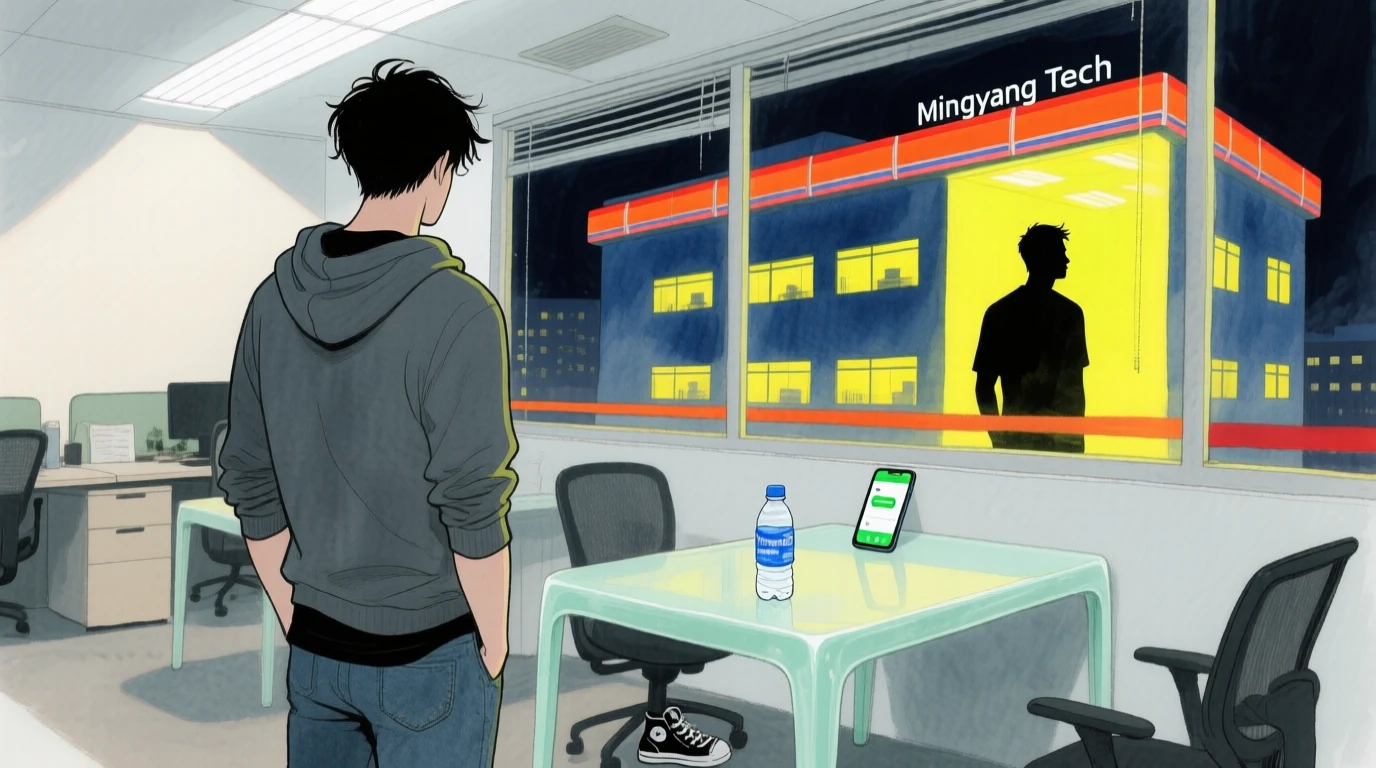
Chen Mo hung up and took a sip of water. The convenience store’s automatic doors kept sliding open and shut, people coming and going, none of them noticing him. He stared through the window at the Mingyang Technology building. The light in Li Zonghan’s office was still on—still working late.
Chen Mo turned off his phone, stood up, and left the convenience store. Instead of going home, he circled around to the back of Mingyang Technology. There was a narrow alley behind the building leading to the warehouse area, rarely used by anyone. He pulled a small tool kit from his pocket—containing a screwdriver, a master key, and a roll of double-sided tape.
His target wasn’t the safe. It was the surveillance camera.
Yesterday, he’d observed that the only camera covering the support team’s seating area was positioned to catch his computer screen. If Li Zonghan ever checked the footage, he’d see Chen Mo lingering over the KPI formula file. Chen Mo needed to create a backup plan—not by disabling the camera, but by adjusting its angle so it couldn’t capture his screen.
The safe code was indeed 0415, but he wasn’t in a hurry to open it—the cost of alarming the target was too high.
Chen Mo waited until half an hour after quitting time, confirmed the hallway was empty, then quickly moved to the back of the support team’s seating area. The camera was mounted in a corner of the ceiling, its lens aimed at the entire row of desks. He took the double-sided tape from his tool kit, peeled off a small piece, and stuck it to the inner side of the camera mount—just enough to tilt the lens a few degrees, enough to miss his computer screen. He quipped to himself: This angle is more crooked than my career path.
The whole operation took less than thirty seconds. He stowed the tool kit, walked out the back door as if nothing had happened, and returned to the street.
The night breeze hit him, carrying the coolness of autumn. Chen Mo took a deep breath, then headed toward the MRT station.
The next morning, Chen Mo arrived at the office half an hour early. He turned on his computer, logged into his email, and found the file Old Zhou had sent. Zhang Wenxiang’s resume was thorough—education, work history, performance at Mingyang Technology, details of recent proposals. One document caught his attention: Zhang Wenxiang had submitted a “Temp Worker Training Plan” the previous week, proposing that the company provide basic skills training for temp workers to improve yield rates.
A copy of this plan had landed on Li Zonghan’s desk. Chen Mo could imagine the expression on Li Zonghan’s face when he saw it—a section chief making an end-run proposal, and one that directly undermined his “Temp Workforce Optimization Project” (cut costs, screw quality), practically a challenge to his authority.
Chen Mo closed the file and started his work. This morning’s task was to organize a departmental KPI report—something Xiao Lin had handed off to him, saying it needed a preliminary compilation before the quarterly meeting. Chen Mo opened the report and looked at the data. The production department’s KPI score put Li Zonghan’s team in third place, behind Sales and R&D.
He noticed a detail: in Li Zonghan’s KPI score, the “turnover rate” item was particularly low—only sixty, barely passing. That was because, in the first half of this year, the temp worker turnover rate in the production department had hit thirty percent, far above the company average of fifteen percent.
If he could push that temp worker turnover rate even higher, Li Zonghan’s KPI would hit rock bottom.
Chen Mo calculated in his head. Step one: get Li Zonghan to raise the weight on temp worker turnover. Step two: trigger a collective complaint or mass resignation among the temp workers. Step three: watch the KPI score crash and burn, drawing senior management’s attention.
He needed a trigger.
At ten a.m., Chen Mo heard a commotion in the office. He looked up to see Li Zonghan storming out of his office, his face ashen, clutching a document. He walked straight to Zhang Wenxiang’s desk and slapped the paper down.
“Section Chief Zhang, is this your proposal?” Li Zonghan’s voice wasn’t loud, but every word was as sharp as a nail.
Zhang Wenxiang stood up, his expression calm. “Yes. The temp worker training plan. I believe basic skills training can reduce scrap rates and improve yield.”
“You believe?” Li Zonghan gave a cold laugh. “Do you know how much this plan costs? Training fees, materials, overtime—where’s that money coming from?”
“We can reallocate from the department budget. I’ve calculated it—if we cut down on outsourced maintenance costs, that’s enough to cover the training.”
“Outsourced maintenance is a necessary expense,” Li Zonghan said. “You want to save a few tens of thousands in training costs by sacrificing equipment upkeep? Section Chief Zhang, are you being naive?”
Zhang Wenxiang didn’t back down. “Equipment maintenance can be handled in-house. The Section Two repair team has the capacity to handle most of the work—we don’t need to outsource everything.”
“Who are you to decide?” Li Zonghan’s voice rose, and he unconsciously touched his tie as he spoke. “Am I the vice manager, or are you?”
The air in the office froze. Everyone lowered their heads, pretending to work, but their ears were pricked. Chen Mo kept his head down too, but his peripheral vision stayed locked on Li Zonghan. He thought: His fury is burning hotter than the department’s KPI.
Zhang Wenxiang was silent for a few seconds, then said, “I’m not trying to challenge you. I just think the issue of temp worker training deserves attention.”
“Attention?” Li Zonghan smiled, a smile like a dull blade. “Do you know why the temp worker turnover rate is so high? Because they’re not long-term employees to begin with. You spend time training them, they learn the skills and jump ship, and all that training money is wasted. It’s called cost-effectiveness, Section Chief Zhang.”
Zhang Wenxiang said nothing more. He lowered his head and began organizing the papers on his desk.
Li Zonghan nodded with satisfaction, turned, and walked back to his office. As he passed Chen Mo’s desk, he stopped again—this time, he didn’t look at Chen Mo, but at the KPI report sitting on his desk.
“Who’s been organizing this report?” Li Zonghan asked.
“I am.” Chen Mo stood up. “Do you have any instructions, Vice Manager?”
“Send it directly to my office once it’s done,” Li Zonghan said, in a tone that brooked no argument.
“Yes, sir.”
Li Zonghan walked into his office and closed the door. Chen Mo sat back down, lowered his head, and continued working on the report. But his mind was racing—Li Zonghan’s attitude just now showed he was very concerned about Zhang Wenxiang’s proposal. That meant Zhang Wenxiang was indeed a thorn in his side.
Opportunity had arrived.
Chen Mo spent the entire morning organizing the report. He deliberately added a line in the notes section: “Recommend adjusting the weight for temp worker turnover rate to more accurately reflect departmental staffing conditions.”—It looked like a routine suggestion, but it was actually bait. To make sure Li Zonghan noticed it, Chen Mo first stopped by the break room and casually mentioned to Xiao Lin: “I heard the Sales Department adjusted their temp worker weight last quarter, and their turnover rate score looks much better.” Xiao Lin, carrying her teacup, ran into Li Zonghan on her way out and casually mentioned it. Chen Mo also slipped a forged “internal document” from Old Zhou, claiming a competitor department had already adjusted their weight, into the report.
In the afternoon, he delivered the report to Li Zonghan’s office.
“Vice Manager, the report is ready.” Chen Mo stood at the doorway, keeping a respectful distance.
Li Zonghan was looking at his computer, not raising his head. “Leave it on the desk.”
Chen Mo placed the report on the desk and turned to leave. Just then, Li Zonghan suddenly spoke.
“Hold on.”
Chen Mo stopped and turned around. “Is there anything else, Vice Manager?”
Li Zonghan looked up, his eyes scanning like they were inspecting a suspicious package. “You… which company did you work for before?”
“I did administrative work at an electronics factory before,” Chen Mo said, his voice steady. “But it was a small company, you probably haven’t heard of it.”
“Name?”
“Shengda Electronics.”
Li Zonghan frowned slightly—he clearly hadn’t heard of the company. Chen Mo breathed a mental sigh of relief. Shengda Electronics was a real company, set up by Old Zhou, with all the documentation available for verification, including labor insurance records and a termination certificate.
“Why did you leave?”
“The company went under.” Chen Mo’s tone carried a hint of resignation. “The boss skipped town, and we were all laid off.”
Li Zonghan didn’t ask further. He lowered his head and started flipping through the report. Chen Mo stood there for about ten seconds, making sure there were no more questions, before turning and leaving.
As he walked out of Li Zonghan’s office, a thin layer of sweat had formed on his back. Not from nerves—from excitement. Li Zonghan was starting to notice him, which meant his plan was moving forward.
At five thirty in the evening, as Chen Mo was packing up to leave, his phone buzzed. He opened it—a message from Xiao Lin: “Vice Manager Li was in a meeting with HR this afternoon, discussing KPI formula changes.”
Chen Mo’s heart rate picked up. He replied with one word: “Good.”
Then he turned off his phone and walked out of the office. Today’s work was done. The next act would be for Li Zonghan to play out himself.
At eight p.m., Chen Mo received a call from Old Zhou at home.
“Li Zonghan had a meeting with HR this afternoon,” Old Zhou said. “The meeting minutes show he proposed raising the temp worker turnover rate weight from 0.5 to 1.5.”
The corner of Chen Mo’s mouth lifted. “He took the bait.”
“Yeah.” Old Zhou’s voice carried a hint of amusement. “But I’m more curious—how are you planning to spike the temp worker turnover rate?”
“Simple,” Chen Mo said. “Make the temp workers realize they can file a collective complaint.”
“A complaint about what?”
“Wage theft.” Chen Mo said. “Supai Human Resources has a history of withholding pay. Once Li Zonghan starts replacing the current temp agency with Supai, there will be temp workers who don’t get their wages. When that happens, they’ll file a complaint with the Labor Bureau.”
“And then?”
“Then, according to Article 22-1 of the Labor Standards Act, if the temp agency is fined for wage arrears, the client company is jointly liable for payment.” Chen Mo said. “Mingyang Technology’s senior management won’t like hearing that. They’ll investigate who brought in a problematic temp agency—and there’s only one answer: Li Zonghan.”
There was a few seconds of silence on the other end, then Old Zhou said, “You’re good at this.”
“I learned from you,” Chen Mo said, a note of sincerity in his voice.
“Be careful,” Old Zhou said. “Li Zonghan isn’t stupid. He’ll fight back.”
“I know.”
Chen Mo hung up and leaned back in his chair. The night outside the window was quiet, punctuated only by the occasional dog bark in the distance. He closed his eyes and ran through the entire plan again in his mind—from the KPI weight adjustment, to the temp workers’ collective complaint, to senior management holding Li Zonghan accountable.
Every step was legal. Every step stayed within the company’s regulations and the Labor Standards Act. Every step brought Li Zonghan one step closer to the abyss.
He opened his eyes, took out his phone, and sent a message to Xiao Lin: “Free tomorrow at noon? Let me buy you a coffee.”
Xiao Lin’s reply came quickly: “Okay.”
Chen Mo turned off his phone, stood up, and walked to the window. In the darkness, the Mingyang Technology building was reduced to a silhouette, like a dormant beast. He stared at that building, his eyes calm.
Li Zonghan, the game has only just begun.
The next day at noon, Chen Mo bought two coffees at the convenience store next to the staff cafeteria. By the time he returned to the office, Xiao Lin was already waiting for him. She was wearing a light gray jacket today, looking a bit more relaxed than the past few days.
“Thanks for the coffee.” Xiao Lin took the cup, a hint of gratitude in her voice.
“You’re welcome.” Chen Mo sat down. “I wanted to talk to you about something—about Vice Manager Li.”
Xiao Lin’s expression immediately tightened. “What about him?”
“You mentioned before that Vice Manager Li personally interviews temp workers one-on-one, right?”
Xiao Lin nodded.
“What if…” Chen Mo lowered his voice. “What if those temp workers were willing to come forward and file a collective complaint with the Labor Bureau?”
Xiao Lin froze. She stared at Chen Mo, a mix of fear and anticipation flickering in her eyes. “You… are you serious?”
“Just a hypothetical,” Chen Mo said, his tone light. “I was just thinking, if the temp workers knew they had the right to file a complaint, maybe they wouldn’t get pushed around so easily.”
Xiao Lin was silent for a long time. The steam from the coffee rose between them.
“Who are you, really?” she finally asked, her voice very soft but very firm.
Chen Mo smiled, a hint of resignation in it. “Just an ordinary temp worker.”
Xiao Lin stared at him for a few seconds, then lowered her head. “You know? Three years ago, there was another temp worker who went up against Vice Manager Li. He ended up leaving—involuntary termination.”
Chen Mo’s heartbeat didn’t quicken. He kept his expression in the confusion channel. “Why?”
“Because he found out something he wasn’t supposed to know.” Xiao Lin looked up, her eyes meeting Chen Mo’s directly. “Are you that person?”
Chen Mo didn’t answer. He took a sip of his coffee, letting the bitterness spread across his tongue.
“I’m not that person,” he finally said. “I just don’t like seeing people get screwed over.”
Xiao Lin didn’t press further. She lowered her head and started drinking her coffee.
Chen Mo knew she wouldn’t say anything. Because she, too, was waiting—waiting for a chance to lift the weight that had been pressing down on her for three years.
In the afternoon, Chen Mo returned to his desk and began organizing the files for the next day. On his computer screen, the last page of the KPI report showed Li Zonghan’s projected score for this quarter—if the temp worker turnover rate weight was raised to 1.5, and the turnover rate stayed at thirty percent, his score would drop from third place to dead last.
Chen Mo closed the file and mentally calculated the next step of the complaint plan—he would wait until he confirmed Li Zonghan had officially switched to Supai Human Resources before launching the specific actions.
Quitting time arrived. Chen Mo packed his backpack and prepared to leave. As he passed Li Zonghan’s office, he saw through the blinds that Li Zonghan was looking at a document—one that looked familiar, the KPI report Chen Mo had delivered that afternoon.
Li Zonghan looked up, his gaze drifting absently toward the doorway, and their eyes met for a split second.
Zero point five seconds of eye contact.
Chen Mo didn’t look away, nor did he force a smile. He just nodded slightly, like an ordinary temp worker showing basic respect to a supervisor.
Li Zonghan didn’t respond. He lowered his head and went back to reading.
Chen Mo walked out of the office, into the elevator, and pressed the button for the first floor. As the elevator doors closed, he finally let out a breath.
He thought of the code on the safe—0415. His birthday. Li Zonghan’s birthday. The coincidence felt ironic—the day Li Zonghan had framed him, three years ago, was also April fifteenth.
He would never forget that day. Li Zonghan called him into the office, that standard smile plastered on his face, and said: “Chen Mo, the company has decided to let you go. The reason is—forgery of procurement documents.”
Chen Mo didn’t argue. Because he knew arguing was useless. The evidence had already been fabricated. Any explanation would only make him look guiltier.
The day he left Mingyang Technology, the sky was a brilliant blue, the sun shining bright. He stood at the company gate, staring up at that building, and made a silent vow: One day, I’ll be back.
Now, he was back.
The elevator reached the first floor. Chen Mo stepped out of the building, and the night air hit him. He looked up at the Mingyang Technology sign, a faint smile on his lips.
Li Zonghan, just you wait.
He turned into the convenience store, bought a bottle of water, and found a seat by the window. He took out his phone and saw a message from Xiao Lin. She said she’d seen Li Zonghan at the staff cafeteria at noon, yelling at a temp worker, “Can’t you even hold a pair of chopsticks?” His tone was so harsh that even the section chief at the next table frowned. Xiao Lin wrote: “I’ve decided. If you need help, count me in.”
Chen Mo smiled and replied with one word: “Good.”
He turned off his phone and took a sip of water. The convenience store’s automatic doors kept sliding open and shut, people coming and going, none of them noticing him. He stared through the window at the Mingyang Technology building. The light in Li Zonghan’s office was still on—still working late.
Chen Mo began his countdown.
When that light finally went out, the next round would begin.