Chapter 4
The Beginning of the Counterattack
Li Zonghan’s counterstrike came faster than Chen Mo had expected.
On Thursday morning, Chen Mo had just settled into his seat when his phone rang. The caller ID read “Jingjie Human Resources.” He picked up, and Old Zhou’s voice came through, calm and measured: “Chen Mo, the HR department at Mingyang Technology just notified me that Assistant Manager Li reported your work attitude as poor and requested a replacement temp worker.”
Chen Mo didn’t panic. He listened quietly, then asked, “What grounds did he give?”
“‘Poor work attitude’—that’s what HR relayed. No specific evidence,” Old Zhou said. “What do you plan to do?”
“Let me think. Stall them on your end. Don’t agree to the replacement.”
He didn’t act immediately. Instead, he opened his computer and pulled up the electronic version of the Labor Standards Act. Article 17-1 prohibited the hiring company from individually interviewing dispatched workers—Xiao Lin had told him about this a few days ago. Li Zonghan had illegally interviewed several temp workers before. And this regulation had an additional effect: if the hiring company conducted an illegal individual interview with a dispatched worker, that worker could claim an employment contract with the hiring company.
In other words, he could turn the law around and refuse to be replaced.
Chen Mo spent five minutes drafting a complaint letter and sent it to Old Zhou. The letter was simple: he asserted that Li Zonghan had individually interviewed him before he started, violating Article 17-1 of the Labor Standards Act, so he had the right to refuse replacement, and demanded that Jingjie Human Resources respond to Mingyang Technology accordingly.
After sending the email, he closed it and began organizing the day’s reports as if nothing had happened. Xiao Lin walked over, handed him a document, and whispered, “You okay?”
“I’m fine,” Chen Mo said. “Just need to make a phone call.”
He stepped into the stairwell, and his phone rang—Old Zhou calling back.
“I’ve read your letter,” Old Zhou said, his voice still calm. “Are you sure Li Zonghan interviewed you illegally?”
“No,” Chen Mo said. “But he interviewed others illegally. I just need to claim he had an individual interview process for all temp workers. That’s enough. Supai Human Resources won’t gamble—if they reject my claim, they’ll face a Labor Bureau investigation.”
“You’re exploiting a loophole,” Old Zhou said, a hint of admiration in his tone.
“A legal loophole,” Chen Mo corrected.
By noon, Old Zhou messaged him: “Jingjie Human Resources has notified Mingyang Technology to suspend the temp worker replacement based on your complaint. Li Zonghan can’t touch you for now.”
Chen Mo read the message and the corner of his mouth lifted slightly. Li Zonghan’s first counterstrike had failed.
But Li Zonghan wasn’t going to give up.
At two in the afternoon, while Chen Mo was organizing the staff cafeteria’s inventory report, Xiao Lin hurried over, her face a little pale. “Assistant Manager Li just had a meeting with HR in his office. He wants to transfer you to the warehouse.”
Chen Mo looked up. “The warehouse?”
“Yes,” Xiao Lin lowered her voice. “He said the support team has too many people, so they need someone to sort expired documents in the warehouse. He said… you’re the most suitable.”
Chen Mo huffed inwardly. Transfer to the warehouse, far from core operations, forcing him to quit through boredom—it was the most common freeze-out tactic in the workplace. Any ordinary temp worker would probably walk out within a week.
But he wasn’t an ordinary temp worker.
“I see,” Chen Mo said, his tone flat. “When does it take effect?”
“Tomorrow,” Xiao Lin said. “Aren’t you… worried?”
“Worried about what?” Chen Mo smiled. “Work is work.”
Xiao Lin looked at him, a hint of confusion in her eyes. She clearly couldn’t understand why this temp worker could still smile in the face of a transfer.
Chen Mo didn’t explain.
Half an hour before the end of the day, HR officially notified him: effective tomorrow, he was to report to the warehouse for a two-week assignment sorting and destroying expired documents.
Chen Mo signed the transfer form without objection.
That evening, he went home, opened his laptop, and looked up the floor plan of Mingyang Technology’s warehouse. Old Zhou’s information was detailed, even marking the locations of the surveillance cameras. The warehouse was divided into three zones: A for raw materials, B for semi-finished products, and C for documents and miscellaneous items. He was assigned to Zone C, where expired documents and abandoned equipment were stored.
A note in the data read: “Zone C files include backup copies of purchasing records from three years ago for the Production Department.”
Chen Mo’s eyes narrowed. Three years ago—the year he was framed. The original forged purchase orders were probably still in Li Zonghan’s safe, but what about the backups? Purchase orders usually had duplicate copies: one kept in the department files, one sent to Finance. If Li Zonghan had forged the orders back then, he would have destroyed the department copy, but what about Finance’s copy? Or… had he missed something?
Chen Mo closed the laptop and sat in the dark for a moment. The warehouse—maybe it wasn’t Li Zonghan’s way of freezing him out. Maybe it was the opportunity he’d been waiting for.
The next morning, Chen Mo arrived at the warehouse on time with his toolbox. The warehouse manager was a man in his fifties, surnamed Liu, who spoke slowly and seemed completely indifferent to his job.
“You’re the new guy?” Uncle Liu glanced at him and pointed to a pile of cardboard boxes in the corner. “Those are purchase records from five years ago. Company policy says we keep them for seven years, but this year we’re switching to digital, so all these paper copies need to be destroyed. Sort them—keep what needs keeping on the left, destroy the rest on the right.”
“Got it,” Chen Mo said.
He started working. Most of the documents in the boxes were standard purchase forms stamped with department seals and supervisor signatures. He quickly scanned each form, searching for anything related to Li Zonghan.
Day one—nothing.
The next afternoon, he came across a box labeled “Production Department – Q4 2019.” The box was heavy. Inside, neatly stacked purchase orders. Chen Mo flipped through them one by one—most were routine purchases: raw materials, equipment parts, office supplies.
When he reached the bottom of the box, his hand touched something unusual.
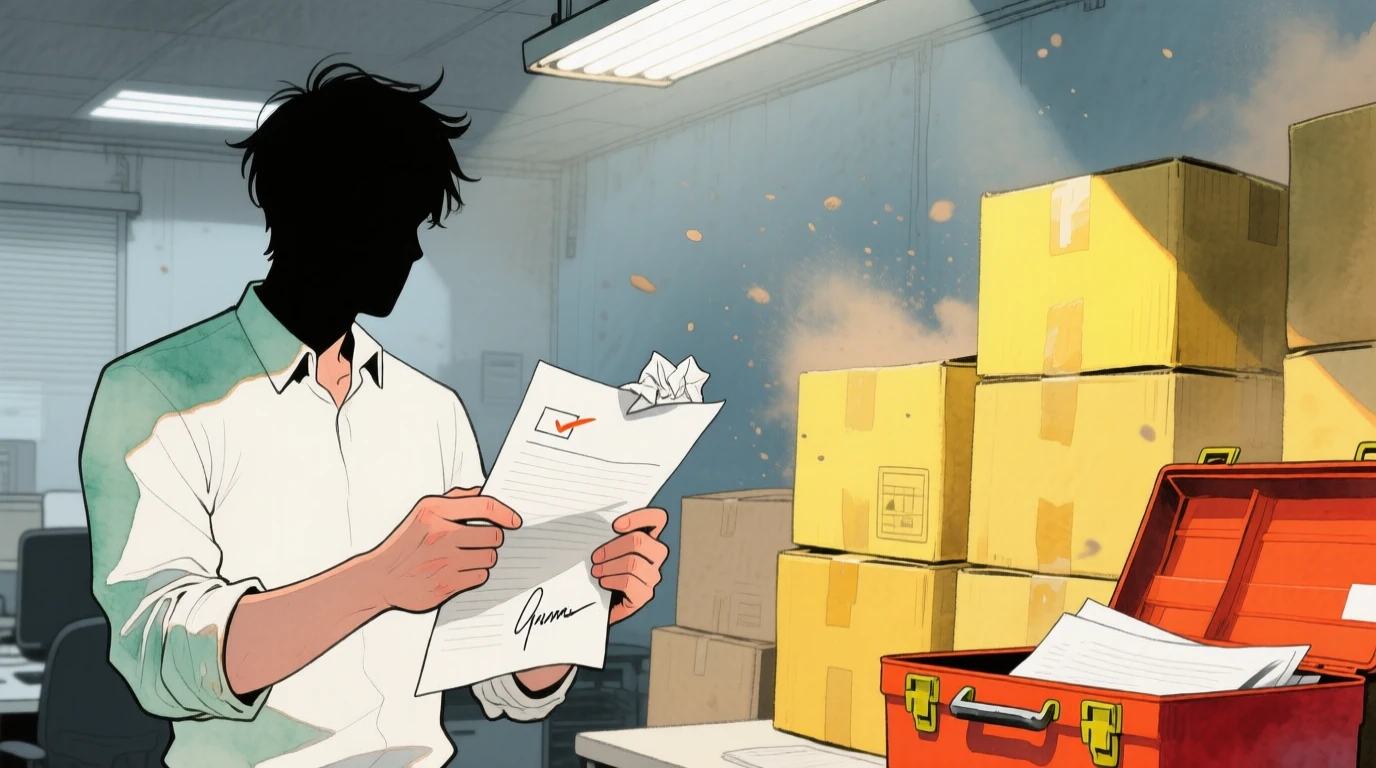
A crumpled piece of paper, wedged into a gap at the bottom of the box. He carefully pulled it out and unfolded it. The paper was yellowed, edges frayed, but the handwriting was still legible—a photocopy of a purchase order. The item column read “CNC Machining Parts, Batch,” amount 320,000 yuan. The supplier name was blacked out, but the signature in the approval column was one he’d never forget.
Li Zonghan.
Chen Mo’s heartbeat quickened. He examined the document closely—dated three years ago, the month he was framed. The purchase items looked normal, but the amount and supplier name had been altered. The black marker covering the supplier name was obvious, but the date and approval signature below were intact.
He flipped the photocopy over and saw a handwritten note: “Original destroyed. This is the backup.”
Chen Mo’s breath caught. This was the evidence. After Li Zonghan forged the order, he destroyed the original, but this photocopy—for some reason—had been stuffed into this box, undiscovered.
He carefully tucked the photocopy into the inner pocket of his toolbox, then resumed sorting the rest of the documents as if nothing had happened.
At three in the afternoon, he returned from the warehouse to the office, intending to refill his water bottle at the staff cafeteria. Passing Li Zonghan’s office, he saw through the gap in the blinds that Li Zonghan was on the phone—his expression tense, his speech hurried. Chen Mo couldn’t hear the conversation, but he was sure the call was with Qian Dafu, because he heard Li Zonghan say, “Why is that temp still here?”
Chen Mo didn’t pause. He walked into the cafeteria, filled his bottle, and returned to his seat. He opened his toolbox, confirmed the photocopy was still there, then locked the toolbox and placed it in his drawer.
At 5:30 p.m., as Chen Mo was packing up, his phone buzzed. He opened it—a message from Xiao Lin: “Assistant Manager Li threw a fit in the office this afternoon. Said someone tampered with his safe.”
Chen Mo’s heart didn’t race. He replied with one word: “Sure?”
“Positive. I walked past his office and heard him yelling that the safe’s combination lock had been turned.”
Chen Mo snorted inwardly. He had indeed memorized the safe’s combination, but he hadn’t opened it—he’d only turned the dial while confirming the code. Li Zonghan’s vigilance was higher than he’d expected.
He replied: “Good.”
Then he turned off his phone and left the office. As he passed Li Zonghan’s office, he saw through the blinds that Li Zonghan was standing in front of the safe, bent over, apparently checking something. His movements were hurried, his fingers spinning the dial quickly, then he swung the safe door open.
Chen Mo didn’t slow down. He continued walking, stepped into the elevator, and pressed the button for the first floor.
As the elevator doors closed, a thought flashed through his mind: Li Zonghan had discovered the safe was tampered with. He would check its contents—the original forged documents. If he found the originals still there, he’d breathe a sigh of relief. But if he found something missing… or if he realized someone had touched those files, what would he do?
Chen Mo stepped out of the elevator, crossed the lobby, and pushed open the glass door. The night wind hit him, carrying the chill of autumn. He took a deep breath, then walked toward the MRT station.
He knew Li Zonghan was nervous now. And nervous people made mistakes.
That evening at home, Chen Mo opened his toolbox and took out the photocopy. He studied every detail—purchase items, amount, supplier name (though blacked out), approval signature, date. He noticed an interesting detail: the “Supplier Name” field was blacked out, but on the back of the photocopy, there was a small line of text that looked like the supplier’s business registration number— “5578XXXX.”
He looked up that number online. The result showed it belonged to a dissolved company called Hongyun Machinery Co., Ltd., registered at a business center commonly used by shell companies.
The corner of Chen Mo’s mouth lifted. That was enough. This photocopy, combined with the registration number search, could prove that Li Zonghan’s purchase order from three years ago was fraudulent—the supplier was a shell company that had since dissolved. If he passed this photocopy and the registration data to Old Zhou, Old Zhou could use his contacts to trace the financial records from back then.
He closed the computer and leaned back in his chair. Outside, the night was quiet, only the occasional distant bark of a dog. He closed his eyes and replayed the plan in his mind.
Step one: Li Zonghan tried to replace him—failed. Step two: Li Zonghan transferred him to the warehouse—succeeded, but Chen Mo turned misfortune into fortune and found evidence. Step three: Li Zonghan discovered the safe was tampered with—now he was surely nervously checking the forged documents.
Next step: make Li Zonghan slip up on his own.
Chen Mo opened his eyes, pulled out his phone, and sent a message to Old Zhou: “Found a photocopy of a purchase order from three years ago. The supplier is a shell company. I’ll send it to you tomorrow.”
Old Zhou’s reply came quickly: “Got it.”
Chen Mo turned off his phone, stood up, and walked to the window. In the night, the Mingyang Technology building was just a silhouette, like a crouching beast. He stared at it, his eyes calm.
Li Zonghan, you thought sending me to the warehouse was punishment—but you handed me the evidence yourself.
The next morning, when Chen Mo arrived at the warehouse, Uncle Liu was brewing tea. He glanced at Chen Mo and said slowly, “Yesterday afternoon, Assistant Manager Li came by the warehouse.”
Chen Mo’s heart didn’t race. “What did he want?”
“No idea.” Uncle Liu shrugged. “He walked around, looked at Zone C’s files, and left.”
Chen Mo quickly assessed the situation. Li Zonghan had come to the warehouse because he’d noticed the safe had been tampered with and was worried the backup of the forged document had been found. But he hadn’t found the photocopy—it was already in Chen Mo’s toolbox.
“How did he look?” Chen Mo asked.
“Not great,” Uncle Liu said flatly. “Like he hadn’t slept all night.”
Chen Mo said nothing, but smiled inwardly. Li Zonghan, you must be anxious now, aren’t you? You know the safe was tampered with, but you can’t be sure—you can’t report it, can’t make a scene, afraid it’ll blow up. You came to the warehouse yourself to search, but you don’t even know what you’re looking for.
That was exactly the effect he wanted.
In the afternoon, Chen Mo returned from the warehouse to the office to grab lunch at the staff cafeteria. As he passed Li Zonghan’s office, he saw Li Zonghan talking to someone—the person’s back was to the door, but from the silhouette, it was Qian Dafu. Their voices were low, but Chen Mo still caught a phrase: “…that temp worker, we can’t keep him any longer.”
Chen Mo didn’t pause. He continued into the cafeteria, bought a boxed meal, and found a seat in the corner. As he ate, he calculated in his mind: Li Zonghan was starting to panic. He’d take more aggressive action—maybe pressure the staffing agency through Qian Dafu, maybe file a direct complaint to senior management, maybe create an excuse to get Chen Mo fired.
He needed to speed up the pace.
After lunch, Chen Mo returned to the warehouse and continued sorting documents. At two in the afternoon, he got a call from Old Zhou.
“I’ve looked at that photocopy,” Old Zhou said. “The shell company from the registration number had a 320,000-yuan transaction with Li Zonghan back then. The financial trail shows that after the money went into the shell company, it was transferred to a private account the next day.”
“Whose account?”
“Still checking,” Old Zhou said. “But what’s certain is that the money wasn’t used for any purchase.”
Chen Mo’s heartbeat quickened. This was the hard evidence he needed—proof that Li Zonghan had embezzled funds and forged documents.
“When do you plan to use it?” Old Zhou asked.
“Not yet,” Chen Mo said. “Wait until Li Zonghan makes another mistake—one he can’t recover from.”
“You have a plan?”
“Yes,” Chen Mo said. “He’s nervous now. Nervous people do stupid things.”
After hanging up, Chen Mo returned to the warehouse and continued sorting. At four in the afternoon, he heard footsteps at the warehouse entrance. He looked up and saw Li Zonghan standing in the doorway, impeccably dressed in a suit, a standard smile on his face.
“Chen Mo,” Li Zonghan said. “Got a minute? I want to talk to you.”
Chen Mo stood up. “Go ahead, Assistant Manager.”
Li Zonghan walked into the warehouse, looked around, then turned to Chen Mo. “Are you settling in okay here?”
“Not bad,” Chen Mo said. “Sorting documents, pretty easy.”
“Good, good.” Li Zonghan nodded, then lowered his voice. “Actually… I wanted to ask you something.”
“Please.”
Li Zonghan stepped closer, his eyes sharp. “You… have you worked at Mingyang Technology before?”
Chen Mo’s heart didn’t race. He met Li Zonghan’s gaze, expression calm. “No. This is my first time at Mingyang.”
“Is that so?” Li Zonghan stared into his eyes. “You just remind me of someone—someone who left here three years ago.”
“Maybe I have a common face,” Chen Mo said lightly.
Li Zonghan didn’t press further. He studied Chen Mo for a few seconds, then turned and left. At the door, he looked back and said, “Chen Mo, do your job well. Don’t do anything unnecessary.”
Chen Mo didn’t reply. He watched Li Zonghan’s back disappear through the door, then lowered his head and continued sorting documents.
But in his mind, he was counting down.
Li Zonghan, you’re already rattled.
That evening, Chen Mo went home, opened his laptop, and began organizing the evidence he’d collected over the past few days. The KPI weight adjustments, the collective complaint plan for temp workers, the forged purchase order photocopy—each was a weapon against Li Zonghan. But he knew the timing wasn’t right yet. He needed to wait for Li Zonghan to make one more mistake—one that senior management couldn’t ignore.
He remembered what Li Zonghan had said to him in the warehouse that day: “Don’t do anything unnecessary.”
Chen Mo smiled. Unnecessary? No, everything he did was necessary.
He closed the laptop, lay down on his bed, and shut his eyes. In the darkness, he heard his own heartbeat—steady, strong.
Li Zonghan, the game isn’t over. Next round, it’s your turn to make a move.